Can Nail Salons Help with Thick Toenails, or Should You See a Podiatrist?
No, nail salons cannot treat thick, discolored, or fungal toenails—and legally, they are prohibited from doing so. State Boards of Cosmetology strictly forbid salon technicians from diagnosing or providing care for medical nail dystrophies. Commercial salon tools, soaking tubs, and non-sterile files cannot safely penetrate or debulk hypertrophic keratin.
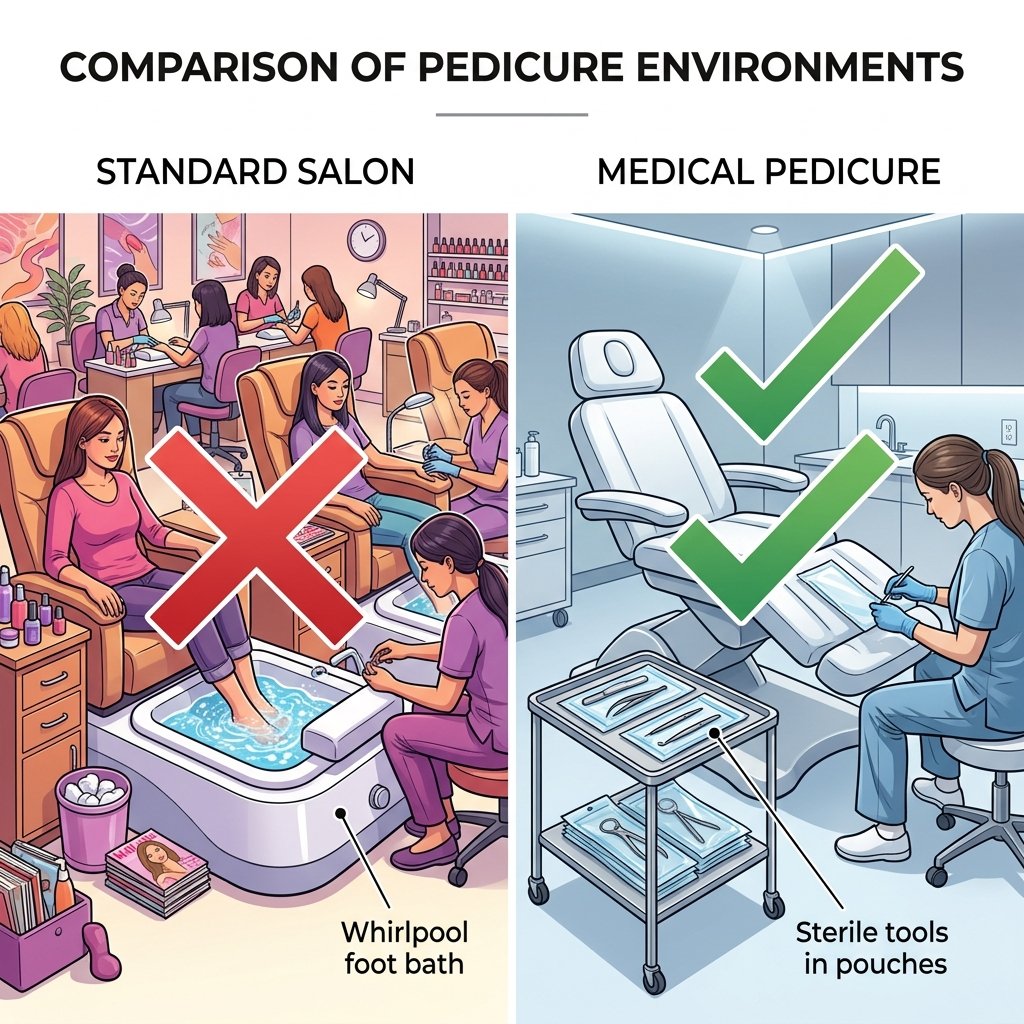
Attempting to have a salon file or clip thick fungal nails frequently results in torn nail beds, traumatic onycholysis, and secondary bacterial infections. A medical pedicure (medi-pedi) performed in a podiatric clinic uses steam-autoclaved instruments, waterless diamond rotary debridement, and HEPA particulate capture to safely restore nail thickness to normal without infection risk.
The Legal Boundary: Why Nail Salons Are Prohibited from Treating Thick Nails
Many patients with thick, yellowed, or crumbling toenails visit a neighborhood nail salon hoping for a quick aesthetic fix. However, there is a fundamental legal and anatomical barrier that separates cosmetic nail salons from medical podiatry suites:
Under the rules established by the New York State Division of Licensing Services and Cosmetology Boards nationwide, salon nail technicians are licensed strictly for the cosmetic cleansing, beautifying, and embellishment of healthy nails and skin. State administrative codes explicitly dictate:
- Mandatory Refusal of Service: If a customer exhibits signs of onychomycosis (toenail fungus), bacterial paronychia (swollen, red nail borders), or suspicious pigmentation, the nail technician is legally mandated to refuse treatment and refer the client to a medical physician.
- No Cutting of Living Tissue: Technicians cannot legally cut the living eponychium (cuticle seal), remove ingrown nail spikes, or use sharp blades to excise calluses.
- Lack of Medical Diagnostics: Thick toenails can stem from a dozen distinct medical conditions—including fungal dermatophytes, microvascular trauma, nail psoriasis, lichen planus, subungual bone spurs (exostosis), or subungual melanoma. A salon technician has zero medical diagnostic training and cannot identify the root pathology.
The Credo Blade & Foot Scraper Hazard: Why Illegal Razors Threaten Your Feet
To tackle tough calluses and thick skin, some salon workers quietly pull out a tool known as a Credo Blade—a small razor blade mounted onto a curved metal scraping handle.
Consumer Health Warning: Credo Blades Are Illegal in NY
In New York State and over 40 other jurisdictions, using a razor scraper or credo blade in a commercial nail salon is a direct violation of state health laws. Because calluses vary in thickness across the heel and ball of the foot, hand-held razor blades frequently slice through the stratum corneum into the vascular reticular dermis. If a technician cuts your foot in a non-sterile salon environment, infectious pathogens gain immediate access to the bloodstream.
Even common metal "cheese grater" foot rasps and pumice stones used in salons carry severe microbial risks. Pumice stones are highly porous volcanic rocks that cannot be sterilized; they absorb sloughed skin cells, sweat, and fungal arthrospores from every previous client and transfer them directly into your micro-fissures.
The Whirlpool Hazard: What Lurks in Salon Jet Plumbing
The centerpiece of the traditional salon experience is the bubbly, circulating foot basin. While relaxing on the surface, public health investigations by the Centers for Disease Control and Prevention (CDC) have repeatedly demonstrated that jetted whirlpool foot tubs are notorious biohazard incubators.
Behind the porcelain or fiberglass tub basin sits several feet of hidden, flexible PVC plumbing lines. Warm water, organic foot skin debris, oils, and bacteria circulate through these pipes, forming a dense, glue-like microbial sheet known as biofilm. The most common pathogens thriving inside salon plumbing lines include:
Mycobacterium fortuitum
A waterborne atypical mycobacterium that triggers deep, boil-like ulcers and recurrent skin abscesses on the lower legs, often requiring months of potent oral antibiotics.
Pseudomonas aeruginosa
The notorious "green nail" bacteria. It secretes pyocyanin pigments that turn toenails dark blackish-green and releases enzymes that dissolve the nail bed seal.
Human Papillomavirus (HPV)
The viral agent responsible for deep plantar warts (verrucae). Highly contagious and resistant to chlorine sanitizers, HPV penetrates tiny cuts on the soles of feet.
Even if a salon technician wipes down the basin bowl with a disinfectant spray between customers, surface cleaning cannot reach or penetrate the dense biofilm clinging to the interior PVC pipe walls. When the water jets are switched on for your session, microscopic clusters of bacteria and fungal spores are blasted directly onto your toenails.
Hospital Steam Autoclaves vs. Salon UV Blue-Light Boxes
One of the most widespread myths in commercial nail salons is that placing clippers and nippers inside a small glass cabinet with a glowing blue bulb "sterilizes" them.
In reality, those blue-light boxes are merely low-intensity ultraviolet (UV-C) storage cabinets. While UV light can slightly reduce airborne surface bacteria on exposed metal, it is physically incapable of killing bacterial endospores, fungal spores ($Trichophyton$ $rubrum$), or bloodborne pathogens like Hepatitis B and C. Furthermore, liquid blue Barbicide jars only achieve chemical sanitization if instruments are pre-cleaned of all organic debris and fully submerged for 20 continuous minutes—a standard rarely met during busy salon turnover.
The Medical Standard: Class B Steam Autoclave
In contrast, an accredited podiatric medical practice employs hospital-grade steam autoclaves—the exact same sterilization technology utilized for surgical instruments in hospital operating rooms:
- Every instrument is first cleaned in an ultrasonic enzymatic bath to strip organic residue.
- Tools are sealed inside individual medical-grade pouches equipped with chemical heat-sensitive indicator strips.
- The autoclave exposes the sealed tools to saturated high-pressure steam at 250°F to 273°F (121°C to 134°C) under 15 to 30 psi of pressure for a minimum of 30 minutes.
- The pouch is opened exclusively in front of the patient at the beginning of their clinical treatment, guaranteeing 100% spore, virus, and bacterial destruction.
Comprehensive Comparison: Medical Pedicure vs. Commercial Salon
Here is how medical podiatry foot care directly compares against commercial nail salons across every vital health, safety, and therapeutic metric:
| Clinical Benchmark | Commercial Nail Salon | Podiatric Medical Suite (Medi-Pedi) |
|---|---|---|
| Sterilization Standard | Chemical Barbicide or UV blue cabinets (Incomplete spore kill) | Hospital-grade steam autoclave (100% spore, virus & bacterial kill) |
| Water Basin Use | Jetted whirlpool foot tubs (High biofilm & bacterial hazard) | 100% Waterless (Zero cross-contamination risk) |
| Provider Credentials | Cosmetology license (Zero formal medical education) | Board-Certified Podiatrist or Certified Medical Nail Technician |
| Thick Nail Debridement | Unsafe manual nipping; illegal razor credo blades | Medical electronic rotary burrs with diamond tips and HEPA capture |
| Legal Treatment Scope | Strictly cosmetic; prohibited from treating fungal or thick nails | Full medical diagnosis, biopsy culturing, prescription authority & surgery |
| Diabetic / High-Risk Safety | Dangerous (High risk of unhealed cuts, ulcers & amputations) | Medicare-compliant diabetic wound prevention protocols |
| Nail Polish Application | Non-breathable synthetic polishes that trap fungal moisture | Physician-formulated breathable antifungal polishes (tea tree/biotin) |
| Insurance Eligibility | Never covered; out-of-pocket only | Frequently covered by Medicare & health insurance for medical necessity |
The Waterless Advantage: Why Podiatrists Never Soak Your Feet
While soaking your feet in warm water is the hallmark of a salon visit, clinical dermatology recognizes that foot soaking actively degrades nail integrity:
- Keratin Swelling & Splintering: Toenail keratin is hydrophilic, absorbing water rapidly and swelling up to 35% in volume. When waterlogged nails are clipped or filed, the compressed onychocyte layers separate, resulting in microscopic splintering, distal peeling, and brittle ridges.
- Masking Pathological Borders: Soaking skin causes healthy and dead skin cells to swell uniformly. This masks the exact anatomical boundary between healthy dermis and dead hyperkeratotic calluses, leading salon technicians to inadvertently file away healthy, protective skin.
- Precision Diamond Debridement: A medical waterless pedicure utilizes medical rotary burs under bright surgical illumination. The podiatrist can precisely distinguish between hardened corns, subungual fungal debris, and living tissue, removing dead keratin with sub-millimeter precision.
Who Must Avoid Commercial Nail Salons Entirely?
For healthy adults with pristine feet, a luxury salon visit may carry manageable risk. However, for specific medical populations, visiting a commercial nail salon is an unacceptable clinical hazard:
Diabetic Patients ($Type$ $1$ & $2$)
Diabetic sensory neuropathy numbs pain receptors in the toes. If a salon technician nicks a cuticle or uses a sharp blade, the patient feels zero pain. With impaired circulation and elevated blood glucose, this tiny cut rapidly evolves into a limb-threatening diabetic foot ulcer.
Individuals with Peripheral Artery Disease (PAD) & Poor Circulation
Reduced arterial blood flow means the body cannot deliver infection-fighting white blood cells to the toes. A minor salon-induced paronychia can precipitate digital gangrene.
Immunocompromised Individuals
Patients undergoing chemotherapy, organ transplant recipients on immunosuppressants, and those taking biologic medications for autoimmune diseases have depleted immune defenses against waterborne salon mycobacteria.
Patients with Chronic Thick, Deformed Nails (Onychauxis / Onychogryphosis)
Nails that are thicker than 3mm cannot be cut with regular cosmetic clippers. Forcing salon clippers onto thickened nails shatters the nail plate, causing painful partial nail avulsion and permanent germinal matrix trauma.
Frequently Asked Questions
Q Can a regular nail salon treat or fix thick, fungal toenails?
Q Can you get a pedicure if you have thick toenails or active toenail fungus?
Q Why are razor foot scrapers (credo blades) illegal in nail salons?
Q What makes a medical pedicure completely sterile compared to a salon?
Q Does health insurance or Medicare cover a medical pedicure in NYC?
Q How does a podiatrist reduce thick toenails during a medical pedicure?
Related Clinical Analysis
Medical Pedicure Overview
The clinical protocol for comprehensive medical foot and nail debridement.
Nail Debridement Protocol
How podiatrists painlessly reduce hypertrophic nails using rotary diamond burrs.
Diabetic Foot Care Rules
Sterile hospital-grade standards for neuropathy and compromised circulation.
Toenail Fungus Causes
How salon whirlpool basins transfer fungal spores to healthy nails.