What Happens If Toenail Fungus Is Left Untreated? The Real Risks You Shouldn’t Ignore
Find a Podiatrist Near You
Get same-day appointments with verified podiatrists. Insurance accepted.
Toenail fungus left untreated is one of the most underestimated conditions in everyday foot health. Most people see early discoloration and assume it’s cosmetic — something to deal with later, or hide under nail polish. That assumption is where the real damage begins.
Fungal nail infections do not stay still. They progress through predictable clinical stages, quietly destroying nail structure, opening pathways for bacterial infection, and — in high-risk patients — creating conditions serious enough to require hospitalization. The biology of this progression is well understood. The timeline is not unpredictable. And the risks are entirely preventable when caught early.
Understanding exactly what happens when toenail fungus is left untreated — stage by stage — gives you the clearest possible picture of where you currently stand and what needs to happen next.

What Happens When Toenail Fungus Is Left Untreated?
When toenail fungus is left untreated, it progresses through four clinical stages — ending in Total Dystrophic Onychomycosis, where the nail becomes severely thickened, painful, and permanently deformed. The infection destroys the natural seal of the nail bed, creating a direct entry point for bacteria. This leads to escalating risks including cellulitis, ulceration, bone infection, and in vulnerable patients, systemic complications.
This is not a worst-case scenario. It is progression biology — predictable, documented, and preventable with early intervention.
The 4 Stages of Toenail Fungus Left Untreated
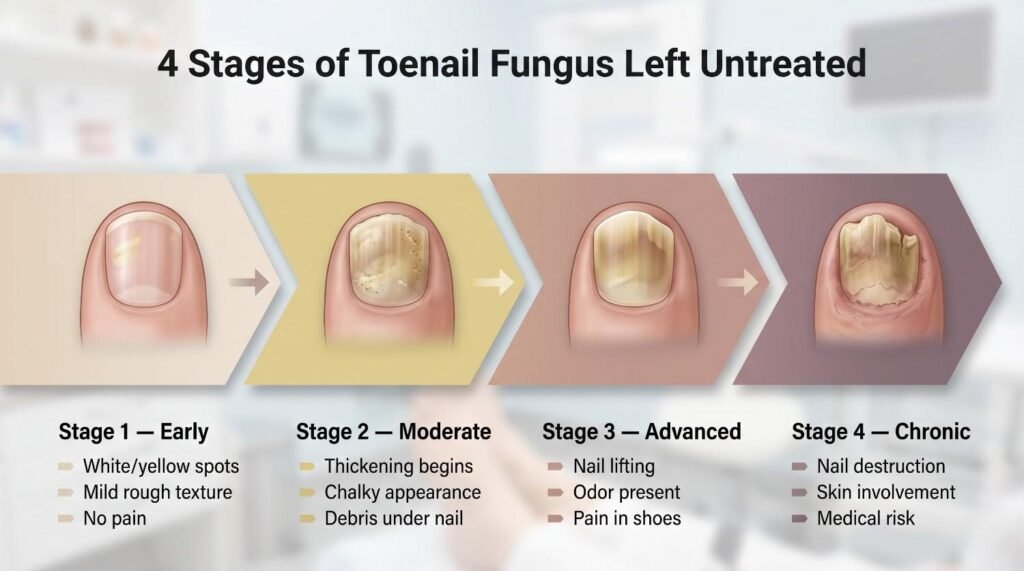
Stage 1: Early — Cosmetic Changes Only
At this stage, toenail fungus left untreated remains superficial and limited to the outer nail plate. The nail matrix — the tissue that produces new nail — is still untouched.
What you may notice:
- White spots or faint yellowing near the nail tip — discoloration that does not grow out with trimming
- Slightly rough nail surface — texture changes before structural damage begins
- No pain, no odor — the infection is contained and not yet clinically dangerous
Treatment success rates are highest at Stage 1. The fungus has not yet reached the nail bed, and topical antifungal medications have direct access to the infected tissue.
The risk of waiting: Every week at Stage 1 without treatment is a week closer to Stage 2 — where recovery becomes significantly harder.
Stage 2: Moderate — Structural Breakdown Begins
When toenail fungus is left untreated past the early stage, the organism moves beneath the nail plate and begins feeding on keratin — the structural protein that forms the nail.
The mechanism is specific and destructive:
- Proteolytic enzymes are released — The fungus secretes enzymes that chemically break down the nail’s protein architecture
- Nail becomes chalky or opaque — Loss of translucency signals keratin degradation beneath the surface
- Subungual hyperkeratosis develops — Debris accumulates under the nail plate, causing visible thickening
- Dermatophytoma may form — A dense mass of fungal material becomes trapped beneath the nail, blocking topical treatments entirely
A dermatophytoma is a critical development. Once formed, it physically prevents antifungal medication from reaching the infection site. Professional debridement by a podiatrist becomes necessary — home treatment alone will not work.
Progressive symptom: Nail becomes visibly twice its normal thickness, with debris clearly visible beneath the plate.
Stage 3: Advanced — The Portal of Entry Opens
This is the stage where toenail fungus left untreated crosses from a nail problem to a tissue problem.
Dermatophyte organisms reach the deeper nail bed layers and breach the hyponychium — the thickened skin seal that normally protects the nail bed from the external environment. Once this seal fails, it stays open.
What follows is a cascade of complications:
- Nail separation (onycholysis) — The nail lifts from the nail bed, creating a warm, dark, moist space
- Secondary bacterial colonization — Bacteria exploit the open portal; foul odor signals their presence alongside the fungus
- Pseudomonas infection (green nail syndrome) — Moisture trapped under the lifted nail frequently leads to Pseudomonas bacterial growth, producing a green or blackish discoloration that requires separate antibacterial treatment
- Pain in footwear — Nail thickening and separation create pressure and discomfort with every step
The critical point here is that toenail fungus left untreated at Stage 3 is no longer a single infection. It is a polymicrobial environment — fungal and bacterial — that requires more complex treatment than either pathogen alone.
Progressive symptom: Nail lifting, crumbling edges, persistent odor, and discomfort when wearing shoes.
Stage 4: Chronic — Medical Risk Stage (Total Dystrophic Onychomycosis)
Total Dystrophic Onychomycosis (TDO) represents the endpoint of toenail fungus left untreated over years. At this stage, the nail is severely deformed or partially destroyed, and the nail matrix is often permanently scarred.
Key clinical features of Stage 4:
- Permanent nail dystrophy — Even after the fungus is eliminated, the nail may never grow back normally due to matrix scarring
- Onychomycosis-induced ulceration — Pressure from the severely thickened nail can create an ulcer beneath the nail plate — often hidden and painless in high-risk patients
- Surrounding skin involvement — The perimeter skin becomes red, scaly, and increasingly fragile
- Systemic infection risk — In immunocompromised or diabetic patients, the open tissue portal creates a direct pathway for serious systemic infection
The harsh reality: Toenail fungus left untreated to Stage 4 may require nail avulsion, oral antifungal therapy, or surgical intervention — and full nail recovery is not guaranteed.
Toenail Fungus Progression Timeline
| Timeframe | Clinical Stage | Risk Level | Primary Concern |
|---|---|---|---|
| 0–3 months | Early discoloration | Low — cosmetic | Nail surface affected only |
| 3–6 months | Subungual debris forming | Low-moderate | Keratin breakdown begins |
| 6–12 months | Hyperkeratosis and thickening | Moderate — functional | Dermatophytoma possible |
| 1–2 years | Onycholysis and nail separation | High — infection portal open | Bacterial co-infection risk |
| 2–3 years | Advanced nail destruction | Very high | Ulceration and tissue damage |
| 3+ years | Total Dystrophic Onychomycosis | Extreme — systemic risk | Permanent damage, possible hospitalization |
Toenail fungus left untreated does not plateau. Every stage increases both the complexity of treatment and the risk of serious complications.
This YouTube video below shows fungal nail treatment progression, highlighting before-and-after results over time. It demonstrates how proper care improves nail condition. Understanding this helps set realistic expectations for treatment outcomes.
The Portal of Entry — How Secondary Infections Begin
The most medically significant consequence of toenail fungus left untreated is not the nail damage itself — it is what the nail damage allows to happen next.
The hyponychium is a specialized skin structure that seals the nail bed from the external environment. Once fungal invasion destroys it, bacteria gain direct access to warm, moist, living tissue.
This creates a condition called secondary bacterial synergy:
- Fungus opens the pathway — destroying the natural tissue barrier
- Bacteria colonize the exposed tissue — exploiting the already compromised environment
- Interdigital maceration develops — skin between the toes becomes soft, white, and fragile — a common starting point for deeper bacterial spread
- Cellulitis becomes possible — spreading bacterial skin infection that produces redness, heat, and swelling
- Lymphangitis may follow — red streaks tracking up the leg indicate the infection is spreading through the lymphatic system — a medical emergency
If you notice red streaks, warmth, swelling, or fever alongside a nail infection — this requires emergency medical care, not a podiatry appointment.
How Toenail Fungus Left Untreated Can Spread to Other Areas
Toenail fungus left untreated does not remain localized indefinitely. Autoinoculation — self-spread — is a well-documented clinical phenomenon:
- Hands during trimming — Fungal spores transfer to fingernails and surrounding skin, causing tinea manuum
- Towels and socks — Contaminated fabric spreads spores to the groin area, causing tinea cruris (jock itch)
- Between toes — Athlete’s foot (tinea pedis) frequently develops alongside or from toenail fungal infections
- To other toenails — Without treatment, adjacent nails become colonized progressively over months
- Systemic spread — Rare in healthy individuals but a documented risk in immunocompromised patients
Who Faces the Highest Risk From Toenail Fungus Left Untreated

People With Diabetes
Diabetic neuropathy reduces pain awareness. Pressure from thickened nails goes unnoticed. Ulcers form silently beneath the nail. Poor circulation slows healing. For diabetic patients, toenail fungus left untreated is not a cosmetic concern — it is a documented clinical risk factor for limb-threatening complications.
People With Peripheral Vascular Disease
Compromised circulation limits the immune response available at the infection site. Healing is delayed or absent. Small infections escalate rapidly without the vascular capacity to fight back.
Older Adults
Thickened dystrophic nails from toenail fungus left untreated interfere with proprioception — the body’s ability to sense foot position during movement. This altered sensory feedback changes gait mechanics and significantly increases fall risk. Falls remain one of the leading causes of serious injury in adults over 65.
Immunocompromised Individuals
Patients on immunosuppressive medications, those undergoing chemotherapy, or individuals with HIV face dramatically elevated risk of rapid infection progression and systemic spread from toenail fungus left untreated.
Warning Signs That Toenail Fungus Has Become a Medical Priority
Stop monitoring at home and contact a podiatrist immediately if you notice any of the following:
- Pain when walking or wearing shoes — Pressure-related pain signals structural nail damage affecting surrounding tissue
- Nail lifting completely from the nail bed — The portal of entry is fully open at this point
- Foul odor — Signals active secondary bacterial colonization alongside the fungal infection
- Redness, swelling, or warmth around the nail — Signs of bacterial skin infection (paronychia or early cellulitis)
- Red streaks tracking away from the toe — Lymphangitis — seek emergency care
- Fluid-filled blisters near the nail fold — Bullae indicate significant inflammatory tissue response
- Small red dots around the toe (petechiae) — Signal vascular involvement
- Any nail symptoms in a diabetic or immunocompromised patient — These groups should never self-monitor fungal nail infections without professional oversight
Why Early Treatment Is the Medical Standard of Care
When toenail fungus is left untreated, every stage passed makes treatment longer, more complex, and less likely to achieve full nail restoration. Early-stage fungal infection responds to topical prescription antifungals.
Moderate-stage infection often requires combination therapy. Advanced and chronic infections typically need oral systemic antifungals, professional debridement, and in some cases, nail avulsion procedures.
The clinical case for early treatment is unambiguous:
- Early treatment preserves nail matrix function — preventing permanent nail dystrophy
- Early treatment eliminates the bacterial co-infection pathway — before the hyponychium is breached
- Early treatment reduces ulceration risk — especially critical in diabetic and elderly patients
- Early treatment is less expensive — both in direct treatment cost and in avoided complications
- Early treatment produces faster, more complete nail recovery — with higher rates of normal nail regrowth
Waiting does not make toenail fungus easier to treat. It makes it harder — consistently, at every stage.
Frequently Asked Questions
Q: Can toenail fungus go away on its own if left untreated?
A: No. Toenail fungus left untreated does not self-resolve. Fungal organisms survive by consuming keratin — the material your nail is made of. Without antifungal treatment, the infection continues progressing through each clinical stage. Over-the-counter treatments can slow early-stage infections but rarely eliminate them without prescription intervention.
Q: How quickly does untreated toenail fungus spread to other nails?
A: Spread varies by individual, but adjacent nail involvement is common within 6–12 months when toenail fungus is left untreated. The big toenail is most frequently affected first, with spread to smaller toenails following. Fingernail involvement through hand contact during trimming can occur within weeks.
Q: Is toenail fungus dangerous for someone with diabetes?
A: Yes — significantly. For diabetic patients, toenail fungus left untreated is a clinical risk factor, not a cosmetic issue. Neuropathy prevents pain awareness, circulation impairs healing, and the open portal created by nail damage creates conditions for silent ulceration and serious bacterial infection. Diabetic patients should seek podiatric evaluation at the first sign of toenail infection.
Q: Can untreated toenail fungus cause permanent nail damage?
A: Yes. At Stage 4 — Total Dystrophic Onychomycosis — the nail matrix becomes scarred from years of fungal invasion. Even after successful antifungal treatment eliminates the organism, the nail may never grow back with normal shape, thickness, or texture. This is the most important reason why toenail fungus left untreated carries long-term consequences beyond the active infection period.
Q: What does it mean if my toenail fungus smells bad?
A: Odor from a fungal nail infection signals secondary bacterial colonization — meaning bacteria have joined the fungal infection through the damaged nail bed. This combination of fungal and bacterial infection requires more complex treatment than either pathogen alone and should be evaluated by a podiatrist promptly.
Conclusion: Toenail Fungus Left Untreated Always Gets Worse
Toenail fungus left untreated is not a stable condition. It is a progressive one — moving through clearly defined clinical stages, each more difficult to treat than the last. What begins as cosmetic discoloration becomes structural nail failure, bacterial co-infection, tissue ulceration, and — in vulnerable patients — a genuine medical emergency.
The single most important clinical fact about toenail fungus left untreated is this: the window for straightforward, effective treatment is early. Every stage beyond Stage 1 reduces treatment options, extends recovery time, increases the risk of permanent nail damage, and raises the probability of serious complications.
If you are seeing discoloration, thickening, crumbling, odor, or any pain associated with your toenails — that window is open right now. The specialists at The Toenail Clinic NYC diagnose and treat toenail fungal infections at every stage of progression, with treatment plans tailored to your specific clinical presentation. Book your evaluation today — before toenail fungus left untreated becomes something far harder to reverse.
Struggling to get an appointment?
We help patients in your area bypass clinic waitlists by instantly finding verified podiatry doctors who accept their insurance.