Milky White Toenails and Liver Disease
Find a Podiatrist Near You
Get same-day appointments with verified podiatrists. Insurance accepted.
Milky white toenails and liver disease share a connection that most patients are completely unaware of — until they notice their nails have turned an unusual pale white color and start searching for answers. Nail changes are not the first symptom most people associate with liver problems, yet the nails can reflect significant changes in liver function before other more obvious symptoms appear.
The specific pattern of nail whitening most associated with liver disease — known clinically as Terry’s nails — is distinct enough that an experienced clinician can often identify it from across the examination table. Understanding what this pattern looks like, what it means physiologically, and how it differs from other causes of white toenails is the core of what this guide covers.
This is not a reason for panic if your nails look pale. Most white or whitened nails have benign causes. But it is a reason to read carefully and understand exactly which features distinguish a medically significant nail finding from an innocent one.

How the Liver Affects Nail Appearance
To understand why milky white toenails and liver disease are connected, you need to understand what the liver does that affects nail tissue.
Albumin production:
The liver produces albumin — the most abundant protein in blood plasma. Albumin maintains oncotic pressure, which keeps fluid appropriately distributed between blood vessels and surrounding tissues. It also carries nutrients, hormones, and various molecules throughout the body. When the liver fails to produce adequate albumin, blood albumin levels drop — a state called hypoalbuminemia.
Low albumin affects nail vasculature: the capillaries in the nail bed change in density and distribution when albumin is low. This alters how the nail bed appears through the translucent nail plate above it — producing the characteristic pale, milky white appearance.
Blood flow to nail bed capillaries:
Chronic liver disease — particularly cirrhosis — produces changes in vascular tone and blood flow distribution throughout the body. Peripheral vascular changes affect the nail bed, altering capillary density and causing the loss of the normal pink vascular appearance visible through the nail plate.
Connective tissue changes:
Chronic liver disease produces changes in connective tissue throughout the body. The connective tissue immediately beneath the nail plate — between the nail plate and the nail bed capillaries — becomes altered in ways that further reduce the transmission of the normal pink color from the nail bed through to the nail surface.
The combined effect of these changes — reduced albumin, altered peripheral blood flow, and changed subungual connective tissue — is a nail that loses its normal pink transparency and takes on a milky, pale white appearance.
Terry’s Nails: The Signature Pattern
The specific nail pattern most clearly associated with milky white toenails and liver disease is Terry’s nails, first described by Richard Terry in 1954 following his observation of nail changes in patients with liver cirrhosis.
What Terry’s nails look like:
The nail plate appears predominantly white — two-thirds to three-quarters of the nail from the base is opaque milky white. The visible lunula (the pale half-moon shape normally visible at the nail base) disappears into the surrounding white. A narrow band of reddish-pink or brownish-pink color remains at the nail tip, typically 1 to 3 mm wide.
The nail surface itself is generally smooth — this is not a rough, crumbling, or structurally damaged nail like a fungal nail. It is a smooth nail that simply looks very pale white where it should look pink.
The pressing test:
Unlike white spots within the nail plate (which stay white when pressed), Terry’s nails demonstrate apparent leukonychia — the whiteness is in the nail bed, not the nail plate. When you press firmly on the nail, the color temporarily blanches even further and then returns to its characteristic milky white when pressure is released. This test distinguishes nail bed-origin whitening from nail plate-origin whitening.
Which nails are affected:
Terry’s nails typically affect all fingernails and may involve toenails, reflecting the systemic nature of the underlying cause.
What Conditions Are Associated With Terry’s Nails?
When considering milky white toenails and liver disease, it is important to understand the full spectrum of conditions associated with Terry’s nails — because liver disease is the most classic association but not the only one.
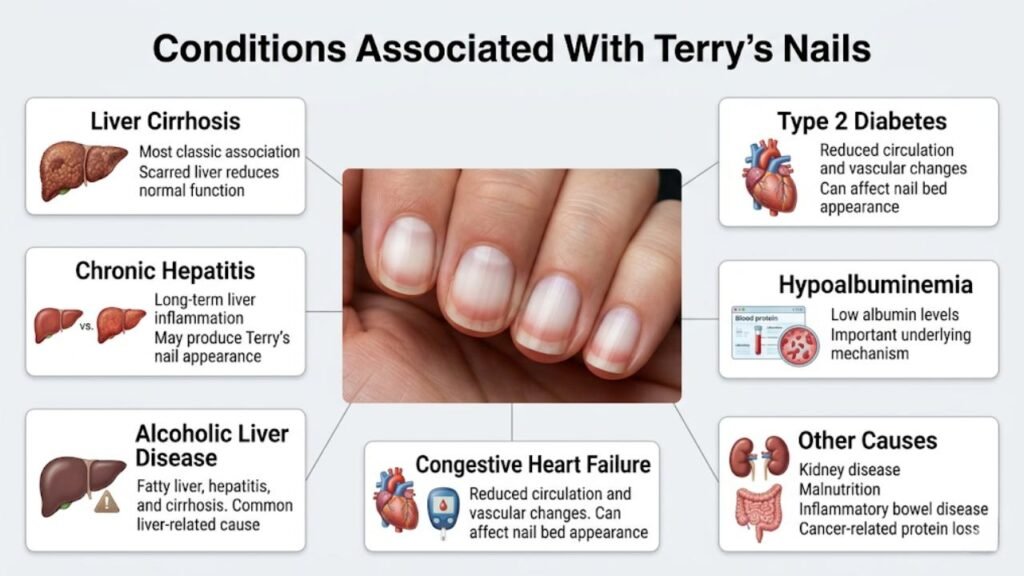
Liver cirrhosis:
The original and most strongly documented association. Cirrhosis involves progressive replacement of normal liver tissue with scar tissue, significantly impairing all liver functions including albumin production and vascular regulation. Terry’s nails prevalence in cirrhotic patients has been documented in multiple studies.
Chronic hepatitis:
Hepatitis B and C causing chronic liver inflammation and progressive liver damage can produce the same physiological changes as cirrhosis, particularly when liver function is significantly impaired.
Alcoholic liver disease:
Alcohol-related liver disease — spanning fatty liver, alcoholic hepatitis, and cirrhosis — is among the most common causes of liver dysfunction associated with Terry’s nails.
Congestive heart failure:
Heart failure produces venous congestion and reduced tissue perfusion — including to peripheral vascular beds like the nail bed. This altered nail bed circulation can produce a pattern similar to Terry’s nails.
Type 2 diabetes:
Diabetes affects peripheral vascular function and tissue composition in ways that can produce apparent nail whitening, though the mechanism differs somewhat from the hypoalbuminemia-driven Terry’s nails of liver disease.
Hypoalbuminemia from other causes:
Because the nail bed changes associated with milky white toenails and liver disease are primarily mediated through low albumin, any condition producing significant hypoalbuminemia can produce similar nail findings. These include:
- Nephrotic syndrome (kidney disease causing protein loss in urine)
- Malnutrition with severe protein deficiency
- Inflammatory bowel disease with malabsorption
- Cancer with significant protein depletion
Age-related changes:
Aging produces some degree of nail bed vascular change that can cause nails to appear less pink and more opaque. Mild age-related nail pallor is not the same as Terry’s nails — the latter has a more distinctive two-thirds white pattern with a clearly demarcated distal band.
Milky White Toenails and Liver Disease vs Other Causes of White Toenails
Understanding what distinguishes the nail pattern associated with liver disease from other causes of white toenails is clinically essential.
| Feature | Terry’s Nails (Liver Disease) | Muehrcke’s Lines | Punctate Leukonychia | Fungal Infection | Aging |
|---|---|---|---|---|---|
| Pattern | Two-thirds white, narrow pink band at tip | Paired parallel white bands | Small scattered white dots | White/yellow patches, often with structure change | Diffuse mild opacity |
| Location | In nail bed (apparent leukonychia) | In nail bed (apparent leukonychia) | In nail plate (true leukonychia) | Nail surface or under nail | Nail plate |
| Pressing test | Color temporarily blanches further | Color disappears with pressure | No color change with pressure | No color change | Mild change |
| Nail surface texture | Smooth and intact | Smooth and intact | Smooth | Rough, crumbling, or thickened | May be slightly rough |
| Movement with nail growth | Does not move (nail bed origin) | Does not move (nail bed origin) | Moves toward tip | Does not move predictably | Does not move |
| Clinical significance | High — liver, heart, diabetes | High — hypoalbuminemia | Benign — trauma | Moderate — needs antifungal | Low — aging |
| What to do | Medical evaluation | Medical evaluation | No treatment needed | Podiatric evaluation | Monitoring |
Muehrcke’s lines deserve special mention in the context of milky white toenails and liver disease because they are another nail finding associated with hypoalbuminemia. They appear as paired, parallel white horizontal bands crossing the nail — not the longitudinal white pattern of Terry’s nails, but sharing the same underlying mechanism (low albumin). Both Terry’s nails and Muehrcke’s lines disappear temporarily when the nail bed is pressed, confirming their nail bed origin.
Other Signs That Accompany Milky White Toenails in Liver Disease
When milky white toenails and liver disease are genuinely connected, nail changes rarely appear completely in isolation. Understanding what other signs may accompany the nail findings helps patients recognize when a broader clinical picture is developing.
Jaundice: Yellowing of the skin and the whites of the eyes from bilirubin accumulation when the liver cannot process it normally. This is one of the most recognizable signs of significant liver dysfunction.
Fatigue and weakness: The liver’s role in metabolic regulation means that liver disease produces profound fatigue — often out of proportion to what a person might expect from the degree of visible jaundice or nail changes.
Abdominal swelling (ascites): Fluid accumulation in the abdominal cavity from portal hypertension and low albumin. The abdomen appears distended and may feel uncomfortable or heavy.
Palmar erythema: Reddening of the palms of the hands, particularly at the thenar and hypothenar eminences. This vascular change accompanies many chronic liver diseases.
Spider angiomata: Small vascular lesions on the skin — small central red spots with radiating red lines that look like a spider — appearing on the face, chest, and arms. A sign of altered estrogen metabolism from liver dysfunction.
Dark urine and pale stools: Changes in bile processing produce darker than normal urine (excess bilirubin) and paler than normal stools (reduced bile reaching the bowel).
Easy bruising and bleeding: The liver produces most clotting factors. Liver disease impairs clotting, producing easy bruising and prolonged bleeding from minor injuries.
If you have noticed your toenails looking milky white and you recognize any of these accompanying features, medical evaluation is urgent — not something to monitor at home.
What to Do If You Think Your White Nails May Be Liver-Related
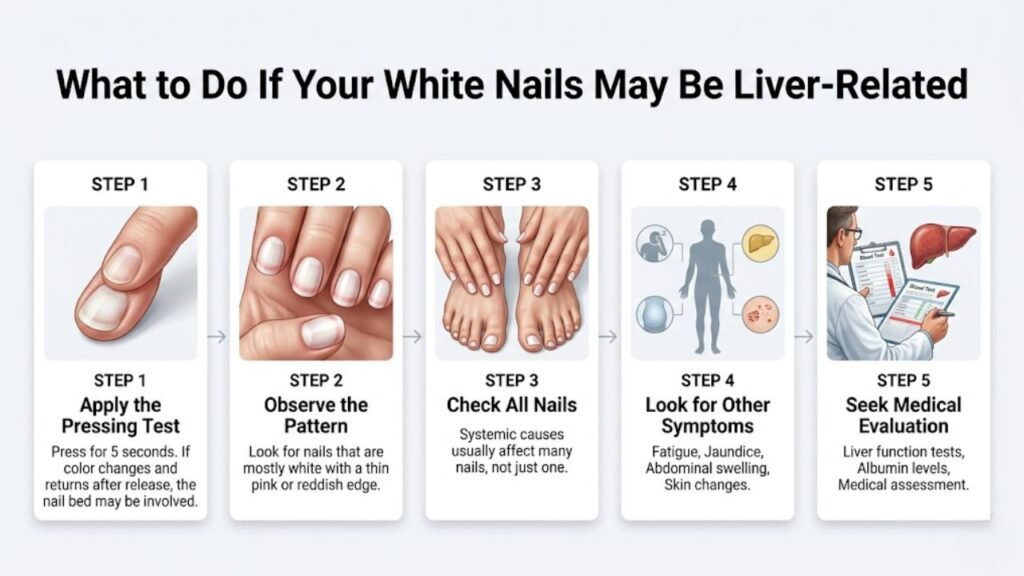
Step 1: Apply the pressing test
Press firmly on the milky white nail for 5 seconds. Release. In Terry’s nails, the color temporarily blanches even more with pressure and then returns. In benign white spots within the nail plate (like from trauma), the color does not change with pressing.
Step 2: Observe the pattern
Are the nails two-thirds to three-quarters white with a clearly demarcated narrow pink or reddish band remaining at the tip? Is the lunula invisible within the surrounding white area? This is the Terry’s nails pattern.
Step 3: Check all nails
Liver disease-related nail changes typically affect all nails simultaneously — fingernails and toenails. Isolated white spots in one or two toenails are less likely to have a systemic cause.
Step 4: Assess for accompanying symptoms
Fatigue, jaundice, abdominal swelling, or skin changes alongside milky white nails significantly raise the clinical probability of a systemic cause.
Step 5: Seek medical evaluation without delay
If the pressing test is positive, the pattern matches Terry’s nails, multiple nails are affected, or accompanying symptoms are present — physician evaluation is appropriate and should not be deferred. Blood tests for liver function (ALT, AST, bilirubin, albumin) provide the initial assessment.
Diagnosis and Testing for Milky White Toenails and Liver Disease
When a physician evaluates milky white toenails and liver disease as a possible connection, the assessment typically involves:
Physical examination:
The nail pattern, skin color, eye whiteness (scleral jaundice), abdominal assessment, and vascular signs (palmar erythema, spider angiomata) all contribute to the initial clinical picture.
Liver function blood tests:
- ALT (alanine aminotransferase) and AST (aspartate aminotransferase) — elevated in liver cell damage
- Bilirubin — elevated when liver cannot process it normally
- Albumin — reduced when liver function is impaired
- Prothrombin time / INR — assesses clotting factor production (liver-dependent)
Complete blood count:
Liver disease can produce changes in platelet count and red blood cell parameters that contribute to the clinical picture.
Imaging:
Liver ultrasound provides information about liver size, texture (coarsened in cirrhosis), and associated findings like splenomegaly or ascites.
Supporting Liver Health: What Patients Can Do
While this guide does not offer treatment guarantees, certain lifestyle measures genuinely support liver health and may contribute to better nail appearance alongside medical management:
Alcohol:
Alcohol is directly hepatotoxic. For any patient with confirmed or suspected liver disease, alcohol elimination is the most impactful lifestyle modification available.
Weight management:
Non-alcoholic fatty liver disease (NAFLD) is increasingly prevalent and directly associated with excess weight. Weight reduction in overweight patients with NAFLD can produce measurable improvements in liver health markers.
Nutrition:
Adequate protein intake supports albumin production. A varied diet including lean protein, vegetables, and complex carbohydrates supports liver metabolic function. Severely restricting protein is not appropriate for most liver disease patients — adequate protein intake is important.
Medication review:
Many medications are hepatotoxic. Any patient with liver disease should ensure their prescribing physicians are aware of the diagnosis so that hepatotoxic medications can be avoided or monitored more carefully.
Antiviral therapy for hepatitis B and C:
Effective antiviral treatments for hepatitis B and C can halt or reverse liver inflammation and fibrosis when started before cirrhosis is fully established. For eligible patients, this is one of the most impactful interventions available.
Frequently Asked Questions About Milky White Toenails and Liver Disease
Do milky white toenails always mean liver disease?
No. Milky white toenails have multiple possible causes including aging, congestive heart failure, diabetes, kidney disease, and malnutrition. Liver disease is an important cause of the specific Terry’s nails pattern, but it is not the only one. The pressing test, the specific pattern, and accompanying symptoms together guide whether medical evaluation is needed.
What do Terry’s nails look like exactly?
Terry’s nails appear as nails that are two-thirds to three-quarters white — the milky white area covers most of the nail from the base. A narrow band of reddish-pink or brownish-pink color remains at the nail tip, typically 1 to 3 mm wide. The lunula at the base of the nail is not visible because it blends into the surrounding white.
How do I know if my white nails are in the nail plate or the nail bed?
Press firmly on the white area for 5 seconds and release. If the color temporarily disappears with pressure and returns when released, the whiteness is in the nail bed (apparent leukonychia) — this is the pattern associated with liver disease and other systemic causes. If the color does not change with pressing, the whiteness is in the nail plate — typically benign trauma-related leukonychia.
Can liver disease nail changes improve with treatment?
Yes. When the underlying liver disease is treated effectively — particularly in earlier-stage hepatitis B or C — and albumin levels improve, the nail bed changes can partially or fully reverse. Terry’s nails associated with stable chronic cirrhosis may not significantly improve if the underlying liver damage cannot be reversed.
Are milky white toenails from liver disease painful?
No. The nail changes associated with milky white toenails and liver disease are painless. Pain around the nail would suggest a different cause — infection, ingrown nail, or inflammatory nail condition. The liver-related changes are structural and vascular, not inflammatory.
How urgent is it to see a doctor if I have milky white toenails?
If your nails show the Terry’s nails pattern — predominantly white with a narrow pink tip, positive pressing test, multiple nails affected — and you have not been evaluated for liver disease, medical evaluation within the next week or two is appropriate. If you also have jaundice, significant fatigue, or abdominal swelling, seek evaluation more urgently.
Summary
Milky white toenails and liver disease are connected through specific physiological changes — primarily low albumin production and altered nail bed vasculature — that produce a characteristic nail pattern called Terry’s nails. This pattern is distinctive: the nail is predominantly milky white, two-thirds or more from the base, with a narrow reddish-pink band preserved at the nail tip. The whiteness is in the nail bed rather than the nail plate, confirmed by the pressing test.
Terry’s nails are associated with liver cirrhosis, chronic hepatitis, alcoholic liver disease, congestive heart failure, diabetes, and other conditions producing significant hypoalbuminemia. The nail change may appear alongside or before more obvious liver disease symptoms — making it a clinically useful early signal worth paying attention to.
Most white nails are benign. But milky white nails with the Terry’s pattern, affecting multiple nails, with positive pressing test behavior, and particularly with accompanying systemic symptoms, warrant physician evaluation and liver function testing without delay.
Struggling to get an appointment?
We help patients in your area bypass clinic waitlists by instantly finding verified podiatry doctors who accept their insurance.