Toenail Color & Texture Changes Guide
Find a Podiatrist Near You
Get same-day appointments with verified podiatrists. Insurance accepted.
Toenail color changes are among the most visible — and most commonly dismissed — signals your body sends about your overall health. A nail that turns yellow, thickens overnight, develops a dark streak, or begins crumbling at the edges is not simply a cosmetic inconvenience. It is a clinical indicator that something beneath the surface has changed — and in many cases, is actively progressing.
Healthy toenails are pale pink, smooth, slightly curved, and firmly attached to the nail bed. When toenail color changes appear — whether gradual yellowing, sudden darkening, white patches, or a rough crumbling surface — they reflect changes in the biological systems that produce and maintain nail tissue. Some causes are benign. Others are infections that will continue to worsen without treatment. A small number are signs of systemic disease or, rarely, malignancy.
The challenge is knowing which category your specific toenail color changes fall into — and how urgently that category demands action. This guide gives you the clinical framework to make that assessment accurately.
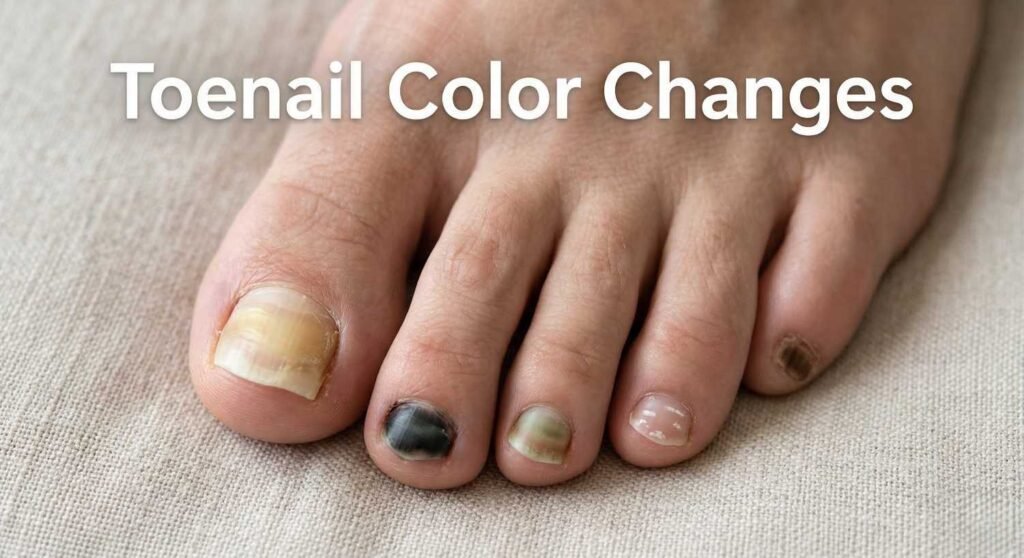
What Healthy Toenails Actually Look Like
Before evaluating abnormal toenail color changes, it helps to establish a clear baseline for what normal looks like.
Healthy toenails typically display:
- Pale pink, uniform color — Consistent tone across the entire nail plate with no patchy discoloration
- Smooth, even surface — No significant ridging, pitting, or rough texture
- Firm but slightly flexible structure — The nail plate does not crumble, crack excessively, or feel hollow
- Secure attachment to the nail bed — No gaps, lifting, or separation at the edges or tip
- Consistent thickness — Not significantly thicker or thinner than adjacent nails
Any meaningful deviation from these characteristics — especially when it persists, progresses, or affects multiple nails — warrants closer evaluation.
The 6 Most Clinically Significant Toenail Color Changes
1. Yellow Toenails

Yellow toenails are the most common toenail color and texture change patients report — and the most frequently misattributed to nail polish staining alone.
Most likely causes:
- Onychomycosis (fungal infection) — The leading cause of yellow toenail color changes. Dermatophyte fungi digest keratin from beneath the nail, producing yellowing that begins at the tip or sides and spreads progressively inward
- Nail polish staining — Pigment molecules in polish chemically bond to keratin over time, producing surface-level yellowing without structural damage
- Aging — Natural reduction in nail lipid content and slower keratin production creates a duller, more opaque yellowish tone
- Smoking — Nicotine and tar deposits on nail surfaces produce progressive yellowing
- Yellow nail syndrome — A rare condition associated with chronic respiratory disease and lymphedema, producing uniformly yellow, thickened, slow-growing nails
The key distinction: Fungal yellowing is accompanied by progressive thickening, crumbling, and debris beneath the nail. Staining-related yellowing is surface-level and does not worsen nail structure. If your yellow toenails are getting thicker — that is not staining.
This YouTube video below explains how to remedy yellow toenails, highlighting common causes like fungus and staining. It shows simple treatment and care tips. Understanding this helps improve nail health and appearance.
2. White Toenails and White Spots

White toenail color changes generate significant anxiety — but the cause determines whether concern is warranted.
Most likely causes:
- Punctate leukonychia (white spots) — Small, smooth white dots caused by minor trauma to the nail matrix. These are entirely harmless, move forward as the nail grows, and require no treatment
- White superficial onychomycosis — Chalky white patches that sit directly on the nail surface and can be lightly scraped off. This is an active fungal infection requiring treatment
- True leukonychia — Uniform whitening of the entire nail plate, associated with systemic conditions including liver disease, kidney disorders, and hypoalbuminemia
- Zinc or nutritional deficiency — Generalized whitening or white banding linked to dietary inadequacy
The key distinction: White spots that move forward with nail growth — trauma, benign. Chalky patches that scrape off or don’t move — active infection. Full nail whitening without a clear trauma history — systemic evaluation needed.
This YouTube video below explains what causes white spots on toenails, highlighting factors like minor injuries, fungal infections, or nutritional issues. It shows what these spots may indicate. Understanding this helps you take better care of your nail health.
3. Black and Dark Brown Toenails
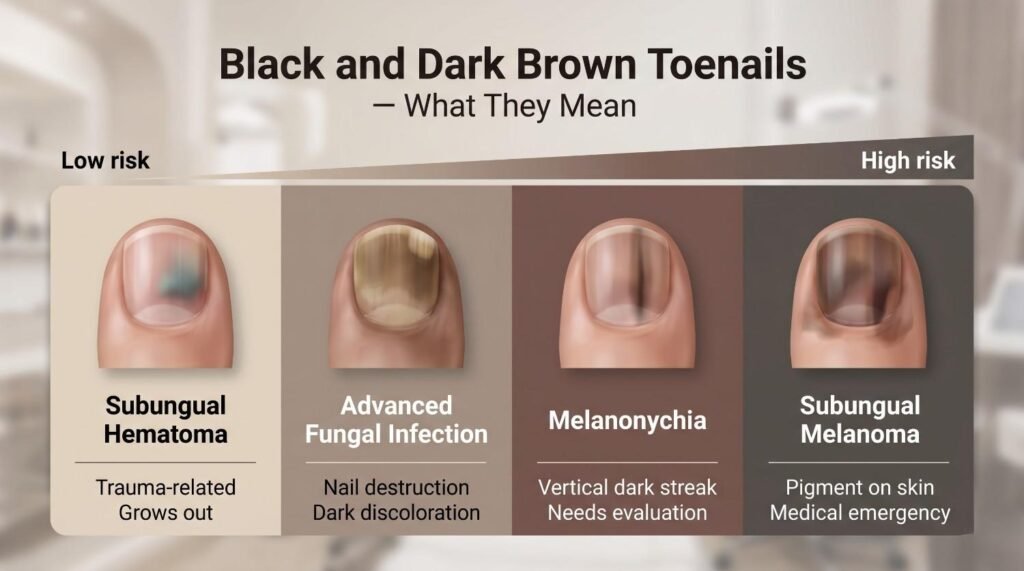
Dark toenail color changes are the category that most urgently requires professional evaluation. The causes range from completely benign to immediately serious.
Most likely causes:
- Subungual hematoma — Blood trapped beneath the nail following direct trauma (dropping something on the toe, tight footwear during running). Produces a dark red, purple, or black discoloration that is painful initially and grows out with the nail
- Fungal infection (advanced onychomycosis) — Severe fungal infection with secondary bacterial involvement can produce very dark discoloration alongside significant nail destruction
- Melanonychia (dark vertical streaks) — Pigmented streaks running lengthwise along the nail, caused by melanocyte activation. Common in darker skin tones, often benign — but requires professional evaluation when appearing for the first time after age 40–50
- Subungual melanoma — A rare but serious malignancy. Distinguished by the Hutchinson’s sign — pigmentation spreading from the nail onto the surrounding cuticle or skin fold. This is a medical emergency
The rule that matters: Any new dark streak or dark toenail color and texture change without a clear trauma history must be evaluated by a podiatrist or physician. If pigment is spreading to the skin surrounding the nail, seek evaluation immediately.
4. Green Toenails

Green toenail color changes almost always indicate bacterial infection — specifically Pseudomonas aeruginosa — rather than fungal infection.
How green nails develop:
- Nail lifting (onycholysis) creates a warm, moist space beneath the separated nail plate
- Pseudomonas colonizes this space — the bacteria produce pyocyanin, a blue-green pigment that colors the nail from beneath
- Green nail syndrome develops — producing a distinctive green or greenish-black discoloration beneath the nail
Why this matters: Green toenail color changes do not respond to antifungal treatment. They require targeted antibacterial intervention. Many patients treating what they assume is a fungal infection with over-the-counter antifungals see no improvement because the organism is bacterial. A podiatrist can identify this distinction accurately and recommend appropriate treatment.
5. Blue and Purple Toenails
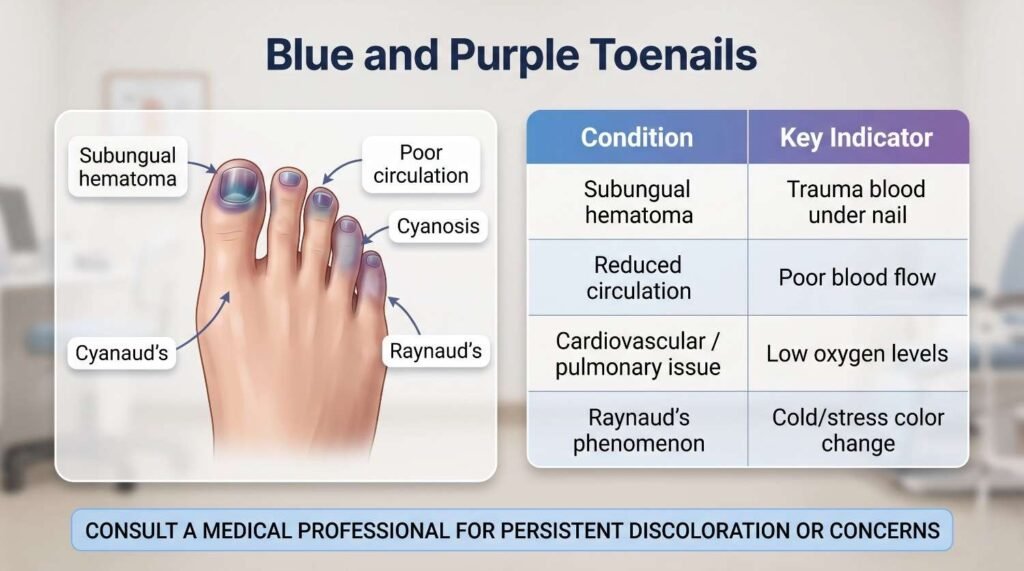
Blue or purple toenail color changes warrant prompt attention because they frequently reflect vascular or systemic health issues.
Most likely causes:
- Subungual hematoma — Blood beneath the nail in the acute phase appears dark red or purple before darkening further
- Reduced peripheral circulation — Poor blood flow to the toes produces a blue-purple discoloration called peripheral cyanosis
- Cardiovascular or pulmonary conditions — Systemic oxygen deficiency produces cyanosis in peripheral tissues, including the nails
- Raynaud’s phenomenon — Episodic vascular spasm in response to cold or stress produces dramatic color changes from white to blue to red
The key point: Blue or purple toenail color changes that appear without an obvious trauma history — particularly in both feet simultaneously — require systemic medical evaluation, not just podiatric care.
6. Texture Changes — Thickening, Crumbling, Ridging, and Pitting
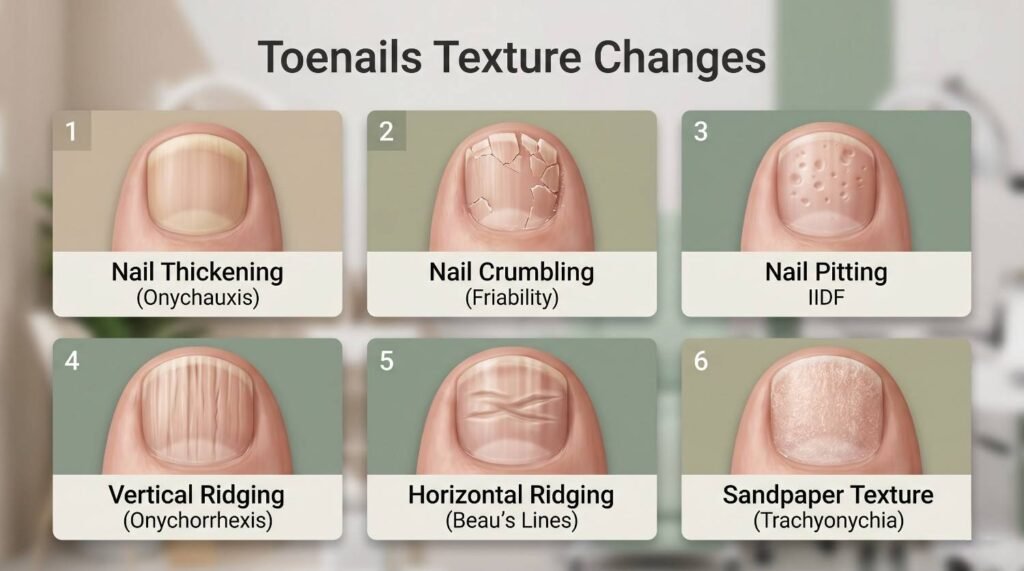
Toenail color changes frequently occur together. Texture changes alone — without significant discoloration — are equally important clinical indicators.
Most significant texture changes:
- Nail thickening (onychauxis) — Uniform thickening from aging or repeated trauma; distinct from fungal thickening, which is accompanied by crumbling and debris
- Nail crumbling (friability) — The nail breaks apart in chalky fragments when trimmed; a hallmark of moderate to advanced fungal infection
- Nail pitting — Small depressions on the nail surface, strongly associated with nail psoriasis and alopecia areata
- Vertical ridging (onychorrhexis) — Common with aging, nutritional deficiency, and dehydration; lines run lengthwise along the nail
- Horizontal ridging (Beau’s lines) — Deep grooves running across the nail; signal interrupted nail growth following illness, surgery, fever, or severe stress
- Sandpaper texture (trachyonychia) — Rough, frosted, uniformly dull nail surface; associated with autoimmune conditions including lichen planus and alopecia areata
Toenail Color Changes: Complete Reference Table
This YouTube video below explains how to fix toenails that change shape and color, highlighting common causes and practical care techniques. It also shows methods to improve nail appearance and overall nail health. 🦶✨
| Color / Texture Change | Most Likely Cause | Severity Level | Action Required |
|---|---|---|---|
| Yellow with thickening | Fungal infection (onychomycosis) | Moderate–High | Podiatrist evaluation; antifungal treatment |
| Yellow without thickening | Nail staining, aging, smoking | Low | Monitor; polish-free period |
| White spots moving forward | Minor trauma (leukonychia) | Low | No treatment needed |
| Chalky white patches | White superficial onychomycosis | Moderate | Antifungal treatment required |
| Full nail whitening | Systemic disease (liver, kidney) | High | Medical evaluation urgently |
| Dark streak (new onset) | Melanonychia or subungual melanoma | High–Emergency | Immediate professional evaluation |
| Black after trauma | Subungual hematoma | Low–Moderate | Monitor; podiatrist if painful |
| Green discoloration | Pseudomonas bacterial infection | Moderate–High | Antibacterial treatment; podiatrist |
| Blue or purple (no trauma) | Circulatory or cardiac condition | High | Systemic medical evaluation |
| Crumbling, friable edges | Advanced fungal infection | Moderate–High | Podiatrist; prescription antifungals |
| Nail pitting | Psoriasis, autoimmune condition | Moderate | Dermatology or podiatry evaluation |
| Horizontal ridges (Beau’s lines) | Post-illness growth interruption | Moderate | Investigate systemic trigger |
| Sandpaper texture | Trachyonychia, lichen planus | Moderate | Specialist evaluation |
What Causes Toenail Color Changes? Key Risk Factors
Understanding what places you at elevated risk for significant toenail color changes helps determine how proactively you should monitor and act.
- Diabetes — Peripheral neuropathy reduces pain awareness; poor circulation limits immune response; toenail changes in diabetic patients carry significantly higher complication risk
- Older age — Slower nail growth, reduced lipid production, capillary rarefaction, and weakened immune function make older adults more vulnerable to both age-related and infection-driven changes
- Frequent gym, pool, or locker room use — Communal moist environments are the primary transmission setting for dermatophyte fungi
- Tight or non-breathable footwear — Creates warm, humid conditions inside the shoe that significantly increase fungal colonization risk
- Compromised immune system — Patients on immunosuppressive medications, undergoing chemotherapy, or with HIV face elevated risk of severe and rapidly progressing nail infections
- Peripheral vascular disease — Compromised blood flow limits the immune response available at the nail site and slows healing significantly
- Nail trauma history — Repeated microtrauma from sport, running, or ill-fitting shoes damages the nail matrix and creates entry points for infection
6 Steps to Take When You Notice Toenail Color Changes
- Remove nail polish completely and examine every toenail. Inspect under good lighting and compare each nail to its neighbors. Look for asymmetry — changes affecting one or two nails are more likely to indicate infection or trauma than aging.
- Apply the friability test when trimming. If the affected nail crumbles, produces chalky debris, or feels hollow when cut — that is active fungal infection, not cosmetic discoloration. Stop treating it as a minor issue.
- Check for nail separation from the nail bed. Gently press on the nail near the tip. If the nail lifts away from the nail bed, the barrier protecting the nail bed from the external environment has failed — and bacterial co-infection becomes a serious risk.
- Look for associated symptoms. Pain, swelling, redness, warmth, drainage, or odor alongside toenail color changes elevates the clinical urgency significantly. These combinations warrant same-week podiatry appointments.
- Photograph the affected nails. Clear photos under good lighting document the current state and help a podiatrist assess progression during your appointment.
- Book a podiatrist appointment without delay. If your toenail color changes are worsening, asymmetric, accompanied by additional symptoms, or not improving after 4–6 weeks of home care — professional evaluation is the next appropriate step.
Treatment Options for Toenail Color Changes
Treatment depends entirely on accurate diagnosis of the underlying cause. Here is what effective treatment looks like across the most common presentations:
- Topical prescription antifungals (efinaconazole, tavaborole) — First-line for mild to moderate fungal infection; require direct nail contact and consistent daily application
- Oral antifungal therapy (terbinafine, itraconazole) — Most effective treatment for moderate to advanced onychomycosis; requires liver function monitoring in some patients
- Professional nail debridement — Podiatrist-performed thinning and cleaning of the nail removes fungal biofilm and subungual debris, significantly improving treatment penetration
- Antibacterial treatment — Required for green nail syndrome (Pseudomonas); antifungals are ineffective against this organism
- Nail avulsion — Partial or complete nail removal in severe cases where the nail plate itself is a barrier to healing
- Targeted treatment for psoriasis or autoimmune causes — Requires dermatology or rheumatology coordination; antifungals have no effect on psoriatic nail disease
- Systemic medical management — For toenail color changes driven by circulatory, hepatic, renal, or cardiovascular conditions
Frequently Asked Questions
Q: Can toenail color changes go away without treatment?
A: It depends entirely on the cause. Minor white spots from trauma will grow out naturally. Nail staining from polish fades with polish-free periods. Fungal infections, bacterial infections, and disease-related toenail color changes do not self-resolve — they progress. Waiting without treatment consistently leads to harder-to-treat conditions.
Q: How do I know if my yellow toenail is fungal or just staining?
A: Check the texture. Staining discolors the surface but leaves nail structure intact — the nail feels normal when pressed and cuts cleanly. Fungal infection discolors and damages the nail structure — producing thickening, debris beneath the nail, crumbling edges, and sometimes odor. If the nail is thickening alongside the yellowing, fungal infection is the far more likely cause.
Q: Are toenail color contagious?
A: Fungal infections are contagious through shared surfaces, contaminated tools, and direct contact. If you have a confirmed fungal infection, shared nail clippers, towels, socks, and bathroom surfaces can transmit the infection to family members. Personal nail tools and good bathroom hygiene are essential during active treatment.
Q: Can psoriasis affect toenails and look like a fungal infection?
A: Yes — nail psoriasis closely mimics fungal onychomycosis in appearance, producing yellowing, thickening, and nail separation. The distinguishing features of nail psoriasis include nail pitting (small depressions), the oil drop sign beneath the nail, and a beveled nail edge. Antifungal medications have no effect on nail psoriasis. Professional diagnosis is essential before beginning any treatment.
Q: How long does treatment for fungal toenail color take?
A: Toenails grow approximately 1.5mm per month, meaning full nail replacement takes 12–18 months. Treatment timelines reflect this growth rate — topical antifungals typically require 9–12 months of consistent application; oral antifungals produce faster results but still require the nail to grow out fully for complete clearance.
Q: When are toenail color changes a medical emergency?
A: Seek immediate evaluation if you notice dark pigment spreading from the nail onto the surrounding skin (Hutchinson’s sign), red streaks tracking up the foot or leg from the nail area, significant swelling with fever, or any nail change in a diabetic patient accompanied by pain or drainage.
Conclusion
Toenail color changes are your body’s most visible communication about what is happening inside the nail matrix, the surrounding tissue, and in some cases, your systemic health. Some of those communications are routine. Others are urgent. And the only reliable way to know which category applies to your specific situation is through professional evaluation.
Ignoring toenail color changes — or self-treating based on assumptions about the cause — consistently leads to more advanced infections, harder treatment courses, longer recovery timelines, and in high-risk patients, serious complications that could have been prevented at an earlier stage.
If your toenails look different than they used to — in color, texture, thickness, or structure — and that difference is persisting or progressing, now is the right time to act. The specialists at Toenail Clinic are experienced in diagnosing and treating the full spectrum of toenail color changes — from early-stage fungal infection to complex nail disease — with treatment plans built around accurate diagnosis, not guesswork. Book your evaluation and get the clear answers your toenails are asking for.
Struggling to get an appointment?
We help patients in your area bypass clinic waitlists by instantly finding verified podiatry doctors who accept their insurance.