Split Toenails Causes and Prevention
Find a Podiatrist Near You
Get same-day appointments with verified podiatrists. Insurance accepted.
Split toenails are a problem that most people deal with at some point, yet they are often dismissed as a purely cosmetic nuisance. In reality, a toenail that consistently cracks, peels, breaks vertically, or separates in layers is telling you something specific about what is happening with the nail plate structure — and in some cases, with broader health factors that deserve attention.
Split toenails are not all the same. A nail that splits vertically from tip toward the cuticle (onychorrhexis) has different causes than a nail that separates in horizontal layers at the tip (onychoschizia). Understanding which type you have, and what caused it, is the first step toward addressing the right problem with the right approach.
This guide covers the seven most common causes of split toenails, explains the clinical differences between split types, and gives you the practical prevention and treatment steps that actually reduce splitting over time.

Understanding the Two Types of Split Toenails
Before examining causes, understanding the two clinical patterns of split toenails helps identify what is happening with the nail plate structure.
Vertical Splitting (Onychorrhexis)
Vertical split toenails run lengthwise along the nail — a crack or split originating at the nail tip and extending toward the cuticle. In more severe cases, the split reaches the nail fold at the base.
Vertical splits involve the nail plate breaking along its length — the direction of nail growth. This typically reflects weakness in the cohesion between keratin layers within the plate, often from dryness, aging, or repeated mechanical stress.
- One or more cracks running lengthwise from the nail tip
- The nail may separate into two sections at the tip
- Jagged, rough nail tip that catches on socks and clothing
- In severe or recurring cases, multiple vertical ridges that may split independently
Horizontal Splitting and Peeling (Onychoschizia)
Horizontal split toenails peel apart in layers — the nail plate separates horizontally at the nail tip, with the superficial layers lifting away from the deeper layers beneath.
This pattern reflects delamination of the nail plate layers — the tightly packed keratin sheets within the nail plate separating from each other. It is particularly associated with repeated wet-dry cycling and chemical exposure.
- The nail tip appears to be separating into paper-thin layers
- The superficial layers peel away
- The exposed undersurface may have a slightly rough or opaque appearance
- The nail tip looks progressively thinner as layers peel
Why the distinction matters:
Vertical splits often reflect systemic or structural nail problems (dryness, nutritional factors, aging). Horizontal splitting often reflects environmental and chemical exposure. The cause shapes the prevention approach.
7 Causes of Split Toenails
Cause 1: Trauma and Repetitive Mechanical Stress
Physical trauma is the most straightforward cause of split toenails. The nail plate, despite being hard, is a brittle structure that responds to mechanical overload by cracking or splitting.
Acute trauma:
A single significant impact — stubbing the toe forcefully, dropping a heavy object, or crushing the toe — can crack the nail plate directly. The split may be immediately visible or may become apparent over the following days.
Repetitive microtrauma:
This is the more common mechanism in athletes, runners, and people who work on their feet. Each repetitive impact is insufficient to crack the nail alone, but accumulated over thousands of steps in training runs or long work days, the cumulative stress produces progressive weakening of the nail plate that eventually produces splitting.
Runners in particular frequently develop split toenails on the longest toe — the nail that contacts the shoe front most with every stride. Hiking, soccer, and basketball produce similar patterns.
What to look for:
Vertical splits or cracks at the nail tip, often on one specific nail rather than all nails. Clear history of high-impact activity or specific injury. The split worsens with continued activity and improves with rest.
Prevention:
Correct footwear — adequate toe box length (one thumb’s width between the longest toe and the shoe front), appropriate depth, and activity-matched cushioning. Keep nails trimmed short before high-impact activity to minimize the nail area exposed to shoe contact.
Cause 2: Chronic Dryness and Wet-Dry Cycling
The nail plate maintains its integrity through adequate moisture and lipid content. When the nail alternates repeatedly between wet and dry states — during dishwashing, swimming, or frequent foot soaking — this cycling extracts the natural lipids from the nail plate.
The result is a nail plate that becomes progressively more brittle and dehydrated. In dry states, brittle nails crack and split more readily. This is the classic mechanism behind horizontal splitting and peeling, particularly at the nail tip where the nail is longest and most exposed.
Contributing factors:
- Frequent swimming or water sports
- Working with hands or feet regularly immersed in water
- Cold, dry weather that removes ambient moisture
- Air-conditioned environments that reduce environmental humidity
- Repeated use of harsh soaps or detergents
What to look for:
Horizontal peeling or splitting at the nail tip affecting multiple nails. Nails that feel dry and rough. Worse in winter or during periods of increased water exposure.
Prevention and management:
After any water exposure, dry feet completely — including around and beneath the nail tips. Apply a nail oil or moisturizing cream to the nail plate and surrounding skin while the nail is still slightly warm from water exposure. Cuticle oil, vitamin E oil, or even a simple emollient applied nightly to the nail surface and folds can meaningfully reduce dehydration-related split toenails over several weeks.
Cause 3: Fungal Nail Infection (Onychomycosis)
Fungal nail infection affects the structural integrity of the nail plate from within. Dermatophyte fungi produce keratinases — enzymes that break down the keratin forming the nail plate. As the infection progresses and more keratin is consumed, the nail plate becomes progressively weaker and more brittle.
The result is a nail that crumbles, chips, and eventually splits more readily than a healthy nail. Split toenails from fungal infection typically appear alongside other fungal nail features — yellow or brown discoloration, nail thickening, subungual debris accumulation, and nail lifting.
What to look for:
Splitting and crumbling at the nail tip and edges, accompanied by yellowing or browning of the nail, thickening, and chalky debris beneath the nail edge. Often starts in one nail and spreads to others. May have associated athlete’s foot between the toes.
Treatment:
Antifungal therapy — topical prescription antifungals for mild cases, oral terbinafine or itraconazole for moderate to severe cases. Laboratory confirmation before treatment ensures the correct organism is targeted.
Cause 4: Nutritional Deficiencies
The nail matrix requires adequate nutritional substrate to produce strong, resilient nail plate. Several specific nutritional deficiencies affect keratin quality in ways that produce more brittle, split-prone nails.
Biotin (vitamin B7):
Biotin is the most studied nutrient in nail health. It is required for the carboxylase enzymes involved in keratin synthesis. Biotin deficiency produces thin, brittle, split-prone nails. Clinical studies using biotin supplementation in patients with documented brittle, splitting nails have shown improvement in nail plate thickness and reduction in splitting in a proportion of patients.
Iron:
Iron deficiency affects multiple aspects of nail health. Iron-deficient nails may be brittle, thin, and prone to splitting, alongside the koilonychia (spoon nail) shape change that is the classic iron deficiency nail finding.
Zinc:
Zinc is required for normal nail matrix cell division. Deficiency produces nail fragility alongside white banding and irregular growth.
Protein:
The nail plate is made of keratin — a protein. Severe protein deficiency from restricted diet or malabsorption reduces the availability of the amino acids needed for keratin production, weakening the resulting nail plate.
What to look for:
Split toenails affecting multiple nails simultaneously, with no obvious local cause (no trauma history, no fungal features), particularly in someone with a restricted diet, history of bariatric surgery, or inflammatory bowel disease. Other deficiency signs may be present — fatigue, hair loss, skin changes.
Assessment:
Blood testing for ferritin (iron stores), serum zinc, albumin (protein status), and complete blood count provides objective information about nutritional status before supplementation is started. Supplementing specific nutrients confirmed by testing is more effective than general multivitamin use.
Cause 5: Age-Related Nail Changes
Nail plate quality changes with age in ways that make split toenails more common in older adults, even without any specific pathology.
As people age:
- Nail growth rate slows — the nail plate is at its active growth surface for longer before being replaced
- The lipid content of the nail plate decreases — reducing flexibility and increasing brittleness
- Keratin organization becomes less efficient — producing nail plate that is simultaneously thicker (harder to cut) but structurally less resilient (more prone to splitting)
- Circulation to the nail bed decreases — reducing nutrient delivery to the matrix
The result is nails that develop vertical ridges (a feature of age-related onychorrhexis) and are more prone to cracking along those ridges when stressed.
What to look for:
Multiple nails developing vertical ridges with associated splitting along the ridges. Gradual onset over years rather than sudden change. Nails that are also thicker and harder to trim. No specific underlying cause.
Management:
Regular moisturizing of the nail surface and surrounding skin, professional nail care for very thick nails, and gentle trimming technique all reduce splitting from age-related nail changes. Biotin supplementation may provide modest benefit even in the absence of frank deficiency.
Cause 6: Incorrect Nail Care and Chemical Damage
How nails are cared for significantly influences their tendency to split. Several common nail care practices directly contribute to split toenails.
Cutting nails too short:
Trimming the nail below the nail fold margin removes the protective nail edge and leaves the nail bed exposed to direct pressure. It also creates a nail edge that catches more readily on fabric and surfaces, increasing the mechanical force applied to the nail tip with every movement.
Using dull clippers:
Dull nail clippers tear rather than cut — they crush the nail plate edge rather than making a clean cut. Crushed nail edges have micro-cracks that propagate into splits under subsequent mechanical stress.
Aggressive filing:
Filing the nail in a back-and-forth sawing motion generates heat and creates micro-fractures in the nail edge. Filing should be done in one direction only, with a fine-grit file.
Harsh nail products:
Acetone-based nail polish removers remove the natural oils from the nail surface. Repeated use over time dehydrates the nail plate, increasing brittleness and susceptibility to horizontal splitting. Some nail hardeners contain formaldehyde, which can paradoxically increase brittleness with overuse.
Forcibly removing stuck nail polish or products:
Peeling or picking off gel polish or acrylic products removes surface nail plate layers along with the product, producing immediate nail thinning and splitting at the tip.
Prevention:
Use sharp, good-quality nail clippers. Cut nails straight across at an appropriate length (not too short). File in one direction with a fine-grit file. Use acetone-free remover where possible. Never peel off nail products — have them properly removed.
Cause 7: Systemic Skin and Nail Conditions
Several dermatological and systemic conditions affect nail plate production and structure in ways that make split toenails a component of the overall nail presentation.
Psoriasis:
Nail psoriasis disrupts the normal organization of nail plate production at the matrix and nail bed. The resulting nail plate has irregular keratin organization that is more prone to splitting, crumbling, and structural fragmentation. Pitting (small depressions on the nail surface) and oil-drop discoloration underneath the nail are associated features.
Lichen planus:
This inflammatory condition can affect the nail matrix and produce thinning, grooved nails that split readily along the longitudinal ridges. Lichen planus is one cause of the sandpaper nail texture (trachyonychia). Scarring of the nail matrix from severe lichen planus can produce permanent pterygium — where scar tissue grows over the nail plate from the cuticle.
Thyroid dysfunction:
Hypothyroidism produces dry, brittle nails that split more readily. Hyperthyroidism can cause nail lifting (onycholysis) and nail softening. Both thyroid conditions affect nail keratin quality and growth rate.
What to look for:
Split toenails accompanying other nail changes (pitting, oil-drop sign, roughness across the surface) or other skin changes suggesting psoriasis. Split nails with a sand-paper quality surface affecting multiple nails (lichen planus). History of thyroid disease or thyroid symptoms (weight changes, fatigue, temperature intolerance) alongside splitting nails.
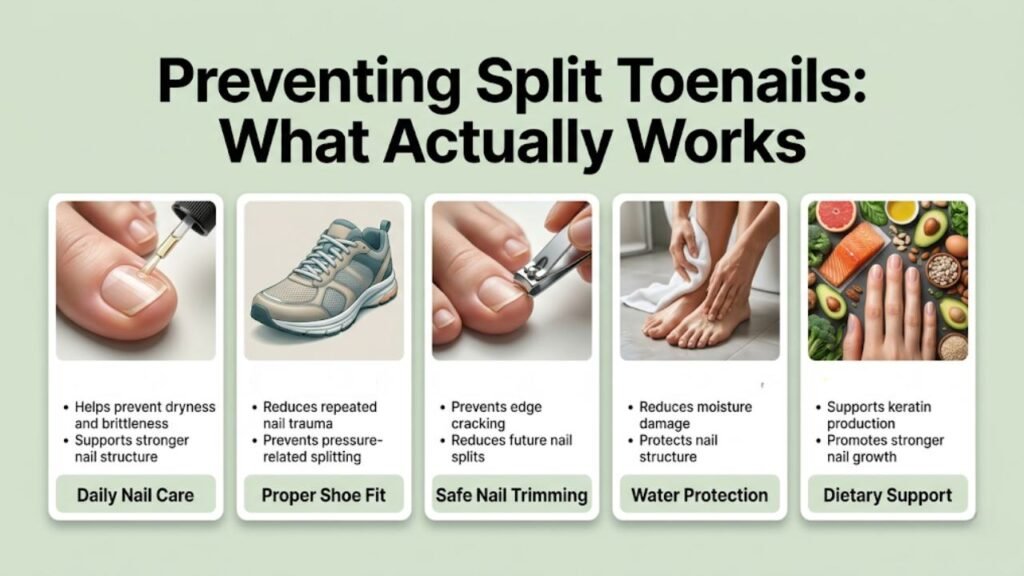
Preventing Split Toenails: What Actually Works
Moisturizing the Nail Plate
This is the single most evidence-supported preventive measure for split toenails from dryness and dehydration. Applying nail oil, cuticle oil, or a thick emollient to the nail plate and surrounding skin nightly — particularly after bathing when the nail is slightly hydrated from water — maintains the lipid content of the nail plate and reduces dehydration-related brittleness.
Consistent daily application for 6 to 8 weeks produces measurable improvement in nail plate moisture content and reduces splitting frequency.
Correct Footwear
For trauma-related split toenails, footwear correction is the most direct intervention. The nail cannot heal faster if it continues sustaining the same impacts. Appropriate footwear length (adequate toe clearance), width (no lateral compression), and depth (nail does not contact the shoe ceiling) eliminates the mechanical cause.
Trimming Technique
Use sharp clippers, cut straight across, leave an appropriate length (not so short the nail bed is exposed, not so long the nail catches on footwear), and file in one direction with a fine-grit file. These techniques prevent the micro-fractures at the nail edge that propagate into splits under subsequent stress.
Protecting Nails During Water Exposure
Wearing rubber gloves for dishwashing and cleaning, and drying feet thoroughly after swimming or bathing, reduces the wet-dry cycling that depletes nail plate lipids and causes horizontal splitting.
Dietary Support
A varied diet including adequate protein, iron, zinc, and biotin provides the nutritional substrate for normal keratin production. If deficiency is suspected, targeted blood testing confirms which nutrients are low before supplementation is started.
When to See a Professional About Split Toenails
Most split toenails can be managed with improved nail care habits and prevention measures. Seek professional evaluation when:
- Splitting is accompanied by nail discoloration, thickening, or crumbling — suggesting fungal infection
- Multiple nails are splitting without a clear lifestyle or environmental cause
- Splitting is accompanied by other skin changes suggesting psoriasis or lichen planus
- The split extends deep into the nail plate and reaches the nail bed — painful, bleeding, or at infection risk
- Home care measures have not reduced splitting after 2 to 3 months
- You have diabetes or poor circulation — nail issues in these populations warrant professional assessment
Frequently Asked Questions About Split Toenails
Why do my toenails keep splitting even though I care for them?
Persistent split toenails despite good nail care often indicate an underlying cause that home care cannot address — fungal infection, nutritional deficiency, a skin condition like psoriasis, or a systemic factor like thyroid dysfunction. Professional evaluation with appropriate testing identifies the specific cause.
Does biotin actually help split toenails?
Biotin may help reduce splitting in patients with genuinely brittle, splitting nails — clinical studies suggest measurable improvement in nail plate thickness with biotin supplementation. However, biotin is most effective when deficiency is present. In people with adequate biotin levels, results are more modest. It is safe to try, but expectations should be realistic.
Can split toenails heal on their own?
Split toenails do not repair themselves — the split portion remains split until that section of nail grows out and is trimmed off. New nail growing from the matrix replaces it. The question is whether the new nail will be stronger (if the underlying cause has been addressed) or will split again (if the cause remains).
How long does it take for a split toenail to grow out?
Toenails grow approximately 1.5 mm per month. A split at the nail tip may grow off within 2 to 3 months. A split that extends significantly toward the base may take 9 to 12 months to fully grow out.
Should I file down split toenails or cut them off?
Smooth any jagged split edge gently with a fine-grit file — filing in one direction to avoid creating additional micro-fractures. Do not try to cut off a split that extends deep into the nail, as this may worsen the split or injure the nail bed. If a split is deep and painful, professional podiatric assessment is appropriate.
Are split toenails contagious?
Split toenails from mechanical causes, dryness, or nutritional deficiency are not contagious. Split toenails that result from fungal infection can be a sign of an active infection that is potentially transmissible — treat the infection appropriately and maintain foot hygiene.
Summary
Split toenails have seven main causes: trauma and repetitive mechanical stress, chronic dryness from wet-dry cycling, fungal nail infection, nutritional deficiencies (particularly biotin, iron, and zinc), age-related nail changes, incorrect nail care and chemical damage, and systemic skin conditions including psoriasis and thyroid dysfunction.
Vertical splits and horizontal peeling reflect different mechanisms — mechanical stress and structural failure in the former, dehydration and layer delamination in the latter — and respond to somewhat different preventive approaches.
Prevention centers on consistent nail moisturizing, appropriate footwear, correct trimming technique, and addressing any underlying systemic cause. When split toenails are persistent despite good care, professional evaluation identifies the specific driving cause and ensures the right treatment is applied.
Struggling to get an appointment?
We help patients in your area bypass clinic waitlists by instantly finding verified podiatry doctors who accept their insurance.