Toenail Fungus Without Thickening — Is It Possible?
Find a Podiatrist Near You
Get same-day appointments with verified podiatrists. Insurance accepted.
Toenail fungus without thickening is not only possible — it is actually how most fungal nail infections begin. The image most people carry of toenail fungus involves thick, yellowed, crumbling nails that are impossible to miss. That picture is accurate for advanced infection. But it describes the endpoint of a process that starts weeks or months earlier, when the nail looks almost entirely normal and thickening has not yet developed.
This gap between what toenail fungus looks like at its most recognizable stage and what it looks like when it first becomes treatable is one of the most important clinical realities patients need to understand. Toenail fungus without thickening is the most favorable stage for treatment — and the stage most commonly missed precisely because it does not match the expected picture.
This guide explains why toenail fungus without thickening occurs, which specific infection types are most likely to present this way, what the early signs actually look like, and what appropriate treatment involves when the nail is still relatively intact.

Why Toenail Fungus Does Not Always Cause Thickening Immediately
Understanding why toenail fungus without thickening is possible requires understanding the biological relationship between fungal infection and the nail plate response.
Nail thickening in fungal infection is not caused directly by the fungal organisms themselves. It is primarily a consequence of two processes:
1. Subungual keratin debris accumulation
As dermatophyte fungi consume nail keratin in the subungual space — the area between the nail plate and the nail bed — they produce debris. This debris accumulates beneath the nail plate, progressively pushing it upward and outward. The result is a nail that appears thicker from above because the space between the plate and the nail bed is filling with material.
2. Reactive hyperkeratosis of the nail bed
The nail bed skin responds to fungal invasion by producing excess keratin — a protective response that thickens the tissue beneath the nail. As this subungual hyperkeratosis develops, it further raises the nail plate.
Both of these processes take time. In early infection, the fungal colony is still small, the debris accumulation is minimal, and the nail bed response has not yet produced enough hyperkeratosis to visibly elevate the nail plate.
This is why toenail fungus without thickening is the norm in the first weeks to months of infection — not the exception. Thickening is a consequence of established, progressing infection, not of early colonization.
Which Types of Toenail Fungus Present Without Thickening
Not all fungal nail infection types progress through the same biological pathway. Some types are specifically characterized by their tendency to present as toenail fungus without thickening — at least initially, and sometimes for extended periods.
White Superficial Onychomycosis (WSO)
White superficial onychomycosis is the infection type most associated with toenail fungus without thickening, because the infection is genuinely superficial — it sits on the outer surface of the nail plate rather than beneath it.
The causative organism — most commonly Trichophyton mentagrophytes — penetrates the superficial nail surface layers rather than the nail plate through the hyponychium. The result is characteristic white, powdery, chalky patches on the nail’s outer surface. These patches can be physically scraped off, and the nail beneath them is normal in thickness and structure.
Because WSO does not involve subungual space accumulation or nail bed hyperkeratosis in its early stages, it produces classic toenail fungus without thickening. The nail looks dull, white, and chalky — but its profile and thickness are normal.
If untreated, WSO can eventually penetrate deeper and produce thickening — but many cases of WSO can persist at the superficial level for an extended period while remaining genuinely treatable with topical antifungal therapy.
Early Distal Subungual Onychomycosis (DSO)
Distal subungual onychomycosis is the most common pattern of onychomycosis overall. It begins at the hyponychium — the seal at the nail tip — where the fungus enters and begins spreading proximally under the nail.
In its early phase, DSO produces toenail fungus without thickening. The initial changes are:
- A small area of yellow or white discoloration at the nail tip
- Mild separation of the nail edge from the skin beneath
- Slight surface changes at the distal nail
Thickening develops as DSO progresses and subungual debris accumulates, but this takes time. Many patients with early DSO have a nail that is still near-normal in thickness with only subtle visible changes.
Proximal Subungual Onychomycosis (PSO) — Early Stage
Proximal subungual onychomycosis is less common and is associated with immune compromise. It enters the nail unit through the proximal nail fold — near the cuticle — and spreads distally.
In early PSO, a white area may appear beneath the proximal nail, visible through the translucent nail plate. The nail is not thickened at this stage. This presentation of toenail fungus without thickening is less common but clinically important because PSO’s association with immune compromise means it should prompt evaluation for underlying health conditions.
4 Early Signs of Toenail Fungus Without Thickening
Recognizing toenail fungus without thickening requires looking for subtler changes than the dramatic nail destruction that most people associate with fungal infection.
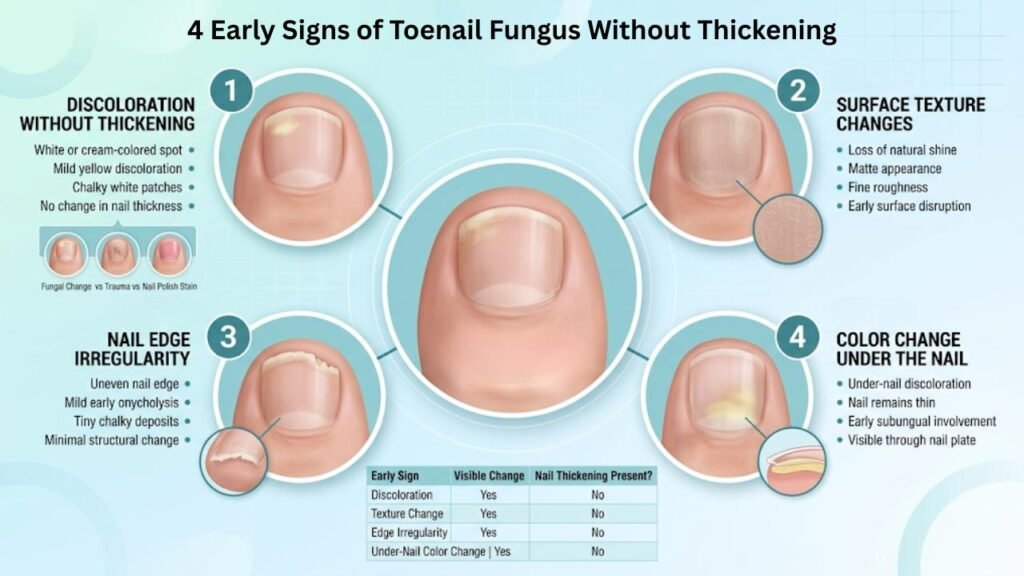
Sign 1: Discoloration Without Structural Change
The most consistent early sign of toenail fungus without thickening is a change in nail color without any accompanying change in nail thickness or shape.
What this looks like:
- A white, cream, or pale yellow area at the nail tip that is clearly different from the nail’s normal color
- White powdery or chalky patches on the nail surface (characteristic of WSO)
- A subtle cloudiness or loss of translucency in part of the nail
- In proximal presentations: a whitish area visible under the nail near the cuticle
How to distinguish fungal discoloration from other causes:
- Trauma-induced discoloration (subungual hematoma) tends to appear immediately after an injury and gradually grows out with the nail
- Nail polish staining tends to affect the nail surface uniformly and clears when polish is removed
- Fungal discoloration typically develops gradually, persists without a clear cause, and does not resolve on its own
Any area of nail discoloration that persists beyond 4 to 6 weeks without a clear and resolving traumatic explanation warrants professional evaluation.
Sign 2: Surface Texture Changes
Toenail fungus without thickening often produces subtle changes to the nail plate’s surface texture before any thickening develops.
What to look for:
- Loss of the normal glossy, smooth nail surface — the nail looks dull or matte
- Fine surface roughness that can be felt when running a fingernail across the nail surface
- Very subtle pitting or irregularities in the nail surface
- White powdery material on the nail surface that can be scraped off (WSO-specific)
These surface changes reflect early fungal disruption of the outer nail plate layers. They are distinct from the crumbling and irregularity of advanced infection — at this stage the changes are subtle and require deliberate inspection to notice.
Sign 3: Nail Edge Irregularity
Even in toenail fungus without thickening, the nail edge — particularly at the tip and lateral borders where most infections enter — may show early changes.
Early edge changes:
- The nail tip appears slightly irregular or jagged rather than growing out smoothly
- A minimal separation between the underside of the nail tip and the skin beneath it — the very beginning of onycholysis
- Minimal chalky or powdery material visible at the very distal nail edge when examined closely
These changes are not dramatic. The nail still cuts reasonably cleanly, still looks normal at a glance from standing height, and does not produce any pressure or discomfort. But close inspection — particularly in good lighting — reveals that the nail edge is not as clean and uniform as it was before.
Sign 4: Color Change Under the Nail Visible Through the Plate
In some cases of toenail fungus without thickening, particularly early DSO and early PSO, the discoloration is visible beneath the nail plate rather than on its surface. The nail itself remains clear and translucent — but a yellow, white, or cream area is visible through it from above.
This sign is specific to early infection because the nail plate is still thin enough and translucent enough to allow visualization of the early subungual changes. As infection progresses and the nail plate itself becomes more opaque, this through-plate visibility is lost.
What Toenail Fungus Without Thickening Looks Like vs. Other Conditions
One of the most important clinical challenges with toenail fungus without thickening is distinguishing it from other conditions that produce similar-appearing nail changes without thickening.
| Feature | Toenail Fungus Without Thickening | Nail Psoriasis (Early) | Trauma Discoloration | Nail Polish Staining |
|---|---|---|---|---|
| Discoloration pattern | White, yellow, spreading proximally | Silvery, pitting, oil-drop spots | Dark red/brown, at injury site | Uniform surface staining |
| Surface changes | Dullness, powdery patches | Pitting, roughness | Smooth beneath discoloration | Surface staining only |
| Progression | Slow spread over weeks/months | Variable, associated with skin psoriasis | Grows out with nail | Clears with polish removal |
| Pain | None | Variable | At injury site | None |
| Laboratory confirmation | KOH/culture positive | KOH negative | KOH negative | Not applicable |
Laboratory confirmation through KOH microscopy or fungal culture is the only reliable way to distinguish toenail fungus without thickening from non-fungal conditions. This distinction matters enormously — treating nail psoriasis with antifungal medication produces no benefit, wastes months of effort, and delays appropriate dermatological management.
How Long Can Toenail Fungus Stay Without Thickening?
The duration of toenail fungus without thickening varies considerably by infection type and individual factors.
White superficial onychomycosis — Because WSO is genuinely superficial, it can persist for months in a non-thickened state if untreated. In some patients with healthy immune function, WSO progresses slowly and may remain relatively stable in appearance for an extended period. However, it does not resolve spontaneously — it continues to expand across the nail surface.
Early distal subungual onychomycosis — Early DSO typically remains in the non-thickened phase for weeks to a few months before progressive subungual debris accumulation begins driving thickening. In patients with diabetes, immune compromise, or poor circulation, this transition may occur faster.
Early proximal subungual onychomycosis — PSO tends to progress more readily into thickening because the proximal location means the infection has direct access to new nail being produced at the matrix. Early PSO without thickening is a shorter window than WSO or early DSO.
The key clinical message: toenail fungus without thickening is a time-limited window. How long it lasts depends on the infection type and individual health factors — but it does not last indefinitely, and using this window for treatment produces the best possible outcomes.
Diagnosing Toenail Fungus Without Thickening
Diagnosis of toenail fungus without thickening is more challenging than diagnosing advanced infection because the clinical signs are subtle and non-specific. Laboratory confirmation is essential.
KOH microscopy: Nail clippings or surface scrapings from the affected area dissolved in potassium hydroxide and examined under microscope. In WSO, surface scrapings from the powdery patches often yield positive results readily. In early DSO, nail clippings from the distal nail and subungual scraping from beneath the nail tip are the most productive sampling sites.
Fungal culture: Provides species identification, which guides treatment selection. Particularly important if KOH is negative but clinical suspicion remains high, or if the infection does not respond as expected to initial treatment.
Clinical examination pattern: An experienced podiatrist or dermatologist can often recognize WSO by its characteristic white powdery surface appearance and the ability to scrape the patches from the nail surface. Early DSO has a characteristic distal-to-proximal spread pattern that is recognizable with experience.
Treating Toenail Fungus Without Thickening
Toenail fungus without thickening is the most favorable presentation for treatment. The infection is superficial, nail penetration requirements for topical agents are lower, and the nail architecture is intact — meaning treatment can reach the infection more effectively and new healthy nail replacement proceeds from a less damaged starting point.
Topical Antifungal Therapy as First-Line
For toenail fungus without thickening — particularly WSO and early DSO with less than 50 percent nail involvement and no matrix involvement — topical antifungal therapy is the appropriate first-line treatment.
- Efinaconazole 10% solution — Daily application for 48 weeks. Best penetration profile among available topical antifungals for subungual infections
- Ciclopirox 8% nail lacquer — Daily for 48 weeks. Most effective when combined with nail surface preparation
- Tavaborole 5% solution — Daily for 48 weeks. Particularly useful for WSO given its mechanism of action
For WSO specifically: Because the infection is genuinely on the nail surface rather than beneath it, topical agents work particularly well. The surface can also be gently mechanically debrided — the white powdery material scraped from the surface — before applying topical medication, improving direct contact between the antifungal agent and the remaining fungal colony.
Professional Debridement as Adjunct
Even in toenail fungus without thickening, professional debridement by a podiatrist improves topical medication penetration. Surface preparation — gently thinning the nail surface with a nail file — improves topical contact with the affected area.
When Oral Therapy Is Indicated Even Without Thickening
Certain presentations of toenail fungus without thickening warrant oral antifungal therapy despite the absence of nail thickening:
- PSO (proximal subungual onychomycosis) — because of its progression pattern and association with immune compromise, PSO typically requires oral therapy
- Multi-nail involvement even without thickening in each nail — topical coverage of many nails simultaneously is impractical
- Immunocompromised patients — even mild infection in these patients may progress rapidly and benefits from systemic treatment
- Topical therapy trial that has not produced improvement after 3 to 4 months
Preventing Toenail Fungus Without Thickening From Progressing
Once toenail fungus without thickening is identified and treatment has begun, preventing progression requires addressing the conditions that facilitate fungal growth.
During active treatment:
- Apply topical medication daily without missing doses — consistency is the primary determinant of topical therapy success
- Keep the affected nail clean and dry
- Treat concurrent athlete’s foot immediately — the skin infection provides a continuous fungal reservoir
- Disinfect nail tools after every use — do not use the same tool on the affected nail and healthy nails in sequence
- Apply antifungal powder inside footwear regularly
Footwear and moisture:
- Rotate shoes to allow complete drying between wears
- Choose breathable footwear materials
- Change socks daily and after exercise
- Dry feet completely after bathing — particularly between the toes and around the nail folds
Monitoring:
- Photograph the affected nail monthly to track whether discoloration is changing, staying stable, or spreading
- Monthly inspection of all other nails for any early signs of spread
Frequently Asked Questions
Is toenail fungus without thickening still contagious?
Yes. Toenail fungus without thickening is still an active fungal infection producing spores. It is still contagious through shared surfaces, nail tools, and footwear — the same transmission routes as advanced infection. The absence of thickening does not mean the infection is inactive.
Can toenail fungus without thickening go away on its own?
Spontaneous resolution is rare. Toenail fungus without thickening, like established nail fungus at any stage, almost always requires antifungal treatment for meaningful clearance. The advantage of the non-thickened stage is that treatment is simpler — but waiting for spontaneous resolution consistently allows progression to the thickened, harder-to-treat stage.
How do I know if nail discoloration without thickening is fungal or something else?
Fungal discoloration tends to spread gradually over weeks, starts at the nail tip or surface, and persists without resolving on its own. Traumatic discoloration typically appears immediately after injury and grows out with the nail. Nail polish staining clears when polish is removed. Laboratory testing — KOH microscopy or fungal culture — is the only definitive way to confirm fungal involvement.
Does toenail fungus without thickening require oral medication?
Not always. Infections limited to less than 50 percent of the nail without matrix involvement often respond to topical antifungal therapy alone at this stage. Certain presentations — including PSO, multi-nail involvement, or infection in immunocompromised patients — may require oral therapy even without thickening.
How long does treatment take for toenail fungus without thickening?
Topical antifungal therapy for toenail fungus without thickening runs for 48 weeks of daily application. The infection may clear and nail appearance normalize before this — but completing the full course prevents relapse. Full nail replacement takes 12 to 15 months.
Should I see a podiatrist for toenail fungus without thickening?
Yes. Professional evaluation confirms the diagnosis, rules out non-fungal conditions with similar appearances, identifies the causative organism if culture is performed, and provides access to prescription topical antifungals that have stronger evidence than over-the-counter alternatives. Starting appropriate treatment at the non-thickened stage is the highest-value intervention in toenail fungus management.
Summary
Toenail fungus without thickening is not an unusual presentation — it is the normal presentation of early-stage fungal nail infection. The thickening most people associate with nail fungus is a consequence of established, progressing infection — it develops months after the fungal colony has already been active in the nail.
The three infection types most associated with toenail fungus without thickening are white superficial onychomycosis, early distal subungual onychomycosis, and early proximal subungual onychomycosis. Each has distinct characteristics but shares the common feature of early disease without significant nail structural alteration.
The 4 signs to recognize toenail fungus without thickening are: discoloration without structural change, surface texture changes, nail edge irregularity, and color visible through the nail plate. Laboratory confirmation is essential before committing to treatment — because several non-fungal conditions produce identical appearances.
Treating toenail fungus without thickening with appropriate topical antifungal therapy, combined with nail debridement and consistent foot hygiene, offers the best available combination of treatment simplicity and outcome quality. This is the window — and acting within it makes everything that follows easier.
Struggling to get an appointment?
We help patients in your area bypass clinic waitlists by instantly finding verified podiatry doctors who accept their insurance.