Pulse Dosing vs Continuous Terbinafine
Find a Podiatrist Near You
Get same-day appointments with verified podiatrists. Insurance accepted.
Pulse dosing vs continuous terbinafine is a question that arises in nail fungus treatment discussions more often than most patients expect — because terbinafine, unlike itraconazole where pulse dosing is standard clinical practice, is almost always prescribed as a continuous daily regimen. Yet pulse dosing of terbinafine does exist, has clinical rationale behind it, and is occasionally appropriate for specific patient situations.
Understanding the difference between these two approaches requires understanding something fundamental about how terbinafine behaves in the body — specifically, the way it accumulates in nail tissue and persists there for months after the final dose. This pharmacokinetic property is the biological foundation that makes any form of pulsed terbinafine dosing pharmacologically plausible.
This guide explains both regimens clearly, compares the clinical evidence, identifies which patients might benefit from each approach, and provides practical guidance for anyone navigating terbinafine treatment decisions.

Why Terbinafine Is Different From Other Antifungals
The pulse dosing vs continuous terbinafine comparison only makes clinical sense when you understand why terbinafine is unusual among antifungal medications.
Terbinafine’s exceptional nail tissue retention:
After terbinafine is absorbed from the gut and enters the bloodstream, it does not distribute evenly throughout body tissues. Instead, it actively concentrates in keratinized tissues — skin, hair, and most importantly for nail fungus treatment, the nail plate and nail bed.
The drug’s lipophilic (fat-soluble) nature causes it to partition out of blood and into keratin-rich tissue. Once in the nail plate, it binds to nail keratin and remains there. Therapeutic terbinafine concentrations have been detected in toenails for 6 to 9 months after the final dose of a standard 12-week course.
This extraordinary persistence in nail tissue is what makes any discussion of pulse dosing vs continuous terbinafine relevant. If the drug remains in the nail for months after stopping, there is a biological rationale for whether the drug needs to be taken continuously or whether interrupted courses might maintain adequate nail concentrations.
The mechanism in the nail:
Terbinafine in the nail is not just sitting passively. The drug incorporated into the nail plate during growth continues to inhibit fungal squalene epoxidase as fungal organisms within the nail encounter these drug-laden keratin layers. The drug essentially builds a pharmacologically active nail — one that is itself antifungal throughout its full thickness as it grows forward from the matrix.
Continuous Terbinafine: The Standard Regimen
Continuous terbinafine is the regimen with the most clinical evidence, the strongest guideline support, and the highest cure rates for toenail onychomycosis. In the pulse dosing vs continuous terbinafine comparison, continuous therapy is the reference against which pulse approaches are evaluated.
Standard continuous regimen:
- 250 mg terbinafine daily
- 12 weeks (3 months) for toenail infection
- 6 weeks for fingernail infection
How it works:
During the 12-week daily dosing period, terbinafine is continuously absorbed from the gut and delivered to the nail matrix and nail bed via blood circulation. As new nail is produced by the matrix, terbinafine is incorporated into the growing nail plate at high concentrations. By the end of the 12-week course, the nail matrix, nail bed, and nail plate throughout are saturated with therapeutic drug concentrations.
After the 12-week course ends, the drug remains active in nail tissue for many additional months — continuing to inhibit fungal growth as the treated nail plate grows forward from matrix to tip over the subsequent 12 to 18 months.
Efficacy of continuous terbinafine:
- Mycological cure rate (laboratory confirmed elimination of fungal organisms): 70 to 80 percent
- Complete cure rate (clear nail + negative laboratory): 35 to 50 percent at study endpoints
- These are the highest cure rates of any single oral antifungal agent for dermatophyte toenail infection
Why continuous therapy produces the highest cure rates:
Continuous daily dosing maintains the highest and most sustained drug concentrations in nail tissue throughout the treatment period. Every day of dosing builds on the previous day’s drug accumulation in the nail. By the end of 12 weeks, nail tissue drug concentrations are at their peak.
Pulse Dosing Terbinafine: The Alternative Approach
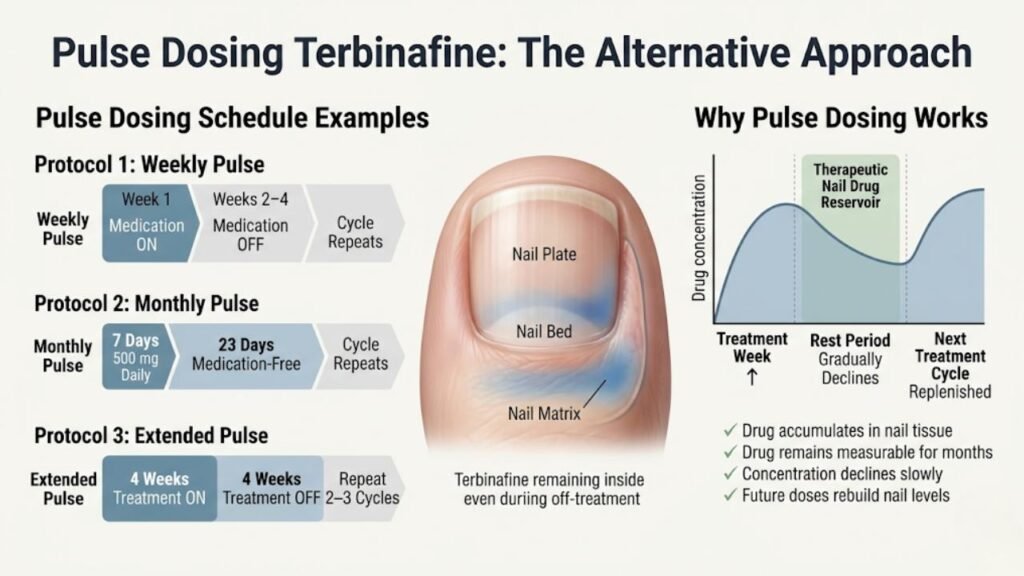
In the pulse dosing vs continuous terbinafine comparison, pulse dosing represents an alternative scheduling strategy that takes advantage of terbinafine’s nail tissue persistence to allow treatment breaks while theoretically maintaining antifungal activity in the nail.
The core rationale:
If terbinafine remains in nail tissue at therapeutic concentrations for months after stopping, perhaps a cycle of treatment followed by a drug-free period — during which drug levels in the nail remain active — could achieve clinical outcomes comparable to continuous dosing while reducing total drug exposure and potential side effects.
Pulse dosing protocols that have been studied:
Protocol 1: Weekly pulse
250 mg daily for 7 days, followed by 21 days off (medication-free). This cycle is repeated for 3 to 4 months.
Protocol 2: Monthly pulse (higher dose)
500 mg daily for 7 days per month, repeated for 3 to 4 months.
Protocol 3: Extended pulse
250 mg daily for 4 weeks, followed by 4 weeks off, repeated for 2 to 3 cycles.
The pharmacological basis:
After one week of daily terbinafine 250 mg, drug concentrations in nail tissue are measurable and in some studies approach therapeutic levels. During the subsequent 3-week off period, nail tissue concentrations decline but — based on the drug’s known persistence — do not drop to zero. The next treatment week rebuilds the concentration.
Whether the trough concentrations during the off-period are consistently above the minimum inhibitory concentration (MIC) for clinically relevant dermatophytes is the critical question the pulse dosing vs continuous terbinafine comparison must answer.
Clinical Evidence: Pulse Dosing vs Continuous Terbinafine
The evidence base for this comparison is somewhat one-sided — continuous terbinafine has far more robust clinical trial data than pulse terbinafine regimens.
Continuous terbinafine evidence:
Multiple large randomized controlled trials, meta-analyses, and decades of clinical experience establish continuous 12-week terbinafine as the most effective monotherapy regimen available for dermatophyte toenail onychomycosis. The mycological cure rate of 70 to 80 percent and complete cure rate of 35 to 50 percent are among the strongest in the field.
Pulse terbinafine evidence:
A smaller number of studies have examined pulse terbinafine regimens. The findings are relevant:
One study comparing continuous 12-week terbinafine (250 mg/day) with pulse terbinafine (250 mg/day for 1 week per month × 3 months) found continuous therapy produced higher mycological cure rates — approximately 72 percent for continuous versus 59 percent for pulse dosing.
Another comparison found that continuous therapy produced clinical cure rates approximately 10 to 15 percentage points higher than pulse therapy at 12-month follow-up.
Studies examining higher-dose pulse protocols (500 mg/day for 1 week per month) have shown improvement compared to lower-dose pulse regimens, narrowing the efficacy gap with continuous therapy, but still generally not reaching the same cure rates.
The honest conclusion of the pulse dosing vs continuous terbinafine comparison:
Continuous terbinafine produces higher cure rates. For patients who can tolerate it safely, continuous therapy is the superior choice for achieving the best possible clinical outcome.
Pulse dosing is a meaningful alternative for patients where reducing total drug exposure is clinically justified — but it comes with an accepted reduction in expected efficacy.
Comparing Pulse Dosing vs Continuous Terbinafine Side by Side
| Feature | Continuous Terbinafine | Pulse Terbinafine |
|---|---|---|
| Dosing schedule | 250 mg daily × 12 weeks | 250 mg daily × 7 days per month × 3-4 months |
| Total tablets consumed | Approximately 84 | Approximately 21 to 28 |
| Nail tissue drug levels | Consistently high throughout | High during treatment weeks; declining during off weeks |
| Mycological cure rate | 70 to 80 percent | 55 to 65 percent |
| Complete cure rate | 35 to 50 percent | 25 to 40 percent |
| Liver enzyme exposure | Higher cumulative | Lower cumulative |
| Side effect burden | Slightly higher | Potentially lower |
| Evidence quality | Strong — multiple large RCTs | Moderate — fewer and smaller studies |
| Guideline recommendation | First-line standard | Alternative for selected patients |
| Best for | Moderate to severe infection, strong efficacy priority | Patients requiring reduced drug exposure |
Why Pulse Dosing Exists: The Clinical Justification
If continuous terbinafine is more effective, why does pulse dosing exist? In the pulse dosing vs continuous terbinafine discussion, there are legitimate clinical reasons to consider pulse dosing for specific patients.
Reducing Liver Enzyme Exposure
Terbinafine is hepatically metabolized. While serious liver injury from terbinafine is rare (estimated at 1 in 45,000 to 1 in 100,000 treatment courses), liver enzyme elevation during treatment is more common. For patients with:
- Pre-existing liver conditions that are mild and stable
- Prior history of elevated liver enzymes on continuous antifungal therapy
- Multiple other hepatically-processed medications
- Personal or physician preference for reducing cumulative liver drug exposure
…pulse dosing reduces the total hepatic drug burden by approximately 75 percent compared to continuous therapy.
Managing Significant Drug Interactions
Terbinafine inhibits CYP2D6. For patients taking medications that are CYP2D6 substrates — certain antidepressants (tricyclics, some SSRIs), beta-blockers, certain opioids — this interaction requires consideration. Pulse dosing reduces the sustained CYP2D6 inhibition compared to continuous therapy, potentially making the drug interaction more manageable.
Patient Adherence Considerations
Some patients find daily medication for 12 weeks challenging to maintain adherence with. Pulse protocols that involve active treatment weeks followed by drug-free weeks may suit certain patients’ adherence patterns better — though the more complex cycle tracking has its own adherence challenges.
Mild Infection
For mild onychomycosis — limited to the nail tip, involving less than 25 percent of the nail plate, with no matrix involvement — pulse terbinafine may produce adequate results while minimizing the treatment burden.
Pulse Dosing vs Continuous Terbinafine: Decision Framework
Choose continuous terbinafine when:
- The infection is moderate to severe (more than 50 percent nail involvement)
- Multiple nails are infected simultaneously
- The nail matrix is involved
- The patient has had a previous treatment failure with topical therapy
- Achieving the highest possible cure rate is the clinical priority
- The patient has no significant contraindications to continuous dosing
- Liver function is normal at baseline
Consider pulse terbinafine when:
- The infection is mild to moderate (less than 50 percent nail involvement, nail tip)
- Reducing total hepatic drug exposure is clinically relevant
- A significant CYP2D6 drug interaction needs to be managed
- The patient is elderly with multiple comorbidities where reducing medication burden is appropriate
- A continuous course was previously not well tolerated
- The patient is a poor candidate for oral antifungals generally but mild disease warrants some systemic treatment
Note: Both decisions require physician evaluation and prescription. The pulse dosing vs continuous terbinafine choice should never be made by the patient independently — the regimen change must be prescribed and supervised.
How Both Regimens Compare to Itraconazole Pulse Dosing
The pulse dosing vs continuous terbinafine comparison exists within a broader context where pulse dosing is already standard clinical practice — for itraconazole.
Itraconazole pulse dosing is not an alternative to continuous itraconazole — it is the primary way itraconazole is used. Itraconazole 200 mg twice daily for one week per month, repeated for 3 to 4 months, is a standard first-line regimen with strong evidence and guideline support.
The key pharmacological difference: itraconazole accumulates in nail tissue even more dramatically than terbinafine during treatment weeks, and the drug concentration during the off-weeks remains sufficient for antifungal activity. The pulse design for itraconazole was validated in large comparative trials showing equivalence or near-equivalence to continuous itraconazole.
Terbinafine pulse dosing never achieved the same level of validation against its continuous counterpart — which is why continuous terbinafine remains standard and itraconazole pulse dosing is standard.
For patients who genuinely need pulse dosing, itraconazole pulse therapy has stronger evidence than terbinafine pulse therapy.
Safety Monitoring for Both Regimens
Before starting either regimen:
- Baseline liver function tests (ALT, AST, bilirubin)
- Review of all current medications for CYP2D6 interactions
- Laboratory confirmation of fungal infection diagnosis (KOH or culture)
During continuous terbinafine (12 weeks):
- Liver function monitoring at approximately 6 weeks for higher-risk patients (pre-existing liver conditions, multiple hepatotoxic medications)
- Immediate testing if symptoms of liver dysfunction appear — fatigue, jaundice, dark urine, right upper abdominal pain
During pulse terbinafine:
- Monitoring at the same relative intervals
- Because total cumulative drug exposure is lower, monitoring concerns are proportionally reduced — but not eliminated
Symptoms requiring immediate physician contact during either regimen:
- Yellowing of skin or eyes
- Dark or tea-colored urine
- Persistent abdominal pain on the right side
- Unexplained severe fatigue
- Taste disturbance (dysgeusia) — report to physician; usually resolves but can persist
Frequently Asked Questions About Pulse Dosing vs Continuous Terbinafine
Is pulse dosing or continuous terbinafine more effective?
Continuous terbinafine produces higher mycological and clinical cure rates — typically 10 to 15 percentage points higher than pulse regimens in comparative studies. For patients who can safely tolerate continuous therapy, it is the superior choice for treatment efficacy.
Why would a doctor choose pulse dosing over continuous terbinafine?
Pulse dosing is chosen when reducing total drug exposure is clinically important — typically due to liver health concerns, significant drug interactions with CYP2D6-substrate medications, or for elderly patients with multiple comorbidities. For mild infections where the reduced cure rate is an acceptable trade-off, pulse therapy may also be appropriate.
How long does terbinafine stay in the nail after stopping?
Terbinafine concentrations in nail tissue remain detectable for 6 to 9 months after the final dose of a standard 12-week continuous course. This persistence is the pharmacological basis for pulse dosing — but nail concentrations during pulse off-periods are lower and more variable than during continuous therapy.
Can I take terbinafine once a week instead of every day?
Once-weekly terbinafine is not a validated regimen. This is distinct from once-weekly pulse protocols. Any modification to the prescribed schedule should be discussed with your prescribing physician rather than self-adjusted.
Is itraconazole pulse dosing the same as pulse dosing terbinafine?
They share the concept of interrupted treatment cycles but are not equivalent. Itraconazole pulse dosing (200 mg twice daily for one week per month) is a validated, guideline-supported standard regimen with strong evidence. Pulse terbinafine has less evidence and produces lower cure rates than continuous terbinafine. Itraconazole pulse therapy generally has stronger evidence supporting it than pulse terbinafine.
Should I continue treatment if the nail looks better during the course?
Never stop terbinafine early because the nail appears to be improving. Nail improvement during treatment reflects medication suppressing the fungal organisms — but they are not yet eliminated. Stopping early allows surviving organisms to regrow. The full prescribed course must be completed regardless of nail appearance.
Summary
Pulse dosing vs continuous terbinafine represents a genuine clinical choice — not between two equally effective options, but between the more effective standard regimen and a reduced-exposure alternative for situations where continuous therapy is less appropriate.
Continuous terbinafine at 250 mg daily for 12 weeks produces the highest cure rates for dermatophyte toenail onychomycosis and remains the evidence-based standard of care. For patients who can safely complete this course, it is the right choice.
Pulse terbinafine — taking the medication daily for one week per month for 3 to 4 months — reduces total drug exposure and is appropriate when liver health, drug interactions, or patient-specific factors make the full continuous course less suitable. The trade-off is an expected reduction in cure rates.
Both approaches require physician prescription and monitoring. The pulse dosing vs continuous terbinafine decision is made based on the individual patient’s infection severity, health status, concurrent medications, and risk-benefit assessment — not patient preference alone.
Struggling to get an appointment?
We help patients in your area bypass clinic waitlists by instantly finding verified podiatry doctors who accept their insurance.