Nail Matrix Damage and Permanent Thick Nails
Find a Podiatrist Near You
Get same-day appointments with verified podiatrists. Insurance accepted.
Nail matrix damage and permanent thick nails are connected in a way that most patients only discover after months of failed antifungal treatment. They have a nail that is thick, discolored, and structurally abnormal — but every fungal test comes back negative and every antifungal product makes no difference. The real explanation, in many of these cases, is that the nail’s growth center was damaged at some point, and the thick nail is not an infection at all. It is simply the only nail that growth center is capable of producing now.
Understanding nail matrix damage and permanent thick nails helps patients stop wasting time and money on the wrong treatments, set realistic expectations about recovery, and learn what management actually looks like for a nail that may not fully return to normal.

What the Nail Matrix Actually Does
The nail matrix is a small strip of tissue sitting under the skin at the base of the nail — beneath and just behind the cuticle. It is the nail’s factory. Every cell that makes up the nail plate originates here.
The matrix works by constantly producing new nail cells. These cells push forward, harden as they move, and become the nail plate that grows out over the nail bed toward the nail tip. The characteristics of the nail — its thickness, surface smoothness, color, and structural integrity — are largely determined by what happens in the nail matrix.
When the nail matrix is healthy:
- It produces organized, smooth nail plate cells
- The nail grows at a consistent rate
- The nail is uniform in thickness and relatively translucent
- The surface is smooth and even
When the nail matrix is damaged:
- The cells it produces are irregular and disorganized
- The nail plate it creates is thicker, denser, and often structurally abnormal
- The nail may be opaque, ridged, or misshapen
- The growth rate may slow
- These changes persist with every growth cycle because the source — the matrix itself — is the problem
This is the fundamental explanation for nail matrix damage and permanent thick nails. The nail cannot produce better output than its growth center is capable of. A damaged matrix produces damaged nail — consistently, indefinitely, until the matrix either recovers or is addressed directly.
How Nail Matrix Damage Causes Permanent Thick Nails
When the nail matrix sustains significant damage, the cells it produces are altered at a structural level.
Scar tissue formation
Physical injury, repeated trauma, or severe infection can trigger scar tissue formation within the matrix. Scar tissue does not produce organized nail cells the same way normal matrix tissue does. The nail cells produced by a scarred matrix are irregular in size, arrangement, and structure — resulting in a nail plate that is thicker, denser, and less uniform than a normal nail.
Chronic inflammation
Ongoing mechanical stress — from tight footwear applied daily over years, or from an untreated nail condition — creates persistent inflammation in the matrix. This chronic inflammation disrupts normal nail cell production continuously, keeping the nail in a state of abnormal growth as long as the source of inflammation persists.
Cell alignment disruption
Healthy matrix cells produce nail in organized layers. When the matrix structure is disrupted physically, the cell alignment changes. The resulting nail plate has more layers packed together than normal — literally more material in the same space, producing a thicker nail.
The term “permanent” in nail matrix damage and permanent thick nails reflects the fact that once the matrix cells have been replaced by scar tissue, they cannot regenerate back to normal function. This is in contrast to temporary nail changes from short-lived pressure or minor surface trauma, where the matrix may recover and begin producing normal nail again.
What Causes Nail Matrix Damage?
Acute Physical Injury
A single significant impact is one of the most common causes of nail matrix damage and permanent thick nails.
Common acute injury events:
- Dropping a heavy object directly on the toe
- Crushing the toe in a door or heavy machinery
- A severe stubbing injury that disrupts the nail base
- Sports injuries involving direct blunt force to the toe
After a significant impact, blood collects beneath the nail (subungual hematoma), the nail may eventually fall off, and new nail begins growing. If the impact was forceful enough to reach and disrupt the matrix cells — not just the nail plate or nail bed — the regrown nail will be structurally different from before.
Many patients notice this only months later when the new nail grows in thicker and more irregular than expected, and never recovers to normal. This is nail matrix damage and permanent thick nails from a single event.
Chronic Repetitive Pressure
More gradual matrix damage develops from sustained low-level pressure applied over months and years. Unlike acute injury, this type of nail matrix damage develops slowly and patients often do not connect the nail changes to the footwear or activity causing them.
Common sources of chronic pressure:
- Shoes that are consistently too short or narrow
- Safety boots where the toe box presses down on the nail
- Running in shoes where the longest toe contacts the shoe front on every stride
- Occupational footwear worn for long hours on hard surfaces
The repeated application of pressure over the nail matrix gradually disrupts its normal function. The matrix responds by producing thicker nail — a protective response — which itself creates more pressure in the same tight shoe, worsening the cycle.
Over years, this process can produce nail matrix damage that becomes structural and lasting rather than reversible.
Severe or Deep Fungal Infection
This is clinically important: while fungal nail infection affects the nail plate and nail bed, if the infection is severe enough and long-standing enough, it can extend into the nail matrix itself.
When fungal organisms or the inflammation they produce reaches the matrix, it can disrupt the organized nail cell production that normal matrix function depends on. This leaves behind matrix damage even after the fungal infection is eventually treated and cleared.
The clinical result is a nail that clears the infection but does not return to a fully normal appearance — because the matrix was damaged during the period of untreated infection. This is one reason early treatment of nail fungal infection matters beyond simply clearing the infection itself.
Surgical Nail Procedures
Some nail procedures intentionally affect the matrix. A matrixectomy — partial or total matrix ablation — is performed specifically to prevent nail regrowth in conditions like severe ingrown nails. Chemical or surgical destruction of part of the matrix stops regrowth in that area.
However, unintended matrix damage can also occur during other nail procedures — from too-aggressive nail avulsion, from instruments slipping during ingrown nail treatment, or from inadequate technique during nail surgery.
When the matrix is inadvertently damaged during a procedure, the subsequent nail growth may be permanently altered — thicker, irregular, or structurally abnormal — representing nail matrix damage and permanent thick nails from iatrogenic (treatment-caused) injury.
Chemical or Heat Injury
Exposure to strong chemicals — harsh solvents, concentrated cleaning agents, or industrial compounds — that penetrate the nail fold and reach the matrix can damage the nail matrix cells. Similarly, thermal injury from burns to the nail area can disrupt matrix function if deep enough.
These causes are less common in the general population but represent genuine mechanisms of nail matrix damage in occupational settings where chemical or heat exposure is part of regular work activities.
Is the Damage Truly Permanent?
This is the question patients most want answered honestly.
Some nail matrix damage is temporary and recoverable:
When the disruption was relatively mild — such as a period of pressure from new footwear that has since been corrected, or a minor injury that did not cause significant structural matrix disruption — the matrix may recover over several nail growth cycles. As new nail grows in from the recovering matrix, it progressively becomes thinner and more normal in structure.
This type of recovery takes time — toenails grow 1.5 mm per month, so full replacement of a nail takes 9 to 18 months — but it is genuine recovery.
Some nail matrix damage is permanent:
When the disruption was significant enough to cause scar tissue formation within the matrix — from a crushing injury, from years of sustained chronic pressure, from severe longstanding infection, or from a procedure that inadvertently damaged the matrix — the nail it produces may be permanently altered.
In these cases, with every new nail growth cycle, the matrix produces thicker, more irregular nail because the matrix cells that would have produced normal nail have been replaced by scar tissue that cannot do so.
Practical indicators of likely permanent nail matrix damage:
- The nail has looked the same for several years without improvement
- It started after a specific significant injury or procedure
- The new nail emerging from the base of the nail looks thick from the very beginning — it is not thinning out as new growth
- Multiple antifungal treatments have been completed with no change
- Fungal testing consistently comes back negative
Recognizing Nail Matrix Damage and Permanent Thick Nails
The clinical appearance of nail matrix damage and permanent thick nails has some characteristic features that help distinguish it from fungal infection or other nail conditions:
Typical features:
- Thickened nail plate that does not improve over time
- The affected nail is often only one nail — corresponding to a specific injury site or the most-pressured toe
- Deep horizontal ridges in the nail surface, reflecting disruptions in matrix cell production at specific points in time
- Irregular or split nail plate that did not exist before the damage event
- Opaque or white nail appearance rather than the yellow or brown of typical fungal infection
- New nail growing in from the base is already thick — not normal nail that thickened later
Negative indicators:
- Fungal culture, KOH test, and PAS staining all come back negative
- No athlete’s foot or skin fungal infection alongside the nail change
- Antifungal treatment across multiple courses has produced no improvement
- The change affects only one specific nail without any spread to adjacent nails over years
How Nail Matrix Damage and Permanent Thick Nails Are Managed
The management goal for nail matrix damage and permanent thick nails shifts away from cure — because you cannot regrow normal matrix tissue once it has scarred — toward ongoing control of the nail’s structural effects.
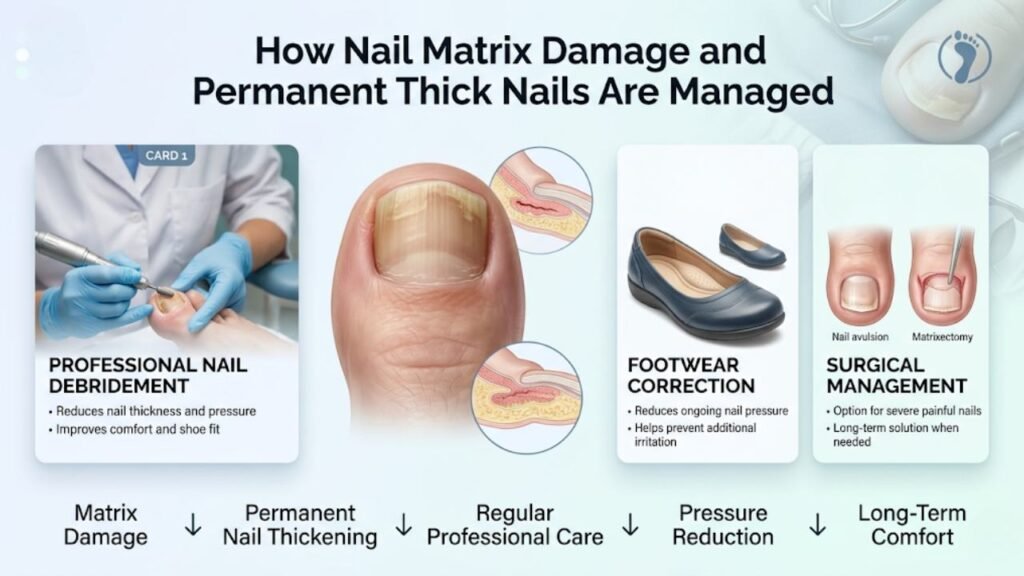
Professional Nail Debridement
Regular podiatric debridement is the cornerstone of managing nail matrix damage and permanent thick nails. A podiatrist uses specialized instruments — rotary burrs, nail files, and nippers — to safely reduce the nail thickness at each appointment.
What debridement achieves:
- Reduces nail profile so it fits comfortably in footwear
- Removes nail material that cannot be safely trimmed at home
- Prevents the nail edge from pressing into surrounding skin
- Reduces the risk of the thickened nail causing pressure pain
- Makes the nail visually more manageable
For most patients with nail matrix damage and permanent thick nails, regular professional debridement every 6 to 12 weeks is the most practical and effective long-term strategy.
Footwear Correction
Even when the matrix damage is permanent, appropriate footwear reduces the ongoing pressure that worsens thick nail discomfort and potentially causes further damage.
- Wide toe box shoes that do not press on the damaged nail
- Adequate depth in the toe box
- Avoiding narrow or rigid footwear styles
- Cushioned insoles that reduce impact transmitted to the nail
Surgical Options for Severe Cases
When nail matrix damage and permanent thick nails are causing significant pain, repeated complications, or are structurally so severe that debridement cannot adequately manage them, surgical options exist.
Nail avulsion removes the nail plate, allowing the nail bed to be assessed directly and giving some patients relief from pressure. The nail will grow back — still from a damaged matrix — but the regrowth period allows temporary relief.
Partial or total matrixectomy is considered when the nail is causing persistent pain or complications and ongoing management is clearly insufficient. A matrixectomy permanently stops nail production in the treated area. This is a definitive option for a nail that is causing ongoing harm with no realistic prospect of structural improvement.
The decision to pursue surgical options should be made with a podiatrist who understands your specific nail situation and overall foot health.
Home Care Between Professional Appointments

- Keep nails trimmed to the shortest comfortable length using strong clippers designed for thick nails
- Soak feet in warm water before trimming to soften the nail plate
- Use a nail file or emery board to gently reduce surface roughness
- Moisturize the nail and surrounding skin regularly
- Inspect the nail and surrounding skin monthly for any signs of secondary infection or nail edge pressing into skin
What Realistic Recovery Looks Like
Setting realistic expectations is one of the most important parts of managing nail matrix damage and permanent thick nails.
For patients whose matrix damage is recoverable:
- New nail growing from the base will progressively look thinner and more normal over the 9 to 18 month growth cycle
- By the end of full nail replacement, most of the nail should look significantly improved
- The patient should see progressive change month by month in the new nail growing from the base
For patients whose matrix damage is permanent:
- The nail growing from the base will consistently look thick from the beginning of each growth cycle
- Debridement provides comfort and management but does not produce a progressively normalizing nail
- The goal is a nail that is kept at a manageable thickness and does not cause complications — not a nail that returns to pre-injury appearance
Being honest with yourself about which category your nail falls into helps avoid endless frustration from expecting recovery that is not coming, and allows you to commit instead to the management approach that will actually help.
Frequently Asked Questions
Can nail matrix damage ever heal on its own?
Mild matrix damage from temporary pressure may recover over several nail growth cycles once the pressure is removed. Significant matrix damage from major injury or chronic long-term trauma that has caused scar tissue formation is unlikely to recover on its own.
How do I know if my thick nail is from matrix damage or fungus?
Laboratory testing — KOH test, fungal culture, or PAS staining — is the most reliable way to distinguish between the two. Negative fungal tests combined with a history of nail injury, no nail-to-nail spread, and no improvement with antifungal treatment strongly suggest nail matrix damage rather than infection.
Is there any treatment that can repair a damaged nail matrix?
No treatment can reverse scar tissue that has replaced matrix cells. Management focuses on controlling the structural consequences of the damage rather than repairing the matrix itself. Professional debridement, footwear correction, and in severe cases surgical options address the effects rather than the cause.
Will my nail ever look normal again?
If the damage was mild and the matrix has retained most of its normal function, the nail may progressively improve over 12 to 18 months as new nail grows in. If significant matrix scarring occurred, the nail may not return to fully normal appearance even with excellent management.
How often should I see a podiatrist for nail matrix damage?
Most patients with nail matrix damage and permanent thick nails benefit from professional debridement every 6 to 12 weeks. The exact frequency depends on how quickly your nail grows and accumulates thickness between appointments.
Can nail matrix damage cause infection?
Directly, no — matrix damage does not cause infection. However, the structural changes it produces — thickened nail, potential lifting, irregular nail edges — create conditions where secondary fungal or bacterial infection becomes more likely. This is why regular monitoring and nail hygiene matter even when the thick nail itself is non-infectious.
Summary
Nail matrix damage and permanent thick nails represent a clinical reality that is frequently missed when every thick nail is assumed to be fungal. The nail matrix — the growth center beneath the cuticle — determines the characteristics of every nail plate it produces. When that matrix is damaged significantly, the thick, irregular, or structurally abnormal nail it produces is a permanent structural consequence rather than a treatable infection.
Causes range from single acute injury to years of chronic pressure, severe fungal infection reaching the matrix, or unintended surgical damage. Management focuses on professional debridement for ongoing nail maintenance, footwear correction to reduce aggravating pressure, and in severe cases, surgical options to address a nail that cannot be managed conservatively.
Setting realistic expectations about recovery — distinguishing between a matrix that may recover and one that will not — is the foundation of practical, effective management. For many patients with nail matrix damage and permanent thick nails, the goal is not a normal nail but a comfortable, manageable nail that does not cause complications.
Struggling to get an appointment?
We help patients in your area bypass clinic waitlists by instantly finding verified podiatry doctors who accept their insurance.