Cost Comparison – Laser vs Medication
Find a Podiatrist Near You
Get same-day appointments with verified podiatrists. Insurance accepted.
Laser vs medication is the comparison most patients want to understand clearly before committing to nail fungus treatment — because the decision involves real money, real time, and real uncertainty about which approach will actually work.
The challenge is that most information available about laser vs medication for nail fungus either comes from clinics marketing laser services (predictably enthusiastic about laser) or from sources that dismiss laser as ineffective without examining the nuanced clinical picture. Patients deserve a straightforward, honest comparison that covers what each option actually costs, what the evidence shows about effectiveness, what insurance covers, and how to think about long-term value rather than just upfront expense.
That is what this guide provides.
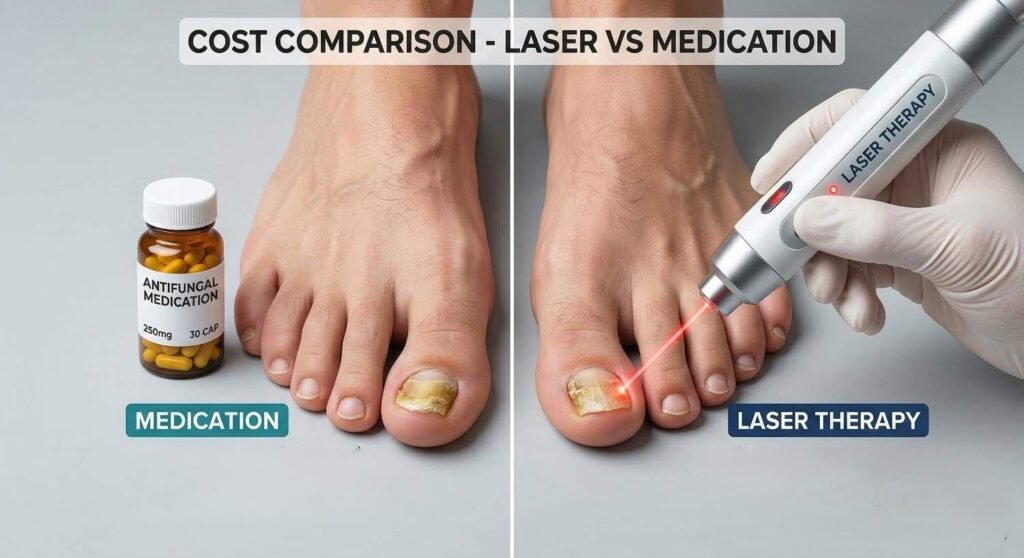
The Treatments Being Compared
Before diving into laser vs medication cost figures, understanding what falls into each category matters.
Medication in this context covers three distinct options:
- Oral antifungal medication — primarily terbinafine (most effective, most evidence) and itraconazole (broader spectrum, pulse dosing)
- Prescription topical antifungal medication — efinaconazole, ciclopirox, tavaborole (applied daily to the nail surface)
- Over-the-counter topical products — generally not recommended for established nail infection due to very limited efficacy
Laser in this context covers:
- Near-infrared laser therapy — primarily Nd:YAG 1064 nm devices, the most studied and most widely used laser for nail fungus
- Dual-wavelength diode laser systems
- Photodynamic therapy (PDT) — a related but distinct light-based approach
These are genuinely different treatment categories with different mechanisms, different evidence bases, and very different cost structures. Understanding the laser vs medication comparison requires looking at each against these specific options.
The Honest Effectiveness Summary First
Cost only makes sense in the context of what you get for it. In the laser vs medication comparison, the effectiveness picture looks like this:
Oral terbinafine (12 weeks):
Mycological cure rate (laboratory-confirmed elimination of fungal organisms): 70 to 80 percent. Complete cure (clear nail + negative lab): 35 to 50 percent. This is the highest efficacy available from any single treatment modality.
Prescription topical antifungals (48 weeks daily):
Complete cure rates: 5 to 18 percent depending on the specific agent. Meaningful nail improvement in a higher proportion of patients. Best suited for mild, early infection — not established moderate-to-severe onychomycosis.
Laser therapy (3 to 4 sessions over 3 to 4 months):
Clinical improvement in nail appearance: 60 to 75 percent of treated patients in studies. Mycological cure rates: more variable and generally lower than oral terbinafine in direct comparisons. The FDA clearance language for nail laser devices — “temporary increase in clear nail” — is accurate and important: it describes appearance improvement, not confirmed fungal eradication.
The bottom line for the laser vs medication effectiveness comparison:
Oral terbinafine produces the highest confirmed cure rates. Laser produces the most uncertain evidence base but the most appealing treatment experience. Topical medication occupies a middle ground — safer systemic profile than oral, lower efficacy than oral.
Cost Breakdown: Oral Antifungal Medication
The Drug Cost Itself
Generic terbinafine — the most commonly prescribed oral antifungal for nail fungus — is a relatively affordable generic medication.
Important note: Specific prices vary significantly by pharmacy, location, insurance plan, and whether the patient uses discount programs. The figures below are illustrative ranges rather than specific price guarantees.
Generic oral terbinafine for a 12-week course is significantly more affordable than brand alternatives. Itraconazole in generic form is also available, though at a higher price point than terbinafine.
Insurance Coverage for Oral Antifungals
This is where the laser vs medication cost comparison shifts significantly. Oral antifungal medications — terbinafine and itraconazole — are generally covered by most health insurance plans, including Medicare Part D, when prescribed for a documented fungal infection.
What insurance typically requires:
- A valid prescription from a licensed provider
- Sometimes: prior authorization confirming the diagnosis
- Documentation of the medical indication
The practical outcome: For most patients with health insurance, the out-of-pocket cost for a 12-week terbinafine course may be limited to their plan’s copay or coinsurance — potentially a small fraction of the drug’s full cost.
For uninsured patients: Generic terbinafine is available through discount programs (GoodRx and similar) at substantially reduced rates from retail pharmacy prices. Patients without insurance should explore these programs before comparing to the full retail figure.
Associated Costs With Oral Medication
The full cost picture for oral medication includes more than just the drug:
Medical visits: At minimum, an initial appointment for diagnosis and prescription. Many prescribers also do a mid-course check. If liver monitoring is included (standard for 12-week terbinafine courses), blood tests add to the cost — though many insurance plans cover routine blood work.
Laboratory testing: KOH microscopy and fungal culture before treatment is the standard of care. These tests add cost but are essential for ensuring the right diagnosis and organism identification.
Professional nail debridement: Not mandatory but significantly improves outcomes when combined with oral medication. Podiatric nail debridement is often covered by insurance when medically necessary (diabetic patients, confirmed infection). When covered, the cost to the patient is copay or coinsurance only.
Total estimated out-of-pocket cost for oral medication treatment (with insurance): Typically moderate — primarily copays for office visits, prescription drug copays, and any cost-sharing for blood work.
Total estimated out-of-pocket cost for oral medication treatment (without insurance): Significantly higher, but generic terbinafine discount pricing, community health center pricing, and telehealth prescription services can reduce this substantially.
Cost Breakdown: Prescription Topical Antifungal Medication

Prescription topical antifungals — efinaconazole (Jublia), ciclopirox (Penlac), tavaborole (Kerydin) — have a very different cost profile from oral medications.
The drug cost:
Prescription topical antifungals are expensive medications. Brand-name efinaconazole and tavaborole are among the higher-cost prescription medications in podiatry. Generic ciclopirox is substantially more affordable than the brand efinaconazole or tavaborole.
Insurance coverage for topical antifungals:
Coverage varies significantly by insurer and formulary. Some plans cover prescription topical antifungals with prior authorization; others exclude them or place them on high cost-sharing tiers. Patients should verify their plan’s formulary before assuming coverage.
Duration of treatment: 48 weeks of daily application. The extended duration means the cumulative cost is significant.
In the laser vs medication comparison: Prescription topical antifungals — particularly branded agents — can represent substantial out-of-pocket expense for patients whose insurance does not cover them or has high cost-sharing. Patient assistance programs and manufacturer coupons can significantly reduce this cost for eligible patients.
Cost Breakdown: Laser Therapy

Laser nail treatment pricing varies by geography, clinic type, and the specific protocol used. The ranges below represent general market pricing; actual figures require obtaining quotes from specific providers.
Per-session pricing:
Each laser treatment session involves applying the laser to all affected nails, typically taking 20 to 40 minutes. Session pricing varies by market and clinic.
Full treatment course:
Most protocols involve 3 to 4 initial sessions spaced 4 to 6 weeks apart. Some clinics offer package pricing for a full course that may be more economical than per-session pricing.
Insurance coverage for laser nail treatment:
This is the most important financial reality in the laser vs medication cost comparison: laser nail fungus treatment is almost universally not covered by health insurance.
The FDA clearance for nail laser devices describes “temporary increase in clear nail” — which insurance companies classify as cosmetic rather than medically necessary treatment. Almost all major insurers, including Medicare, specifically exclude laser nail fungus treatment from covered services.
This means laser treatment is an out-of-pocket expense for virtually all patients.
Additional costs with laser:
No significant additional monitoring costs (unlike oral antifungals which may require liver function testing). No drug interactions to assess. Professional nail debridement before or between laser sessions improves penetration — adding debridement cost if not already included.
The Total Cost Comparison: Laser vs Medication
| Treatment | Drug/Session Cost | Typical Insurance Coverage | Estimated Total Patient Cost | Approximate Cure Rate |
|---|---|---|---|---|
| Oral terbinafine (12 weeks) | Drug cost + medical visits | Usually covered | Low to moderate (with insurance) | 70 to 80% mycological cure |
| Generic oral terbinafine (uninsured) | Drug cost (discounted) + medical visits | Not applicable | Moderate — reduced with discount programs | 70 to 80% mycological cure |
| Topical efinaconazole (48 weeks) | High brand cost | Varies — often limited | Potentially high without coverage | 15 to 18% complete cure |
| Generic ciclopirox (48 weeks) | Moderate cost | Variable | Lower than brand topicals | 5 to 8% complete cure |
| Laser therapy (3 to 4 sessions) | Session fees | Not covered | High — entirely out-of-pocket | 40 to 75% clinical improvement (variable mycological data) |
| Oral + topical + debridement | Combined costs | Oral/debridement often covered | Moderate overall | 75 to 85% (highest for combination) |
When Laser vs Medication Is the Right Comparison for You
The laser vs medication choice is not always a pure cost comparison — for some patients, clinical circumstances make one option more appropriate regardless of cost.
Situations where laser makes clinical sense despite higher cost:
- You cannot take oral antifungal medication due to liver disease, drug interactions (particularly with statins and itraconazole), or other contraindications
- You are in a life stage where avoiding systemic pharmacological burden matters (though note that pregnancy concerns also apply to some topical agents — discuss with your provider)
- You have tried oral medication and experienced significant side effects
- You want to try a non-pharmaceutical approach for mild infection before considering oral medication
Situations where oral medication is clearly the better choice:
- Established moderate to severe onychomycosis — this is where oral terbinafine’s superior cure rates are most clinically significant
- You have insurance that covers oral antifungals — the cost difference becomes very large in favor of medication
- Matrix involvement (infection near the cuticle) — topical and laser penetration to this level is particularly limited
- Multiple nails infected — systemic treatment addresses all infected nails simultaneously
Situations where combination therapy is the best value:
For patients who can take oral medication, the combination of oral terbinafine + topical antifungal + professional nail debridement produces the highest published cure rates (75 to 85 percent mycological cure). When the oral medication and debridement components are covered by insurance, the additional cost of adding topical antifungal to the protocol adds incremental cost but produces substantially better outcomes.
In the laser vs medication comparison, this combination approach often represents the best cost-effectiveness overall — when insurance coverage applies.
What the Evidence Actually Shows About Long-Term Value
Looking purely at the laser vs medication comparison through a long-term value lens:
Recurrence rates matter as much as initial cure rates.
A treatment that achieves 75 percent cure with 15 percent recurrence at 1 year produces better long-term outcomes than a treatment achieving 60 percent improvement with 40 percent recurrence — even if the first treatment costs more initially.
Oral terbinafine has the most favorable long-term value in this comparison:
Highest initial cure rates + excellent nail tissue persistence (drug remains active in nail for 6 to 9 months post-treatment) + substantial recurrence reduction with maintenance topical prophylaxis = the treatment with the best overall value per successful, durable clearance.
Laser therapy’s value is best as an adjunct:
Laser added to topical antifungal therapy for patients who cannot take oral medications — or added to oral medication in very resistant cases — provides more value than laser as a standalone primary treatment in the laser vs medication cost-effectiveness calculation.
Frequently Asked Questions About Laser vs Medication
Is laser treatment for nail fungus worth the money?
For patients who cannot take oral antifungal medication, laser provides a viable alternative treatment experience without systemic drug exposure, and the cost may be justified by the individual clinical circumstances. For patients who can take oral medication safely, the laser vs medication cost-effectiveness comparison generally favors oral terbinafine — which produces higher cure rates at lower total cost when insurance coverage applies.
Why doesn’t insurance cover laser nail treatment?
Insurance companies classify laser nail treatment as cosmetic based on the FDA clearance language — which describes “temporary increase in clear nail” rather than confirmed medical cure of infection. Until clinical evidence demonstrates mycological cure rates competitive with approved antifungal medications, this classification is unlikely to change significantly.
Can I use laser and medication together?
Yes — and combination approaches are increasingly used. Laser sessions alongside topical antifungal application, or laser alongside oral antifungal treatment, address the infection from multiple directions. When the medication components are covered by insurance, combining laser with covered treatments may provide the laser’s additive benefit at a lower incremental total cost than laser alone.
How long until I see results from each approach?
Oral medication: New clear nail visible at the nail base within 2 to 4 months; full nail replacement taking 12 to 18 months. Topical medication: Visible improvement typically takes 4 to 8 months minimum; full clearance requires the full 48-week treatment duration plus nail growth-out time. Laser: Clinical improvement in nail appearance visible within 3 to 6 months of completing sessions; nail must physically grow out over 12 to 18 months regardless of treatment.
Summary
The laser vs medication comparison reveals that oral terbinafine — when safely tolerable and covered by insurance — consistently provides the highest cure rates at the most cost-effective total investment for most patients with established toenail onychomycosis. Laser therapy provides a meaningful alternative for patients who cannot take oral antifungals, but the entirely out-of-pocket cost combined with more variable cure rate evidence places it at a disadvantage in the laser vs medication value comparison for the general patient population.
The practical recommendation: obtain an accurate diagnosis with laboratory testing, confirm your insurance coverage for oral antifungals and professional nail debridement, discuss your suitability for oral terbinafine with your podiatrist, and use laser as a primary option only when oral medication is genuinely contraindicated or add it as an adjunct to your primary treatment plan.
Struggling to get an appointment?
We help patients in your area bypass clinic waitlists by instantly finding verified podiatry doctors who accept their insurance.