Toenail Fungus Treatment – Complete Guide
Find a Podiatrist Near You
Get same-day appointments with verified podiatrists. Insurance accepted.
Toenail fungus treatment is something millions of adults search for every day — yet most people still end up confused, frustrated, or stuck using products that simply do not work for their level of infection.
If your nail has changed color, thickened, started crumbling, or separated from the skin beneath it, you are dealing with a real medical condition called onychomycosis. It does not clear up on its own in most cases, and it responds very differently depending on which treatment path you choose.
This guide covers every proven toenail fungus treatment option available — what each one does, who it works best for, how long it takes, and what realistic results look like. No exaggerated promises. No confusing medical jargon. Just clear, accurate, practical information.
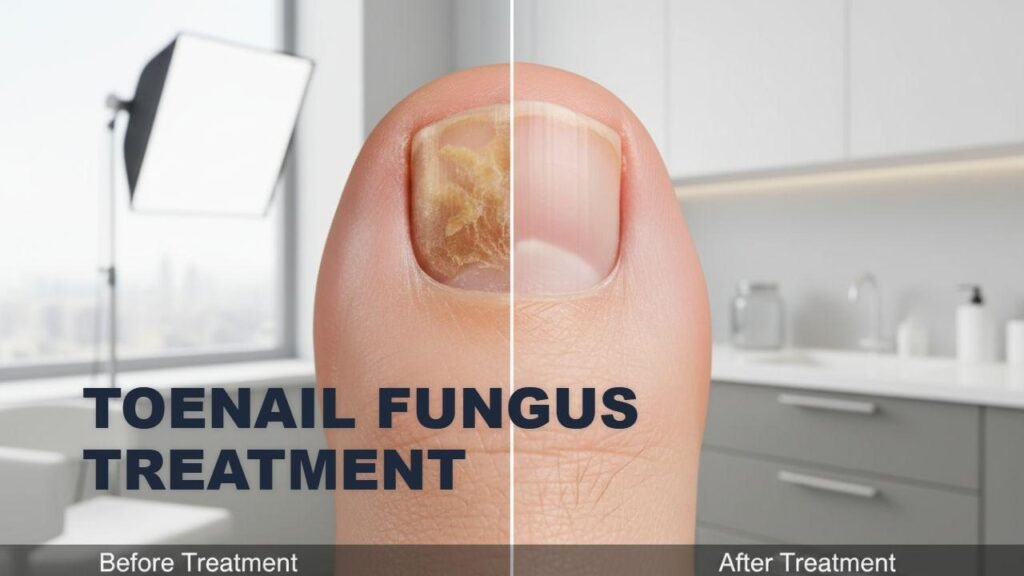
What Is Toenail Fungus and Why Does It Need Treatment?
Toenail fungus — clinically called onychomycosis — is a fungal infection that invades the nail plate and the tissue beneath it. The most common culprits are dermatophytes, specifically Trichophyton rubrum and Trichophyton mentagrophytes. In some patients, yeasts or environmental molds are responsible instead.
Fungal organisms thrive in warm, moist environments. Inside a closed shoe, conditions are almost ideal. Tiny cracks in the nail or surrounding skin allow spores to enter and quietly establish an infection beneath the surface.
Once established, the infection spreads inward and deeper. This is why toenail fungus treatment becomes harder — and takes longer — the longer it goes unaddressed.
Without proper toenail fungus treatment, you risk:
- Permanent nail damage from matrix involvement
- Spread to adjacent nails and surrounding skin
- Secondary bacterial infections, especially dangerous in diabetics
- Chronic pain as the thickened nail presses into tissue
- Transmission to family members through shared floors and tools
Early recognition and appropriate treatment make a significant difference in how well and how quickly the nail recovers.
Recognizing the Signs: When Toenail Fungus Treatment Becomes Necessary
Not every nail problem is fungal. Psoriasis, trauma, and lichen planus can all produce similar-looking changes. Accurate diagnosis before starting any toenail fungus treatment is essential.
Common signs of a fungal nail infection:
- Yellow, white, brown, or greenish discoloration
- Thickened nail plate that is hard to trim
- Brittle, crumbling, or ragged nail edges
- Nail pulling away from the skin beneath (onycholysis)
- Debris accumulating under the nail
- Mild unpleasant odor
- Distorted or irregular nail shape
Pain typically appears in moderate to advanced cases, particularly when wearing enclosed footwear. If you notice these changes in one or more nails, professional evaluation is the right next step.
Types of Toenail Fungus That Affect Treatment Choice
Different patterns of onychomycosis respond differently to toenail fungus treatment. Knowing the type helps your podiatrist choose the most effective approach.
Distal Subungual Onychomycosis
The most common form. Infection enters at the nail tip and progresses toward the base. It causes yellowing, subungual buildup, and eventual nail thickening.
White Superficial Onychomycosis
White, powdery patches appear on the nail surface. This form is more accessible to topical toenail fungus treatment because the infection sits on the nail rather than beneath it.
Proximal Subungual Onychomycosis
Infection starts near the cuticle and works outward. This pattern is less common and sometimes associated with immune system compromise. It often requires oral toenail fungus treatment.
Total Dystrophic Onychomycosis
The entire nail is affected — thickened, distorted, and severely damaged. This advanced form requires the most aggressive toenail fungus treatment approach.
How Doctors Diagnose Toenail Fungus Before Treatment
Professional diagnosis before toenail fungus treatment matters. Several other conditions look identical to fungal infection but require completely different management.
KOH Preparation — Nail clippings are dissolved in potassium hydroxide solution and examined under a microscope. Fungal elements become visible and confirm infection. Quick but carries a small false-negative rate.
Fungal Culture — Nail debris is cultured in a laboratory to identify the specific organism. Results take 3 to 6 weeks but identify whether dermatophytes, yeasts, or molds are responsible — directly influencing toenail fungus treatment selection.
PAS Staining — Nail biopsy specimens are stained with periodic acid-Schiff reagent. Sensitivity exceeds 90 percent, making this one of the most reliable confirmation methods.
PCR Testing — Polymerase chain reaction testing rapidly identifies fungal DNA with high specificity. Increasingly available in clinical practice.
Skipping diagnosis and jumping straight to toenail fungus treatment based on appearance alone leads to delayed recovery when the wrong approach is selected.
7 Proven Toenail Fungus Treatment Options
1. Topical Antifungal Medications
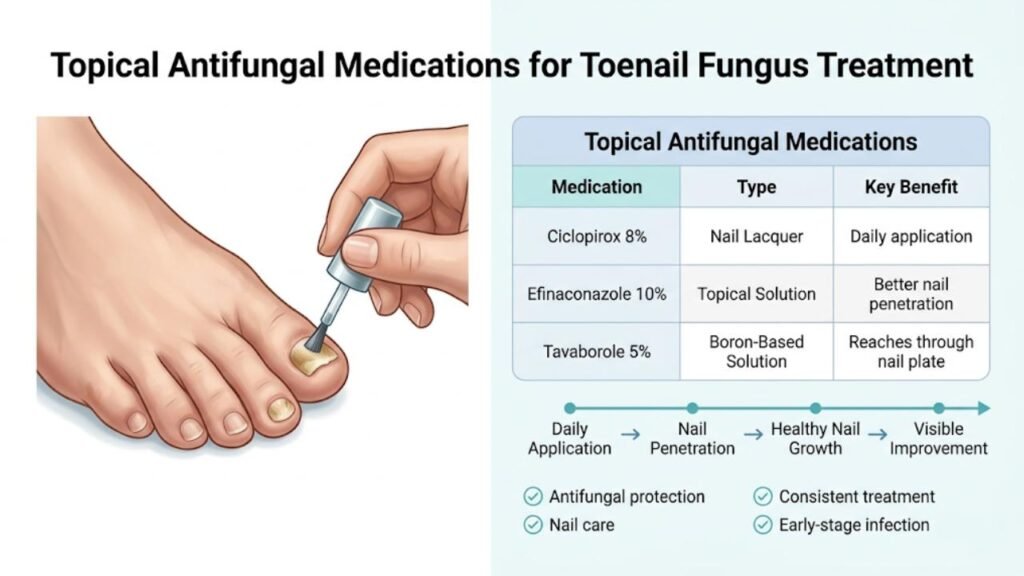
Topical toenail fungus treatment works by applying antifungal compounds directly to the nail surface. These medications are most effective for mild infections or white superficial onychomycosis where the nail plate is not severely involved.
Prescription topical options include:
- Ciclopirox 8% nail lacquer — Applied daily for up to 48 weeks. Complete cure rates as a sole therapy are modest but improve substantially when combined with nail debridement.
- Efinaconazole 10% solution — Improved formulation with better nail penetration. More effective than ciclopirox in head-to-head comparisons.
- Tavaborole 5% solution — A boron-based antifungal with a low molecular weight that allows better penetration through the nail plate.
Results emerge slowly. The medication must reach the nail bed, which requires consistent daily application over many months. Thinning the nail through regular filing or professional debridement improves penetration meaningfully.
Topical toenail fungus treatment is the appropriate starting point for mild, early-stage infections and for patients who cannot take oral antifungals.
2. Oral Antifungal Medications
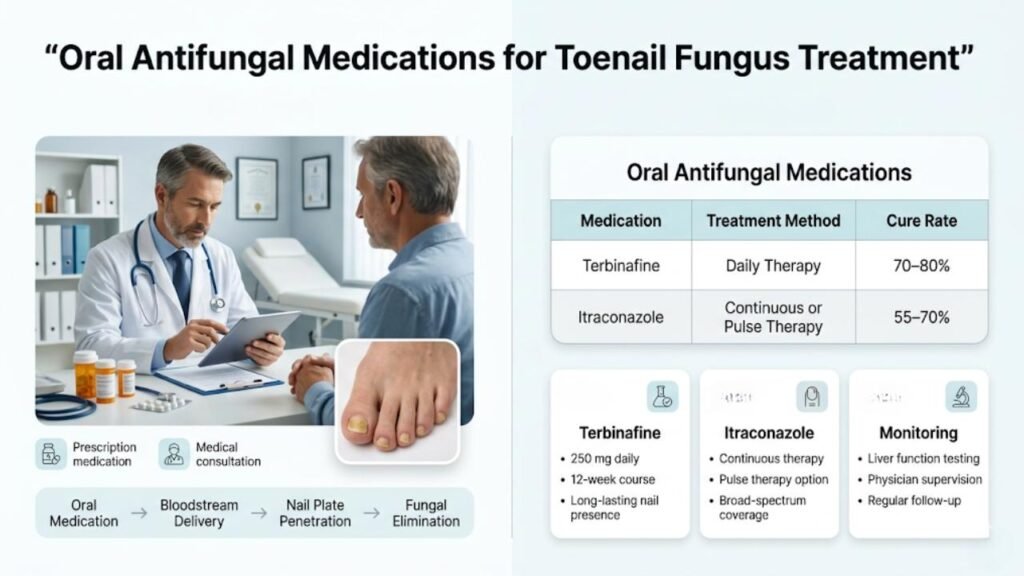
Oral toenail fungus treatment delivers antifungal medication through the bloodstream into the nail plate from the inside. This approach produces significantly higher cure rates than topical therapy alone for moderate to severe infections.
First-line oral options:
Terbinafine
- Mechanism: Blocks squalene epoxidase, disrupting the fungal cell membrane
- Standard course: 250 mg daily for 12 weeks
- Mycological cure rate: 70 to 80 percent
- Persists in the nail plate for months after the final dose
Itraconazole
- Mechanism: Inhibits ergosterol synthesis via lanosterol demethylase
- Can be given continuously or as pulse therapy (one week per month)
- Broader spectrum — effective against dermatophytes, yeasts, and some molds
- Mycological cure rate: 55 to 70 percent
Both medications require liver function monitoring before and during therapy. Most healthy adults tolerate them well. Side effects are uncommon but should be discussed with your prescribing physician before starting.
Oral toenail fungus treatment is the recommended pathway for multi-nail involvement, matrix-affected infections, or cases that have not responded to topical therapy.
3. Laser Toenail Fungus Treatment
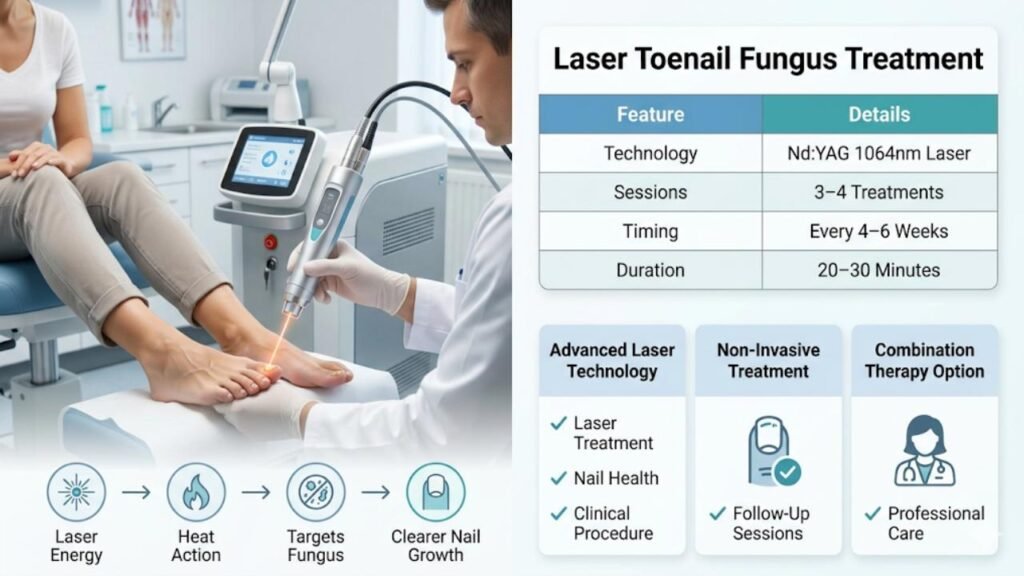
Laser toenail fungus treatment uses concentrated light energy to generate heat within the nail plate. This heat targets and disrupts fungal cell structures without damaging surrounding healthy tissue.
Most used system: Nd:YAG 1064nm laser, the most studied wavelength for onychomycosis.
Typical protocol:
- 3 to 4 sessions
- Sessions spaced 4 to 6 weeks apart
- Each session takes approximately 20 to 30 minutes per foot
What the evidence shows:
Clinical improvement in nail appearance is reported by a significant portion of patients. However, long-term mycological cure data — meaning confirmed laboratory eradication of the fungus — is more variable. The FDA has cleared several laser devices for “temporary increase of clear nail” rather than for cure of onychomycosis.
Laser toenail fungus treatment is most valuable as part of a combination approach — particularly for patients who cannot take oral antifungals, or as an adjunct to ongoing topical therapy.
4. Nail Debridement
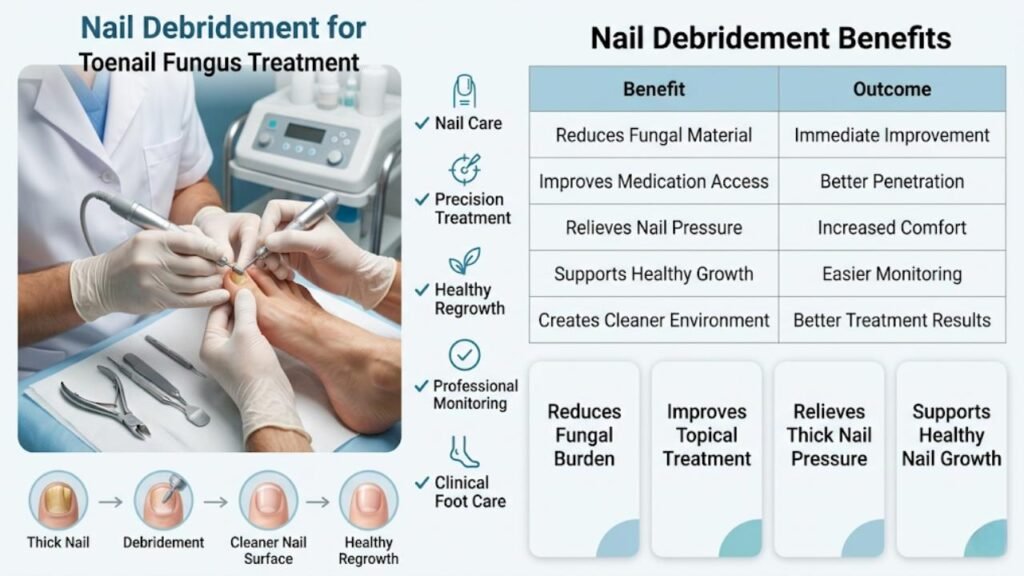
Debridement is the professional reduction and removal of infected nail material. A podiatrist uses specialized instruments — rotary burrs, nail nippers, or curettes — to thin the nail, clear subungual debris, and remove heavily infected tissue.
Why debridement supports toenail fungus treatment:
- Reduces the physical fungal burden immediately
- Significantly improves topical medication penetration
- Relieves pressure and discomfort from thickened nails
- Allows better visual monitoring of new healthy nail growth
- Creates a cleaner environment for regrowth
Debridement alone does not cure fungal nail infection, but it consistently improves outcomes when paired with antifungal medication. Most patients undergoing active toenail fungus treatment benefit from debridement every 6 to 12 weeks.
5. Partial Nail Avulsion
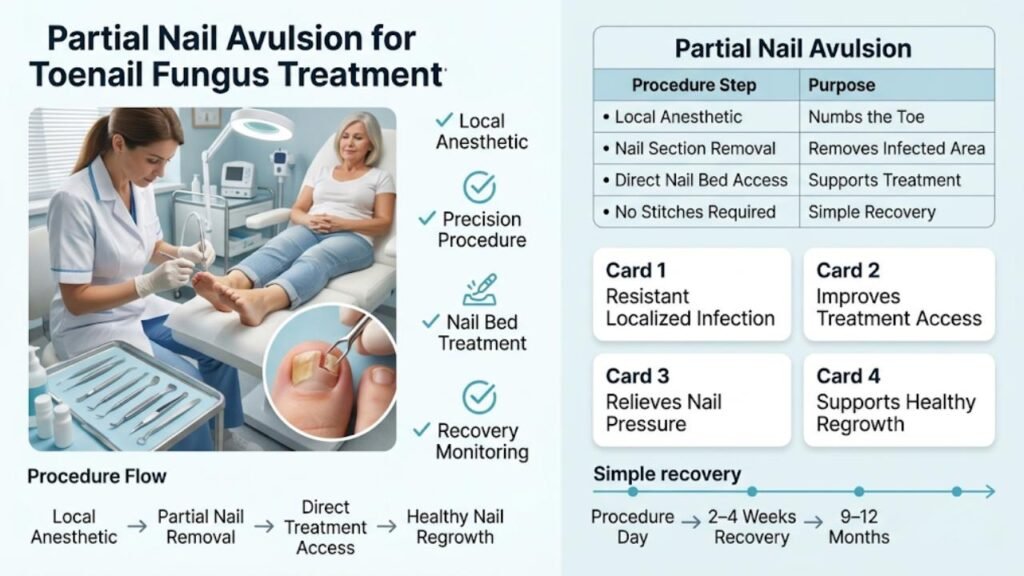
When a section of the nail harbors deep or resistant infection, partial nail avulsion removes that portion while preserving the healthy nail and matrix.
The procedure:
- Local anesthetic (digital block) numbs the toe
- The affected nail segment is cleanly removed
- The exposed nail bed receives direct antifungal treatment
- No stitches are required
Best candidates for this toenail fungus treatment:
- Localized but resistant infection in one nail section
- Severe subungual debris blocking topical medication
- Pain from ingrown or thickened nail margins
- Infection not responding to medication alone
Recovery takes 2 to 4 weeks. Nail regrowth over the treated area takes 9 to 12 months.
6. Total Nail Removal
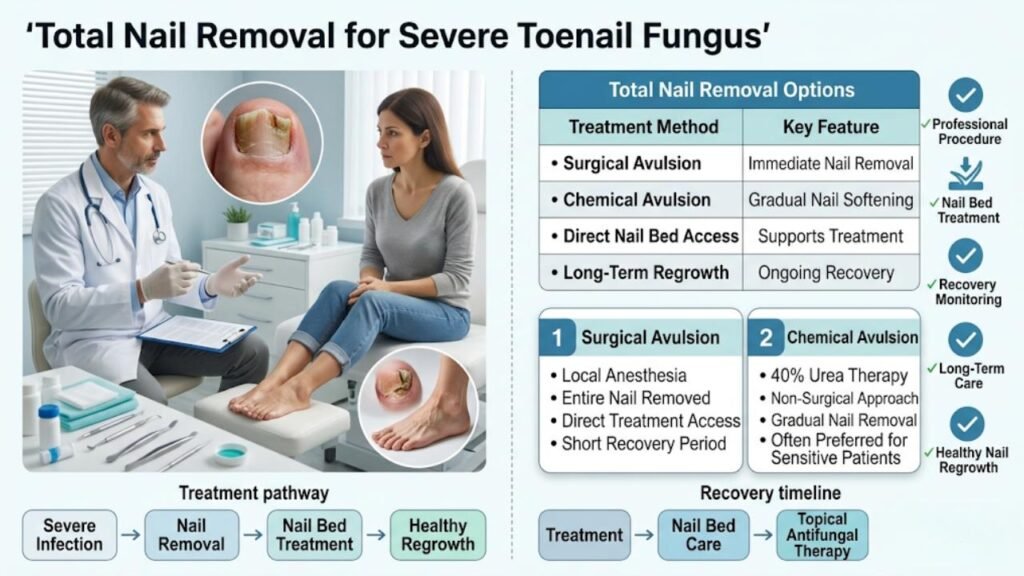
Total nail removal is reserved for the most severe cases — where the nail is completely dystrophic, where multiple treatments have failed, or where the infection poses a health risk the patient cannot afford.
Two approaches:
Surgical avulsion — The entire nail plate is removed under local anesthesia. The nail bed is treated directly with antifungal agents. This is definitive but requires a short recovery period.
Chemical avulsion — A 40 percent urea paste softens and dissolves the nail plate over 7 to 14 days, allowing painless removal without surgery. Often preferred for elderly or diabetic patients.
After removal, toenail fungus treatment continues with topical antifungals applied to the nail bed during the 12 to 18 month regrowth period.
7. Combination Toenail Fungus Treatment
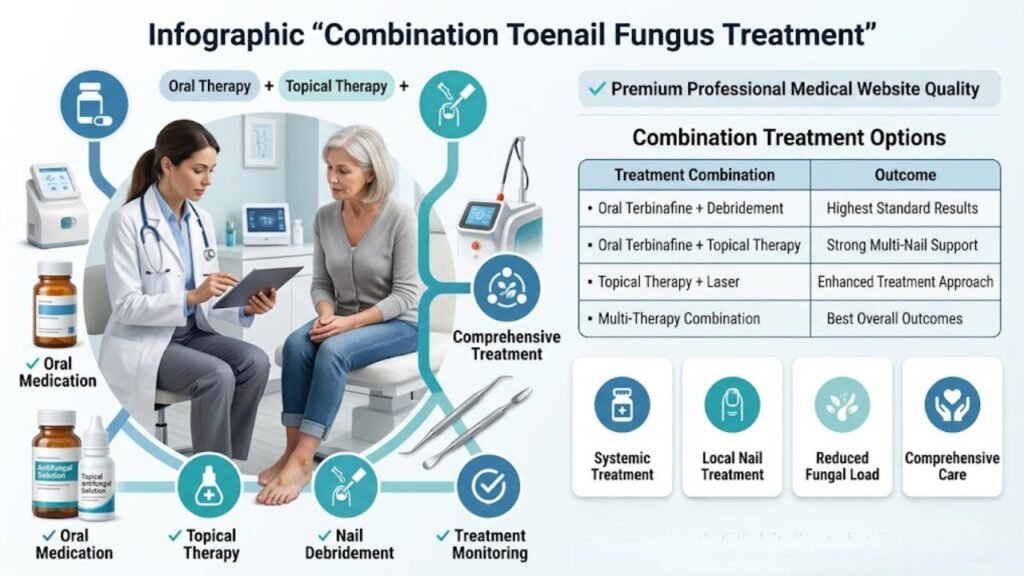
The highest published cure rates for onychomycosis consistently come from combination approaches — using two or more treatment methods together.
Why combination toenail fungus treatment works:
- Oral medication attacks the infection systemically through the bloodstream
- Topical medication attacks locally through the nail surface
- Debridement reduces fungal load physically
- Laser therapy may enhance drug penetration and reduce fungal viability
- Multiple mechanisms reduce the chance of fungal resistance or escape
| Combination Used | Approximate Outcome |
|---|---|
| Oral terbinafine + debridement | Highest standard cure rates |
| Oral terbinafine + topical efinaconazole | Strong outcomes in multi-nail cases |
| Topical antifungal + laser | Improved over topical alone |
| Oral antifungal + topical + debridement | Best overall results reported |
For moderate to severe toenail fungus, combination treatment is increasingly considered the standard of care rather than a last resort.
Toenail Fungus Treatment for Special Groups
Diabetics
Diabetes slows circulation and reduces the immune response in the feet. Toenail fungus treatment in diabetic patients requires careful drug interaction screening, closer monitoring, and sometimes a more conservative approach focused on debridement and topical therapy rather than aggressive oral medication.
Seniors
Age-related changes in kidney and liver function affect how antifungal medications are metabolized. Toenail fungus treatment for older adults often relies more heavily on topical therapy, debridement, and laser treatment, with oral medication considered case by case.
Pregnant Women
Oral antifungals carry fetal safety concerns and are generally avoided during pregnancy. Toenail fungus treatment during pregnancy focuses on gentle debridement and, in some cases, carefully selected topical therapy. Definitive treatment is typically deferred until after delivery.
Children
Pediatric onychomycosis requires weight-adjusted medication dosing and careful monitoring. Toenail fungus treatment for children is approached conservatively, with preference for topical options where infection severity permits.
Why Toenail Fungus Treatment Sometimes Does Not Work
Understanding why treatments fail is as important as understanding how they work.
- Wrong diagnosis — The condition is psoriasis, trauma, or another non-fungal disorder
- Wrong organism identified — Mold or yeast infections require different antifungal agents than dermatophytes
- Stopping early — Nails look better before the infection is fully cleared; stopping medication invites relapse
- Reinfection — The environment (shoes, shower floor, gym) reintroduces spores before the nail fully recovers
- Poor nail penetration — Using topical-only therapy on deep, thick nail infections
- Non-adherence — Inconsistent daily application of topical medication reduces efficacy dramatically
- Immune compromise — The body cannot support full clearance without immune system support
How Long Does Toenail Fungus Treatment Take?
Timeline management is one of the biggest challenges in toenail fungus treatment. Results take months — not weeks — and this is entirely normal.
| Treatment Method | Active Treatment | Visible Improvement | Full Nail Regrowth |
|---|---|---|---|
| Oral terbinafine | 12 weeks | 3–6 months | 12–18 months |
| Oral itraconazole (pulse) | 3–4 months | 3–6 months | 12–18 months |
| Topical ciclopirox | 48 weeks | 6–12 months | 12–18 months |
| Topical efinaconazole | 48 weeks | 4–8 months | 12–18 months |
| Laser therapy | 3–4 sessions | 3–6 months | 12–18 months |
| Nail removal + regrowth | Immediate removal | Immediate debris removal | 12–18 months |
The critical point: Toenails grow approximately 1.5 mm per month. Even after successful fungal eradication, new healthy nail must physically replace the damaged nail. Progress is visible at the base where new nail emerges — not in the existing damaged nail itself.
Evaluating toenail fungus treatment success too early — by looking at the middle or tip of the nail — leads to premature discouragement and, often, premature treatment abandonment.
Preventing Recurrence After Toenail Fungus Treatment
Recurrence is one of the biggest challenges in managing onychomycosis. Published studies report recurrence rates of 10 to 50 percent over several years. Prevention must be an active part of any toenail fungus treatment plan.
Essential prevention steps after completing toenail fungus treatment:
- Treat any athlete’s foot immediately — tinea pedis is the primary reinfection source
- Apply topical antifungal to previously infected nails once or twice weekly as maintenance
- Rotate shoes and allow 24 to 48 hours of drying time between wears
- Use antifungal powder or spray inside shoes regularly
- Wear moisture-wicking socks and change them daily
- Wear protective footwear in gyms, pools, hotel showers, and public wet areas
- Sterilize nail clippers with rubbing alcohol or bleach solution after each use
- Trim nails straight across and keep them short
- Inspect nails monthly — early reinfection caught quickly is far easier to treat
Common Mistakes People Make With Toenail Fungus Treatment
Stopping medication early because visible improvement is noticeable. The infection is still present at the nail bed even when surface appearance improves.
Skipping laboratory testing and assuming nail changes are fungal. Treating psoriasis with antifungals does nothing and delays the correct diagnosis.
Using only over-the-counter products on moderate or severe infections that require prescription-strength or oral toenail fungus treatment.
Neglecting shoe hygiene during and after treatment. Fungal spores survive for months inside footwear and can reintroduce infection constantly.
Expecting fast results and abandoning treatment within the first few weeks before any measurable effect is possible.
Applying nail polish over topical medication — polish blocks penetration and creates a moisture-trapping barrier that promotes fungal growth.
When to See a Specialist for Toenail Fungus Treatment
Many patients wait too long before seeking professional toenail fungus treatment. Schedule an evaluation if:
- Nail changes have persisted for more than 2 to 3 months
- Multiple nails are affected
- The nail is thickening, lifting, or crumbling significantly
- You have diabetes, peripheral vascular disease, or immune system problems
- Over-the-counter products have produced no improvement after 2 to 3 months
- You experience pain in or around the affected nail
- The infection appears to be spreading to surrounding skin or other nails
A podiatrist or dermatologist will confirm the diagnosis, identify the organism, and build a toenail fungus treatment plan matched to your specific situation.
Frequently Asked Questions About Toenail Fungus Treatment
What is the most effective toenail fungus treatment?
Oral terbinafine combined with nail debridement produces the highest documented cure rates for dermatophyte onychomycosis. For patients who cannot take oral medication, combination topical therapy with debridement offers the next best results.
How long before toenail fungus treatment shows visible results?
Most patients see new healthy nail emerging from the base within 3 to 6 months of starting treatment. Complete nail replacement takes 12 to 18 months regardless of which treatment method is used.
Can toenail fungus treatment work without a prescription?
Mild, very early infections may respond to over-the-counter antifungal products. Moderate or severe nail fungus almost always requires prescription toenail fungus treatment for meaningful clearance.
Does laser toenail fungus treatment actually cure the fungus?
Laser therapy clears nail appearance in many patients, but consistent long-term mycological cure data is limited. It works best as part of a combination approach rather than as standalone toenail fungus treatment.
Can toenail fungus come back after successful treatment?
Recurrence is common. Prevention measures — antifungal maintenance, shoe hygiene, and regular monitoring — are a necessary part of any long-term toenail fungus treatment strategy.
Is toenail fungus treatment safe for people with diabetes?
Toenail fungus treatment is not only safe but strongly recommended for diabetic patients, who face higher complication risks from untreated infection. Treatment plans are adjusted to account for medication interactions and circulation concerns.
Last Words: Choosing the Right Toenail Fungus Treatment
Toenail fungus treatment is not one-size-fits-all. The right approach depends on:
- The type of fungal infection present
- The severity and how many nails are affected
- Your overall health and any existing medical conditions
- Your ability to tolerate oral medications
- Your commitment to completing a full treatment course
Mild infections respond well to topical antifungal therapy with consistent application. Moderate to severe infections almost always need oral toenail fungus treatment, often combined with debridement or laser therapy. Total nail removal is reserved for cases where other methods have consistently failed.
Whatever path you take, the most important factors are accurate diagnosis, completing the full treatment course, and following through with preventive measures afterward.
Toenail fungus is stubborn — but it is treatable. Starting the right toenail fungus treatment at the right time gives your nails the best possible chance of full recovery.
Struggling to get an appointment?
We help patients in your area bypass clinic waitlists by instantly finding verified podiatry doctors who accept their insurance.