How Thick Nails Affect Walking Mechanics
Find a Podiatrist Near You
Get same-day appointments with verified podiatrists. Insurance accepted.
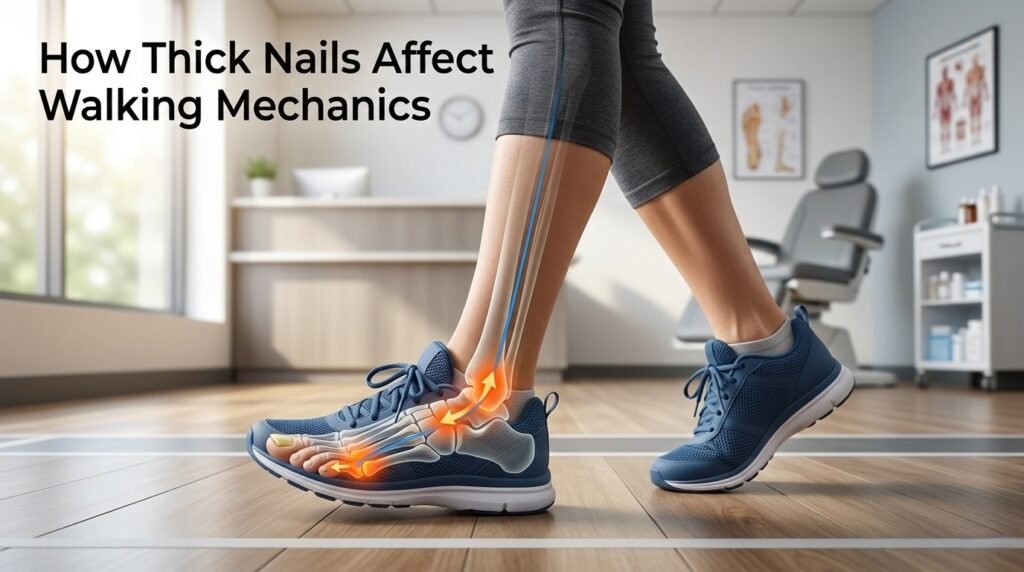
Thick nails affect walking mechanics in ways that most patients never connect to their nails — and that is exactly why the problem so often goes unaddressed until it causes significant discomfort or injury elsewhere in the body.
A thick toenail pressing against the inside of a shoe seems like a localized inconvenience. But the foot does not function in isolation. Every time a thick, painful nail forces you to shift your weight or shorten your stride, that compensation travels up the kinetic chain — into the ankle, the knee, the hip, and the lower back. Over weeks and months of altered movement, what began as nail pressure inside a shoe can contribute to pain far removed from the nail itself.
This guide explains how thick nails affect walking mechanics specifically, what changes in gait look like, which structures beyond the foot are most at risk from sustained gait alteration, and what treatment actually helps restore normal movement.
Why Toenails Matter for Walking
Before examining how thick nails affect walking mechanics, it is worth understanding what role healthy toenails play in normal foot function.
Toenails do more than protect the toe tip. During the final phase of each step — the push-off phase — the toes extend and push against the ground to propel the body forward. The great toe bears the majority of this propulsive force. A healthy toenail provides a rigid dorsal surface that helps transmit force effectively during this phase.
More broadly, the toes maintain balance and adapt to surface variations during walking. They act as a sensory platform, providing feedback about ground contact and position that helps the body make constant small balance adjustments.
When the nail becomes significantly thickened, two things happen that begin to affect how thick nails affect walking mechanics:
- Physical pressure — The thickened nail now occupies more space within the shoe, pressing against the shoe ceiling or sides during every step. This creates pain or discomfort that the body tries to avoid.
- Altered sensory input — The changed nail structure affects how the toe tip contacts the ground and what feedback the foot receives during stance and push-off phases.
Both of these effects drive the gait compensations that explain how thick nails affect walking mechanics at a practical level.
5 Real Effects of Thick Nails on Walking Mechanics
Effect 1: Shortened Push-Off — Reduced Propulsion
The most direct mechanical effect of a painful thick nail is on the push-off phase of the gait cycle.
Normal push-off requires the great toe (and to a lesser extent the lesser toes) to fully extend as the heel rises and the body weight transfers forward over the toe tips. This toe extension generates the propulsive force that drives each step forward.
When a thick nail makes this extension painful — because extending the toe compresses it against the shoe ceiling — the body instinctively limits toe extension. The push-off becomes shortened. The propulsive force per step is reduced.
The result is a walking pattern with reduced forward momentum at each step, requiring more energy to cover the same distance. Patients often describe this as feeling like they cannot quite get their stride back. Over time, the gait cycle adapts to the limited push-off, making the compensation more automatic and harder to consciously correct even after the nail issue is addressed.
This is how thick nails affect walking mechanics at the most fundamental biomechanical level.
Effect 2: Weight Shifting — Altering Load Distribution
When one nail is significantly thickened and painful, the body naturally shifts weight away from the affected toe and foot to minimize pain during walking.
The most common patterns:
- Shifting onto the outer edge of the foot (lateral weight shift) to keep pressure off the great toe or inner toes
- Supinating the foot — rolling it outward — during the stance phase
- Taking shorter steps on the affected side to spend less time bearing weight on the painful toe
- Walking with the foot slightly externally rotated to reduce toe-to-shoe pressure
Each of these patterns alters the normal distribution of forces across the entire foot and up the leg. The foot is designed to load from heel to midfoot to the ball of the foot to the toe tips in a specific sequence. Any disruption of this sequence creates abnormal loading elsewhere.
Where the redirected force goes:
- Increased lateral loading can contribute to fibularis (peroneal) tendon strain
- Supination increases ankle inversion stress and risk of lateral ankle injury
- External foot rotation changes knee and hip joint mechanics
- Asymmetric walking patterns stress the lower back and sacroiliac joint
This is how thick nails affect walking mechanics well beyond the foot itself — the compensation is systemic, not local.
Effect 3: Reduced Walking Speed and Efficiency
As a direct consequence of shortened push-off and weight shifting, patients with painful thick nails typically walk more slowly than they would with healthy nails.
Walking speed reduction is not trivial from a health perspective. Gait speed is one of the most well-established predictors of overall health outcomes in older adults — it is associated with fall risk, cognitive health, and overall longevity. Any factor that meaningfully reduces comfortable walking speed matters clinically.
Beyond speed, the compensated gait is metabolically less efficient. More muscular effort is required to maintain forward progress when push-off is limited and weight shifting is necessary. Patients often report feeling more tired during walks that previously felt easy — a consequence of the extra energy expenditure required by their altered gait.
This effect of how thick nails affect walking mechanics is often invisible to casual observation but is noticeable to the patient.
Effect 4: Balance Compromise
The toes contribute meaningfully to balance — both static (standing still) and dynamic (maintaining balance during movement). The toe tips provide ground contact that generates sensory feedback about body position and stability. The great toe in particular acts as a stabilizing anchor during single-leg stance phases of walking.
When thick nails make full toe contact uncomfortable or alter how the toes interact with the ground surface, this balance contribution is reduced.
Practical consequences:
- Less confidence on uneven surfaces like grass, gravel, or sloped walkways
- More difficulty with stairs — both ascending and descending
- Reduced ability to recover from unexpected balance perturbations (stumbles)
- Increased risk of falls, particularly in older adults
The balance impact of how thick nails affect walking mechanics is most clinically significant in elderly patients, where any reduction in balance competence directly translates to elevated fall risk. Falls in elderly populations carry serious consequences — hip fractures, head injuries, loss of confidence in independent mobility — that are substantially more impactful than the original nail condition.
Effect 5: Secondary Joint and Muscle Strain
The sustained gait compensations described above — shortened push-off, weight shifting, altered foot rotation, reduced walking speed — all create abnormal mechanical loading on joints and muscles that are not designed for these altered loading patterns.
Structures most commonly affected:
Ankle joint and surrounding tendons
Lateral weight shift increases stress on the lateral ankle complex. The peroneal tendons and lateral ankle ligaments are subjected to increased load when the foot habitually rolls outward to avoid nail pain. Over time, this can produce peroneal tendinopathy, lateral ankle pain, or increased susceptibility to ankle sprains.
Knee joint
Changes in foot rotation and loading patterns alter the moment forces acting on the knee. External foot rotation is associated with increased lateral knee compartment loading. Medial foot loading reduction changes the mechanics of the subtalar joint, which directly influences tibial rotation and therefore knee alignment. Patients with thick nail-related gait alteration sometimes present with new knee pain on the same side as the most symptomatic nail.
Hip joint and surrounding muscles
Asymmetric gait — walking differently on one side to protect the affected foot — creates asymmetric hip loading. The hip abductors and external rotators on the compensating side work harder to maintain a stable gait. Hip flexor and extensor mechanics change with reduced push-off. Over months, this asymmetric loading contributes to hip muscle fatigue, hip joint discomfort, and occasionally hip flexor tightness that persists even when the nail is treated.
Lower back and sacroiliac joint
Any sustained asymmetry in walking mechanics eventually reaches the spine. The lower back absorbs compensatory loading from the legs with every step. Asymmetric gait is associated with asymmetric lumbar paraspinal muscle activity, sacroiliac joint stress, and in some cases, new or worsening lower back pain.
This cascade of secondary effects illustrates how significantly thick nails affect walking mechanics throughout the entire musculoskeletal system — not just at the nail itself.
Who Is Most at Risk From Walking Mechanics Affected by Thick Nails?
While thick nails affect walking mechanics in any adult with significant nail thickening, certain groups face the greatest risk of serious functional consequences.
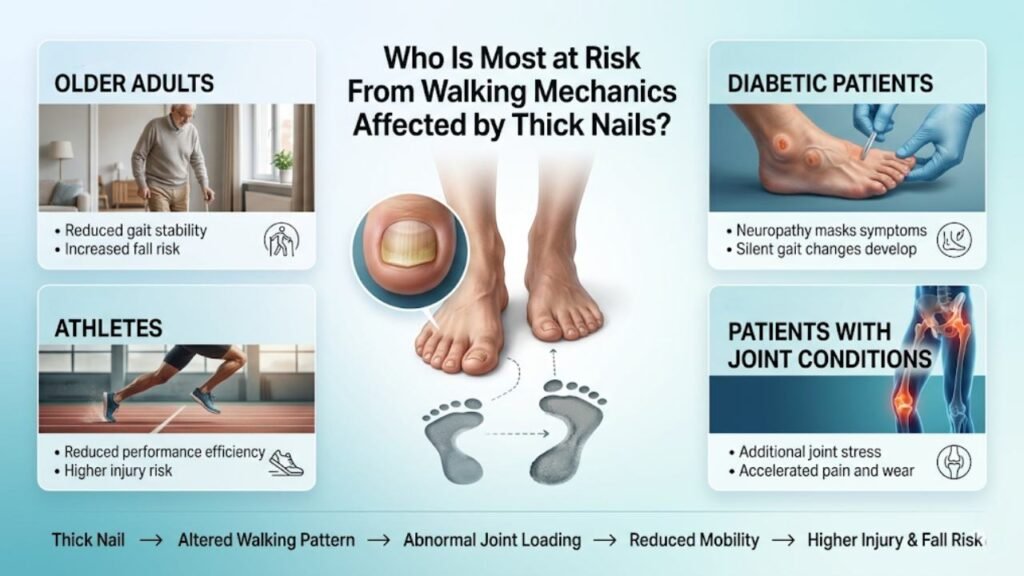
Older adults
The balance effects of altered nail-related gait are most dangerous in older adults, where the margin between stable and unstable gait is narrower. Reduced gait speed, which is already a health concern in aging populations, is further reduced by nail pain. Fall risk elevates meaningfully.
Diabetic patients
Peripheral neuropathy in diabetics masks the pain signals that would normally prompt gait adjustment. But the mechanical reality of a thick nail pressing on surrounding tissue continues even without pain awareness. Silent gait alterations develop without the patient noticing — and without the compensatory feedback that normally limits how far the alteration progresses.
Athletes
Thick nails affect walking mechanics in athletes because the movement patterns involved in athletic performance are biomechanically demanding. An altered push-off from nail pain directly reduces running efficiency. Altered foot rotation during lateral movement increases injury risk in the ankle, knee, and hip. Athletes often push through nail-related discomfort without connecting it to declining performance or increasing injury rates.
Patients with pre-existing joint conditions
Patients with osteoarthritis, hip replacement, or knee problems are particularly vulnerable to the cascading joint effects of altered gait. Any additional mechanical stress on already-compromised joints accelerates wear and pain.
Diagnosing the Gait Impact of Thick Nails
A podiatrist assessing how thick nails affect walking mechanics will typically evaluate:
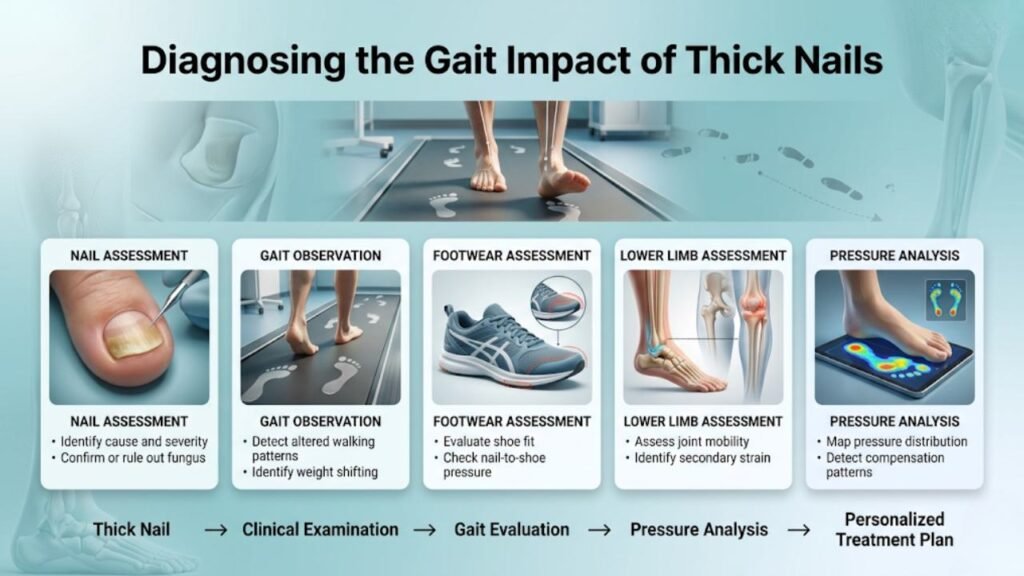
Nail assessment — Identifying the cause (fungal, traumatic, structural) and severity of nail thickening. Laboratory testing to confirm or rule out fungal infection.
Gait observation — Watching the patient walk to identify compensatory patterns — weight shifting, foot rotation, reduced push-off, altered step length.
Footwear assessment — Examining current footwear for adequate toe box space, signs of abnormal wear patterns, and evidence of nail-to-shoe contact.
Lower limb assessment — Checking ankle, knee, and hip mobility and muscle strength for signs of secondary strain from gait alteration.
Pressure assessment — Some podiatric practices use plantar pressure analysis to identify abnormal loading patterns across the foot that indicate compensatory gait.
Treatment That Addresses Thick Nails and Walking Mechanics
Professional Nail Debridement — Immediate Mechanical Relief
Reducing nail thickness through professional debridement directly and immediately addresses the mechanical cause of gait alteration. When the nail no longer presses against the shoe ceiling during walking, the incentive for compensatory gait patterns is removed.
Many patients notice walking improvement quickly after their first professional debridement appointment — the nail pressure is gone, push-off becomes less uncomfortable, and the involuntary avoidance patterns begin to reduce.
Regular debridement — typically every 6 to 12 weeks — maintains this mechanical benefit throughout the treatment period.
Treating the Underlying Cause
Debridement provides symptomatic relief. Addressing the underlying cause provides lasting improvement.
- For fungal infection: appropriate oral or topical antifungal therapy
- For trauma-related thickening: footwear correction and activity modification
- For psoriatic nail: dermatological management of the underlying condition
- For age-related or genetic thickening: ongoing professional nail management
Footwear Correction
Appropriate footwear removes the mechanical interaction between the thick nail and the shoe that drives gait compensation in the first place.
- Adequate toe box depth — the nail must not contact the shoe ceiling
- Adequate toe box width — no lateral compression
- Correct shoe length — at least one thumb’s width of clearance at the longest toe
Gait Rehabilitation
When thick nails have significantly affected walking mechanics for an extended period, the compensatory patterns can become habitual even after the nail issue is resolved. Gait re-education — either through conscious attention or with physiotherapy guidance — helps restore normal movement patterns after the nail cause is treated.
Frequently Asked Questions
Do thick toenails really affect how you walk?
Yes. When a thick nail creates pressure inside footwear, the body compensates by shortening push-off, shifting weight, and altering foot rotation. These changes affect gait efficiency, balance, and loading on ankle, knee, and hip joints.
Can thick nail pain cause knee or hip pain?
Yes. Sustained gait compensations from thick nail discomfort alter how the lower limb loads and moves. This can contribute to secondary knee, hip, and lower back pain that initially seems unrelated to the nail.
How quickly does walking improve after thick nail treatment?
Many patients notice improvement in walking comfort relatively quickly after professional nail debridement reduces nail thickness. Full gait normalization depends on the duration of altered walking pattern — long-standing compensations may benefit from physiotherapy support alongside nail treatment.
Are elderly people more affected by thick nails and walking?
Significantly. Older adults have less gait stability reserve, meaning that any factor reducing balance or walking confidence — including thick nail pain — has a proportionally larger impact on fall risk and overall mobility.
Can I fix thick nail-related gait problems with different shoes alone?
Footwear with adequate toe box space reduces the shoe-to-nail pressure that drives gait compensation. It is an important part of management, but for established nail thickening, professional nail treatment to reduce the nail thickness itself provides the most direct and comprehensive mechanical relief.
Should I see a podiatrist if my thick nails are affecting my walking?
Yes. A podiatrist can safely reduce nail thickness, identify the underlying cause, assess your gait for compensatory patterns, and provide footwear guidance — addressing both the nail condition and its functional consequences.
Summary
Thick nails affect walking mechanics through five interconnected effects: shortened push-off reducing propulsive force, weight shifting that alters full-limb load distribution, reduced walking speed and efficiency, balance compromise — particularly dangerous in older adults — and secondary joint and muscle strain from sustained gait compensations.
The key clinical insight is that the body does not isolate the problem to the nail. It compensates — and those compensations travel through the ankle, knee, hip, and lower back with every step. Patients who present with new knee pain, hip discomfort, or lower back pain alongside thick, symptomatic nails may be experiencing exactly this cascade.
Treatment that addresses both the nail condition and the footwear environment that creates nail-to-shoe pressure is the most effective approach to restoring normal walking mechanics. For patients whose compensatory gait patterns have become established, gait re-education alongside nail treatment produces the best functional outcomes.
Struggling to get an appointment?
We help patients in your area bypass clinic waitlists by instantly finding verified podiatry doctors who accept their insurance.