When Thick Toenails Cause Nerve Pain
Find a Podiatrist Near You
Get same-day appointments with verified podiatrists. Insurance accepted.
Thick toenails cause nerve pain in a way that many patients find surprising — because the connection between a nail problem and burning, tingling, or shooting pain in the toe is not obvious. When most people think of thick toenails, they think of cosmetic changes: discoloration, difficulty trimming, pressure inside shoes. The idea that the nail itself could be irritating nerve tissue beneath and around it does not immediately come to mind.
But the toes are densely innervated. The nail bed, nail fold, and surrounding soft tissue all contain small nerve fibers that respond to pressure, temperature, and tissue changes. When a nail becomes significantly thickened, it does not just sit passively on top of the toe — it applies sustained force to the nail bed beneath it, compresses surrounding soft tissue, and in some individuals, generates enough pressure and inflammation to produce genuine nerve symptoms.
This guide explains how and why thick toenails cause nerve pain, which patients are most vulnerable, what nerve pain from a thick nail actually feels like, and what treatment effectively addresses both the nail and the pain it is causing.

The Anatomy Behind Why Thick Toenails Cause Nerve Pain
To understand why thick toenails cause nerve pain, it helps to appreciate how close the nerve supply of the toe is to the nail and its supporting structures.
The toes receive sensory innervation from branches of the digital nerves — plantar digital nerves from the medial and lateral plantar nerves, and dorsal digital nerves from the superficial fibular (peroneal) nerve. These nerve branches run along the sides of each toe, sending smaller branches into the nail fold, nail bed, and surrounding soft tissue.
The nail bed — the skin directly beneath the nail plate — is particularly rich in nerve endings. It contains both free nerve endings (which detect pain and temperature) and specialized endings (Meissner’s corpuscles and Pacinian corpuscles) that detect fine touch and pressure. This sensory richness is what makes normal nails good at detecting subtle changes in the environment.
When the nail plate becomes significantly thickened, it presses down onto this nerve-rich nail bed with force that a normal nail would never exert. Additionally, subungual debris — the crumbly material that accumulates beneath the nail in fungal infection — takes up space in the already-limited subungual region, adding to the compressive force on nail bed tissue.
The nearby digital nerve branches are also vulnerable. Soft tissue inflammation around a chronically thickened nail, or the nail edge pressing into the nail fold as the nail grows thicker and more curved, directly contacts the lateral digital nerve branches running along the toe’s sides.
This anatomical proximity is the fundamental reason thick toenails cause nerve pain — the nail and the nerves are physically close, and any significant alteration in nail size and pressure changes the mechanical relationship between them.
4 Mechanisms Through Which Thick Toenails Cause Nerve Pain
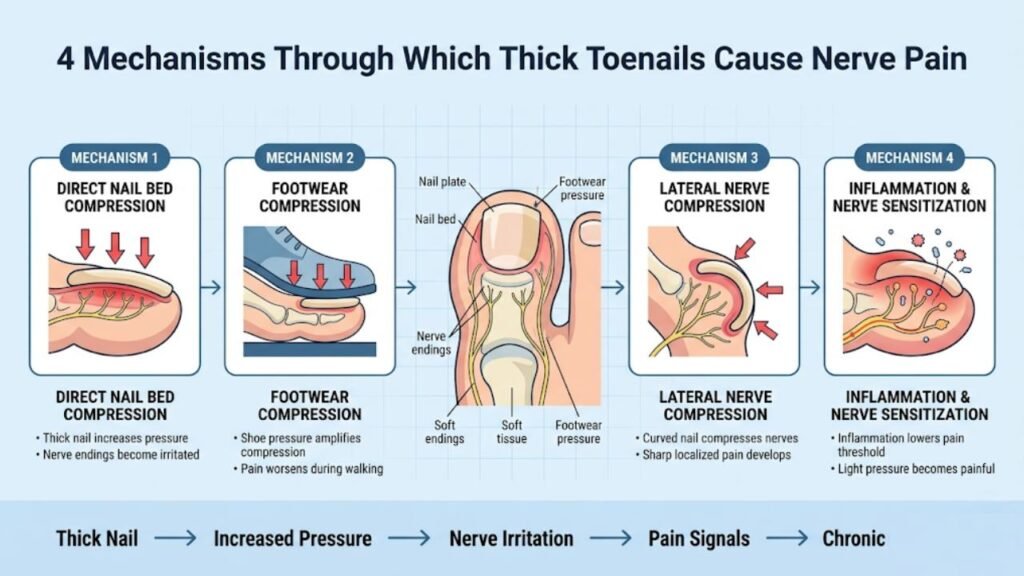
Mechanism 1: Direct Nail Bed Compression
The most straightforward mechanism through which thick toenails cause nerve pain is direct downward pressure on the nail bed.
A normal toenail is relatively thin — approximately 0.5 to 0.6 mm. This thin nail exerts minimal compressive force on the nail bed beneath it. When the nail thickens significantly — sometimes reaching 2 to 3 mm or more in severe cases — the weight and rigidity of the nail plate create sustained downward compression on the nail bed tissue.
In a typical day, walking loads the foot thousands of times. Each loading event transmits additional compressive force through the thickened nail to the nail bed beneath. Over the course of a day, the nail bed nerve endings are subjected to far more mechanical stimulation than they would be under a normal nail.
This sustained, abnormal compression produces nerve symptoms in several ways:
- Direct mechanical stimulation of pain receptors (nociceptors) in the nail bed
- Reduced blood flow to nail bed tissue from sustained compression, which can trigger ischemic pain
- Sensitization of nerve endings from repeated daily mechanical overload, reducing the threshold at which they fire pain signals
The resulting symptoms: Aching or throbbing pain directly under the nail, particularly after prolonged walking or standing. Sensitivity to pressure on the nail surface. Pain that is worse at the end of the day after cumulative nail bed loading.
Mechanism 2: Footwear Compression — Nail Forced Into Surrounding Tissue
The second mechanism through which thick toenails cause nerve pain involves the interaction between the thickened nail and the interior of the shoe.
A normal nail fits comfortably within the toe box of appropriately sized footwear. A significantly thickened nail may not. During walking, the foot slides slightly forward in the shoe, and the nail tip contacts the shoe front. The shoe ceiling may press down on the thick nail from above. The toe box sides may compress the nail laterally.
Each of these contact points transmits force — from the shoe, through the nail, into the nail bed and surrounding soft tissue where the digital nerve branches run. This shoe-mediated force amplifies the direct nail bed compression described above, and also creates lateral pressure on the nail fold tissue where the nerve branches are located.
The resulting symptoms: Pain that is distinctly worse during walking and wearing closed footwear. Relief when barefoot or in open footwear. Tenderness along the nail fold sides (where lateral digital nerve branches run) rather than only directly under the nail.
Mechanism 3: Nail Curvature and Lateral Nerve Branch Compression
When a thick nail also develops curvature — as occurs in pincer nail or onychogryphosis — the nail edges press inward and downward into the nail fold tissue on both sides of the nail. The lateral digital nerve branches run directly adjacent to the nail fold, and significant nail edge curvature can directly compress these structures.
This is a more specific and more severe form of how thick toenails cause nerve pain. Rather than general nail bed pressure, this mechanism produces more localized, sharp pain along one or both sides of the nail — reflecting the specific nerve branch being compressed by the curved nail edge.
The resulting symptoms: Sharp, well-localized pain along the nail edge or corner. Pain with any lateral pressure on the nail. In some patients, shooting pain along the toe or to the toe tip, reflecting nerve branch involvement rather than simple nail bed pressure. The pain can have a more burning or electric quality — characteristic of nerve compression rather than simple tissue pressure.
Mechanism 4: Inflammation-Mediated Nerve Sensitization
Chronic nail thickening — particularly from fungal infection — is accompanied by a persistent low-grade inflammatory response in the nail bed and surrounding tissue. This inflammation involves the release of pro-inflammatory chemicals (prostaglandins, bradykinin, substance P) into the local tissue environment.
These inflammatory mediators directly sensitize nerve endings — lowering their pain threshold so that stimuli that would normally be felt as non-painful pressure are instead perceived as pain. This is the same mechanism responsible for the tenderness of sunburned skin (where nerve endings are sensitized by inflammation, making even light touch painful).
When thick toenails cause nerve pain through this inflammatory pathway, the pain is not solely a mechanical phenomenon — it persists even in situations where mechanical pressure is reduced, because the nerve endings themselves are in a sensitized state.
The resulting symptoms: Pain that seems disproportionate to the degree of mechanical pressure being applied. Burning or aching pain that is present even with light touch or when barefoot. Hyperalgesia — where even normal touch to the nail area feels painful. This pattern suggests nerve sensitization rather than pure mechanical compression.
What the Nerve Pain From Thick Toenails Actually Feels Like
Understanding the type of pain helps patients recognize when thick toenails cause nerve pain as opposed to simple mechanical nail pressure.
Pressure pain — a dull aching or throbbing under the nail, worse with activity and footwear, better with rest — is the simplest form of nail-related pain and reflects direct tissue loading rather than nerve involvement specifically.
Nerve-quality pain has more specific characteristics:
- Burning — a persistent heat or burn sensation in the nail area, often present even without direct contact
- Sharp or shooting — brief intense pain that radiates along the toe, sometimes to the tip, reflecting nerve branch stimulation
- Tingling — pins-and-needles sensation in the toe or nail area
- Electric — sudden, brief electric-feeling sensations
- Allodynia — pain from stimuli that should not be painful, like a sock touching the toe, bed sheets at night, or light finger pressure on the nail
When thick toenails cause nerve pain in the burning, tingling, or electric quality described above, it indicates that actual nerve fibers are being affected — not just pressure receptors in the nail bed.
Who Is Most Vulnerable When Thick Toenails Cause Nerve Pain?
While any patient with significantly thick toenails can develop pain, certain groups are more likely to experience pronounced nerve involvement.
Diabetic Patients
Diabetic peripheral neuropathy alters nerve function in complex ways. In early neuropathy, nerve fibers are not simply absent — they are dysfunctional. Small fiber neuropathy in particular can produce paradoxical hypersensitivity — heightened pain perception — alongside reduced sensation in some areas.
For diabetic patients with early neuropathy, thick toenails may cause disproportionate nerve pain because the neural threshold changes of neuropathy make the already-sensitized nerve endings more responsive to the compression from thick nails. Simultaneously, the reduced protective sensation in other areas of the foot means the patient may not notice the nail problem until the nerve pain becomes prominent.
Patients With Pre-Existing Nerve Conditions
Any patient with pre-existing peripheral nerve pathology — from diabetes, chemotherapy-induced neuropathy, hereditary neuropathies, or vitamin deficiencies — has nerve function that is already compromised. Superimposing nail-related nerve compression on an already-dysfunctional nerve system produces symptoms more readily than the same nail condition would in someone with healthy peripheral nerves.
Patients With Onychogryphosis or Pincer Nail
These structural nail deformities produce the most direct and severe nail edge-to-tissue contact, creating the most focused compression on the lateral digital nerve branches. The nerve pain associated with severely curved nails is typically more intense and more specifically nerve-quality in character than the pain from simple nail plate thickening without shape distortion.
Elderly Patients
Age-related changes in nerve function and tissue composition make older adults more susceptible to pain from nail pressure. Thinner skin, less protective fat padding around the digital nerves, and age-related peripheral nerve changes all reduce the buffer between the thickened nail and the nerve tissue.
Diagnosing When Thick Toenails Cause Nerve Pain
When a patient presents with pain in the toe alongside nail thickening, the clinical evaluation needs to:
Confirm the nature of the nail condition — Is the thickening from fungal infection, trauma, structural deformity, or another cause? Laboratory testing (KOH, fungal culture) addresses this.
Assess whether nerve involvement is present — The quality of the pain (burning, tingling, shooting vs simple pressure aching) and the distribution (along the toe rather than purely under the nail) help distinguish nerve involvement from simple mechanical discomfort.
Identify contributing footwear factors — Whether the shoe’s contact with the thick nail is amplifying compression.
Screen for underlying conditions — Diabetic neuropathy, vitamin deficiencies (B12 particularly), and other causes of nerve dysfunction that might make the patient more susceptible to nail-related nerve symptoms.
Assess nail shape — Whether curvature is present that creates direct lateral nerve branch compression, as in pincer nail or onychogryphosis.
Treatment When Thick Toenails Cause Nerve Pain
Effective treatment addresses both the nail condition creating the compression and the nerve symptoms it is producing.
Professional Nail Debridement — First Priority
Reducing nail thickness through professional podiatric debridement removes the primary mechanical cause of nerve compression. This is typically the most immediately effective intervention when thick toenails cause nerve pain — reducing the compressive force the nail exerts on the nail bed and surrounding tissue.
Many patients experience meaningful pain reduction after their first debridement appointment, as the nail pressure on the nerve-rich nail bed is directly reduced.
Debridement should be repeated regularly — every 6 to 12 weeks depending on nail growth rate — to maintain the mechanical benefit.
Treating the Underlying Nail Cause
Debridement provides symptomatic relief but does not address what made the nail thick.
- For fungal infection: oral or topical antifungal therapy
- For structural deformity (pincer nail, onychogryphosis): specific management including nail bracing or surgical correction of the nail edge causing lateral nerve compression
- For trauma-related thickening: footwear correction and activity modification
Footwear with Adequate Toe Box Space
Removing the shoe-mediated compression that amplifies nail-to-nerve pressure requires footwear with:
- Sufficient depth in the toe box that the shoe ceiling does not contact the thick nail
- Sufficient width that lateral shoe walls do not increase nail edge pressure against the nail fold
- Soft, yielding toe box lining material rather than rigid construction
In some patients, extra-depth footwear or diabetic shoes with custom insoles are appropriate, particularly when nerve involvement is significant.
Protective Padding
Protective padding — gel toe caps, foam nail protection, or custom orthotics — can reduce the direct contact between the nail area and footwear while the nail treatment produces improvement.
Managing Underlying Conditions
For diabetic patients whose nerve sensitivity is contributing to severe pain from relatively moderate nail thickening, optimizing glycemic control supports nerve health and reduces the hypersensitivity component.
For patients with B12 deficiency or other nutritional causes of nerve dysfunction, appropriate supplementation supports nerve recovery.
When to Seek Professional Care
When thick toenails cause nerve pain, this situation specifically warrants professional evaluation rather than home management:
- Pain that is burning, electric, or shooting in quality — suggesting nerve involvement beyond simple pressure
- Pain that persists even when barefoot or in open footwear
- Tingling or numbness in the toe alongside nail thickening
- Pain that is worsening despite footwear changes
- The nail has developed significant curvature pressing into surrounding tissue
- You have diabetes, peripheral neuropathy, or another nerve condition
- The pain is affecting how you walk or limiting your activity
Frequently Asked Questions
Can a thick toenail really cause burning pain?
Yes. When thick toenails cause nerve pain through sustained compression of nerve-rich nail bed tissue or through direct contact with lateral digital nerve branches, burning is one of the characteristic symptoms. Burning pain reflects irritation of small nerve fibers rather than just mechanical pressure on tissue.
Why does my toe tingle when I have thick nails?
Tingling — pins-and-needles — is a classic symptom of nerve fiber irritation. When thick toenails cause nerve pain through compression of the digital nerve branches running along the toe side, tingling in the toe or nail area reflects the nerve’s response to that compression.
Is nerve pain from thick toenails permanent?
In most cases, no. Once the nail pressure is reduced — through professional debridement and treatment of the underlying cause — the compressive source of nerve irritation is removed. Nerve recovery takes time (nerve tissue heals slowly), but most patients experience gradual reduction in nerve symptoms as the nail is appropriately managed.
Why are my diabetic nerve symptoms worse near my thick toenail?
Diabetic neuropathy alters nerve function in ways that can make the nerve endings more sensitive to mechanical compression rather than simply less sensitive overall. The compression from a thick nail on already-compromised nerves can produce more prominent pain than the same nail would cause in someone without diabetes.
What is the fastest way to relieve nerve pain from a thick toenail?
Professional nail debridement to reduce nail thickness provides the most immediate mechanical relief. This removes the primary source of nail bed and nerve compression. This should be followed by treatment of the underlying nail cause to prevent the nail from returning to its previous thickness.
Should I see a podiatrist or neurologist for thick toenail nerve pain?
See a podiatrist first. Podiatric evaluation identifies the nail condition, confirms whether the nail is the source of nerve symptoms, and provides nail management. If nerve symptoms are severe, persistent after nail treatment, or suggest a broader nerve problem (symptoms beyond just the nail area, both feet affected symmetrically), additional neurological evaluation may be appropriate alongside podiatric care.
Summary
Thick toenails cause nerve pain through four main mechanisms — direct nail bed compression, footwear-mediated compression of surrounding nerve-rich tissue, nail curvature pressing directly against lateral digital nerve branches, and inflammation-induced nerve sensitization. All four mechanisms produce genuine nerve symptoms — burning, tingling, shooting pain, or electric sensations — not just simple mechanical pressure discomfort.
Patients with diabetes, peripheral nerve conditions, structural nail deformities, or advanced nail thickening are most vulnerable to significant nerve involvement when thick toenails cause nerve pain. For these patients, the pain can be disproportionately severe relative to the visible nail changes.
Treatment focuses on reducing nail thickness through professional debridement — which removes the mechanical source of nerve compression — alongside treating the underlying cause of nail thickening, correcting footwear, and managing any contributing systemic conditions.
If thick nail pain has a burning, tingling, or electric quality, professional evaluation rather than home management is the appropriate response.
Struggling to get an appointment?
We help patients in your area bypass clinic waitlists by instantly finding verified podiatry doctors who accept their insurance.