Are Thick Toenails Genetic? Causes, Myths, and What You Should Know
Find a Podiatrist Near You
Get same-day appointments with verified podiatrists. Insurance accepted.
Thick toenails genetic factors are something many patients suspect but rarely get a clear answer about. You have noticed your nails getting harder and thicker over the years. Your parent had the same thing. Maybe a sibling too. No fungal infection has ever been confirmed. The antifungal products you tried did nothing. The question that keeps coming up is whether your thick nails are simply inherited.
The honest answer is: yes, genetics can contribute to thick toenails — but it is almost never the complete picture. Hereditary factors influence nail structure, nail growth patterns, nail thickness, and susceptibility to certain nail conditions. But most cases of thick toenails involve a combination of genetic tendencies and other factors — aging, pressure from footwear, circulation changes, or past nail injury — acting together.
This guide explains what the thick toenails genetic connection actually means, which specific inherited conditions cause nail thickening, how doctors determine whether genetics is the primary cause, and what realistic management looks like when the answer is yes.
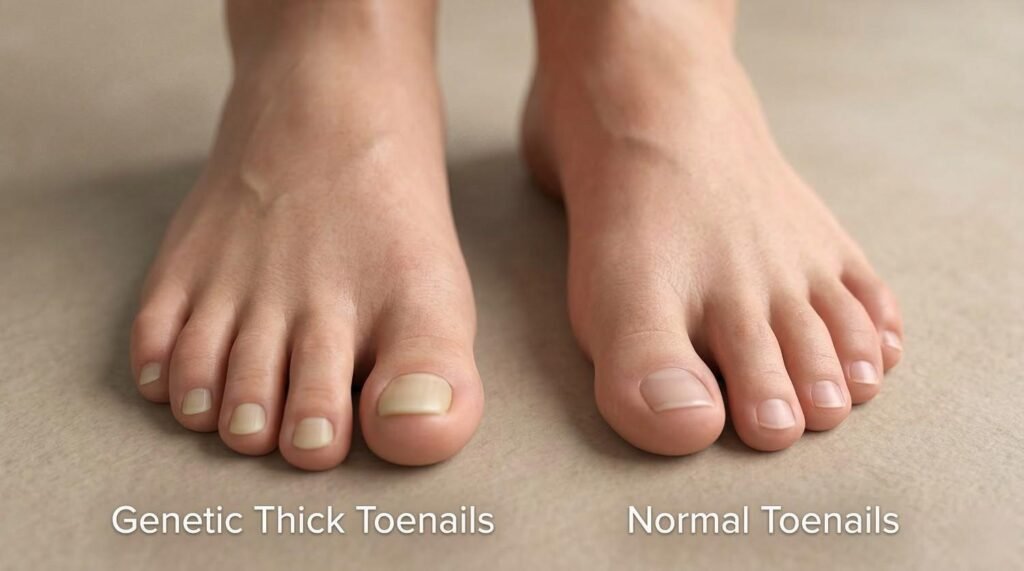
How Genetics Influences Nail Structure
To understand the thick toenails genetic relationship, it helps to understand what genetics actually controls in the nail.
The nail grows from the nail matrix — the growth center hidden beneath the cuticle at the nail base. The matrix produces nail plate cells that push forward, harden, and become the nail you see. The characteristics of that nail — how thick it is, how fast it grows, how curved it is, how the surface looks — are largely determined by what happens in the matrix.
Genetic factors influence:
Nail matrix cell behavior — The rate at which matrix cells divide, how they organize into nail layers, and how they produce keratin (the protein forming the nail) are all influenced by inherited gene variants.
Keratin protein structure — Different individuals produce keratin with slightly different structural properties. Some keratin variants produce naturally thicker, harder nails. Others produce thinner, more flexible nails. These differences are inherited.
Nail growth rate — How quickly the nail plate grows — typically around 1.5 mm per month in healthy adults — has a genetic component. Slower-growing nails remain exposed to mechanical stress for longer and may accumulate structural changes more readily.
Nail curvature — The tendency for nails to curve across their width — which influences whether someone is predisposed to pincer nail deformity — has a documented hereditary component.
Susceptibility to nail disease — How effectively the immune system defends against fungal organisms at the nail unit is partly genetically determined, explaining the familial clustering of onychomycosis discussed in other areas of nail research.
When patients ask about thick toenails genetic causes, they are often noticing the downstream effect of one or more of these inherited nail characteristics manifesting across their family.
What Genetic Thick Toenails Look Like
When thick toenails have a primarily genetic basis, certain patterns tend to be present that help distinguish them from other causes.
Characteristics suggesting genetic thick toenails:
- Multiple family members — particularly parents, siblings, or children — have consistently thicker nails than average without obvious fungal infection
- The nail thickening affects multiple nails simultaneously and relatively symmetrically, rather than starting in one nail and spreading
- The nails have been relatively thick for most of the patient’s adult life — this is not a new development over the last one to two years
- Laboratory testing for fungal infection consistently comes back negative
- The nails are thick but do not show the specific features most characteristic of fungal infection — crumbling edges, chalky subungual debris, significant spreading discoloration
- Antifungal treatment over multiple courses has produced no improvement
None of these points individually confirms a genetic cause — but together, particularly in someone with a clear family history, they build a strong clinical picture suggesting thick toenails genetic factors are the primary explanation.
Inherited Conditions That Specifically Cause Thick Toenails
While general genetic nail tendencies explain many cases of familial nail thickening, some specific inherited conditions produce nail thickening as a more prominent and defined feature.
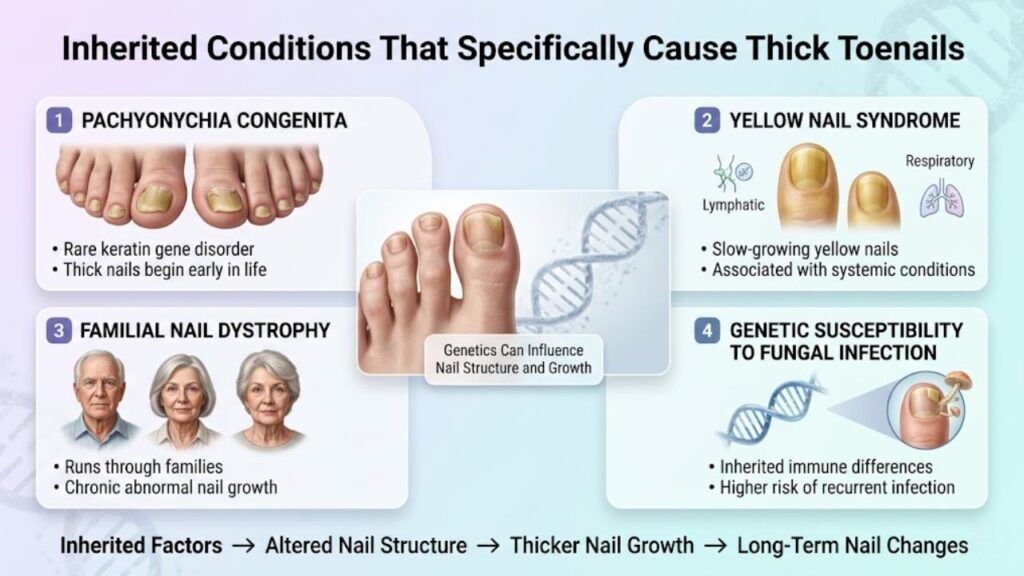
Pachyonychia Congenita
Pachyonychia congenita is a rare genetic disorder caused by mutations in keratin genes — specifically KRT6A, KRT6B, KRT16, and KRT17. These mutations produce structurally abnormal keratin that forms nail plates that are dramatically thicker than normal.
Key features:
- Severe nail thickening affecting all fingernails and toenails, typically beginning in early childhood or at birth
- Nails that are very hard and wedge-shaped in cross-section
- Significant pain from the nail plate pressing on the nail bed, particularly when walking
- Often accompanied by painful plantar keratoderma — thickened, callused skin on the soles of the feet that causes significant walking difficulty
- Oral leukokeratosis — white patches inside the mouth
- Cysts of the hair follicles
Pachyonychia congenita is diagnosed clinically and confirmed with genetic testing. It is one of the clearest examples of a thick toenails genetic condition where the hereditary cause produces the nail thickening directly. Management focuses on palliative care — reducing nail thickness through professional trimming, managing foot pain, and addressing the skin and other tissue involvement.
Yellow Nail Syndrome
Yellow nail syndrome produces a triad of findings: nail changes, lymphedema (swelling from impaired lymphatic drainage), and respiratory conditions (such as chronic cough or pleural effusion). The nail changes include:
- Slow or arrested nail growth
- Nail thickening
- Yellow or yellowish-green discoloration
- Loss of the cuticle
- Nail lifting (onycholysis)
The exact genetic contribution to yellow nail syndrome is not fully established — it can occur sporadically or appear to run in families. When it does run in families, it represents another example of thick toenails genetic predisposition.
Hereditary Nail Dystrophy (Familial)
Some families show a consistent pattern of nail dystrophy — abnormal nail growth, thickening, and structural irregularity — across generations without the specific features of named syndromes like pachyonychia congenita. This represents familial nail dystrophy driven by inherited nail matrix characteristics.
In these families:
- Multiple generations show similar nail characteristics
- The nails have been thicker and more abnormal-appearing from a relatively young age
- No single underlying condition fully explains the nail pattern
- Standard nail treatment provides limited improvement
This category is perhaps the most clinically common form of thick toenails genetic presentation — not a dramatic rare syndrome, but a family tendency toward thicker, more abnormal nail structure that has a hereditary basis.
Genetic Susceptibility to Onychomycosis
A separate but related genetic dimension involves inherited susceptibility to fungal nail infection. As described in other articles in this series, specific genetic variants — in HLA genes, toll-like receptor genes, and cytokine pathway genes — reduce the immune system’s efficiency at clearing early dermatophyte colonization of the nail.
This means that while the fungal infection itself is not inherited, the susceptibility to developing it is partially inherited. Families where multiple members develop recurrent or chronic nail fungal infection — producing thick, discolored, structurally damaged nails — may have an inherited immune vulnerability as the shared underlying factor.
Thick Toenails Genetic vs Other Causes: Key Differences
| Feature | Genetic Thick Toenails | Fungal Thick Toenails | Trauma Thick Toenails | Age-Related Thick Toenails |
|---|---|---|---|---|
| Family history | Common | Not typical | Not typical | Not typical |
| Age of onset | Often early adulthood or younger | Any age, more common over 40 | After injury/activity change | Gradual from middle age |
| Nails affected | Multiple, often symmetric | Often starts in one, spreads | Usually one nail | Multiple, gradual |
| Lab test result | Negative | Positive | Negative | Negative |
| Subungual debris | Usually minimal | Common | Less typical | Less typical |
| Nail discoloration | Mild to moderate | Yellow-brown, often prominent | Bruise-like if trauma | Mild yellowish |
| Response to antifungal | None | Gradual improvement | None | None |
| Treatment approach | Management-focused | Antifungal treatment | Footwear correction | Regular professional care |
How Doctors Determine If Thick Toenails Are Genetic
When a patient presents with thick toenails and a family history suggesting a genetic component, the diagnostic process involves several steps.
Step 1: Laboratory testing to rule out fungal infection
This is the most important first step. KOH microscopy, fungal culture, and in some cases PAS nail staining definitively confirm or rule out onychomycosis. If all testing is consistently negative across multiple nail samples, fungal infection is unlikely to be the primary cause.
Step 2: Family history assessment
A detailed family history exploring whether parents, siblings, and other relatives have similar nail characteristics helps establish the hereditary pattern. When nail thickening shows clear vertical transmission across generations, the thick toenails genetic explanation becomes more likely.
Step 3: Clinical pattern evaluation
The distribution of nail thickening across toes, the characteristics of the nail plate (smooth versus crumbling, uniformly thick versus debris-filled), and the age at which changes first appeared all contribute to the clinical picture.
Step 4: Dermatology or genetics referral for specific syndromes
When features suggest a specific inherited condition like pachyonychia congenita — particularly if nail symptoms are severe and accompanied by other tissue involvement — referral for dermatology evaluation and potentially genetic testing is appropriate.
Step 5: Assessment of concurrent contributing factors
Even when thick toenails have a genetic basis, other factors often compound the problem. Footwear assessment, circulation evaluation, and review of any skin conditions help identify secondary contributors that can be managed to reduce symptom severity.
What Management Looks Like for Genetic Thick Toenails
When thick toenails have a predominantly genetic cause, management goals shift. The aim is not to reverse the inherited nail characteristic — genetics cannot be changed — but to keep the nail manageable, comfortable, and free of complications.
Professional Nail Debridement
Regular professional nail debridement by a podiatrist is the cornerstone of managing genetic thick toenails. A podiatrist uses specialized instruments — rotary burrs, nail files, and heavy-duty nippers — to safely reduce the nail plate to a manageable thickness at regular intervals.
What debridement achieves:
- Reduces nail thickness so footwear fits more comfortably
- Makes the nail safe to manage between appointments
- Prevents the nail from growing in ways that cause pressure sores
- Reduces the risk of secondary infection in a structurally compromised nail
Most patients with significant genetic thick toenails benefit from professional debridement every 6 to 10 weeks.
Footwear Optimization
Even when genetics is the primary cause of nail thickening, appropriate footwear significantly reduces the symptoms and prevents compounding damage from mechanical pressure.
- Wide toe box footwear reduces lateral nail compression
- Adequate toe box depth prevents the thick nail from contacting the shoe ceiling
- Cushioned insoles reduce impact transmitted to the nail bed
Preventing Secondary Infection
Thick nails — regardless of cause — create structural conditions where secondary fungal or bacterial infection becomes more likely. Subungual space accumulates debris. Nail edges may lift. These create environments where fungi can establish.
Preventive measures include:
- Keeping nails trimmed at professional appointments
- Monthly self-inspection for any color or texture changes
- Prompt treatment if athlete’s foot develops on surrounding skin
- Good foot hygiene and moisture control
Regular Monitoring
Because thick toenails genetic conditions are not resolved by treatment — they are ongoing — regular monitoring is important. A podiatrist who knows your baseline nail state can identify meaningful changes (like the addition of a true fungal infection on an already-thick nail, or the development of a nail edge pressing into surrounding skin) that require additional management.
When to See a Podiatrist About Thick Toenails
Whether or not you suspect a thick toenails genetic basis, professional evaluation is appropriate when:
- Nails are too thick to trim safely at home
- Multiple nails are consistently thick without a clear fungal diagnosis
- Family members show similar nail patterns and no one has been evaluated
- Nails are causing discomfort in footwear
- You have diabetes or poor circulation — thick nails in these populations require professional care regardless of cause
- You have tried antifungal products across multiple courses with no improvement
- Nail changes are accompanied by pain, skin involvement, or other tissue changes that suggest a more complex condition
Frequently Asked Questions About Thick Toenails Genetic Causes
Are thick toenails always genetic?
No. Fungal infection, trauma, aging, poor circulation, and nail psoriasis are all common non-genetic causes. Genetics is one factor among several. A proper evaluation — including laboratory testing — determines how much genetics contributes in each individual case.
If my parents have thick toenails, will I definitely get them too?
Not necessarily. Genetic tendencies increase the probability but do not guarantee the outcome. Environmental factors — footwear, lifestyle, health conditions — interact with genetic predisposition. Some people with a strong family history of thick toenails manage to maintain relatively normal nails with good footwear and regular professional nail care.
Can genetic thick toenails be treated?
The genetic tendency itself cannot be reversed. But the nail thickening it produces can be managed effectively with regular professional debridement, appropriate footwear, and monitoring for secondary complications. Management keeps the nail at a comfortable, functional thickness even if full normalization is not achievable.
How do I know if my thick toenails are from genetics or fungus?
The most reliable answer comes from laboratory testing — KOH microscopy and fungal culture. Negative results across multiple tests, combined with a family history of similar nail characteristics and no response to antifungal treatment, strongly suggest a genetic thick toenails basis.
Are the rare genetic conditions causing thick nails very serious?
Pachyonychia congenita and similar rare conditions can cause significant disability — particularly from foot pain and difficulty walking. However, most genetic nail thickening represents a milder familial tendency rather than a serious syndrome. A clinical evaluation distinguishes between the two.
Does having thick toenails from genetics mean I will get nail fungus?
Not directly. However, a structurally thick nail creates conditions — subungual space, altered nail architecture — that can make secondary fungal infection easier to establish. People with thick toenails genetic backgrounds should be particularly attentive to foot hygiene and early treatment of athlete’s foot.
Summary
Thick toenails genetic factors are real and explain a meaningful proportion of cases where multiple family members share similar nail characteristics, laboratory testing is consistently negative for fungal infection, and antifungal treatment produces no improvement.
Genetics influences nail matrix function, keratin structure, nail growth rate, nail curvature, and immune susceptibility to nail infection — all of which can contribute to thicker-than-normal nails. Specific inherited conditions like pachyonychia congenita represent the more dramatic end of this spectrum, while familial nail dystrophy represents the more common, milder end.
Management for thick toenails genetic causes focuses on keeping the nail comfortable and complication-free — regular professional debridement, appropriate footwear, preventive hygiene, and monitoring — rather than expecting the nail to return to a normal thickness, which genetic nail characteristics do not allow for.
If you have thick nails that run in your family and have not responded to antifungal treatment, proper diagnostic evaluation and specialist nail care is the most useful next step.
Struggling to get an appointment?
We help patients in your area bypass clinic waitlists by instantly finding verified podiatry doctors who accept their insurance.