Nail Clubbing vs Thickening – Key Differences
Find a Podiatrist Near You
Get same-day appointments with verified podiatrists. Insurance accepted.
Nail clubbing vs thickening is a comparison that matters far more than most patients realize. Both conditions produce visible nail changes. Both can make nails look abnormal or feel different. But they originate from completely different places in the body, carry very different health implications, and require very different responses.
Nail thickening — when the nail plate becomes denser, harder, and more difficult to trim — is usually caused by something happening locally at the nail: fungal infection, repeated trauma, pressure from footwear, or age-related changes in nail matrix function. It is generally manageable and in most cases does not indicate a serious underlying health problem.
Nail clubbing is different. In nail clubbing, the change is not primarily about the nail plate — it is about the soft tissue beneath the nail and the shape of the fingertip. And the causes of nail clubbing are systemic — they involve the heart, lungs, liver, or bowel. Nail clubbing is a recognized clinical sign of serious underlying disease, and when it appears, it deserves serious medical attention.
Getting the nail clubbing vs thickening distinction right is not academic. It determines whether someone needs a podiatrist or an urgent physician evaluation.
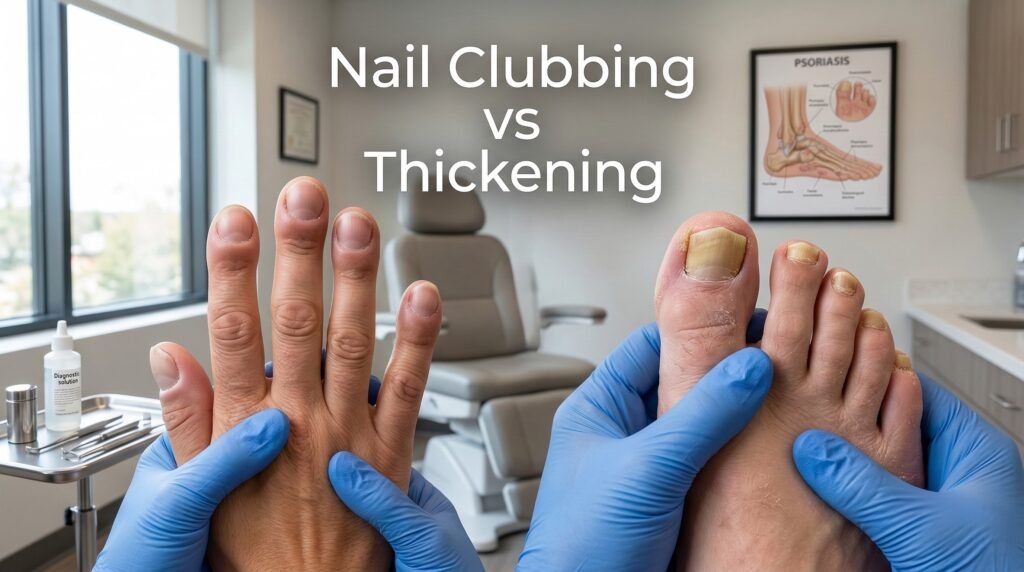
What Is Nail Thickening?
Nail thickening — formally described as onychauxis when uniform — occurs when the nail plate itself becomes abnormally dense, hard, and taller in profile than a normal nail.
The nail plate is produced by the nail matrix, the growth center beneath the cuticle. When the matrix is disrupted by infection, sustained pressure, trauma, or biological aging, the nail it produces is thicker and structurally different from normal. Additionally, the space beneath the nail plate can fill with keratin debris — particularly in fungal infection — making the nail appear and feel thicker from above.
What nail thickening looks like:
- The nail plate is visibly denser and taller than adjacent normal nails
- Color may shift to yellow, brown, white, or opaque
- The nail surface may be rough, irregular, or ridged
- The nail is hard to trim with standard nail clippers
- The nail edges may crumble or chip (particularly in fungal cases)
The nail thickening process is local — something affecting the nail unit specifically, rather than the whole body.
Common causes of nail thickening:
- Fungal nail infection (onychomycosis) — the most common
- Repeated mechanical trauma — from athletic activity, footwear, or occupation
- Nail psoriasis
- Age-related changes in nail matrix function
- Poor circulation affecting nail tissue nutrition
- Nail matrix damage from past injury
What Is Nail Clubbing?
Nail clubbing is a distinctly different structural change. In nail clubbing, the primary change is not in the nail plate itself — it is in the soft tissue beneath the nail and in the shape of the finger or toe tip.
In a normal finger, the nail meets the skin at the base (the proximal nail fold) at an angle — typically less than 180 degrees when measured. This is called the Lovibond angle or the hyponychial angle. The finger tip is firm and flat. The nail curves gently from side to side but does not curve dramatically downward over the fingertip.
In nail clubbing, the soft tissue beneath the nail (the nail bed) proliferates — it increases in volume. This swells the finger tip, creating a bulbous, rounded appearance. The Lovibond angle increases — it exceeds 180 degrees. The nail itself curves downward over the rounded fingertip, taking on a “watch glass” or “drumstick” appearance.
What nail clubbing looks like:
- The fingertip appears larger, rounder, and more bulbous than normal
- The nail curves downward over the fingertip rather than ending flat or with a slight upward tip
- The normal angle between the nail and the nail fold is lost — it becomes flat or reversed
- The nail bed feels spongy when pressed — softer and less firm than normal
- The nail itself may be relatively normal in thickness — it is the surrounding soft tissue and the nail curvature that has changed
- Typically affects all fingers and toes, not just one or two
The Schamroth window test is a practical clinical test for clubbing: when two corresponding fingers are pressed together nail-to-nail, a healthy individual will see a small diamond-shaped gap at the cuticle junction. In nail clubbing, that gap disappears because the nail angle has changed.
The 5 Critical Differences Between Nail Clubbing vs Thickening
Difference 1: What Has Actually Changed
This is the most fundamental distinction in the nail clubbing vs thickening comparison.
Nail thickening: The nail plate itself is the problem. The nail plate has become denser, harder, and taller. The fingertip shape is normal. The nail bed is firm.
Nail clubbing: The nail plate is often relatively normal in thickness. The fingertip soft tissue has increased in volume, the fingertip has become rounded and bulbous, and the nail angle has changed because of this soft tissue change beneath it.
If you press on the nail and the nail bed feels soft or spongy — rather than firm against bone — this suggests clubbing rather than simple thickening.
Difference 2: The Cause — Local vs Systemic
Nail thickening is caused by something affecting the nail locally — an infection, physical pressure, trauma, or aging.
Nail clubbing is caused by something affecting the whole body — specifically, conditions that alter blood oxygen levels, blood flow dynamics, or growth factor release from distant organs. The nail is the visible end result of a process originating elsewhere in the body.
Conditions most commonly associated with nail clubbing:
Pulmonary (lung) causes — most common:
- Lung cancer — the most commonly cited cause in adults
- Chronic obstructive pulmonary disease (COPD) in advanced cases
- Idiopathic pulmonary fibrosis
- Bronchiectasis
- Cystic fibrosis
- Mesothelioma
Cardiovascular (heart) causes:
- Congenital heart disease — particularly cyanotic congenital heart disease in children
- Infective endocarditis (heart valve infection)
- Atrial myxoma (a benign heart tumor)
Gastrointestinal causes:
- Inflammatory bowel disease — Crohn’s disease and ulcerative colitis
- Liver cirrhosis
- Celiac disease (in some cases)
Other causes:
- Thyroid acropachy (a rare thyroid condition)
- Familial/idiopathic clubbing — some people develop nail clubbing without any underlying disease, particularly if it runs in families
Difference 3: Which Nails Are Affected
Nail thickening typically begins in one or two nails and may spread over time — particularly in fungal infection which can spread from nail to nail. Traumatic thickening usually affects only the nails most exposed to pressure.
Nail clubbing typically affects all ten fingernails and often all toenails simultaneously. This bilateral, multi-digit involvement is one of the features that distinguishes clubbing from local nail changes. If only one or two nails are involved, true nail clubbing is less likely — one-sided or isolated nail changes prompt a search for local causes.
Difference 4: How Quickly It Develops
Nail thickening from fungal infection or trauma develops slowly over weeks to months. Patients often do not notice the change until it is well-established.
Nail clubbing can develop slowly (in chronic conditions like COPD or inflammatory bowel disease) or relatively rapidly (in lung cancer or infective endocarditis). Rapidly developing clubbing — that appears over weeks rather than months — is considered a more urgent clinical sign and should prompt earlier investigation.
Difference 5: Medical Urgency
Nail thickening from common causes — fungal infection, trauma, aging — is not a medical emergency. It benefits from evaluation and treatment but does not indicate a life-threatening underlying condition in most patients.
Nail clubbing can be the first visible sign of serious, life-threatening disease — particularly lung cancer. An adult who presents with new nail clubbing without a known underlying cause requires thorough medical investigation, typically including chest imaging, to rule out pulmonary malignancy.
This is the most clinically important aspect of the nail clubbing vs thickening distinction: the urgency of the response required.
Side-by-Side Comparison: Nail Clubbing vs Thickening
| Feature | Nail Clubbing | Nail Thickening |
|---|---|---|
| Primary structural change | Soft tissue beneath nail; nail curvature | Nail plate density and height |
| Fingertip shape | Bulbous, rounded, enlarged | Normal |
| Nail angle | Increased — loss of normal angle | Normal angle preserved |
| Nail bed feel | Soft, spongy | Firm |
| Nail plate thickness | Usually near-normal | Significantly increased |
| Nails affected | All fingers/toes (bilateral) | Often one or few nails |
| Common causes | Lung, heart, liver, bowel disease | Fungal infection, trauma, aging |
| Systemic disease indicator | Frequently | Rarely |
| Onset speed | Weeks to months | Weeks to months |
| Medical urgency | High — requires physician evaluation | Moderate — podiatric evaluation |
| Lab testing | Chest imaging, blood tests | KOH/fungal culture |
How Each Is Diagnosed
Diagnosing Nail Thickening
When a patient presents with thick nails, the clinical diagnostic pathway focuses on identifying the local cause:
Laboratory testing — KOH microscopy and fungal culture to confirm or rule out fungal infection. This is the most important first test.
Clinical examination — Assessment of nail pattern, distribution, and characteristics. Fungal debris, spreading discoloration, and athlete’s foot alongside suggest fungal infection. Symmetric thickening without debris and negative testing suggests non-fungal causes.
Health history — Review of psoriasis, past nail injury, footwear, and athletic history helps identify the likely cause.
Podiatric examination — A podiatrist evaluates the nail structure, surrounding skin, and overall foot health.
Diagnosing Nail Clubbing
When nail clubbing is suspected, the evaluation pathway is focused on finding the underlying systemic cause.
Confirming clubbing clinically — The Schamroth test, assessment of the Lovibond angle, and nail bed sponginess assessment confirm the presence of clubbing.
Chest X-ray or CT scan — The most important initial investigation in an adult with new clubbing. Lung pathology is the most common cause and must be excluded urgently.
Blood tests — Full blood count, liver function, inflammatory markers, and oxygenation assessment.
Echocardiogram — When cardiac cause is suspected.
Gastroenterology assessment — When inflammatory bowel disease or liver disease is possible.
Family history — Familial/idiopathic clubbing is a diagnosis of exclusion after pathological causes have been ruled out.
When Nail Clubbing vs Thickening Is Uncertain
In clinical practice, there are sometimes situations where the distinction between nail clubbing vs thickening is not immediately clear from observation alone. The following additional assessment helps resolve uncertainty:
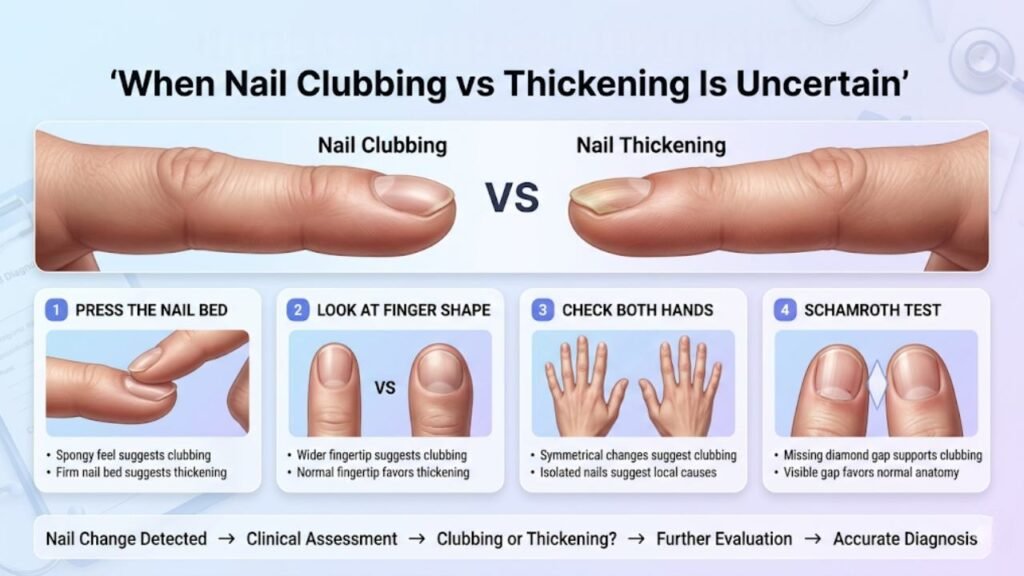
Press the nail bed — If it compresses noticeably and springs back (spongy feel), clubbing is more likely. A firm nail bed suggests thickening rather than clubbing.
Look at the finger shape — Is the overall fingertip wider and rounder than it should be proportionate to the rest of the finger? This broader digital tip is characteristic of clubbing.
Look at both hands — Is the change symmetrical across multiple digits? Symmetric multi-digit involvement suggests clubbing. Isolated nail changes in one or two nails suggest a local cause.
Schamroth test — Place the nail surfaces of two corresponding fingernails face to face. If the diamond-shaped gap at the cuticle level is absent, this supports clubbing.
When doubt remains after clinical assessment, physician evaluation with appropriate investigation is the appropriate next step.
Practical Guidance: What to Do if You Notice Nail Changes
If your nails are thickening (becoming hard, dense, discolored):
- See a podiatrist for evaluation and laboratory testing
- Do not start antifungal treatment without confirming fungal infection — other causes require different management
- Assess footwear and athletic activity for contributing mechanical factors
- Monitor whether the change is spreading to other nails
If your nails are curving downward and your fingertips seem rounder or softer than before:
- See a physician — not just a podiatrist
- Do not wait to see if it gets better on its own
- Be prepared for chest imaging and blood tests
- If you smoke or have a history of lung problems, cardiac conditions, or bowel disease, mention this to your doctor
If you are not sure which situation you have:
- See a healthcare professional — either a podiatrist as a starting point if you think local nail disease is more likely, or your primary care physician if you have any systemic health concerns
- Do not rely on appearance alone to distinguish nail clubbing vs thickening — clinical examination is needed
Frequently Asked Questions
What is the main difference between nail clubbing vs thickening?
Nail thickening primarily involves the nail plate becoming denser and harder, usually from local causes like fungal infection or trauma. Nail clubbing involves the soft tissue beneath the nail enlarging, the fingertip becoming bulbous, and the nail angle changing — caused by systemic conditions affecting the heart, lungs, liver, or bowel.
Is nail clubbing dangerous?
It can be. Nail clubbing is associated with serious underlying conditions including lung cancer, heart disease, and inflammatory bowel disease. New nail clubbing in an adult without a known cause requires medical investigation — including chest imaging — to rule out serious pathology.
Can you have both nail clubbing and nail thickening at the same time?
Yes. A patient with an underlying condition causing nail clubbing can also develop nail thickening from fungal infection, aging, or footwear pressure. Assessing the nail bed feel and the angle of the nail helps distinguish which component is present.
How do I test for nail clubbing at home?
The Schamroth window test: press the nail surfaces of two corresponding fingers face to face at the cuticle. In healthy nails, a small diamond-shaped gap appears. In nail clubbing, this gap is absent. If you notice this gap is missing, see a physician.
Does nail thickening ever indicate serious disease?
In most cases, nail thickening indicates local conditions — fungal infection, trauma, or aging — rather than serious systemic disease. However, nail thickening alongside other symptoms (joint pain suggesting psoriatic arthritis, circulation problems, immune compromise) may have health implications worth investigating.
Should I see a podiatrist or a physician for nail changes?
For isolated nail plate thickening without changes to finger shape or nail curvature — see a podiatrist for evaluation, laboratory testing, and local nail management. For any nail change involving fingertip rounding, downward nail curvature, or spongy nail bed — see a physician for systemic evaluation.
Summary
Nail clubbing vs thickening represents two very different clinical conditions that both produce visible nail changes but originate from completely different causes and carry completely different health implications.
Nail thickening is a local nail condition — the nail plate becomes denser from fungal infection, physical trauma, footwear pressure, aging, or nail psoriasis. It is generally manageable with the right treatment matched to the confirmed cause. It does not typically signal serious underlying disease.
Nail clubbing is a systemic clinical sign — the fingertip soft tissue enlarges, the nail angle changes, and the nail curves over a rounder, softer fingertip. It is associated with pulmonary, cardiac, gastrointestinal, and hepatic disease. New nail clubbing in an adult without a known cause is a clinical signal that requires medical investigation, not watchful waiting.
The 5 critical differences — what has changed structurally, local vs systemic cause, which nails are affected, development speed, and medical urgency — give patients and clinicians a practical framework for recognizing which situation they are dealing with. Getting this distinction right protects patients from both missed serious diagnoses and from the anxiety of mistaking a manageable local nail condition for something more concerning.
Struggling to get an appointment?
We help patients in your area bypass clinic waitlists by instantly finding verified podiatry doctors who accept their insurance.