Laser Debulking for Thick Nails Explained
Find a Podiatrist Near You
Get same-day appointments with verified podiatrists. Insurance accepted.
Laser debulking for thick nails is a treatment option that more patients are encountering when they visit podiatry clinics with severely thickened, painful, or difficult-to-manage toenails. It sits in a specific clinical space — between routine professional debridement with mechanical instruments and surgical nail removal — and serves patients for whom standard trimming tools are no longer adequate but surgery is not yet necessary or desired.
The term “laser debulking” is sometimes used interchangeably with laser fungal nail treatment, but these are actually different applications. Laser debulking for thick nails focuses on reducing the physical thickness of the nail plate — making the nail thinner, smoother, and more manageable — using laser energy as the instrument of nail tissue reduction. It is a procedure focused on nail structure management, not necessarily on treating the underlying cause.
This guide explains how laser debulking for thick nails actually works, who it is most appropriate for, what the realistic benefits and limitations are, and how it compares to other management options for thick nail conditions.
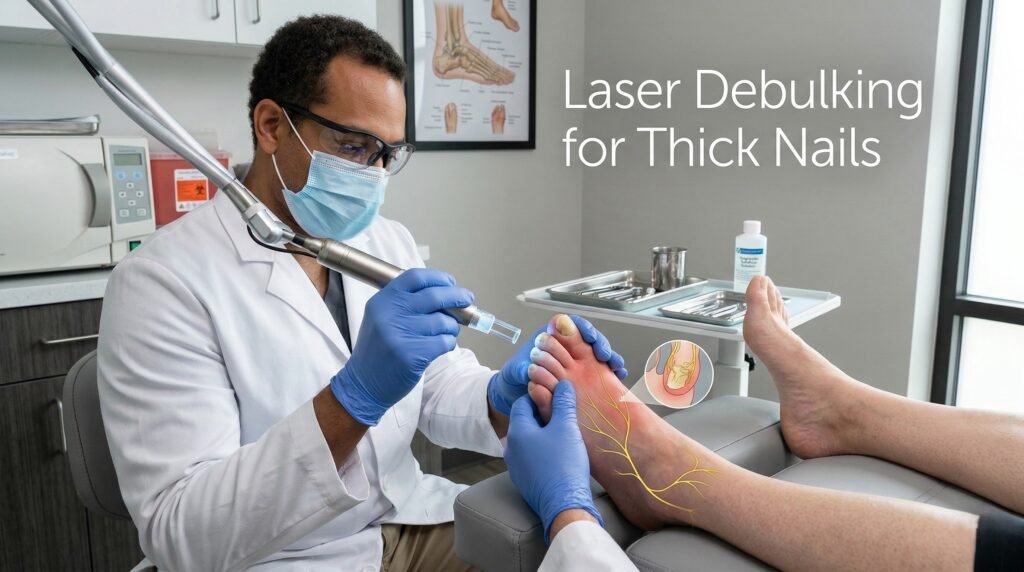
What Is Laser Debulking for Thick Nails?
Laser debulking for thick nails is a procedure where focused laser energy is used to ablate — precisely remove or thin — excess nail plate material. The laser delivers energy in a controlled manner to the nail surface, heating and vaporizing nail tissue layer by layer without the physical force required by mechanical instruments.
The goal of laser debulking for thick nails is to reduce the nail plate to a more normal, manageable thickness. This:
- Removes the physical bulk that causes pressure inside footwear
- Reduces compression on the nail bed beneath the thickened plate
- Makes the nail easier to manage between professional appointments
- Improves topical medication penetration if concurrent antifungal therapy is being used
It is important to understand what laser debulking for thick nails is not:
- It is not a cure for the underlying condition causing nail thickening
- It is not the same as laser treatment for fungal infection (though some laser systems can address both in the same session)
- It does not prevent the nail from growing back to its previous thickness if the underlying cause is not also addressed
- It is not a replacement for treating confirmed fungal infection with antifungal medication
Why Some Thick Nails Cannot Be Managed With Standard Instruments
To appreciate when laser debulking for thick nails becomes relevant, it helps to understand why some nails exceed the management capacity of standard professional debridement tools.
In routine podiatric nail care, thickened nails are managed using:
- Heavy-duty nail nippers for cutting
- Electric nail grinders or rotary burrs for reducing nail thickness
- Nail files for smoothing
These instruments work effectively for the majority of thick nail presentations. However, certain nail conditions produce nail plates that are:
- So thick and hard that rotary instruments struggle to make progress without excessive heat generation and patient discomfort
- Structurally fragile underneath the surface hardness — the nail shatters or splinters when cut rather than cutting cleanly
- Adhesed tightly to the nail bed in a way that makes aggressive mechanical reduction risky
- Infected with organisms that aerosolize nail dust as a transmission risk — laser vaporization reduces this concern in some clinical settings
For these nail presentations, laser debulking for thick nails offers a more controlled and precise method of nail reduction.
5 Key Facts About Laser Debulking for Thick Nails
Fact 1: Laser Debulking Uses Focused Energy to Ablate Nail Tissue — Not Heat to Kill Fungus
The laser technology used for nail debulking works differently from the laser technology used for fungal nail treatment, though some systems combine both functions.
In fungal laser treatment (such as Nd:YAG 1064nm protocols):
The laser generates heat within the nail plate designed to reach temperatures lethal to fungal organisms. The goal is biological — destroying the causative organism.
In laser debulking for thick nails:
The laser ablates nail plate material — it physically removes nail tissue through photovaporization or photothermal ablation. The laser converts nail tissue to vapor precisely and in a controlled manner, layer by layer, reducing the nail plate thickness.
Some modern laser systems can perform both functions in a combined protocol — thinning the nail through ablation while simultaneously generating temperatures at the nail bed level that have antifungal effect. Understanding which modality is being offered is important for patients evaluating treatment options.
The ablative component of laser debulking for thick nails is what produces the immediate structural benefit — a thinner, more manageable nail after the procedure.
Fact 2: Laser Debulking Is Not Painful in the Way Mechanical Instruments Can Be
One of the practical advantages of laser debulking for thick nails over aggressive mechanical rotary reduction is the patient experience during the procedure.
With rotary instruments on very thick, dense nails:
- Heat can build up at the nail surface despite water cooling
- Pressure is required that some patients find uncomfortable
- Vibration transmits through the nail to the nail bed
- For patients with sensitive feet or concurrent nail bed pain, this can be challenging
With laser debulking for thick nails:
- No physical contact or pressure is applied to the nail
- Patients typically describe sensations as mild warmth
- The procedure is well tolerated without anesthesia in the majority of cases
- The precision of the energy delivery means surrounding tissue is minimally affected
For elderly patients, patients with hypersensitive feet, or patients who have found mechanical debridement uncomfortable in the past, laser debulking for thick nails may be a more tolerable alternative.
Fact 3: The Results Are Immediate But Not Permanent Without Addressing the Underlying Cause
Laser debulking for thick nails produces immediately visible nail thinning. After the procedure, the nail is measurably thinner than before, typically fitting more comfortably inside footwear and with less pressure on the nail bed.
However, the nail continues to grow from the nail matrix. If the cause of the thickening — fungal infection, ongoing trauma, psoriasis, poor circulation — is not addressed, the nail will regrow to its previous thickness over the subsequent growth cycle.
This means laser debulking for thick nails is most effective when:
- Combined with treatment of the confirmed underlying cause (antifungal therapy for fungal infection, footwear correction for trauma-related thickening)
- Part of a regular maintenance schedule, repeated periodically as the nail regrows
- Not viewed as a one-time cure but as a management tool within a broader treatment plan
The comparison to professional mechanical debridement is useful here: mechanical debridement also produces immediate nail thinning that is not permanent without addressing the cause. Laser debulking for thick nails offers the same fundamental benefit with a different delivery mechanism.
Fact 4: Laser Debulking for Thick Nails Has Specific Advantages Over Mechanical Debridement in Certain Patient Groups
For most patients with thick nails, professional mechanical debridement with specialist instruments remains the primary management approach — it is effective, widely available, and appropriate for the majority of presentations.
Laser debulking for thick nails offers specific advantages in situations where mechanical approaches are less than ideal:
Extremely hard, dense nails — Nails that have become stone-like in their consistency respond better to laser ablation than to mechanical grinding, which can generate excessive heat and takes significantly longer to achieve adequate reduction.
Nails with concurrent fungal infection being actively treated — In the context of combined treatment approaches for onychomycosis, laser sessions that both debulk the nail and address fungal organisms simultaneously provide dual benefit without requiring separate appointments.
Patients with high nail dust hypersensitivity or clinic exposure concerns — Mechanical grinding of infected nails produces nail dust that may aerosolize fungal spores. Laser vaporization produces a different type of particulate that some clinicians prefer for infection control reasons.
Patients with sensitivity to mechanical vibration — Those with peripheral nerve conditions who find the vibration of mechanical instruments uncomfortable may tolerate laser better.
Patients with specific circulatory conditions — When nail blood supply is significantly reduced, aggressive mechanical cutting may not be appropriate. Laser provides a no-pressure alternative.
Fact 5: Laser Debulking Is Not the Same as Standard Nail Fungus Laser Treatment
Many patients encounter laser treatment for nail fungus and assume it is the same as laser debulking for thick nails. The two procedures overlap in some applications but are conceptually different.
Standard laser nail fungus treatment (e.g., Nd:YAG protocol):
- Designed to heat nail plate and nail bed tissue to temperatures lethal to fungal organisms
- Does not necessarily ablate or remove nail material — it heats it
- Goal: mycological cure (eliminating fungal organisms)
- Outcome measured by: negative laboratory testing after treatment
Laser debulking for thick nails:
- Designed to remove excess nail material through laser ablation
- Goal: physical nail plate reduction — making the nail thinner and more manageable
- Outcome measured by: immediate nail thickness reduction and improved patient comfort
Some modern laser systems combine elements of both approaches — thinning the nail through ablation while achieving antifungal temperature effects simultaneously. This combination approach has logical appeal for fungal thick nails — addressing both the thickness and the underlying infection in one procedure.
When evaluating laser debulking for thick nails, asking the treating clinician which specific laser system is being used and what its primary mode of action is helps set appropriate expectations.
Who Is Most Likely to Benefit From Laser Debulking for Thick Nails?
Most appropriate for:
- Patients with severely thickened nails that cannot be adequately managed with standard professional debridement due to nail density or patient tolerance issues
- Elderly patients with onychogryphosis-type thickening where nail management is a regular ongoing need and laser provides a more comfortable experience
- Patients with concurrent fungal infection where combined laser debulking and antifungal laser protocols address both nail thickness and infection simultaneously
- Patients with painful nail beds where pressure from mechanical instruments is not well tolerated
- Patients who have found mechanical nail care uncomfortable and are looking for an alternative approach
Less appropriate for or not requiring laser specifically:
- Patients with mild to moderate nail thickening manageable with standard professional instruments — mechanical debridement is effective and more widely accessible
- Patients whose primary concern is fungal infection without significant nail structural thickening — antifungal medication remains the most evidence-supported primary treatment
- Patients expecting laser debulking for thick nails to be a one-time permanent solution without addressing the underlying nail condition
What the Procedure Actually Looks Like
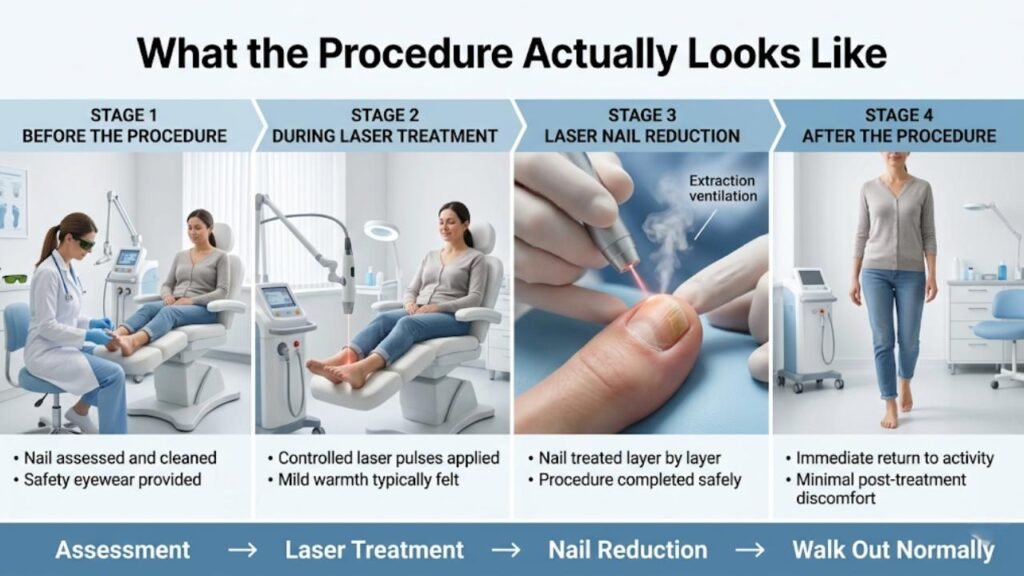
Before the procedure:
The nail is cleaned. The treating clinician assesses nail thickness, surface condition, and any associated fungal or structural changes. Safety eyewear is worn by both the patient and clinician for the duration of the laser session.
During the procedure:
The laser handpiece is held close to but not contacting the nail surface. Short controlled pulses of laser energy are delivered to the nail plate. With ablative protocols, nail material is removed layer by layer. With thermal protocols, the nail is heated to the target temperature throughout its depth.
Patients typically feel mild warmth. The procedure does not require anesthesia. Occasional brief sharp sensations may occur, particularly over thinner nail areas or inflamed nail beds.
The nail may smoke slightly during ablative applications — this is expected and clinics use appropriate ventilation.
Duration: Most sessions for laser debulking for thick nails on one or both feet take 20 to 45 minutes depending on the number of nails being treated and the degree of thickening.
After the procedure:
No dressing is required. Nails are slightly warmer than usual for a few minutes. Some mild redness around the nail fold may be present. Patients can walk out and return to normal activity immediately.
Managing Expectations: What Laser Debulking for Thick Nails Can and Cannot Do
| What Laser Debulking Can Do | What Laser Debulking Cannot Do |
|---|---|
| Immediately thin a severely thick nail | Permanently prevent nail from regrowing thick |
| Reduce nail bed pressure and footwear discomfort | Cure the underlying cause of nail thickening |
| Make nail more manageable between appointments | Replace antifungal medication for fungal infection |
| Improve topical medication penetration | Guarantee complete cosmetic nail restoration |
| Provide a more comfortable alternative to mechanical reduction for some patients | Remove the need for ongoing professional nail management |
Patients who approach laser debulking for thick nails with realistic expectations — a management tool that provides meaningful nail thinning and comfort improvement, most effective when combined with treatment of the underlying cause — consistently report positive experiences. Those expecting a single session to permanently resolve a nail that has been thickening for years are more likely to be disappointed.
How Laser Debulking Compares to Other Thick Nail Management Options
| Approach | Nail Reduction | Addresses Fungal Infection | Invasiveness | Recurrence Without Treatment |
|---|---|---|---|---|
| Professional mechanical debridement | Yes — immediate | No | Minimal | Yes — nail regrows thick |
| Laser debulking | Yes — immediate | Possibly (combined protocols) | Minimal | Yes — nail regrows thick |
| Oral antifungal medication | Indirectly over time | Yes — primary treatment | None (oral) | Yes — if reinfection occurs |
| Topical antifungal medication | Indirectly over time | Yes — limited efficacy | None (topical) | Yes — if reinfection occurs |
| Surgical nail avulsion | Yes — complete | Through nail bed access | Surgical — local anesthesia | New nail grows (unless matrix treated) |
Frequently Asked Questions About Laser Debulking for Thick Nails
How many sessions of laser debulking for thick nails are needed?
The number of sessions varies based on nail thickness and the underlying cause. A single session produces immediate thinning. Maintenance sessions — typically every 3 to 6 months depending on nail growth rate and thickening severity — are often needed for ongoing management, particularly when the underlying cause (such as genetic nail tendency or age-related thickening) cannot be fully eliminated.
Is laser debulking for thick nails covered by insurance?
Coverage varies by plan and by how the procedure is coded and documented. Procedures documented as medically necessary for painful nail conditions may be covered under some plans. Laser treatments categorized as cosmetic are typically not covered. Discussing documentation and coding with your podiatrist and checking with your insurance provider before treatment is the most reliable approach.
Does laser debulking hurt?
Most patients tolerate laser debulking for thick nails well without anesthesia. Sensations are typically described as mild warmth or occasional brief sharpness. It is generally more comfortable than aggressive mechanical grinding for patients with very hard, thick nails.
Can laser debulking for thick nails treat the fungal infection causing the thickening?
Some laser systems combine ablative debulking with antifungal thermal protocols in the same session. This combined approach addresses both the nail structure and the fungal component simultaneously. Standard ablative debulking alone does not replace dedicated antifungal treatment — oral or topical antifungal medication remains the most evidence-supported approach for mycological cure of established onychomycosis.
How long do the results of laser debulking for thick nails last?
Immediately after the procedure, the nail is significantly thinner. As the nail continues to grow from the matrix, it gradually regrows to its previous thickness over the following months — especially if the underlying cause is not addressed. With regular maintenance sessions and concurrent treatment of the underlying cause, the nail can be kept at a manageable thickness long-term.
Is laser debulking better than professional mechanical debridement?
Neither is universally better — they serve the same function (nail plate reduction) through different mechanisms. For most patients, professional mechanical debridement with specialist instruments is the primary approach and is widely available. Laser debulking for thick nails offers specific advantages for patients with extremely hard nails, poor tolerance of mechanical procedures, or when a combined debulking and antifungal laser protocol is clinically appropriate.
Summary
Laser debulking for thick nails is a precise, non-invasive procedure that reduces nail plate thickness using focused laser energy. It offers meaningful advantages over mechanical debridement in specific patient groups — particularly those with extremely dense nails, poor tolerance of vibration or mechanical pressure, or those undergoing combined laser debulking and antifungal treatment protocols.
The immediate results are genuine: a thinner, more manageable nail that causes less pressure inside footwear. The limitations are equally real: without addressing the underlying cause of nail thickening, the nail will regrow to its previous state, and laser debulking for thick nails does not replace antifungal medication for established fungal nail infection.
For patients with significant nail thickening that standard care cannot adequately manage, laser debulking for thick nails represents a practical, comfortable, and clinically appropriate addition to the management toolkit — most effectively when used as part of a comprehensive nail care plan rather than as a standalone treatment.
Struggling to get an appointment?
We help patients in your area bypass clinic waitlists by instantly finding verified podiatry doctors who accept their insurance.