Thick Toenails and Psoriasis Connection
Find a Podiatrist Near You
Get same-day appointments with verified podiatrists. Insurance accepted.
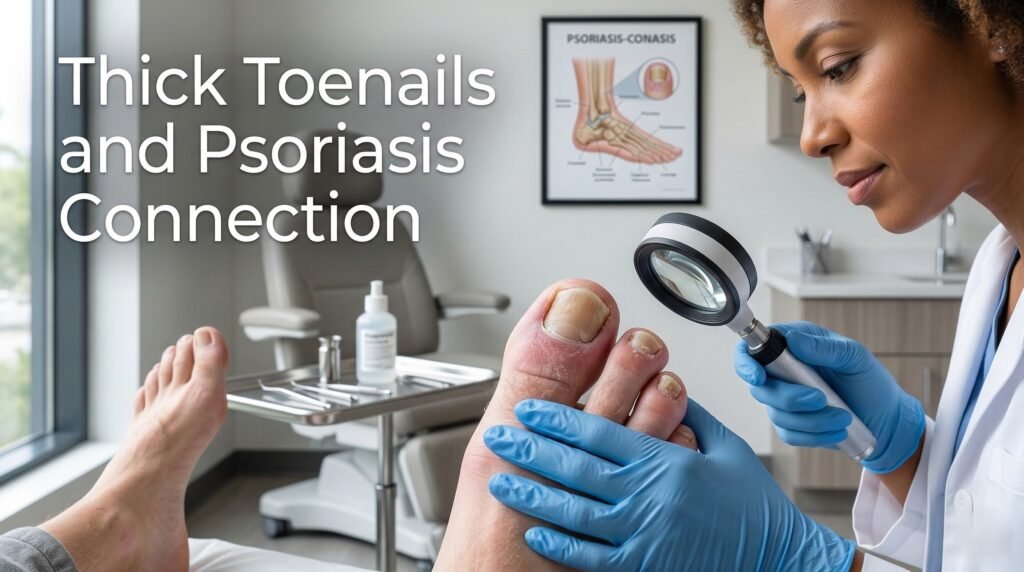
The thick toenails and psoriasis connection is one of the most consistently missed diagnoses in nail health. Thick, discolored toenails are almost universally assumed to be fungal. Patients spend months using antifungal products. Testing sometimes never gets done. And for the patients whose thick nails are actually caused by psoriasis — not fungus — every month of antifungal treatment is wasted time while the real condition continues affecting their nails.
Nail psoriasis affects a significant proportion of people with psoriasis — estimates suggest 40 to 80 percent will develop nail involvement at some point during their condition. And in some patients, nail changes appear before any skin plaques develop, making the psoriasis diagnosis even harder to connect to what is happening with the nails.
This guide explains the thick toenails and psoriasis connection in clear terms — how psoriasis affects nail growth, what nail psoriasis looks like versus fungal infection, how it is confirmed, and what treatment actually involves.
Why Psoriasis Causes Thick Toenails
To understand the thick toenails and psoriasis connection, you need to understand what psoriasis does to the tissues that produce and support the nail.
Psoriasis is a chronic autoimmune condition where the immune system triggers excessive inflammation that accelerates skin cell turnover. In normal skin, cells cycle over approximately 28 days. In psoriatic skin, that cycle accelerates to 3 to 7 days. Cells accumulate faster than the skin can shed them, producing the characteristic thick, scaly plaques on skin surfaces.
The nail unit is, in essence, specialized skin. The nail matrix — the growth center beneath the cuticle — is modified skin tissue. The nail bed beneath the nail plate is also skin. When psoriasis affects these structures, the same immune-driven acceleration of cell production occurs — but in the nail unit, the consequences look different from skin plaques.
What happens when psoriasis affects the nail matrix:
The matrix produces nail cells faster than normal. These cells are also disorganized and structurally less consistent than normal nail cells. The result is nail plate that is thicker, less uniform, more fragile at the edges, and sometimes separated into irregular layers — rather than the smooth, organized nail plate a healthy matrix produces.
What happens when psoriasis affects the nail bed:
The nail bed produces excess keratin in response to the chronic inflammation — a condition called subungual hyperkeratosis. This keratin accumulates beneath the nail plate, raising it from the nail bed. The nail appears thick because of the material accumulating beneath it — not just because the nail plate itself is thicker.
Both mechanisms — matrix-driven abnormal nail plate production and nail bed-driven subungual hyperkeratosis — contribute to the thick toenails and psoriasis connection.
6 Key Facts About Thick Toenails and Psoriasis
Fact 1: Nail Psoriasis Can Appear Without Skin Plaques
One of the most clinically important aspects of the thick toenails and psoriasis connection is that nail involvement can precede skin psoriasis — sometimes by years.
Patients who present with thick, changed toenails but no obvious psoriatic skin plaques are often not considered for nail psoriasis as a diagnosis. Their nails are tested for fungus. Testing may come back negative. A diagnosis is not reached. The psoriasis continues affecting the nail.
When a podiatrist or dermatologist encounters thick toenails with negative fungal testing, nail psoriasis must be on the differential diagnosis list — even when no skin plaques are visible. A careful history may reveal family history of psoriasis, past episodes of skin redness or scaling that resolved, or joint pain that could suggest psoriatic arthritis.
Fact 2: Nail Pitting Is a Distinctive Feature of Psoriasis That Fungus Does Not Cause
The most specific clinical sign of nail psoriasis — the one most helpful for the thick toenails and psoriasis connection — is nail pitting: small, regular depressions in the nail surface that look like the nail has been pricked with a pin multiple times.
Nail pitting occurs because psoriasis affects the proximal nail matrix — the part closest to the cuticle that forms the top surface of the nail plate. When this area of the matrix is inflamed, the surface nail cells it produces are abnormal and eventually shed, leaving small depressions in the nail surface.
Fungal nail infection does not produce pitting in this characteristic pattern. Nail surface changes in fungal infection tend to be irregular roughness, crumbling, and dullness — not organized pits.
When pitting is visible alongside nail thickening, the thick toenails and psoriasis connection becomes a strong clinical possibility, even before laboratory testing.
Fact 3: The Oil-Drop Sign Is Highly Specific to Psoriasis
Another distinctive sign of the thick toenails and psoriasis connection is the oil-drop sign (also called the salmon patch): a yellowish-brown or salmon-colored discoloration visible through the nail plate, with a clearly defined border, located beneath the nail and moving with the nail as it grows.
The oil-drop sign results from psoriatic inflammation and abnormal keratinocyte production in the nail bed. It has a characteristic translucent quality — it looks like a drop of oil has been placed under the nail.
This sign is significantly more specific to nail psoriasis than the general yellow or brown discoloration seen in fungal infection. When an oil-drop sign is visible alongside nail thickening, nail psoriasis is a strong working diagnosis.
Fact 4: Concurrent Fungal Infection Is Common in Psoriatic Nails
This is a clinically important complexity of the thick toenails and psoriasis connection: nail psoriasis and fungal infection frequently coexist.
Psoriatic nails are structurally vulnerable. The abnormal nail architecture — irregular nail plate, subungual hyperkeratosis, onycholysis creating lifted nail spaces — creates conditions where fungal organisms can more easily establish themselves. Published studies suggest that patients with nail psoriasis have a higher rate of concurrent onychomycosis than the general population.
This creates a diagnostic challenge:
- A patient with nail psoriasis and concurrent fungal infection needs treatment for both
- Treating only the fungal infection leaves the psoriatic component active
- Treating only the psoriasis leaves the fungal infection contributing to nail damage
- Assuming that a positive fungal test explains everything may miss the psoriatic component that will prevent full nail recovery even after fungal clearance
This is why laboratory testing — to confirm whether fungal infection is present — is important even when the clinical picture strongly suggests psoriasis. And why clinical evaluation by a dermatologist or podiatrist with experience in nail conditions matters for the thick toenails and psoriasis connection.
Fact 5: Psoriasis-Related Thick Toenails Signal Psoriatic Arthritis Risk
The thick toenails and psoriasis connection has an important systemic dimension: nail psoriasis is one of the strongest risk factors for psoriatic arthritis (PsA).
Psoriatic arthritis is a chronic inflammatory joint condition that can cause significant pain, joint damage, and disability. Early identification and treatment improves long-term outcomes significantly. Nail psoriasis — including thick, changed toenails from psoriatic involvement — predicts PsA risk with enough reliability that its presence in a patient with psoriasis should prompt discussion about joint symptoms.
Patients with nail psoriasis who notice new joint pain, morning stiffness, or swelling in fingers or toes should report this to their rheumatologist or dermatologist promptly.
The thick toenails and psoriasis connection, in this context, is not just a nail health issue — it is a systemic health indicator.
Fact 6: Antifungal Treatment Alone Does Not Help Psoriatic Nails
This is the most practically important fact in the thick toenails and psoriasis connection: if the thick nail is caused by psoriasis rather than (or in addition to) fungal infection, antifungal treatment targeting only the fungal component will not improve the psoriatic nail changes.
The nail thickening, pitting, oil-drop sign, and subungual hyperkeratosis of nail psoriasis are immune-driven phenomena. Antifungal medication does not suppress immune-driven inflammation. It will not improve nail plate quality, reduce subungual hyperkeratosis, or restore normal matrix function in a nail affected by psoriasis.
Months spent on antifungal treatment for psoriatic nails means months of the psoriatic process continuing unchecked — and months of wasted effort and expense on treatment that cannot address the actual cause.
Nail Psoriasis vs Fungal Infection: A Clear Comparison
| Feature | Nail Psoriasis | Fungal Nail Infection |
|---|---|---|
| Nail pitting | Common and characteristic | Rare |
| Oil-drop/salmon patch sign | Present in many cases | Absent |
| Subungual debris appearance | White, chalky-scaly | Crumbly, brown-yellow |
| Nail fold involvement | Possible (psoriatic paronychia) | Uncommon |
| Skin psoriasis elsewhere | Present in most (not all) | Absent |
| Family history of psoriasis | Often present | Not typical |
| Contagious | No | Yes |
| Fungal lab test (KOH/culture) | Negative (unless concurrent) | Positive |
| Response to antifungal | Psoriatic component does not improve | Gradual improvement |
| Associated joint pain | Possible (psoriatic arthritis) | Not associated |
Recognizing Nail Psoriasis: The Full Clinical Picture
Beyond the specific signs of pitting and oil-drop, the thick toenails and psoriasis connection produces a broader range of nail changes depending on which part of the nail unit the psoriasis is affecting.
Signs of proximal nail matrix involvement:
- Nail surface pitting
- Nail plate crumbling at the surface
- Whitish patches in the nail plate (leukonychia)
- Lines across the nail (Beau’s lines in severe flares)
Signs of distal nail matrix involvement:
- Nail thickening
- Loss of nail transparency
- Yellow-white discoloration of the nail plate
Signs of nail bed involvement:
- Oil-drop or salmon patch discoloration
- Subungual hyperkeratosis — accumulation of keratin beneath the nail
- Onycholysis — nail lifting from the nail bed, often with a distinct border to the separated area
Signs of nail fold involvement:
- Psoriatic changes in the skin around the nail
- Sometimes associated with paronychia-type swelling
Not all patients will show all of these signs. Some will present predominantly with thick nails and discoloration. Others will show more pitting and lifting. The pattern varies by individual, and by how severely the psoriasis is affecting each part of the nail unit.
How the Thick Toenails and Psoriasis Connection Is Confirmed
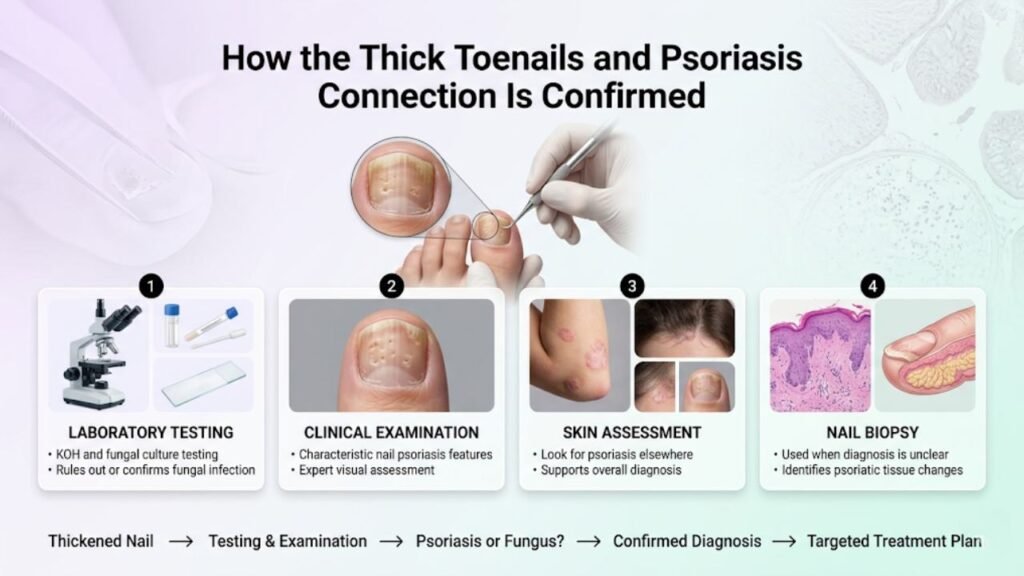
Laboratory Testing to Rule Out or Confirm Concurrent Fungal Infection
KOH microscopy and fungal culture should be performed on nail material from any thick, changed toenail before initiating specific treatment. If fungal testing is negative and the clinical picture suggests psoriasis, nail psoriasis becomes the likely diagnosis.
If testing is positive, both conditions may be present simultaneously — and management needs to address both.
Clinical Examination
An experienced dermatologist or podiatrist can recognize the characteristic signs of nail psoriasis — particularly pitting, oil-drop sign, and the pattern of subungual hyperkeratosis — that distinguish it from typical fungal nail infection.
Skin Assessment
The presence of psoriatic plaques elsewhere — elbows, knees, scalp, lower back, intergluteal fold — strongly supports nail psoriasis when nail changes are present. However, nail changes can precede skin involvement, so absence of skin plaques does not rule out nail psoriasis.
Nail Biopsy
In uncertain cases — particularly when both psoriasis and fungal infection seem possible but testing is inconclusive — a nail biopsy with pathological examination can demonstrate psoriatic changes in the nail unit tissue directly.
Treatment for Thick Toenails and Psoriasis Connection
Treatment for nail psoriasis differs significantly from treatment for fungal nail infection. The goal is to suppress the immune-driven inflammation that is disrupting normal nail growth.
Topical Treatments
Potent topical corticosteroids applied to the nail fold, nail plate, and hyponychium can reduce inflammation in the nail unit. Application to the proximal nail fold area allows some penetration to the nail matrix beneath. Results are typically modest but can reduce pitting, subungual hyperkeratosis, and discomfort.
Topical vitamin D analogs (calcipotriol/calcitriol) reduce the excessive keratinocyte proliferation that drives subungual hyperkeratosis. Often combined with topical steroids.
Topical calcineurin inhibitors (tacrolimus, pimecrolimus) may be used in nail fold areas as an alternative to steroids with fewer skin-thinning side effects.
Topical treatment is most appropriate for mild to moderate nail psoriasis and is limited by how effectively medications can penetrate the nail plate to reach the nail bed and matrix.
Intralesional Injections
Injecting corticosteroids directly into the nail matrix area (under the proximal nail fold) bypasses the penetration barrier of the nail plate and delivers medication directly to the inflamed tissue. This approach is more effective than topical steroids for nail matrix-related changes and is typically performed by a dermatologist. Results can include significant reduction in pitting, nail plate thickening, and oil-drop changes.
Systemic Treatments
For patients with moderate to severe psoriasis affecting both skin and nails, systemic treatments may be considered:
Methotrexate — reduces immune activity throughout the body, improving both skin and nail psoriasis.
Biologic medications — newer targeted treatments including TNF-alpha inhibitors (adalimumab, etanercept), IL-17 inhibitors (secukinumab, ixekizumab), and IL-23 inhibitors (guselkumab, risankizumab) produce some of the most significant nail psoriasis improvement seen in clinical trials. Biologics addressing the IL-17 pathway in particular show strong nail response.
Apremilast (an oral PDE4 inhibitor) also shows benefit for nail psoriasis in clinical studies and may be appropriate for patients who prefer oral medication over injections.
Systemic treatment for nail psoriasis is managed by a dermatologist or rheumatologist (when psoriatic arthritis is also present) and typically reserved for patients with significant skin psoriasis alongside nail involvement, or for patients with disabling nail disease.
Professional Podiatric Nail Care
Regardless of the systemic or topical treatment being used, professional nail management helps with the structural consequences of nail psoriasis:
- Reducing nail plate thickness through debridement
- Safely trimming nails that have become too difficult to manage at home
- Managing subungual hyperkeratosis by clearing accumulated keratin debris
- Providing padding or protective measures for nails that are lifting and causing irritation
Treatment When Fungal Infection Coexists
When both nail psoriasis and fungal infection are confirmed, appropriate antifungal therapy is added to the psoriasis management plan. This typically means:
- Oral antifungal therapy (terbinafine or itraconazole depending on organism) for the fungal component
- Topical or systemic psoriasis treatment continued alongside
- Both conditions treated simultaneously rather than sequentially
Practical Nail Care for the Thick Toenails and Psoriasis Connection
Alongside medical treatment, daily nail care habits reduce complications and discomfort:
Trim nails regularly — keep them short to reduce the weight of the nail plate on the nail bed and reduce lifting and snagging.
Do not pick at the nail or try to remove subungual debris aggressively — this can trigger the Koebner phenomenon in psoriasis, where trauma to psoriatic tissue causes new psoriatic involvement to develop at the site of injury.
Moisturize the nail and surrounding skin — psoriatic nail folds and surrounding skin tend toward dryness and cracking. Regular moisturizing reduces this.
Wear appropriate footwear — adequate toe box space reduces pressure on psoriatic nails that may already be sensitive from subungual hyperkeratosis.
Protect nails from injury — any nail trauma can worsen psoriatic nail involvement through the Koebner effect.
Frequently Asked Questions
Can psoriasis cause thick toenails?
Yes. Psoriasis affecting the nail matrix causes thicker, structurally abnormal nail plate. Psoriasis affecting the nail bed causes subungual hyperkeratosis — keratin accumulation beneath the nail — that makes the nail appear and feel thicker. Both mechanisms contribute to the thick toenails and psoriasis connection.
How is nail psoriasis different from fungal infection?
Nail pitting, oil-drop discoloration with a clear border, and the association with skin psoriasis or psoriatic arthritis suggest nail psoriasis. These features are uncommon in fungal infection. Laboratory testing — KOH microscopy and fungal culture — confirms whether fungal organisms are present. Nail psoriasis is not contagious; fungal infection is.
Can you have both nail psoriasis and nail fungus?
Yes. Psoriatic nails are structurally abnormal and more susceptible to fungal colonization. Concurrent nail psoriasis and onychomycosis is documented and more common than in nails without psoriasis. Both conditions need to be identified and treated.
Will antifungal treatment help psoriatic thick toenails?
Only if fungal infection is also present. The psoriatic component of thick toenails does not respond to antifungal medication. Treating nail psoriasis requires immune-modulating treatment — topical or systemic — not antifungals.
Can nail psoriasis improve with treatment?
Yes, though nail psoriasis is one of the more difficult manifestations of psoriasis to treat because of how slowly nails grow and how hard it is to get medication to the nail matrix. Systemic treatments — particularly biologic medications — produce the most consistent improvement. Full nail recovery takes many months to over a year because even with successful treatment, the nail must grow out completely to replace the previously affected nail.
Should I see a dermatologist or podiatrist for nail psoriasis?
Both have a role. A dermatologist manages the systemic psoriasis treatment that addresses the underlying immune cause. A podiatrist manages the structural nail consequences — debridement, thickness management, nail fold care. Ideally both are involved when nail psoriasis is causing significant nail changes.
Summary
The thick toenails and psoriasis connection is a clinically important and frequently missed relationship. Psoriasis affects the nail unit through two main mechanisms — disrupted nail plate production at the matrix and subungual hyperkeratosis at the nail bed — both of which produce thick, structurally abnormal toenails.
Nail psoriasis shares many visual features with fungal nail infection but can be distinguished by specific signs — nail pitting, oil-drop discoloration, psoriatic skin elsewhere, and negative fungal testing. Both conditions can coexist, requiring treatment of both simultaneously.
The six key facts of the thick toenails and psoriasis connection — that nail changes can precede skin plaques, that pitting is highly distinctive of psoriasis, that the oil-drop sign is specific to psoriasis, that concurrent fungal infection is common, that nail psoriasis signals psoriatic arthritis risk, and that antifungal treatment alone cannot help psoriatic nails — give patients and clinicians the framework to approach this condition accurately.
If your thick toenails have not responded to antifungal treatment and you have any personal or family history of psoriasis, professional evaluation for nail psoriasis is the most important next step.
Struggling to get an appointment?
We help patients in your area bypass clinic waitlists by instantly finding verified podiatry doctors who accept their insurance.