Laser Wavelengths Used for Nail Fungus
Find a Podiatrist Near You
Get same-day appointments with verified podiatrists. Insurance accepted.
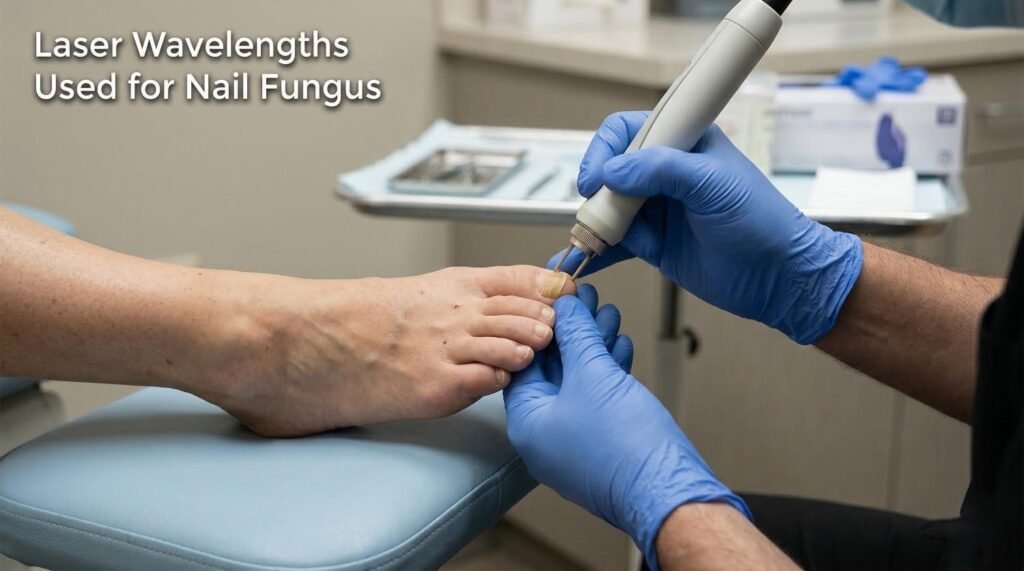
Laser wavelengths used for nail fungus represent one of the more technically complex areas of onychomycosis treatment — and one where patient confusion is understandable. Clinics offering “laser nail fungus treatment” often use different devices, different wavelengths, and different protocols, yet present the technology as a singular concept. Understanding why specific wavelengths matter, how each interacts with nail tissue and fungal organisms, and what the clinical evidence actually shows is essential for making informed treatment decisions.
Laser therapy for nail fungus works on the principle that laser light delivered to the nail generates heat within the nail plate and subungual space. That heat, if calibrated correctly, reaches temperatures that are lethal to fungal cells — while the surrounding nail and skin tissue, which have different optical properties, absorb and dissipate the heat more effectively without sustaining damage.
The wavelength of the laser determines how deeply the light penetrates, which specific chromophores (light-absorbing molecules) it targets, and what temperature profile it generates within the nail unit. This is why laser wavelengths used for nail fungus matter clinically — different wavelengths produce fundamentally different treatment profiles.
The Physics Behind Laser-Tissue Interaction in the Nail
Before examining specific laser wavelengths used for nail fungus, understanding the optical properties of nail tissue helps explain why certain wavelengths are preferred.
Nail keratin and light:
The nail plate is composed primarily of keratin — a protein that absorbs light across a broad spectrum but most strongly in the UV range. At near-infrared wavelengths (800 to 1200 nm), keratin absorbs relatively little light, meaning the laser penetrates through the nail plate rather than being absorbed at the surface. This “transmission window” in the near-infrared range is why the most clinically relevant laser wavelengths used for nail fungus fall in this region — they pass through the nail plate to reach the subungual space and nail bed where the fungal organisms are concentrated.
Water and tissue:
Water absorbs laser light strongly at longer wavelengths (above approximately 1400 nm, with strong absorption peaks at 2940 nm for Er:YAG and 10,600 nm for CO₂ lasers). At these wavelengths, laser energy is absorbed very near the surface and produces rapid heating and tissue ablation — useful for nail thinning but not for reaching deep subungual infection.
Fungal cell targets:
Dermatophyte cells contain proteins and lipid membranes that denature and rupture at temperatures above approximately 50 to 60 degrees Celsius. The thermal susceptibility of fungal cells at temperatures achievable by laser treatment is the biological mechanism underlying laser therapy for nail fungus.
Nd:YAG 1064 nm — The Dominant Wavelength in Clinical Practice
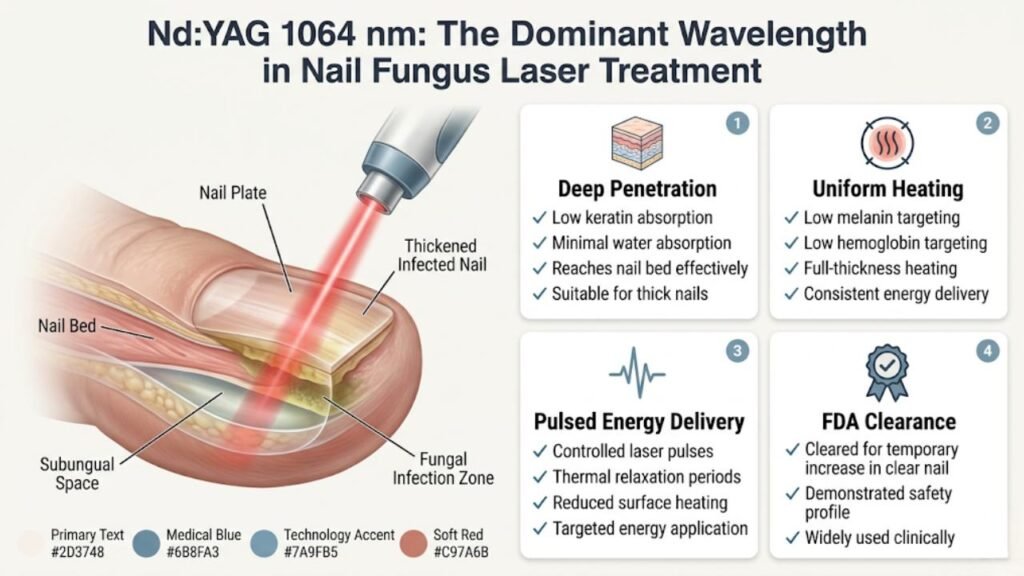
The neodymium:yttrium-aluminum-garnet (Nd:YAG) laser operating at 1064 nm is the most extensively studied and most widely used wavelength for nail fungus laser treatment globally, and it is the system with the most published clinical evidence.
Why 1064 nm is well-suited to nail fungus treatment:
Deep penetration: At 1064 nm, keratin absorption is low and water absorption is minimal. The light penetrates through the full thickness of the nail plate — including significantly thickened infected nails — reaching the subungual space and nail bed where Trichophyton rubrum and other dermatophytes are concentrated. Studies using ex vivo nail specimens have demonstrated that Nd:YAG 1064 nm energy can generate therapeutic temperatures (above 50°C) at the nail bed level.
Minimal surface chromophore targeting: Unlike shorter wavelengths that are preferentially absorbed by melanin or hemoglobin, 1064 nm has relatively low affinity for these chromophores. This means it heats tissue relatively uniformly rather than targeting superficial pigment — an advantage when the goal is heating the full thickness of the nail, not treating a surface lesion.
Pulsed delivery: Clinical Nd:YAG protocols for nail fungus use pulsed energy delivery — laser pulses of defined duration and intervals — that allow thermal relaxation between pulses. This selective photothermolysis approach allows target temperature to be reached in the nail bed while surface skin temperature is managed by the cooling intervals.
FDA clearance:
Multiple Nd:YAG 1064 nm devices have received FDA clearance for onychomycosis treatment — specifically for “temporary increase in clear nail.” It is important to note that FDA clearance indicates demonstrated safety and efficacy for the described purpose — it does not mean the same thing as FDA approval for cure of onychomycosis.
Clinical evidence for 1064 nm:
Published clinical trials and systematic reviews show that Nd:YAG 1064 nm laser treatment produces measurable improvement in nail appearance and mycological improvement (reduced fungal culture positivity) in a significant proportion of treated patients. A 2018 Cochrane-methodology-aligned systematic review found that laser treatment produced clinical improvement rates of 60 to 75 percent in controlled studies — though complete mycological cure rates were more variable and generally lower than those achieved with oral terbinafine.
Important caveat:
The clinical evidence base for all laser wavelengths used for nail fungus has methodological limitations — studies are frequently short-term, lack standardized outcome measures, use varying protocols, and many were funded by device manufacturers. Interpreting laser efficacy claims requires awareness of these limitations.
Diode Lasers — 870 nm, 940 nm, and 980 nm
Diode lasers operating in the range of 870 to 980 nm represent the second major category of laser wavelengths used for nail fungus. They are widely available in podiatry and dermatology clinics due to the lower equipment cost and smaller device footprint compared to Nd:YAG systems.
The 870 nm and 930 nm dual-wavelength approach:
One specific commercially successful system uses a proprietary combination of 870 nm and 930 nm diode laser energy — applied sequentially or simultaneously. The rationale is that 870 nm has specific optical properties that target fungal cell components, while 930 nm targets water in fungal cells.
What the research shows for dual-wavelength diode:
Some studies have reported mycological cure rates comparable to or in some cases exceeding those reported for Nd:YAG laser. However, direct head-to-head comparisons are limited, protocols vary significantly between studies, and the overall evidence quality is similar — showing meaningful improvement in clinical appearance but more variable mycological cure rates.
The 940 nm and 980 nm diode range:
These wavelengths have higher water absorption than 1064 nm, which means they generate heat somewhat more superficially in tissue than Nd:YAG. They are effective for heating within the nail plate but may penetrate to the nail bed with slightly less efficiency than 1064 nm in severely thickened nails.
Diode laser characteristics relevant to laser wavelengths used for nail fungus:
- More compact and portable than Nd:YAG systems
- Lower equipment investment — affects clinic availability
- Variable pulse modes available
- Generally well-tolerated with minimal discomfort
- Multiple sessions required as with all laser wavelengths used for nail fungus
CO₂ Laser 10,600 nm — Ablative Approach
Carbon dioxide (CO₂) lasers operate at 10,600 nm — a dramatically different position on the electromagnetic spectrum from the near-infrared wavelengths described above. At this wavelength, water absorbs the laser energy intensely, producing rapid vaporization of tissue — an ablative rather than photothermal approach.
How CO₂ laser is used in nail fungus:
Rather than heating the nail to fungicidal temperatures, CO₂ laser ablates (removes) surface nail tissue and can create micro-perforations in the nail plate. These micro-channels improve the penetration of subsequently applied topical antifungal medications.
This is a fundamentally different mechanism from Nd:YAG or diode laser wavelengths used for nail fungus — it does not directly kill fungal organisms through thermal effect but rather improves the effectiveness of topical agents.
Applications:
- Nail thinning in severely thickened onychogryphosis
- Creating channels for topical antifungal penetration in treatment-resistant cases
- Combined with topical antifungal application immediately after treatment
Important distinction:
CO₂ laser applied to the nail is not the same as CO₂ laser as a standalone antifungal treatment. The benefit comes from the subsequent topical antifungal treatment that better reaches the nail bed through the created channels.
Er:YAG 2940 nm — Precise Ablative Option
Erbium:YAG lasers operate at 2940 nm — the peak water absorption wavelength. Like CO₂ laser, Er:YAG is ablative, producing precise tissue removal with less thermal damage to surrounding tissue than CO₂ laser.
Use in nail fungus:
Er:YAG is used for nail debulking and surface preparation — mechanically and precisely reducing nail thickness. Its role among laser wavelengths used for nail fungus is primarily as a nail thinning tool that enables better topical drug penetration, rather than as a direct antifungal treatment.
Advantages over mechanical debridement in specific situations:
- Precise, controlled tissue removal
- Less trauma to surrounding nail fold tissue
- Reduced aerosol generation compared to mechanical grinding in some protocols
Photodynamic Therapy — Light-Activated Antifungal
Photodynamic therapy (PDT) uses specific wavelengths of visible or near-infrared light to activate photosensitizing compounds applied to the nail before the laser session. The activated photosensitizer generates reactive oxygen species that directly damage fungal cells.
Wavelengths used in PDT for nail fungus:
Red light at approximately 630 to 670 nm is most commonly used, as it activates common photosensitizers (5-aminolevulinic acid and its derivatives, methylene blue, toluidine blue) effectively.
How this differs from other laser wavelengths used for nail fungus:
PDT requires application of a photosensitizer to the nail — typically under occlusion for 1 to 3 hours — before the light treatment. The laser or LED light source activates the sensitizer, which produces localized antifungal effect. The mechanism is chemical (reactive oxygen species generation) rather than thermal.
Published PDT studies have shown mycological improvement in onychomycosis, with some studies reporting complete cure rates in the range of 30 to 50 percent — comparable to or slightly better than topical antifungal monotherapy.
Comparing Laser Wavelengths Used for Nail Fungus
| Wavelength | Laser Type | Mechanism | Depth of Action | Primary Use |
|---|---|---|---|---|
| 1064 nm | Nd:YAG | Photothermal — deep heating | Deep — reaches nail bed | Most widely used antifungal laser |
| 870/930 nm | Dual diode | Photothermal — fungal targeting | Moderate — nail plate and bed | Antifungal thermal treatment |
| 940-980 nm | Diode | Photothermal — water absorption | Moderate | Antifungal thermal treatment |
| 10,600 nm | CO₂ | Ablative — tissue vaporization | Superficial | Nail thinning, channel creation |
| 2940 nm | Er:YAG | Ablative — precise water absorption | Superficial | Precise nail thinning |
| 630-670 nm | Various (PDT) | Photochemical — reactive oxygen | Variable | PDT photosensitizer activation |
What the Clinical Evidence Actually Shows
The honest assessment of the evidence for laser wavelengths used for nail fungus is more nuanced than marketing materials typically suggest.
What laser treatment consistently achieves:
- Meaningful improvement in nail appearance in a significant proportion of patients
- Measurable reduction in fungal culture positivity
- Patient-reported improvement in nail color and texture
Where the evidence is less clear:
- Complete mycological cure rates (laboratory-confirmed elimination of fungal organisms) are substantially lower for laser treatments than for oral terbinafine
- Long-term durability of laser-induced improvement is variable — reinfection rates at 12-month follow-up are documented
- Direct head-to-head comparisons between laser systems and standardized antifungal medications consistently show oral antifungals producing superior mycological cure rates
What FDA clearance means:
“Temporary increase in clear nail” — the term used in FDA clearance for Nd:YAG nail fungus laser devices — is an important qualifier. This clearance describes a cosmetic improvement outcome, not confirmed fungal eradication. This does not mean laser treatment is ineffective — it means the regulatory language accurately describes what has been demonstrated.
The combination advantage:
The strongest evidence for laser treatment in onychomycosis is for its use as part of a combination approach — laser sessions alongside concurrent topical antifungal application or alongside oral antifungal therapy — rather than as standalone monotherapy.
What to Expect During Laser Nail Fungus Treatment
Regardless of which laser wavelength is used:
Session duration: Each foot typically takes 20 to 40 minutes per session.
Patient experience: Most patients describe mild warmth, occasional stinging, or a tingling sensation during laser delivery. Treatment is generally well-tolerated without anesthesia.
Protocol: Multiple sessions are standard. Most protocols involve 3 to 4 initial treatment sessions spaced 4 to 6 weeks apart.
Post-treatment: No wound care is needed. Patients can return to normal activity immediately.
Timeline for results: Visible nail improvement requires the treated nail to grow out — typically 6 to 12 months for meaningful cosmetic improvement.
What to monitor: New, clearer nail growing from the nail base in subsequent months is the positive indicator. Continuing improvement after sessions reflects ongoing nail growth from the treated matrix.
Frequently Asked Questions About Laser Wavelengths Used for Nail Fungus
Which laser wavelength is most effective for nail fungus?
The Nd:YAG 1064 nm laser has the most extensive clinical evidence base and the deepest nail penetration among the laser wavelengths used for nail fungus, making it the most studied option. However, no laser wavelength has been shown to consistently exceed the mycological cure rates of oral terbinafine.
How many laser sessions are needed for nail fungus?
Most clinical protocols for laser wavelengths used for nail fungus involve 3 to 4 initial treatment sessions spaced 4 to 6 weeks apart. Some patients require additional maintenance sessions. Improvement continues for months after treatment as new nail grows in.
Is laser nail fungus treatment permanent?
Laser treatment reduces the fungal load and can produce lasting improvement, but reinfection from environmental sources remains possible. Without ongoing preventive measures — footwear hygiene, treating concurrent athlete’s foot, protective footwear in public wet areas — recurrence rates are significant.
Does laser treatment hurt?
Most patients experience mild warmth or occasional stinging during treatment. It is generally well-tolerated without any anesthesia. Sensation varies by nail location and the specific device and settings used.
Are all laser nail fungus devices the same?
No. Different laser wavelengths used for nail fungus have different tissue penetration depths, mechanisms, and clinical evidence bases. An Nd:YAG 1064 nm laser, a dual-wavelength diode system, and a CO₂ ablative laser work through completely different mechanisms and are not interchangeable for nail fungus treatment.
Summary
Laser wavelengths used for nail fungus span a range from the near-infrared photothermal approach of Nd:YAG 1064 nm and diode systems to the ablative applications of CO₂ and Er:YAG lasers to the photochemical mechanism of PDT. Each wavelength interacts with nail tissue and fungal organisms through distinct mechanisms that produce different treatment profiles.
The Nd:YAG 1064 nm laser has the deepest nail penetration and the most extensive clinical evidence base, making it the reference system for near-infrared photothermal nail fungus treatment. Dual-wavelength diode systems offer an alternative with different optical properties. CO₂ and Er:YAG lasers serve primarily as ablative nail thinning tools that improve topical antifungal penetration rather than directly eliminating fungal organisms.
The honest clinical position is that laser treatment for nail fungus produces meaningful improvement in nail appearance and measurable antifungal effect, but oral antifungal medications produce higher mycological cure rates. Laser therapy’s most compelling role is for patients who cannot take oral antifungals, as a complement to topical antifungal therapy, or as an adjunct to oral treatment in severe or resistant cases.
Struggling to get an appointment?
We help patients in your area bypass clinic waitlists by instantly finding verified podiatry doctors who accept their insurance.