Combination Therapy for Severe Onychomycosis
Find a Podiatrist Near You
Get same-day appointments with verified podiatrists. Insurance accepted.
Combination therapy severe onychomycosis consistently produces higher cure rates than any single treatment modality — and yet most patients arrive at podiatry appointments having tried only one approach at a time. They completed a course of oral terbinafine. They used a topical lacquer for months. They had a series of laser sessions. Each alone provided some improvement, but complete clearance remained elusive.
The reason single modalities often fall short in severe onychomycosis — and why combination therapy for severe onychomycosis is increasingly the clinical standard rather than the last resort — comes down to the biology of the infection. Established, severe fungal nail infection is a three-dimensional problem. The fungus is in the nail plate layers, in the subungual space, and in some cases at the nail matrix. A single treatment delivered by one route addresses the problem from one direction. Combination therapy addresses it from multiple directions simultaneously.
This guide explains the evidence-based combination approaches for severe onychomycosis, why each combination is more effective than its components used alone, what the treatment process looks like, and what outcomes patients can realistically expect.

Why Severe Onychomycosis Requires a Different Approach
Before examining specific combination approaches, understanding why severe onychomycosis is more resistant to single-modality treatment explains the rationale for combination therapy.
Total fungal burden:
In mild infection, fungal colonization may be limited to the distal nail plate. In severe infection — thick, opaque nail with significant subungual debris, matrix involvement, or infection across the full nail width — the total fungal organism count is dramatically higher. Higher fungal burden requires more complete and sustained drug delivery to achieve clearance.
Physical treatment barriers:
- A severely thickened nail plate (2 to 3 mm or more versus the normal 0.5 mm) presents a vastly greater diffusion barrier to topical antifungals
- Subungual debris accumulation shelters fungal organisms from both topically and systemically delivered drugs
- Dermatophytoma formation — dense, compact colonies of hyphae embedded in the nail plate — creates areas where drug penetration is insufficient regardless of the delivery route
The three-site infection problem:
In established severe onychomycosis, fungal organisms typically exist in three locations simultaneously:
- Within the nail plate itself (between and within keratin layers)
- In the subungual space beneath the nail plate
- At or near the nail matrix in advanced cases
No single treatment method addresses all three sites with equal effectiveness. This is the core rationale for combination therapy for severe onychomycosis.
The Evidence Base for Combination Therapy
Multiple published studies and meta-analyses demonstrate that combination therapy for severe onychomycosis produces superior outcomes to monotherapy. The key findings are consistent:
Oral antifungal + topical antifungal: A 2020 systematic review found that the combination of oral terbinafine plus topical efinaconazole produced complete cure rates significantly higher than either agent used alone.
Oral antifungal + nail debridement: Studies consistently show that professional nail debridement combined with oral antifungal therapy produces mycological and clinical cure rates 15 to 25 percentage points higher than oral antifungal alone, primarily through the debridement’s effect on drug penetration.
Oral antifungal + topical + debridement (triple therapy): The highest published cure rates in recent studies come from triple-modality approaches combining systemic medication, topical antifungal, and regular professional debridement.
The clinical conclusion is clear: for severe onychomycosis, combination therapy for severe onychomycosis should be the starting treatment plan — not something reserved for after single modalities fail.
5 Proven Combination Approaches for Severe Onychomycosis
Combination 1: Oral Terbinafine + Professional Nail Debridement (The Foundation Combination)
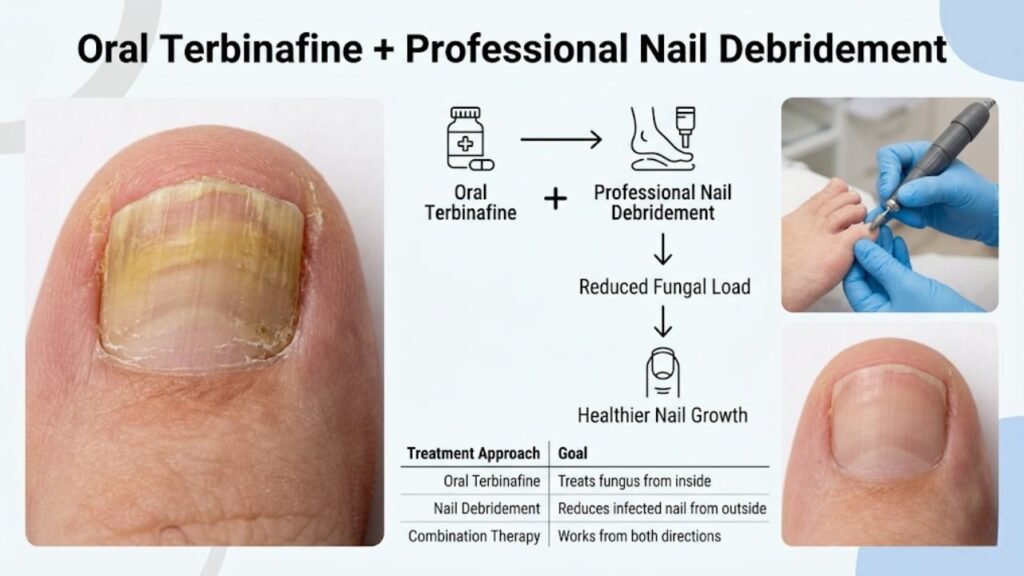
This combination is the most consistently supported by clinical evidence and remains the backbone of combination therapy for severe onychomycosis in most clinical guidelines.
Why this combination works:
Oral terbinafine delivers therapeutic drug concentrations to the nail matrix and nail bed via blood circulation — reaching the infection from below and being incorporated into new nail as it grows. However, in severely thickened nails with significant subungual debris, the drug concentration gradient from nail bed to the outer nail plate may not be sufficient to eliminate the entire fungal burden.
Professional nail debridement attacks the problem from above — physically removing the infected nail plate material and subungual debris that the medication alone must otherwise work through. By reducing a 2 to 3 mm thick infected nail to 0.7 to 1 mm, debridement:
- Removes the majority of the fungal organism load physically
- Reduces the diffusion distance for any topical medication subsequently applied
- Creates immediate symptomatic improvement (reduced pressure)
- Allows visual monitoring of new nail growth from the matrix
Clinical outcomes:
Published data for this combination shows complete cure rates of 60 to 70 percent for severe onychomycosis — significantly above the 35 to 50 percent typically reported for oral terbinafine alone in severe cases.
Protocol:
- Oral terbinafine 250 mg daily for 12 weeks
- Professional nail debridement at the start of treatment and every 6 to 8 weeks during the treatment period
Combination 2: Oral Terbinafine + Topical Efinaconazole
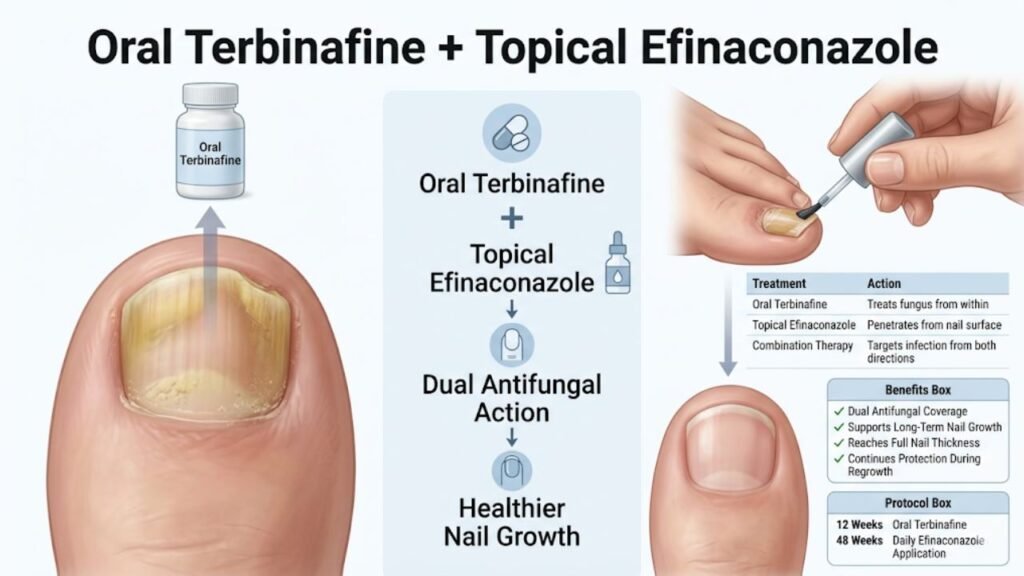
This combination addresses both the systemic and local treatment dimensions simultaneously — oral terbinafine through blood delivery, efinaconazole through topical application to the nail surface.
Why this combination works:
Terbinafine reaches the nail bed from below, incorporated into new nail during growth. Efinaconazole — with its relatively low nail keratin binding affinity that enables better nail plate penetration compared to older topicals — provides ongoing antifungal activity from the nail surface inward.
The two agents work through different mechanisms (squalene epoxidase inhibition for terbinafine; lanosterol 14-alpha-demethylase inhibition for efinaconazole), which theoretically reduces the chance of fungal escape through any single pathway while providing drug presence across the full nail thickness.
Clinical outcomes:
Studies comparing this combination to oral terbinafine monotherapy for moderate to severe onychomycosis show consistent improvement in complete cure rates — some studies reporting combinations exceeding 75 percent mycological cure in intention-to-treat analyses.
Protocol:
- Oral terbinafine 250 mg daily for 12 weeks
- Efinaconazole 10% solution applied to all affected nails and surrounding skin daily, continued for 48 weeks
- The topical continues after oral therapy ends, maintaining antifungal presence at the nail surface throughout the nail growth-out period
Combination 3: Oral Terbinafine + Topical Antifungal + Professional Debridement (Triple Therapy)
The triple-modality combination is where the highest reported cure rates in combination therapy for severe onychomycosis consistently appear in the clinical literature.
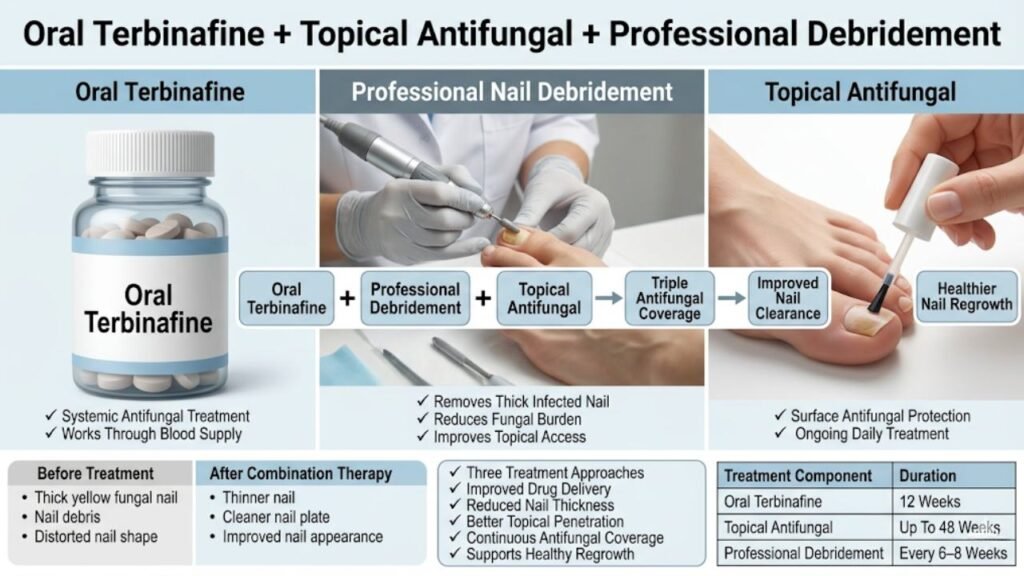
Why this combination works:
Each component addresses a different aspect of the infection simultaneously:
- Oral terbinafine: Systemic delivery through blood supply; antifungal activity in nail plate produced during treatment; persistent nail concentration for months after dosing
- Topical antifungal (efinaconazole or ciclopirox): Local delivery from the nail surface; maintains drug presence at the nail surface throughout the growth-out period after oral treatment ends
- Professional debridement: Physical reduction of fungal burden; reduction of nail plate thickness improving topical penetration; removal of subungual debris; symptomatic relief
The synergy: Debridement maximally improves topical penetration, which complements the systemically-delivered oral medication. Three separate attack vectors against the infection provide overlapping antifungal coverage that makes fungal escape through any single gap less likely.
Clinical outcomes:
Triple therapy protocols have produced the highest complete cure rates published for severe onychomycosis — some studies reporting 75 to 85 percent mycological cure rates, with clinical cure rates (clear nail) of 55 to 70 percent.
Protocol:
- Oral terbinafine 250 mg daily for 12 weeks
- Topical efinaconazole or ciclopirox daily throughout the nail growth-out period (48 weeks total)
- Professional nail debridement every 6 to 8 weeks during and for several months after active oral treatment
Combination 4: Oral Antifungal + Laser Therapy
This combination is particularly relevant for patients who cannot tolerate conventional topical applications (contact dermatitis, specific intolerances) or as an adjunct to oral therapy for very resistant infections.
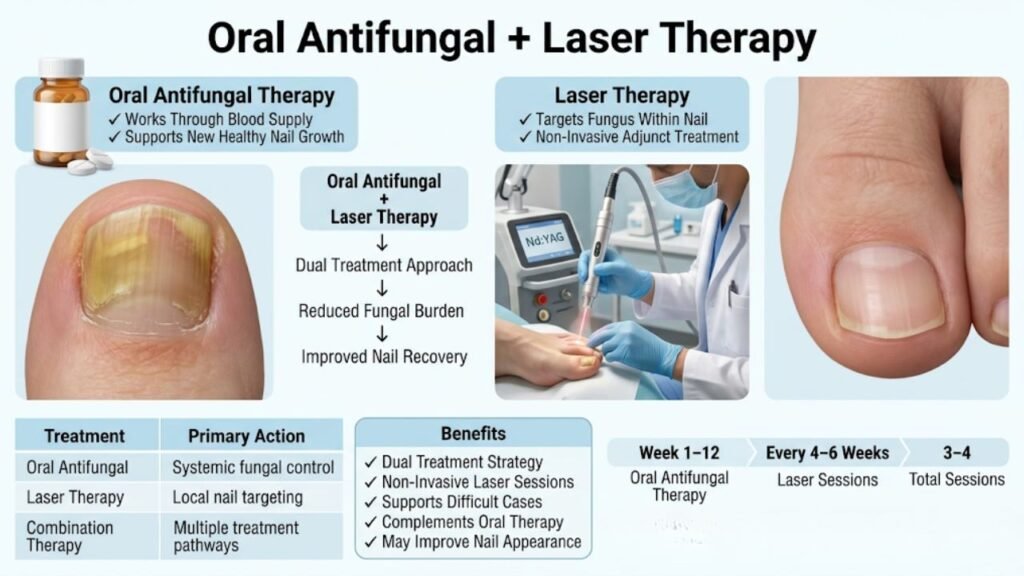
Why this combination works:
Laser therapy — primarily Nd:YAG 1064 nm — generates photothermal antifungal effects within the nail plate by heating tissue to temperatures lethal to fungal organisms. Used alongside oral terbinafine, it provides:
- Additional fungicidal effect within the nail plate complementing systemic drug delivery
- Potential improvement in nail bed temperature and vascularity that may enhance drug delivery
- Mechanical improvement of the nail environment
Honest clinical context:
The evidence base for laser as combination therapy for severe onychomycosis is less robust than for oral + topical + debridement combinations. Laser is expensive, requires multiple sessions, and the mycological evidence for laser’s contribution to combination outcomes is less clearly established than for debridement. However, for patients where conventional topicals are not possible, laser provides a meaningful adjunctive option.
Protocol:
- Oral terbinafine 250 mg daily for 12 weeks
- 3 to 4 laser sessions spaced 4 to 6 weeks apart, with sessions preferably timed during the oral antifungal course
- Continued topical antifungal if tolerated alongside laser
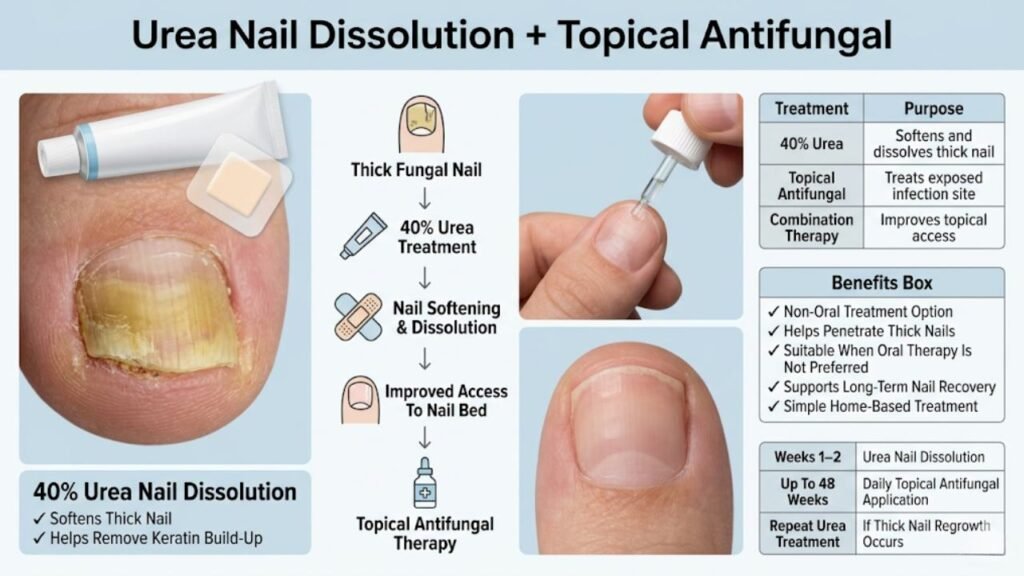
Combination 5: Urea Nail Dissolution + Topical Antifungal (Non-Oral Combination)
For patients who cannot take oral antifungal medication — due to liver conditions, drug interactions, pregnancy, or personal preference — combination therapy for severe onychomycosis still has options.
Why this combination works:
40 percent urea paste applied to the nail under occlusion dissolves the nail plate over 2 to 4 weeks by selectively softening the keratinized nail material. Once the nail plate is removed chemically, topical antifungal treatment reaches the nail bed directly — bypassing the penetration barrier that makes topical-only therapy so limited on intact thick nails.
This approach essentially provides non-surgical nail debulking combined with direct topical antifungal delivery to the exposed nail bed.
Clinical outcomes:
This combination produces better outcomes than topical antifungal alone for severe onychomycosis, though cure rates remain generally lower than oral antifungal combination protocols. It is most appropriate for mild-to-moderate severe infections in patients where oral therapy is contraindicated.
Protocol:
- Urea 40% cream applied under occlusive dressing to the nail for 2 weeks
- Nail removed when dissolution is complete (softened enough to be gently debrided)
- Topical antifungal (efinaconazole preferred) applied daily to the nail bed for 48 weeks
- Repeat urea treatment if nail plate regrows thick during treatment
What Combination Therapy for Severe Onychomycosis Looks Like in Practice
Assessment and Diagnosis
Before starting combination therapy for severe onychomycosis, accurate diagnosis is essential:
- KOH microscopy and fungal culture confirm the infection and identify the causative organism
- Species identification guides antifungal selection (dermatophytes respond to terbinafine; yeasts or molds may require itraconazole)
- Baseline liver function tests if oral antifungal is being prescribed
- Assessment of all concurrent medications for interactions
The First Appointment
The first treatment appointment typically combines diagnosis, treatment initiation, and first debridement:
- Laboratory sample collection from the nail
- Professional debridement of all affected nails — reducing thickness and removing subungual debris
- Prescription of oral antifungal
- Education on topical antifungal application technique
- Footwear assessment and prevention education
- Concurrent athlete’s foot treatment if tinea pedis is present
Ongoing Treatment Sessions
Every 6 to 8 weeks throughout the active oral antifungal phase:
- Professional debridement to maintain optimal nail plate thickness
- Assessment of treatment progress — is new, clear nail growing from the base?
- Check for any side effects of oral medication
- Reinforce topical application adherence
Monitoring Treatment Progress
The correct way to evaluate combination therapy for severe onychomycosis progress:
- Watch the nail base — new nail growing from the cuticle area should become progressively clearer and thinner as the months pass. This reflects what the treated matrix is currently producing.
- Do not watch the nail tip — the existing thick, infected nail at the tip does not transform. It grows out and is replaced. Looking at the tip for improvement leads to premature discouragement.
- Monthly photographs — comparing the nail base from month to month makes gradual progress visible when day-to-day changes seem imperceptible.
When the Oral Course Ends
After completing the 12-week oral antifungal course:
- Topical antifungal continues for the full 48 weeks from when it was started
- Debridement appointments continue until the new nail has substantially replaced the infected nail
- Prevention measures must be implemented immediately — antifungal shoe spray, treating athlete’s foot, protective footwear in communal areas
Comparing Combination Therapy Options
| Combination | Best Suited For | Expected Mycological Cure Rate | Considerations |
|---|---|---|---|
| Oral + debridement | Moderate to severe dermatophyte infection | 60 to 70% | Requires access to professional debridement |
| Oral + topical | Moderate to severe, multi-nail | 65 to 75% | Requires daily topical adherence |
| Oral + topical + debridement (triple) | Severe, resistant, matrix-involved | 75 to 85% | Highest commitment; highest outcomes |
| Oral + laser | Cannot tolerate topicals; very resistant | Variable; less established | Expensive; requires multiple sessions |
| Urea + topical | Cannot take oral antifungals | Lower than oral protocols | Best available non-oral option for severe infection |
Treating Concurrent Athlete’s Foot — The Essential Addition
Every combination therapy for severe onychomycosis protocol must include aggressive management of concurrent tinea pedis — athlete’s foot.
Tinea pedis is present in the majority of patients with onychomycosis and represents the primary source of nail reinfection. The same dermatophyte organisms infecting the nail also infect the surrounding skin. If skin infection is not eliminated, it continuously reintroduces the organism to the nail throughout and after treatment.
Management:
- Topical antifungal cream (terbinafine, clotrimazole, miconazole) applied to all interdigital spaces and plantar skin daily during the nail treatment period
- Continue as maintenance (twice weekly) after symptomatic resolution to prevent skin reinfection of the nails
This step is frequently omitted from treatment plans and its absence is a primary reason patients who complete combination therapy for severe onychomycosis still experience early recurrence.
Frequently Asked Questions
Why is combination therapy better for severe onychomycosis than a single treatment?
Severe onychomycosis involves fungal organisms in multiple nail layers — nail plate, subungual space, and sometimes the nail matrix. Each combination component addresses a different location or delivery route. Together they reduce the total fungal burden more completely than any single agent can.
How long does combination therapy for severe onychomycosis take?
The oral antifungal course runs 12 weeks. Topical therapy continues for 48 weeks total. Debridement appointments occur every 6 to 8 weeks during the active phase. Full nail replacement — and the final visible result — takes 12 to 18 months from starting treatment.
Can I do combination therapy with just topical treatments if I cannot take oral antifungals?
Yes. For patients who cannot take oral antifungals, urea-based nail dissolution combined with topical antifungal therapy represents the most effective non-oral combination. Laser therapy can also be added. Cure rates are generally lower than oral-containing combinations but significantly better than topical-only approaches.
Do I need to keep treating athlete’s foot during combination therapy?
Yes — this is essential. Untreated tinea pedis on the skin surrounding treated nails will reinfect the nails during the growth-out period, undermining even excellent combination therapy outcomes. Topical antifungal for the skin should run concurrently with the nail treatment.
What is the most important thing I can do to make combination therapy work?
Complete every component without shortcuts — the full oral antifungal course, daily topical application without missed days, all scheduled debridement appointments, concurrent athlete’s foot treatment, and prevention measures during and after treatment. Combination therapy for severe onychomycosis works when every component is consistently maintained.
What happens if combination therapy does not work?
Apparent non-response should first assess whether all components were completed correctly and whether environmental reinfection occurred. If a full combination course was genuinely completed without improvement, organism re-identification by culture (to confirm the species has not changed), consideration of total nail removal, or specialist referral are the appropriate next steps.
Summary
Combination therapy for severe onychomycosis is not a last resort — it is the most clinically appropriate first-line approach for established, severe fungal nail infection. Single-modality treatment fails a meaningful proportion of patients with severe disease because no one treatment addresses all three infection sites simultaneously.
The five evidence-based combination approaches — oral + debridement, oral + topical, triple therapy (oral + topical + debridement), oral + laser, and urea + topical — each provide multiple simultaneous attack vectors against the infection. Triple therapy consistently produces the highest published cure rates: 75 to 85 percent mycological clearance and 55 to 70 percent clinical cure.
Treating concurrent athlete’s foot alongside the nail-focused combination is non-negotiable for durable results. And the full timeline — 12 to 18 months from treatment start to final nail outcome — requires patient commitment to see through.
For patients who have struggled with severe onychomycosis and single-modality failures, properly implemented combination therapy for severe onychomycosis represents the most realistic path to genuinely clear nails.
Struggling to get an appointment?
We help patients in your area bypass clinic waitlists by instantly finding verified podiatry doctors who accept their insurance.