Treatment Options for Pregnant Patients
Find a Podiatrist Near You
Get same-day appointments with verified podiatrists. Insurance accepted.
Treatment options for pregnant patients with toenail fungus or other nail conditions require a fundamentally different clinical approach than treatment for the general population. Pregnancy changes almost everything about how the body handles medications — absorption, metabolism, distribution, and crucially, the exposure of a developing fetus to pharmacological agents through placental transfer.
The result is a treatment landscape that is significantly more restricted than what is available to non-pregnant adults. The most effective treatments for nail fungal infection — oral antifungal medications — are either contraindicated or require careful risk-benefit assessment during pregnancy. And yet nail conditions during pregnancy are not rare: hormonal immune modulation, increased peripheral circulation, and foot swelling all create conditions where nail problems are more likely to develop.
This guide explains what is known about the safety of each treatment category, what treatment options pregnant patients can reasonably pursue, and how to manage nail conditions effectively during pregnancy while protecting both maternal and fetal health.

Why Pregnancy Changes Treatment Options
Before examining specific treatment options for pregnant patients, understanding why pregnancy fundamentally changes the safety profile of medications establishes the necessary clinical context.
Placental transfer:
The placenta is not an impermeable barrier. Most medications — including antifungal drugs — cross the placenta to varying degrees, exposing the developing fetus to pharmacological agents that the fetus cannot metabolize in the same way an adult can. The first trimester, when organogenesis (organ formation) occurs, represents the period of greatest risk for medication-induced fetal harm.
Altered maternal pharmacokinetics:
Pregnancy substantially changes how the mother’s body handles drugs:
- Increased blood volume (40 to 50 percent above pre-pregnancy) dilutes drug concentrations
- Increased renal blood flow accelerates drug elimination
- Increased hepatic metabolism from estrogen and progesterone affects drug clearance
- Changes in plasma protein binding alter the proportion of free (active) drug in circulation
These pharmacokinetic changes mean that standard dosing protocols — developed in non-pregnant adults — may not produce the same drug concentrations during pregnancy.
Limited safety data:
Pregnant women are systematically excluded from clinical trials. This means that safety data for most medications in pregnancy comes from animal studies, case reports, registries, and retrospective analyses rather than controlled trials. FDA pregnancy categories (A, B, C, D, X) — now replaced by the PLLR labeling system — reflect this limited evidence. Most drugs fall into categories where evidence is insufficient for definitive safety statements.
Oral Antifungal Medications: The Standard Treatment Problem
The most effective single treatment for toenail onychomycosis — oral terbinafine — is one of the primary treatment options pregnant patients cannot use without careful consideration.
Terbinafine
FDA pregnancy category under old system: B (animal studies show no harm; no adequate human studies)
The clinical reality:
Category B sounds reassuring, but it means only that animal studies did not demonstrate harm — not that safety has been established in humans. Adequate human studies do not exist because pregnant women are excluded from trials. Published human data consists primarily of case series and pregnancy registry reports.
Available registry data suggests that terbinafine does not dramatically increase the overall risk of major birth defects, but the data is insufficient to establish safety definitively. The drug is lipophilic and does cross the placenta.
Standard clinical guidance:
Most dermatology and obstetric guidelines recommend avoiding terbinafine during pregnancy, particularly during the first trimester. For mild to moderate nail fungal infection — which is not life-threatening — the risk-benefit calculation clearly favors deferring treatment until after delivery when the oral route is needed.
For severe nail infection causing significant complications, the clinical calculus changes and a discussion with the obstetric provider is essential before any decision.
Itraconazole
FDA pregnancy category under old system: C (animal studies show potential fetal harm; no adequate human studies)
The clinical reality:
Animal studies at doses significantly above human therapeutic levels showed some evidence of fetal harm. Human data is similarly limited but includes case reports of birth defects associated with high-dose itraconazole during the first trimester for systemic infections.
Standard clinical guidance:
Itraconazole is generally considered contraindicated during pregnancy for the treatment of nail fungal infection. The risk-benefit balance for a non-life-threatening condition clearly does not support its use. Systemic fungal infections (which can be life-threatening) present a different clinical situation managed by infectious disease specialists.
Fluconazole
FDA pregnancy category under old system: C/D depending on dose and duration
The clinical reality:
Single-dose fluconazole (150 mg) used for vaginal candidiasis has a different risk profile than prolonged courses used for nail fungus. Multiple studies have linked prolonged or high-dose fluconazole exposure during the first trimester with cardiac septal defects and other anomalies. The FDA strengthened safety warnings regarding fluconazole during pregnancy.
For nail onychomycosis, which would require weekly doses over many months, fluconazole is not appropriate during pregnancy.
Bottom line on oral antifungals:
For treatment options for pregnant patients with toenail fungal infection, oral antifungal medications are not the appropriate treatment during pregnancy except in rare severe circumstances where the clinical situation is managed in consultation with obstetric specialists. Nail fungal infection is not a medical emergency — deferring definitive treatment until the postpartum period is safe and appropriate in almost all cases.
Topical Antifungal Medications: Limited but Safer Options
Topical antifungal medications avoid systemic circulation, which is their primary safety advantage for treatment options for pregnant patients. Their limitation is significantly reduced efficacy — particularly for established onychomycosis where the nail plate thickness prevents adequate penetration.
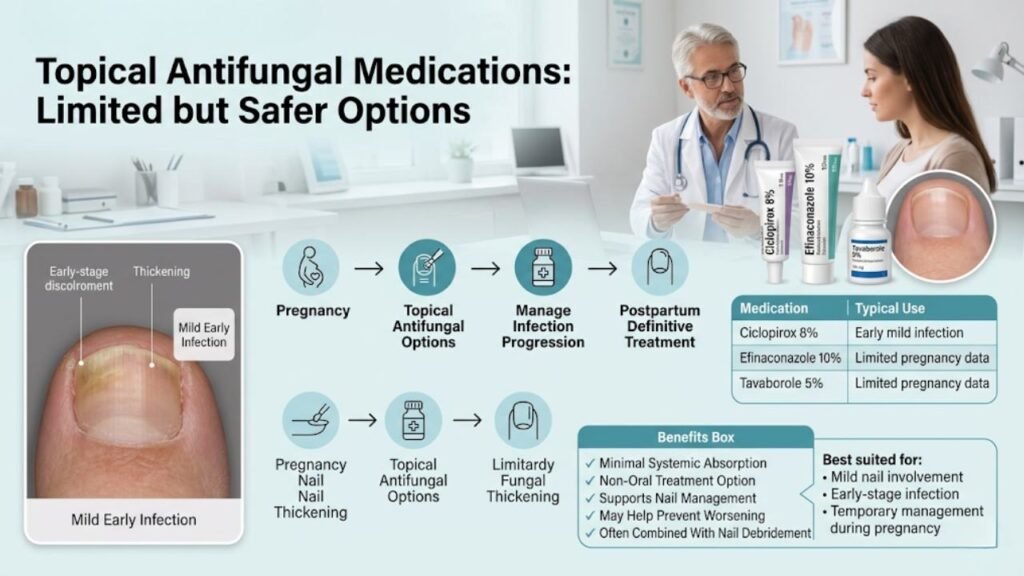
Ciclopirox 8% Nail Lacquer (Penlac)
Ciclopirox has the most favorable safety data of any prescription topical antifungal for nail use during pregnancy. Its systemic absorption after topical application is negligible — studies have detected extremely low or undetectable plasma levels after nail application.
The practical limitation:
Ciclopirox complete cure rates even in optimal (non-pregnant) use are approximately 5 to 8 percent as monotherapy for established toenail onychomycosis. During pregnancy, when the nail is also more likely to be growing faster (hormonal stimulation of nail growth) and when the infection may already be established, topical-only treatment is unlikely to achieve cure.
Appropriate use in pregnancy:
Ciclopirox is most appropriate for:
- Very early, mild, superficial nail changes (white superficial onychomycosis pattern)
- Prevention of worsening during pregnancy while definitive treatment is deferred postpartum
- Combined with nail debridement to maximize penetration during the treatment period
Efinaconazole 10% Solution (Jublia) and Tavaborole 5% (Kerydin)
Both efinaconazole and tavaborole are categorized under the newer PLLR labeling system with insufficient data to characterize fetal risk. The available human data is minimal.
Clinical guidance:
Neither has been adequately studied in human pregnancy. While their systemic absorption after topical nail application is low, the limited safety data means they are generally approached with caution. Some practitioners consider them acceptable for use in pregnancy given the extremely low systemic absorption; others prefer to defer until postpartum. In either case, the decision should be made in consultation with the obstetric provider.
Professional Nail Debridement: Safe and Beneficial
Professional nail debridement by a podiatrist is one of the safest and most clinically useful treatment options for pregnant patients with thick or infected toenails. It involves no medications and carries no systemic risk.
What debridement achieves during pregnancy:
- Reduces nail plate thickness and associated pressure — important as foot swelling in pregnancy already increases nail pressure
- Removes subungual debris that harbors fungal organisms, reducing the infection burden even without antifungal medication
- Improves penetration of any topical antifungal medication being used alongside
- Maintains nail hygiene and prevents secondary bacterial infection at nail edges
- Provides immediate relief of footwear pressure and discomfort
Frequency during pregnancy:
For pregnant patients with significant nail fungal infection or thick nails, professional debridement every 6 to 10 weeks throughout pregnancy manages the condition conservatively — not curing the infection but preventing it from worsening significantly and managing symptoms until postpartum treatment is possible.
Managing ingrown toenails during pregnancy:
Foot swelling during pregnancy frequently exacerbates ingrown toenail tendencies. Professional nail care — including properly trimming the nail, removing any spicule penetrating the nail fold, and packing the nail groove — is entirely safe during pregnancy and should not be deferred when pain or early infection is present. Partial nail avulsion under local anesthesia is also safe during pregnancy for established ingrown nails that are causing significant problems — local anesthetics (lidocaine) used for digital block are not contraindicated in pregnancy.
Laser Therapy During Pregnancy: Limited Evidence
Laser therapy for nail fungus (typically Nd:YAG 1064 nm) is sometimes considered as a treatment option for pregnant patients because it avoids systemic medications entirely.
The theoretical safety rationale:
Laser energy applied to the nail and the resulting localized heat effect in the nail plate does not produce systemic drug exposure. There is no placental transfer of pharmacological agents.
The evidence limitation:
No controlled studies of laser nail treatment specifically in pregnant patients exist. The overall evidence base for laser nail fungus treatment efficacy is itself variable (see the laser wavelengths guide for detail), and the subset of pregnant patients has essentially no specific safety or efficacy data.
Clinical position:
Most podiatrists and dermatologists approach laser treatment in pregnancy with caution — not because there is specific evidence of harm, but because the absence of evidence is not the same as evidence of safety. Each decision should involve the obstetric provider. For mild to moderate infection, deferring until postpartum is usually the more conservative and appropriate choice.
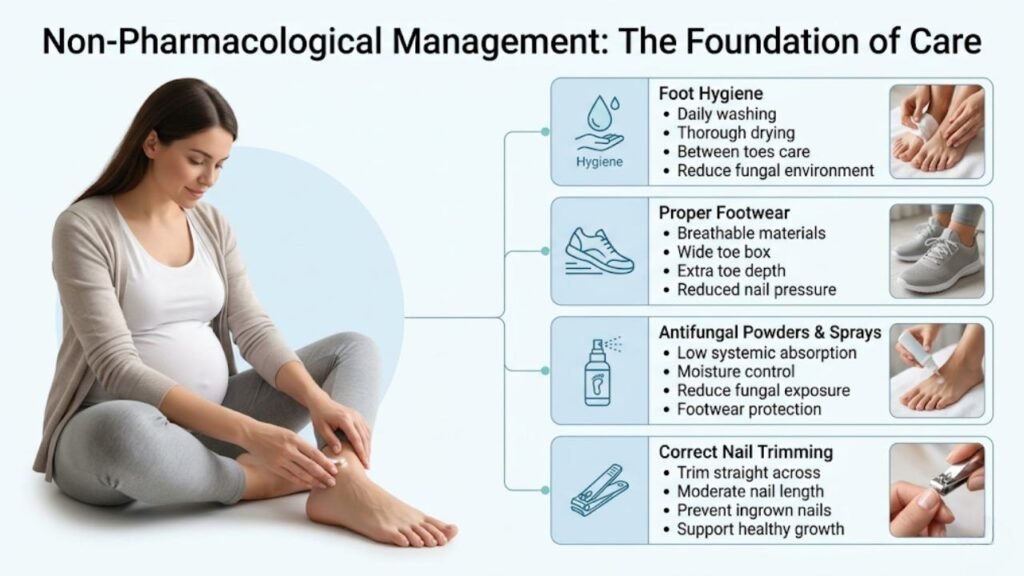
Non-Pharmacological Management: The Foundation of Care
For treatment options for pregnant patients, non-pharmacological management forms the core of safe, evidence-based care during the pregnancy period.
Foot Hygiene
Daily washing and thorough drying of the feet — particularly between toes and around nail folds — reduces the warm, moist environment that supports fungal growth. This is the single most important preventive and management measure.
Footwear Choices
Pregnancy alters foot anatomy — ligament relaxation widens the foot, and swelling reduces fit in pre-pregnancy footwear. Appropriate footwear during pregnancy:
- Breathable materials (leather, canvas, mesh) that allow moisture to escape
- Wider toe box accommodating the widened foot without compressing nails
- Adequate toe box depth to prevent nail pressure from swollen toes
- Comfortable fit without causing the toe compression that worsens ingrown nails
The footwear-nail connection in pregnancy is more significant than in non-pregnant adults — poorly fitting footwear during pregnancy simultaneously worsens nail pressure, contributes to fungal environment conditions, and increases ingrown nail risk.
Antifungal Powder and Sprays
Antifungal foot powders (containing miconazole or clotrimazole) are generally considered low-risk during pregnancy when applied to the feet and inside footwear. They reduce the moisture and fungal spore environment without significant systemic absorption. They cannot cure established onychomycosis but can reduce fungal exposure and slow progression.
Nail Trimming
Correct nail trimming technique — straight across, not rounded at the corners, at an appropriate moderate length — reduces both fungal infection progression and ingrown nail risk during pregnancy. More frequent trimming may be needed if hormonal stimulation has accelerated nail growth.
The Postpartum Treatment Plan: Why Deferral Makes Clinical Sense
A key element of managing treatment options for pregnant patients is establishing a clear postpartum treatment plan before delivery. If nail conditions are being managed conservatively during pregnancy with the intent of definitive treatment postpartum, patients should have a plan in place:
For breastfeeding patients:
Terbinafine does transfer into breast milk. Breastfeeding guidelines for antifungal use require obstetric and lactation specialist input. Most guidance suggests completing a course of terbinafine is not appropriate while actively breastfeeding; some guidelines suggest a waiting period after the final dose before resuming breastfeeding. Itraconazole similarly appears in breast milk.
Patients who intend to breastfeed should discuss the timing of postpartum antifungal treatment with their obstetric and lactation care team — this is a conversation to have before delivery, not after.
For non-breastfeeding postpartum patients:
Oral antifungal treatment can be initiated after delivery without additional pregnancy-related constraints. The prescriber should be aware of any postpartum health conditions, medications for postpartum care, and the patient’s full medical status.
When Nail Conditions During Pregnancy Need Urgent Attention
While most nail conditions in pregnancy can be managed conservatively and definitively treated postpartum, certain presentations require prompt attention:
Seek professional evaluation promptly if:
- An ingrown toenail becomes significantly painful, swollen, or shows discharge
- Nail fold redness is spreading beyond the immediate nail area (possible early cellulitis)
- Any nail wound is not improving or is worsening
- You have diabetes or any condition affecting immune function or circulation — nail problems in these cases carry elevated risk regardless of pregnancy
Seek urgent evaluation if:
- Spreading redness, significant swelling, or fever accompany a nail problem — signs of cellulitis or deeper infection
- Any nail-related wound is not healing
Frequently Asked Questions About Treatment Options for Pregnant Patients
Is nail fungus dangerous during pregnancy?
Nail fungal infection (onychomycosis) is not typically dangerous during pregnancy — it does not spread to the fetus and does not cause obstetric complications. The primary concern is patient comfort and the risk of secondary bacterial infection at compromised nail edges. Most cases can be managed conservatively until postpartum definitive treatment.
Can I use over-the-counter antifungal creams on my feet during pregnancy?
OTC antifungal creams for athlete’s foot (tinea pedis) — containing clotrimazole, miconazole, or terbinafine for skin application — have minimal systemic absorption and are generally considered low risk. They should still be discussed with your obstetric provider. They do not treat established nail fungal infection effectively.
What should I do if I develop an ingrown toenail during pregnancy?
Seek podiatric evaluation promptly. Ingrown toenails in pregnancy can worsen rapidly due to foot swelling. Professional management — proper nail edge trimming, nail fold packing, and if necessary a minor procedure under local anesthesia — is safe during pregnancy and should not be deferred if the nail is causing significant pain or early infection.
Can I have laser nail treatment while pregnant?
Laser therapy for nail fungus does not involve systemic medications, which is a theoretical safety advantage. However, safety data specific to pregnant patients is essentially absent. Most practitioners recommend deferring laser treatment until postpartum unless specific circumstances justify earlier intervention, which should be discussed with the obstetric provider.
When can I start oral antifungal treatment after delivery?
If breastfeeding, discuss timing with your obstetric and lactation specialist — both terbinafine and itraconazole transfer into breast milk. If not breastfeeding, oral antifungal therapy can generally be initiated soon after delivery without pregnancy-related constraints. Establish a postpartum treatment plan with your podiatrist before or shortly after delivery.
Does pregnancy make nail fungus worse?
Pregnancy-related immune modulation reduces the immune system’s ability to resist fungal organisms — making nail fungal infection easier to establish and potentially harder to clear during pregnancy. Hormonal nail changes (faster growth, altered nail plate composition) and increased foot sweating from pregnancy also contribute to a more favorable fungal environment. Aggressive preventive hygiene is particularly worthwhile during pregnancy for this reason.
Summary
Treatment options for pregnant patients with nail conditions require navigating a restricted treatment landscape while maintaining effective management of nail health throughout pregnancy.
- Oral antifungal medications (terbinafine, itraconazole, fluconazole) are generally avoided during pregnancy for non-emergency nail conditions
- Professional nail debridement is safe, beneficial, and forms the clinical foundation of nail management during pregnancy
- Topical antifungals — primarily ciclopirox — have the most favorable safety data for limited use during pregnancy
- Foot hygiene, appropriate footwear, and preventive measures are the highest-evidence, lowest-risk management tools
- Definitive pharmacological treatment is appropriately deferred to the postpartum period in most cases
Establishing a clear postpartum treatment plan — including timing relative to breastfeeding — before delivery ensures continuity of care and avoids the common situation where nail conditions are neglected during pregnancy and then continue unaddressed postpartum.
Struggling to get an appointment?
We help patients in your area bypass clinic waitlists by instantly finding verified podiatry doctors who accept their insurance.