Foot Powder vs Antifungal Spray Differences
Find a Podiatrist Near You
Get same-day appointments with verified podiatrists. Insurance accepted.
Foot powder vs antifungal spray is a comparison that confuses many patients — because the products look similar, sit next to each other on the pharmacy shelf, and are both promoted for “foot health.” The problem is that they work through completely different mechanisms, address different problems, and using the wrong one for your situation means your actual concern goes unaddressed.
Understanding the foot powder vs antifungal spray distinction matters practically because: choosing only foot powder when you have an active fungal infection means the infection continues without treatment; choosing only antifungal spray when your primary problem is moisture and sweating addresses only part of the prevention equation. The right choice — or combination — depends on specifically what you are trying to accomplish.
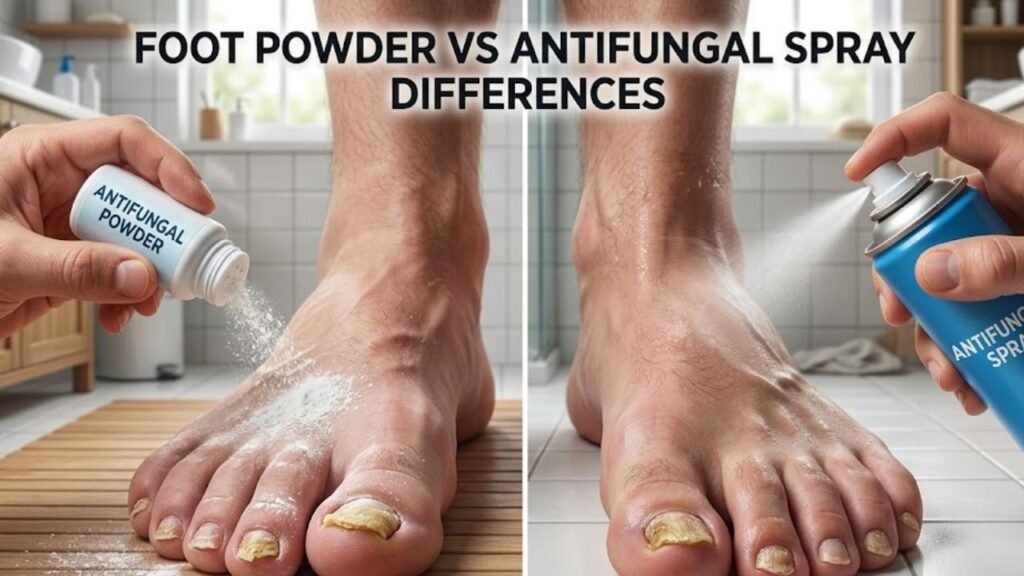
What Foot Powder Actually Does
Foot powder is a moisture management product, not a treatment. Its primary function is absorbing sweat and reducing the humidity inside shoes and socks during wear.
How foot powder works:
Foot powder contains absorbent ingredients — typically talc, cornstarch, or a combination — that absorb liquid and moisture vapor from the skin surface and shoe interior. When applied to the foot before putting on socks and shoes, or directly to the shoe interior, the powder creates a drier microenvironment by absorbing sweat before it can accumulate.
Common ingredients in foot powder:
Talc — A mineral with excellent moisture-absorbing capacity. Talcum-based powders absorb sweat efficiently and reduce friction between the skin surfaces and between the foot and footwear. They feel smooth and comfortable and do not cake as readily as some other absorbents.
Cornstarch — A plant-derived absorbent with similar moisture control properties to talc. Some formulations use cornstarch as the primary absorbent, either because of talc avoidance preferences or for manufacturing reasons.
Baking soda (sodium bicarbonate) — Often added to foot powders for its deodorizing properties. Baking soda neutralizes acidic compounds produced by skin bacteria that are responsible for foot odor.
Zinc oxide — Included in some foot powders for mild antibacterial and skin-soothing properties.
Fragrance — Many foot powders include fragrance for the perception of freshness. This is purely cosmetic and contributes nothing to moisture control or infection prevention.
What foot powder does not do:
Plain foot powder (without added antifungal medication) does not kill or inhibit fungal organisms. It has no antifungal active ingredient. A foot powder without a specific antifungal agent cannot treat athlete’s foot or prevent fungal infection from establishing — it only reduces the moisture that makes infection more likely.
What Antifungal Spray Actually Does
Antifungal spray is a medicated product containing specific active pharmaceutical ingredients that kill or inhibit the growth of fungal organisms, primarily dermatophytes (the fungi that cause athlete’s foot and nail infections).
How antifungal spray works:
Antifungal sprays deliver antifungal drug compounds in a liquid carrier that spreads easily across the skin surface and can reach the interdigital spaces between toes more readily than powder in many situations. The active ingredient disrupts fungal cell biology — typically by targeting the ergosterol pathway (azole antifungals) or squalene epoxidase (terbinafine) — preventing fungal growth and killing existing organisms.
Common active antifungal ingredients in sprays:
Miconazole nitrate (typically 2%) — An azole antifungal that inhibits fungal ergosterol synthesis, disrupting cell membrane integrity. Effective against dermatophytes (the organisms causing athlete’s foot) and some yeasts (Candida). Miconazole is one of the most commonly available OTC antifungal active ingredients in spray formulations.
Clotrimazole (typically 1%) — Another azole antifungal with similar mechanism to miconazole. Effective against dermatophytes and yeasts. Available in spray formulations in some markets.
Tolnaftate (typically 1%) — A thiocarbamate antifungal with a different mechanism — it inhibits squalene epoxidase in fungi. Effective against dermatophytes but not Candida. Tolnaftate is one of the oldest OTC antifungal ingredients.
Terbinafine (typically 1%) — An allylamine antifungal that inhibits squalene epoxidase — the same mechanism as oral terbinafine, delivered topically. Highly effective against dermatophytes. Available in some spray formulations for skin (distinct from nail formulations).
What antifungal spray does not do:
Antifungal spray does not absorb sweat or meaningfully reduce shoe interior moisture. The liquid spray format applies antifungal medication — it is not a moisture management product. Using antifungal spray instead of foot powder in a high-sweat situation does not replace the moisture control that foot powder provides.
The Core Foot Powder vs Antifungal Spray Difference
The fundamental distinction between foot powder vs antifungal spray comes down to mechanism:
Foot powder = physical moisture absorption — reduces the environmental condition (moisture) that supports fungal growth
Antifungal spray = pharmaceutical antifungal action — directly kills or inhibits the biological organism causing infection
This difference means they address different parts of the infection problem:
| Feature | Foot Powder | Antifungal Spray |
|---|---|---|
| Primary action | Moisture absorption | Kills/inhibits fungal organisms |
| Active pharmaceutical ingredient | Usually none | Miconazole, tolnaftate, terbinafine, etc. |
| Treats active infection | No | Yes |
| Reduces infection risk by moisture control | Yes | No |
| Can be used in shoes | Yes | Yes (some formulations) |
| Best application timing | Before wearing shoes | After showering, before shoes |
| Appropriate for prevention only | Yes | Yes (lower risk situations) |
| Appropriate for active infection | No | Yes |
When to Use Foot Powder
Foot powder is appropriate in situations where the primary goal is moisture management — either to prevent infection by reducing the favorable moisture environment, or to improve comfort from sweating.
Use foot powder when:
Sweating prevention and comfort is the primary goal:
If your feet sweat significantly and you want to reduce the moisture inside your shoes throughout the day, foot powder applied to the feet before putting on socks, and/or inside the shoe itself, provides meaningful moisture control. This is appropriate as a daily prevention measure for people who are not currently infected but want to maintain a less hospitable shoe environment.
Reducing shoe odor:
Foot odor comes primarily from bacteria metabolizing sweat — it is a bacterial rather than fungal problem in most cases. The baking soda in foot powder deodorizes by neutralizing the acid compounds these bacteria produce. For foot odor without active infection, foot powder addresses the actual problem.
Reducing friction and discomfort:
Athletes and people who spend long hours in footwear may develop hot spots and blisters from friction between the foot and shoe. Foot powder reduces this friction by creating a smoother, drier interface.
In shoes to maintain drier conditions between wears:
Applying foot powder inside shoes overnight or during rotation intervals absorbs residual moisture and helps maintain a drier shoe interior.
Foot powder is not appropriate when:
- Active athlete’s foot infection is present (scaling, peeling, itching between toes)
- You are using it hoping it will treat a current fungal infection
- Nail fungal infection treatment is the goal (nail penetration is negligible)
When to Use Antifungal Spray
Antifungal spray is appropriate when the goal is actively killing or preventing growth of fungal organisms — either treating an active infection or providing chemical antifungal protection in high-exposure environments.
Use antifungal spray when:
Active athlete’s foot infection:
If you have itching, peeling, redness, or scaling between the toes or on the plantar foot — classic signs of tinea pedis — antifungal spray with an appropriate active ingredient (miconazole, terbinafine, tolnaftate) is the appropriate treatment. Applied daily to the affected area for the full recommended treatment course (typically 2 to 4 weeks depending on the product and severity), antifungal spray treats the infection directly.
Prophylaxis after exposure in high-risk environments:
If you have walked barefoot in a gym locker room or pool area without protective footwear, applying antifungal spray to the interdigital spaces and plantar foot immediately after thorough drying provides a chemical barrier against germination of any spores that may have been picked up. This is most relevant for people with history of recurrent athlete’s foot.
Treating the shoe environment during active infection:
Antifungal spray applied to the interior of shoes worn during an active foot fungal infection helps reduce the viable fungal organism load in the shoe — reducing ongoing reinfection from contaminated footwear.
As maintenance after completing athlete’s foot treatment:
To prevent immediate recurrence after clearing athlete’s foot, antifungal spray applied a few times per week to the interdigital spaces can maintain chemical suppression of any residual fungal organisms during the period when reinfection risk is highest.
Antifungal spray is not appropriate when:
- The goal is primarily moisture or sweat control (foot powder is better for this)
- You expect it to treat toenail fungal infection — the spray concentrations available OTC are not adequate for nail penetration at therapeutic levels for established nail infection
- You are using it instead of prescription treatment when a prescription is indicated
Using Foot Powder vs Antifungal Spray Together
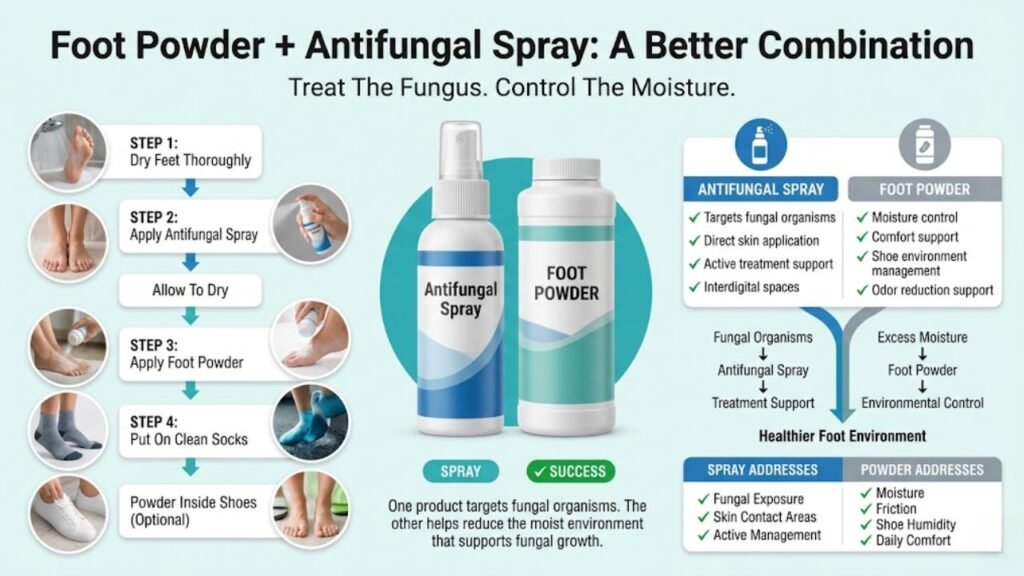
The most practical insight from the foot powder vs antifungal spray comparison is that for many people — particularly those managing active athlete’s foot or those in high-risk situations — using both in combination addresses both dimensions of the problem simultaneously:
Antifungal spray treats the biological problem
Foot powder manages the environmental problem
A practical combined routine:
- After showering, dry feet completely — including thorough interdigital drying with a dedicated towel
- Apply antifungal spray to the interdigital spaces and plantar foot — allow to dry
- After the spray has dried, apply foot powder to the feet before putting on socks
- Apply foot powder to the shoe interior if desired
This sequence allows the antifungal spray to contact and dry on the skin before powder is applied — maintaining the spray’s effective contact with the skin rather than having powder dilute or displace the liquid spray immediately.
Products With Both Functions: Antifungal Powders
Some products combine both functions — they contain antifungal active ingredients (typically miconazole or tolnaftate) in a powder base. These combination antifungal powder products provide:
- Moisture absorption (from the powder base)
- Antifungal activity (from the active ingredient)
- Easy application to both skin and shoe interior
Antifungal powders are particularly convenient for shoe interior application — applying antifungal spray inside shoes and allowing it to dry is more time-consuming and less even in coverage than simply shaking antifungal powder into the shoe.
For people who want a single product addressing both aspects of the foot powder vs antifungal spray comparison, a product like Zeasorb-AF or Lotrimin powder (with antifungal active ingredient) provides both functions in one application.
Frequently Asked Questions About Foot Powder vs Antifungal Spray
Can foot powder treat athlete’s foot?
No. Standard foot powder without an antifungal active ingredient cannot treat an active fungal infection. It reduces moisture (which is helpful as a supportive measure) but does not kill fungal organisms. To treat athlete’s foot, you need a product with an antifungal active ingredient — either antifungal spray or antifungal powder.
Can I use antifungal spray instead of foot powder for sweaty feet?
Antifungal spray does not meaningfully absorb sweat or reduce shoe interior moisture. Using antifungal spray instead of foot powder does not provide the moisture management benefit that foot powder provides. For sweaty feet without active infection, foot powder is the appropriate product; for both issues simultaneously, use both or choose an antifungal powder that provides both functions.
How long should I use antifungal spray for athlete’s foot?
The treatment duration depends on the specific product and active ingredient. Most OTC antifungal sprays for athlete’s foot are used for 2 to 4 weeks of daily application. It is important to continue for the full recommended course even when symptoms improve — stopping early allows residual organisms to regrow. Check the specific product instructions.
Is antifungal spray effective for toenail fungal infection?
OTC antifungal sprays are not an effective treatment for established toenail onychomycosis (nail fungal infection). The concentrations available without prescription and the liquid spray formulation do not achieve adequate penetration through the nail plate to treat nail infection. Nail fungal infection requires prescription topical antifungal formulations designed for nail penetration, or oral antifungal medication.
Summary
The foot powder vs antifungal spray distinction comes down to mechanism: foot powder manages moisture by absorption; antifungal spray kills fungal organisms with pharmaceutical active ingredients. Neither substitutes for the other.
For sweating and moisture prevention without active infection: foot powder
For active athlete’s foot treatment: antifungal spray (with appropriate active ingredient)
For both simultaneously: use both in sequence, or choose an antifungal powder product that provides both functions
For high-risk prevention (gym users, post-treatment maintenance): antifungal spray for chemical protection + foot powder for moisture management
Understanding this foot powder vs antifungal spray distinction prevents the common mistake of reaching for one when the other — or both — is actually needed.
Struggling to get an appointment?
We help patients in your area bypass clinic waitlists by instantly finding verified podiatry doctors who accept their insurance.