Preventing Fungus After a Pedicure
Find a Podiatrist Near You
Get same-day appointments with verified podiatrists. Insurance accepted.
Preventing fungus after a pedicure is something most salon clients never think about until they notice their nail changing color or texture in the weeks following a salon visit. Nail salons — even well-run, clean-looking establishments — are environments where multiple people’s feet and nails are treated with shared equipment, shared water basins, and shared airspace. When infection control standards are not rigorously followed, the salon becomes a direct transmission route for dermatophyte fungal organisms from one client to the next.
The good news is that preventing fungus after a pedicure is entirely achievable — and does not require avoiding pedicures altogether. It requires knowing what to look for, what to ask, what your own responsibilities are, and what to do in the days following a pedicure to protect the nails that the service has inevitably made more vulnerable.
Why Pedicures Create Fungal Infection Risk
Understanding why preventing fungus after a pedicure matters starts with understanding what happens during a pedicure that creates vulnerability:
Cuticle manipulation creates entry points:
The cuticle is not merely cosmetic — it is a seal that closes the gap between the nail plate and the surrounding skin. Intact cuticles prevent organisms from entering the nail fold and accessing the nail bed. Aggressive cuticle removal — cutting, pushing back aggressively, or soaking for extended periods to soften before manipulation — disrupts this seal. The period immediately after cuticle manipulation is the highest-risk window for nail fungal infection from a pedicure, because the protective barrier has been removed or reduced.
This is the primary reason why preventing fungus after a pedicure is most critical in the hours and days immediately following the service, not days or weeks later.
Foot soak basins accumulate organisms between clients:
The whirlpool or basin used for foot soaking is in contact with multiple clients’ feet throughout the day. Dermatophyte fungi, bacteria, and other organisms shed from previous clients’ skin and nails accumulate in the water basin and in the basin’s jets, tubing, and drainage pathways. The whirlpool jets of basin-style pedicure chairs are particularly difficult to adequately disinfect between clients because organisms accumulate in the jet pipes where standard cleaning cannot reach.
Shared tools are direct transmission vectors:
Metal nail files, cuticle pushers, nippers, and other implements that contact one client’s nail tissue and are not properly sterilized before the next client directly transfer organisms between clients. A nail nipper used on a client with active nail fungal infection and then used on the next client without sterilization is a direct inoculation event.
The vulnerability window:
After a pedicure, the nail folds have been manipulated, the cuticle seal is disrupted, and the skin has been softened by soaking. For 24 to 48 hours following a pedicure, the foot is more vulnerable to fungal establishment than before the service. Preventing fungus after a pedicure includes protecting the foot during this specific vulnerability window.
Preventing Fungus After a Pedicure: What to Assess at the Salon
The first category of prevention for preventing fungus after a pedicure happens before you sit in the chair.
Assess Instrument Sterilization Practices
What genuine sterilization looks like:
True sterilization of metal nail implements requires autoclave (steam under pressure) processing — the same equipment used for surgical instruments. This is the gold standard for preventing fungus after a pedicure through tool sterilization.
What insufficient “sterilization” looks like:
- Tools stored in UV lamp boxes — UV lamps reduce bacteria on external surfaces but do not sterilize the full instrument and have no effect on fungal spores
- Tools stored in blue liquid (barbicide or similar disinfectant) — these solutions can reduce bacterial and fungal load on surfaces but are not equivalent to autoclave sterilization for all organisms
- Tools quickly wiped with alcohol between clients — reduces surface bacteria but does not achieve adequate fungal spore reduction
Practical assessment: Ask the salon how their metal implements are sterilized between clients. If the answer involves UV lamps only or quick wipes, the sterilization is insufficient for preventing fungus after a pedicure.
The best solution: Bring your own tools. A personal set of metal nail implements — nail nippers, cuticle pusher, file — purchased from a beauty supply store and used exclusively for your own pedicures eliminates the tool-to-client transmission risk entirely. This is the gold standard approach for preventing fungus after a pedicure from tool contamination.
Assess Foot Bath Practices
What to look for:
- Single-use plastic liners inserted into the basin for each client
- Active cleaning and disinfection of the basin between clients with EPA-registered disinfectants for the minimum required contact time
- Pipeless footbath bowls (no jets) that are easier to clean than whirlpool jets
What is inadequate:
- Basins that are simply refilled with water between clients without disinfection
- Quick rinse of the basin without disinfectant application and appropriate contact time
- Whirlpool basins without evidence of between-client jet line disinfection
The personal option: Some clients pursuing preventing fungus after a pedicure at the highest level bring their own portable foot soaking basin for the salon to fill with water. This removes the shared basin exposure entirely.
Assess the General Facility
Signs of good hygiene practice:
- Disposable toe separators for each client
- Fresh nail polish from dispensed individual portions rather than repeatedly dipping the brush from the same bottle back into contact with the brush applicator
- Clean, covered storage for tools not in use
- Technicians washing hands between clients
- Visible cleanliness of work surfaces
Preventing Fungus After a Pedicure: During the Service
Specific Instructions for Your Technician
An important part of preventing fungus after a pedicure is communicating specific preferences to your nail technician:
Do not cut the cuticle: Ask the technician to push back — not cut — the cuticle. Cutting the cuticle removes the protective seal entirely and creates a wound at the nail fold. Pushing the cuticle back preserves the nail fold seal to a greater degree. Some salons have standard practices of cutting — be specific in requesting no cutting.
Avoid aggressive cuticle soaking: Extended soaking that over-softens the cuticle makes it more vulnerable to damage during subsequent manipulation. For clients focused on preventing fungus after a pedicure, shorter soaking time with gentler cuticle manipulation is preferable.
Do not use razor or callus shavers: Some salons offer “cheese grater” style callus removal devices or straight razors for callus reduction. These create micro-wounds in the skin surface that represent fungal entry points. Pumice stone or electronic callus removers are safer alternatives.
Skip the cuticle cutting entirely if you have any active nail changes: If you notice any early nail discoloration, texture change, or anything that might suggest early nail fungal infection, postpone the pedicure. Having salon instruments contact potentially infected nails during a service both risks spreading infection to other nails during the service and risks contaminating the salon’s tools.
Preventing Fungus After a Pedicure: Immediately After the Service
The Critical 48-Hour Window
The 24 to 48 hours following a pedicure represent the highest-risk period for fungal infection establishment. The cuticle seal has been disrupted, the nail fold skin is temporarily softer than normal, and the foot has been in contact with multiple potentially contaminated surfaces during the service.
Preventing fungus after a pedicure in the immediate post-service period:
Apply antifungal product: Applying an OTC antifungal cream, spray, or powder to the nail folds and interdigital spaces after returning home from a pedicure — after removing any nail polish that would block application — provides a chemical barrier during the vulnerability window.
Keep feet dry: The nail folds that have been manipulated need time to restore their protective seal. Prolonged moisture exposure during this period delays this restoration and extends vulnerability. Avoiding swimming, excessive sweating in footwear, or prolonged water exposure for 24 hours after a pedicure supports faster restoration of the nail fold barrier.
Avoid communal water exposure: Pool and spa environments immediately after a pedicure represent exactly the situation to avoid for preventing fungus after a pedicure — high fungal spore load, warm water, and disrupted nail fold barriers. Wait at least 24 hours before swimming in shared pool or spa environments after a pedicure.
Wear closed shoes carefully: New nail polish takes time to fully cure. Wearing closed shoes before polish is adequately cured creates smudging — but more relevantly for preventing fungus after a pedicure, shoes worn immediately after a pedicure should be clean and dry, not the shoes that have been accumulating moisture and fungal spores from previous wears.
Preventing Fungus After a Pedicure: What to Watch For
Even with good practices at the salon, monitoring the nails in the weeks following a pedicure is part of preventing fungus after a pedicure from becoming unrecognized and untreated:
Early signs that something may have been picked up during a pedicure:
- New white or yellow discoloration at the nail tip or under the nail fold — appearing 2 to 6 weeks after the service (the incubation period for dermatophyte infection means changes appear weeks after exposure, not days)
- Itching or scaling developing between the toes — suggesting athlete’s foot was acquired during the service
- Mild redness or tenderness at the nail fold — suggesting possible bacterial paronychia from instrument trauma or contamination
What to do if you notice these signs:
Early changes respond most effectively to prompt treatment. Do not apply additional nail polish over new discoloration to hide it — this makes monitoring impossible. Remove all nail polish and examine the nails in good lighting. For any persistent change that does not resolve within 2 weeks, seek evaluation from a podiatrist or dermatologist.
Nail Polish and Preventing Fungus After a Pedicure
There is a commonly repeated claim that nail polish “causes” nail fungal infection. The accurate picture is more nuanced:
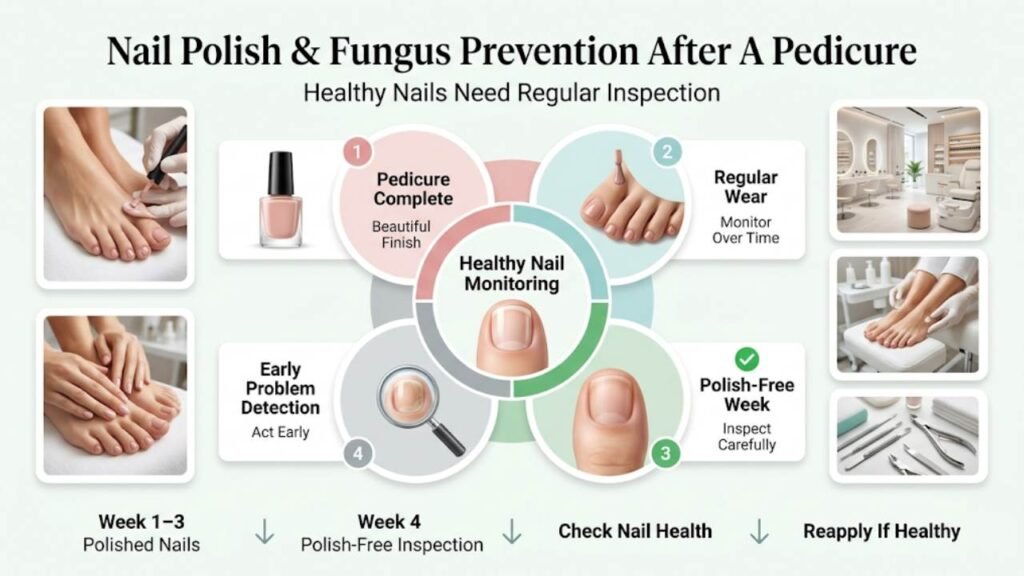
What nail polish actually does: Regular nail polish creates a barrier over the nail surface that reduces oxygen transmission and can trap moisture beneath it if worn continuously for extended periods without removal. This does not directly cause fungal infection but creates a somewhat more favorable environment for organisms already present on the nail surface.
The monitoring problem: Nail polish on infected nails hides the progression of infection. This is why preventing fungus after a pedicure includes removing polish periodically to inspect the nail — not simply painting over existing color with a new color at each subsequent visit.
Polish as a covering for infection: Applying fresh polish to nails that have already developed discoloration from fungal infection disguises the infection and delays treatment. Many patients who present with moderate-to-advanced nail infection report that the infection was hidden under continuous nail polish for months before it was noticed.
The practical recommendation: Between pedicures, allow nails to go polish-free for at least one week per month. During this period, inspect all nails in good lighting and compare to the previous month.
Preventing Fungus After a Pedicure: Choosing Salons Wisely
Long-term preventing fungus after a pedicure involves selecting and returning to salons that maintain appropriate infection control standards — not just visiting any available salon for convenience.
What to prioritize in salon selection:
Genuine autoclave sterilization of metal tools: This is the single most impactful infection control measure. Salons that invest in autoclave equipment for tool sterilization demonstrate a meaningful commitment to client protection.
Single-use basin liners or pipeless basins with documented disinfection protocol: The water basin is the second highest-risk component after tools.
Willingness to answer questions about hygiene practices: A professional salon with appropriate practices will be comfortable answering questions about their sterilization methods. Evasiveness or dismissiveness in response to questions about sterilization is itself a signal.
State licensing compliance: Licensed nail technicians in states with nail salon regulation have completed infection control training as part of their licensure requirements. Verifying that the salon and technicians hold current state licenses provides baseline assurance.
Frequently Asked Questions About Preventing Fungus After a Pedicure
How quickly does nail fungus develop after a pedicure if infection occurred?
Fungal infection does not produce visible nail changes immediately after exposure. The incubation period for dermatophyte nail infection — from spore contact to visible nail change — is typically 2 to 6 weeks. If you develop new nail discoloration or texture change 4 to 6 weeks after a pedicure, the pedicure is a likely candidate for the source of exposure.
Is it safe to get a pedicure if I already have nail fungus?
Having an active nail fungal infection does not mean you can never get a pedicure — but it does mean you need to be transparent with the salon and protect other clients from your infection. Bringing your own tools, informing the technician about the condition, and ensuring the basin is thoroughly disinfected after your use are all components of responsible pedicure practice with an active infection.
Should I avoid nail polish entirely to prevent nail fungus?
No — nail polish does not cause nail fungal infection. The key habit for preventing fungus after a pedicure is removing polish periodically to inspect the nails, not avoiding polish entirely. Monthly polish-free inspection allows early detection of any changes.
What is the safest type of salon basin for preventing fungal infection?
Pipeless basins (simple bowls without jet systems) are the safest because they can be fully disinfected between clients without the residual contamination that accumulates in whirlpool jet pipes. If a salon uses whirlpool basins, single-use liners that are discarded after each client provide the next best protection.
Summary
Preventing fungus after a pedicure involves three distinct phases: pre-service assessment of the salon’s infection control practices, appropriate instructions to the technician during the service, and protective habits in the 24 to 48 hours immediately following the service when nail fold vulnerability is highest.
The most impactful single practice for preventing fungus after a pedicure is bringing your own sterilized nail implements — eliminating the highest-risk transmission vector entirely. The most important post-service practice is applying antifungal product to the nail folds and keeping the feet dry during the vulnerability window when the cuticle seal has been disrupted.
Consistent monthly nail inspection with nail polish removed allows early detection of any infection that occurs despite prevention efforts — when treatment is simplest and most effective.
Struggling to get an appointment?
We help patients in your area bypass clinic waitlists by instantly finding verified podiatry doctors who accept their insurance.