Why Some Nail Fungus Treatments Fail
Find a Podiatrist Near You
Get same-day appointments with verified podiatrists. Insurance accepted.
Nail fungus treatments fail far more frequently than the field of antifungal pharmacology would suggest — and understanding why is the key to finally getting results after months or years of unsuccessful attempts. Patients who have completed multiple full treatment courses, used over-the-counter products consistently for extended periods, or undergone laser sessions without lasting clearance are not simply unlucky. In the overwhelming majority of cases, there is a specific, identifiable reason why nail fungus treatments failed — and that reason is correctable.
This matters because the approach to a second or third treatment attempt needs to differ meaningfully from what was done before. Repeating the same treatment with more commitment is not the solution if the fundamental problem was wrong diagnosis, wrong organism, inadequate drug delivery, or untreated reinfection sources. Identifying which failure mechanism applies to your specific situation is the most clinically valuable step you can take before starting again.
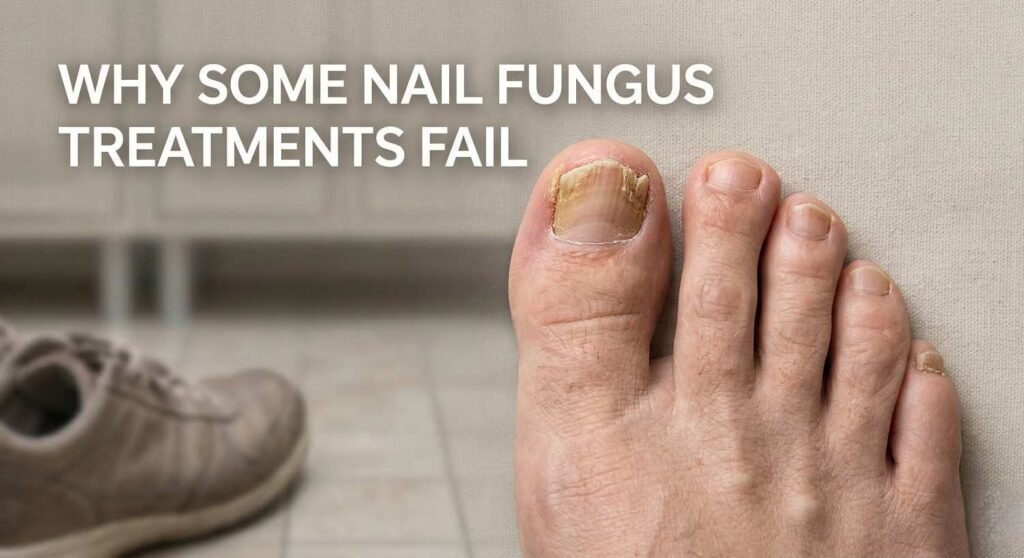
This guide covers the 8 most common and most clinically significant reasons nail fungus treatments fail — with specific, actionable responses to each.
Failure Reason 1: The Nail Condition Was Never Actually Fungal
Perhaps the most common and most consequential reason nail fungus treatments fail is that the nail condition being treated was not caused by fungal infection in the first place.
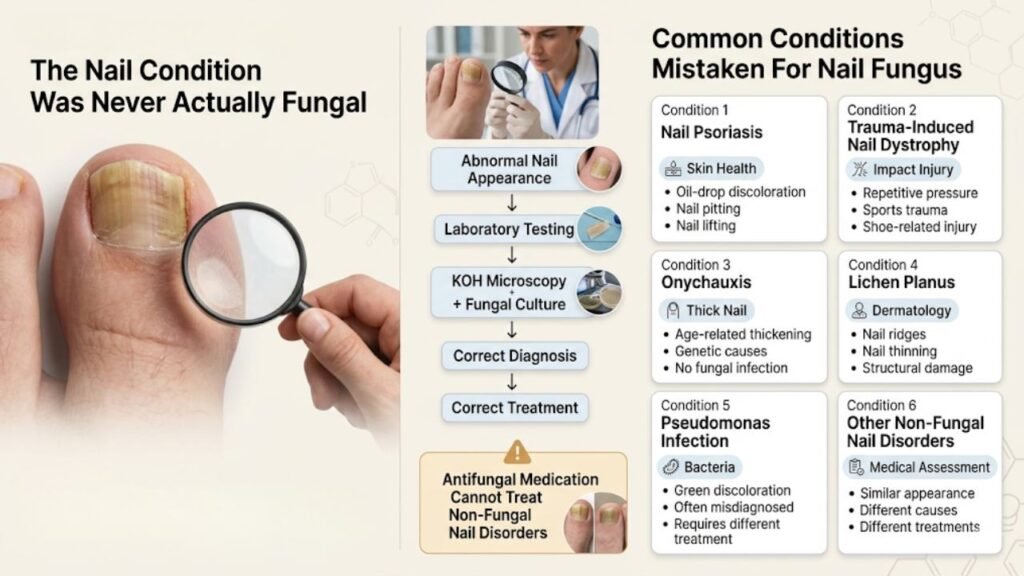
Multiple nail conditions produce changes that look almost identical to onychomycosis — thickening, discoloration, crumbling edges, nail lifting, debris beneath the nail. These include:
- Nail psoriasis — yellow-orange discoloration (oil-drop sign), nail pitting, onycholysis with a characteristically defined border
- Trauma-induced nail dystrophy — thickening and discoloration from repetitive shoe pressure or single impact events
- Onychauxis — uniform nail thickening from aging or genetics without fungal involvement
- Lichen planus — nail thinning, ridging, and in severe cases pterygium formation
- Bacterial infection (Pseudomonas) — green discoloration, mistaken for advanced fungal infection
In each of these cases, antifungal medication — topical or oral — produces no benefit. Nail psoriasis does not respond to efinaconazole. Trauma-induced nail changes do not respond to terbinafine. Months of treatment produce no improvement because the treatment is targeting the wrong biology.
The diagnostic imperative:
KOH microscopy and fungal culture — performed on nail clippings and subungual debris — are the only reliable way to distinguish fungal from non-fungal nail conditions. Studies suggest that when laboratory testing is performed before initiating antifungal treatment, the rate of non-fungal nail conditions being treated with antifungals drops dramatically.
If nail fungus treatments have failed and laboratory confirmation was never done, this is the first thing to address before trying again.
Failure Reason 2: The Wrong Organism Was Treated
Even when the condition is genuinely fungal, nail fungus treatments fail when the treatment chosen does not have activity against the specific organism responsible for the infection.
The default treatment for toenail onychomycosis is oral terbinafine — which is appropriate for dermatophyte infections (the most common cause, responsible for 80 to 90 percent of cases). However, the remaining 10 to 20 percent of nail fungal infections are caused by:
- Candida species (yeasts) — terbinafine has poor yeast activity. Treating Candida onychomycosis with terbinafine produces minimal improvement.
- Non-dermatophyte molds — Fusarium, Scopulariopsis brevicaulis, Aspergillus species — have variable and often poor susceptibility to terbinafine. Some non-dermatophyte molds require entirely different antifungal agents.
The clinical implication:
When nail fungus treatments fail despite full adherence to a terbinafine course, fungal culture with species identification is the critical diagnostic step. If the initial treatment was prescribed based on appearance alone (without culture), the organism may not be the dermatophyte that terbinafine targets.
Additionally, mixed infections — dermatophytes plus molds in the same nail — occur in some patients. Treatment targeting only one organism leaves the other to continue causing nail damage.
Failure Reason 3: Treatment Was Stopped Too Early
This is one of the most common behavioral reasons nail fungus treatments fail — stopping the prescribed treatment course when the nail starts to look better, before the fungal organisms are fully eliminated.
- Oral terbinafine suppresses fungal activity quickly, and new clear nail growing from the base becomes visible within 2 to 4 months
- The nail looks substantially better
- The patient concludes treatment is no longer necessary
- Treatment stops at week 6 or 8 of a 12-week course
- Residual fungal organisms in the deeper nail layers — suppressed but not eliminated — resume active growth when drug concentration falls
This produces a classic treatment failure pattern: improvement during treatment, apparent relapse within 2 to 4 months of stopping early.
Why this is different from treatment failure:
True treatment failure (the drug did not work) versus premature discontinuation (the drug was working but was not given time to complete its action) require different responses. Premature discontinuation typically responds well to completing a full course — the same agent can be used again.
The critical guidance: nail improvement during treatment is not the endpoint. The prescribed course endpoint is. Never stop antifungal medication based on nail appearance alone.
Failure Reason 4: Poor Drug Penetration to the Nail Bed
For topical antifungal medications, drug penetration through the nail plate to the nail bed where the fungus is concentrated is the fundamental challenge — and in many cases, nail fungus treatments fail because therapeutic drug concentrations never actually reach the infection site.
The nail plate as a barrier:
A normal nail plate is approximately 0.5 mm thick. In established onychomycosis with significant subungual debris and nail plate thickening, total nail structure thickness can reach 2 to 3 mm. The drug must diffuse the full distance through dense keratin to reach the nail bed.
Even the best-penetrating topical antifungals achieve limited concentrations at the nail bed in severely thickened nails.
Why topical-only treatment fails for established infection:
Topical monotherapy is appropriate for mild, superficial, or early nail infections. For established moderate-to-severe onychomycosis affecting more than 50 percent of the nail plate — the scenario in which patients most often seek treatment — topical-only therapy has complete cure rates of 5 to 18 percent. The majority of patients using topical agents alone for established infection will see nail fungus treatments fail because the drug cannot reach the fungus.
What actually helps:
Professional nail debridement — reducing nail plate thickness to 0.7 to 1 mm — increases topical antifungal penetration by approximately 40 percent. This single intervention substantially changes the clinical relevance of topical treatment. Topical antifungals used alongside nail debridement produce meaningfully better outcomes than topical agents used alone.
Failure Reason 5: Concurrent Athlete’s Foot Was Never Treated
This is the most consistently overlooked reason nail fungus treatments fail — and the one that most directly explains why treatments that initially appear successful produce early recurrence.
Tinea pedis (athlete’s foot) is present in the majority of patients with onychomycosis. The skin fungal infection — scaling, itching, peeling between the toes and on the plantar surface — is caused by the same dermatophytes that infect the nail. The skin is the primary reservoir from which nails are repeatedly reinfected.
When nail treatment clears the nail but the surrounding skin infection is untreated, the skin continuously reintroduces fungal organisms to the cleared nail through the hyponychium and nail fold. The nail appears to “come back” within months — but actually never fully stayed clear because the skin remained a constant inoculation source.
This is the single most actionable point in this entire guide:
Any nail fungus treatment course that does not simultaneously treat concurrent tinea pedis is operating with a built-in source of treatment failure. Topical antifungal for the skin (terbinafine cream, clotrimazole, miconazole) applied to the plantar skin and interdigital spaces daily during the nail treatment course, then maintained twice weekly afterward, directly addresses this mechanism.
Failure Reason 6: Footwear Contamination Reinfecting Cleared Nails
The shoe interior worn throughout an active nail infection accumulates fungal spores at significant density. Dermatophyte organisms survive in the warm, moist, dark interior of footwear for weeks to months.
A patient who completes a 12-week terbinafine course successfully — achieving mycological clearance — and then resumes wearing the same shoes they wore throughout the infection is continuously reintroducing high-density fungal spore exposure to nails that have been cleared. The “recurrence” occurs not because treatment failed but because the environmental source of reinfection was maintained throughout and after treatment.
How to address this:
- Apply antifungal spray (antifungal shoe spray products) to the shoe interior, allow overnight drying before wearing
- This should be done during treatment and continued for several months afterward
- For shoes worn heavily throughout a prolonged infection, replacement may be the most practical option
- Alternating between multiple pairs of shoes allows adequate drying time between wears, reducing moisture that supports spore viability
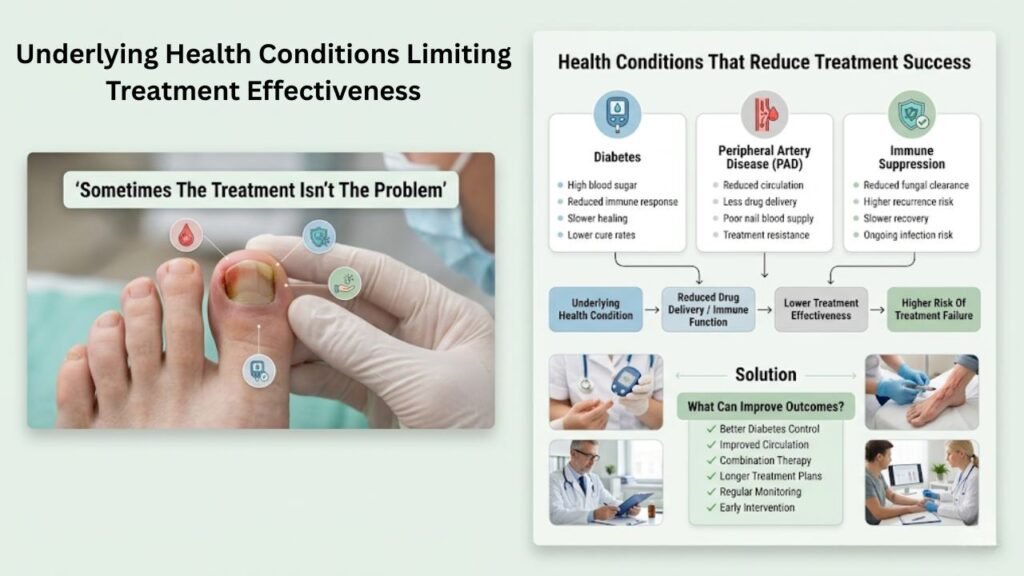
Failure Reason 7: Underlying Health Conditions Limiting Treatment Effectiveness
Certain medical conditions reduce the body’s ability to eliminate fungal infection even when antifungal medication is delivered appropriately.
Diabetes:
Elevated blood glucose creates a favorable fungal growth environment. Peripheral vascular disease reduces drug delivery to the nail through impaired circulation. Impaired neutrophil function (a direct effect of hyperglycemia) reduces the immune system’s contribution to fungal clearance. Standard terbinafine treatment in poorly controlled diabetic patients consistently produces lower cure rates than in normoglycemic patients.
Peripheral artery disease:
Drug delivery to the nail occurs through blood supply to the nail matrix and nail bed. Significantly reduced peripheral blood flow (from PAD or other vascular conditions) means less drug reaches the nail even when plasma drug concentrations are appropriate. Nail fungus treatments fail at higher rates in patients with significant PAD because the drug simply cannot get to where it needs to be.
Immune suppression:
Patients on immunosuppressive medications, chemotherapy, or with immune-affecting conditions have reduced antifungal immune capacity. Antifungal medication reduces the fungal burden, but the immune system’s role in clearing residual organisms — which complements medication in healthy adults — is insufficient. This produces both lower cure rates and higher recurrence rates.
What can be done:
For diabetic patients — optimizing glycemic control directly improves both immune function and peripheral circulation, and makes antifungal treatment more effective. For all patients with underlying conditions affecting treatment — realistic expectations, combination therapy approaches, and potentially longer treatment courses are appropriate.
Failure Reason 8: Dermatophytoma — Dense Fungal Biofilm Within the Nail
Dermatophytoma is a specific nail structural feature that is one of the most treatment-resistant presentations of onychomycosis — and a reason nail fungus treatments fail even with full adherence to appropriate protocol.
A dermatophytoma is a compact, dense mass of fungal hyphae embedded within the nail plate — essentially a fungal biofilm structure within the keratin. Clinically, it often appears as a distinct white or yellow longitudinal streak within the nail (running from base to tip).
Why dermatophytoma causes nail fungus treatments to fail:
The dense hyphae mass creates a physical barrier that prevents drug penetration to the core of the colony. Even with therapeutic drug concentrations in the surrounding nail tissue, the fungal organisms at the center of the dermatophytoma may not be exposed to sufficient drug concentrations.
Published studies demonstrate that dermatophytoma is associated with significantly lower cure rates from standard antifungal treatment — some studies showing cure rates less than 20 percent in dermatophytoma-positive nails treated with standard oral terbinafine monotherapy.
What helps:
Physical disruption of the dermatophytoma through aggressive nail debridement before and during antifungal treatment — breaking up the compact fungal mass and exposing its interior to drug penetration — combined with oral antifungal medication. This is one of the clearest demonstrations of why combination therapy with debridement is more effective than oral therapy alone for specific presentation types.
The Diagnostic Framework: Identifying Which Failure Mechanism Applies
When nail fungus treatments have failed, the next step is not simply trying a different or stronger treatment — it is a systematic assessment of which failure mechanism or combination of mechanisms was operating.
| Failure Mechanism | Key Diagnostic Question |
|---|---|
| Wrong diagnosis | Was laboratory confirmation (KOH/culture) done before starting? |
| Wrong organism | What species was identified? Was it a dermatophyte? |
| Premature stopping | Was the full prescribed course completed? |
| Poor penetration | Was debridement used alongside topical treatment? |
| Untreated tinea pedis | Was skin fungal infection identified and treated? |
| Footwear contamination | Were shoes decontaminated during and after treatment? |
| Underlying health conditions | Are there circulation, immune, or metabolic factors present? |
| Dermatophytoma | Is there a distinct longitudinal streak visible in the nail? |
Working through this framework with a podiatrist or dermatologist — rather than simply repeating a failed protocol — produces the information needed to design a genuinely different and more targeted second attempt.
Frequently Asked Questions About Why Nail Fungus Treatments Fail
Why did oral terbinafine not work for my nail fungus?
Several possibilities: the condition may not be fungal, the causative organism may not be a dermatophyte, treatment may have been stopped before the full course was complete, or dermatophytoma may have been present preventing drug penetration. Culture and species identification before retrying is the most important next step.
Is it normal for nail fungus to come back after treatment?
Recurrence after genuine clearance is common — but it is not inevitable. The most significant modifiable factor is whether concurrent athlete’s foot was treated and whether footwear was decontaminated. Patients who address these two factors after successful treatment have substantially lower recurrence rates than those who do not.
Why does the nail look better but then get worse again?
This pattern typically reflects either: premature treatment discontinuation, or treatment failure with apparent initial improvement from debridement or reduced inflammatory response rather than genuine fungal clearance. Confirming mycological cure with a negative laboratory test at the end of treatment distinguishes these scenarios.
Does debridement alone cure nail fungus?
No. Debridement physically reduces fungal burden and improves drug penetration, but it does not have inherent antifungal activity. It is an adjunct that makes antifungal treatment more effective — not a standalone cure. The combination of debridement plus antifungal medication consistently outperforms either alone.
Summary
Nail fungus treatments fail for eight specific, identifiable reasons: wrong diagnosis, wrong organism treated, premature stopping, poor drug penetration, untreated concurrent athlete’s foot, footwear contamination, underlying health conditions limiting effectiveness, and dermatophytoma formation. In most cases, one or more of these mechanisms is responsible — and most are correctable with the right assessment and treatment modifications.
The most important message for anyone whose nail fungus treatments have failed: the answer is not simply “try harder with the same approach.” It is to work through the failure mechanism framework, identify what specifically went wrong, and design a treatment plan that addresses those specific gaps. For many patients, this means adding debridement, treating tinea pedis simultaneously, addressing footwear, and ensuring complete laboratory confirmation of both the diagnosis and the causative organism.
Struggling to get an appointment?
We help patients in your area bypass clinic waitlists by instantly finding verified podiatry doctors who accept their insurance.