Total Nail Removal — When Is It Needed?
Find a Podiatrist Near You
Get same-day appointments with verified podiatrists. Insurance accepted.
Total nail removal is a procedure that patients often approach with significant apprehension — and understandably so. The complete removal of an entire toenail sounds more dramatic than it typically is in practice. But there are specific clinical situations where leaving a severely damaged, infected, or chronically problematic nail in place causes more harm than removing it, and in those situations, total nail removal (complete nail avulsion) is the most clinically appropriate choice.
Understanding when total nail removal is genuinely necessary — versus when less invasive approaches would work better — helps patients participate meaningfully in treatment decisions rather than either accepting an unnecessary procedure or avoiding a necessary one due to unfounded concern.
This guide explains the clinical indications for total nail removal, both temporary and permanent approaches, what the procedure involves, what recovery looks like, and how new nail growth progresses after the procedure.

What Total Nail Removal Actually Is
Total nail removal — complete nail avulsion — removes the entire nail plate from the nail bed. This is distinct from partial nail avulsion, which removes only one or both lateral nail edges while preserving the central nail.
After total nail removal, the nail bed — the pink, sensitive tissue that the nail plate normally covers — is exposed. It is initially tender and requires careful wound management during healing. The nail bed is not removed — only the nail plate above it.
Temporary total nail removal:
The nail plate is fully removed but the nail matrix — the growth center at the nail base — is left intact. The nail grows back over the following 9 to 18 months. This approach is appropriate when the goal is to access the nail bed for treatment, allow better antifungal contact with an infected nail bed, or provide temporary relief while the underlying condition is managed.
Permanent total nail removal (total matrixectomy):
The nail plate is fully removed AND the nail matrix is destroyed — chemically, surgically, or with laser. No new nail regrows. The nail bed gradually develops a toughened, skin-like covering. This approach is appropriate when the nail has been the source of chronic complications and the patient’s quality of life is better served by permanent absence of the nail than by recurrent problems.
When Total Nail Removal Is the Right Clinical Choice
Total nail removal is not the first treatment for any of the conditions it addresses — it represents the endpoint of a treatment hierarchy where less invasive options have been tried and proven insufficient, or where the initial severity of the condition makes conservative management clearly inadequate.
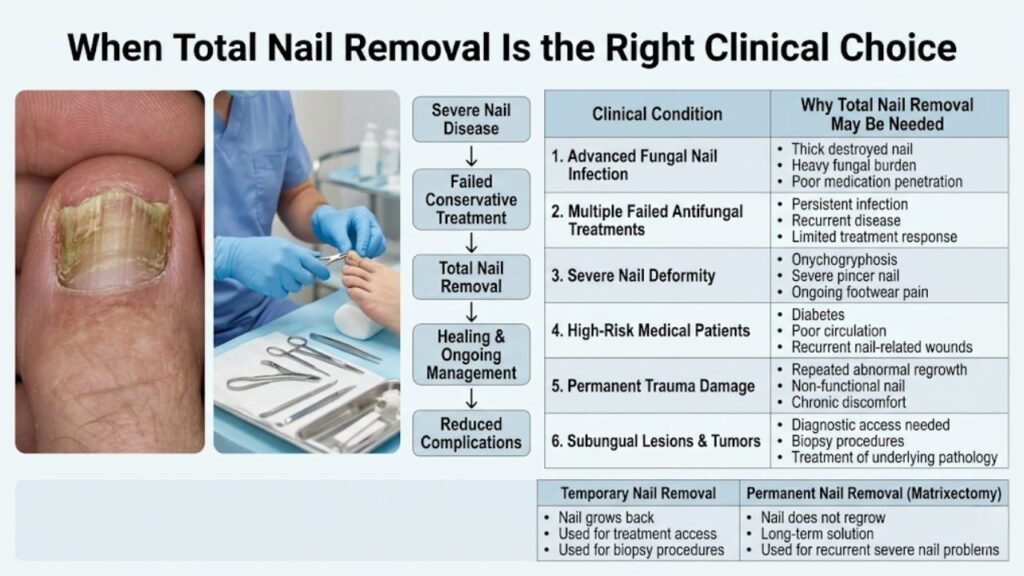
1. Total Dystrophic Onychomycosis — Advanced Fungal Infection
When fungal nail infection (onychomycosis) progresses to total dystrophic onychomycosis, the nail plate is completely destroyed. There is no structural integrity remaining. The nail is thick, crumbling, often brownish-black, and has essentially become a collection of infected keratin debris rather than a functional nail plate.
Why antifungal medication alone is insufficient at this stage:
- Oral antifungal drugs reach the nail bed through blood supply — but the nail bed in total dystrophic onychomycosis is covered by subungual hyperkeratosis (thick keratin accumulation) that creates a physical barrier
- Topical antifungals cannot penetrate the debris and distorted nail structure at therapeutic concentrations
- The dense fungal biofilm within the dystrophic material provides structural protection to the organisms
How total nail removal helps:
Removing the entire nail plate and clearing the accumulated subungual debris does two things simultaneously:
- Physically removes the vast majority of the fungal organism load in that nail
- Exposes the nail bed directly, allowing topical antifungal application to reach the infection site without a nail plate barrier
After total nail removal in total dystrophic onychomycosis, the nail bed receives antifungal treatment directly — either topical or both topical and continued oral — for the 9 to 18 months during which new nail grows back.
The outcome consideration:
If the nail matrix has been damaged by the prolonged fungal infection, the regrown nail may not be fully normal even after successful fungal eradication. Pre-procedure counseling should be honest about this possibility.
2. Multiple Failed Treatment Courses for Established Onychomycosis
For patients who have completed:
- One or more full 12-week courses of oral terbinafine
- Regular professional nail debridement throughout treatment
- Concurrent topical antifungal application
- Appropriate prevention measures
…and whose nails show no meaningful improvement, total nail removal provides an option that changes the entire treatment dynamic. By removing the physical nail structure that has harbored resistant infection through multiple treatment cycles, it allows a fresh start — new nail growing from the matrix, with antifungal treatment applied to the exposed nail bed throughout the regrowth period.
3. Severely Deformed Nails Causing Chronic Complications
Onychogryphosis: The ram’s horn nail — dramatically thickened and curved, often beyond what even specialist debridement can manage comfortably — causes pain with footwear, risk of skin breakdown, and ongoing management challenges. In elderly patients with limited mobility, poor circulation, or other health factors making repeated professional nail care difficult to access, total nail removal with permanent matrixectomy provides a definitive solution. The nail bed heals with a smooth skin-like covering that causes no footwear pressure and requires no ongoing specialist management.
Severe pincer nail: When all lateral edges of the nail have developed extreme inward curvature that is compressing the nail bed from both sides, and the curvature is severe enough that partial avulsion of both edges would leave essentially no nail — total nail removal with consideration of permanent matrixectomy may be the most practical approach.
4. Chronic Nail Causing Complications in High-Risk Patients
For patients with:
- Diabetes with recurrent nail fold breakdown from a problematic nail
- Peripheral vascular disease where nail-related skin wounds heal poorly
- Immune compromise where nail-related secondary bacterial infection poses serious risk
- Elderly patients with multiple factors making nail infections particularly dangerous
…total nail removal eliminates the source of ongoing risk. The exposed nail bed, properly cared for during healing, presents a lower complication risk than an infected nail constantly threatening surrounding tissue.
5. Nail Trauma With Permanent Matrix Damage
When a traumatic nail injury has damaged the nail matrix in a way that the nail cannot grow back normally — the nail grows back thickened, irregularly, or in a direction that causes ongoing problems — and when this has been confirmed across two or more growth cycles, total nail removal with matrixectomy may be appropriate to stop producing a non-functional nail that is causing more problems than it solves.
6. Subungual Pathology Requiring Access for Diagnosis or Treatment
Benign or potentially malignant lesions beneath the nail — subungual tumors, glomus tumors, pigmented lesions requiring biopsy — require nail removal for adequate access. This is typically temporary removal to allow biopsy or excision, with the nail growing back afterward.
The Total Nail Removal Procedure: Step by Step
Total nail removal is performed in an outpatient clinical setting — a podiatry clinic, dermatology clinic, or minor surgery room. Hospital admission is not required.
Digital Block Anesthesia
The first and most important step is achieving complete anesthesia of the toe.
A digital nerve block numbs all sensation in the toe by injecting local anesthetic (typically lidocaine) at the nerve trunks running along the base of the digit. The injections themselves are the most uncomfortable part of the entire procedure — once the block is established (3 to 5 minutes after injection), the patient feels nothing from the injection point forward.
The procedure cannot begin until the block is complete. The podiatrist will confirm anesthesia before proceeding.
Tourniquet Application
A small elastic tourniquet at the toe base reduces blood flow to the operative field, minimizing bleeding and improving visibility. This is typically removed at the end of the procedure before dressing.
Nail Plate Separation
Using a nail elevator (a thin, spatula-like instrument), the podiatrist separates the nail plate from the nail bed by sliding the elevator between the two surfaces. This separation begins at the free nail edge and works proximally toward the nail fold — releasing the attachment of the nail plate to the nail bed across its full length.
The nail plate must also be separated from the nail fold tissues at the sides and from the tissue beneath the proximal nail fold at the base.
Nail Plate Removal
Once fully separated, the nail plate is grasped with hemostat forceps and removed with a firm, rotating motion — rolling the nail out from beneath the proximal nail fold. The entire nail plate comes away in one piece.
The nail bed is now exposed — smooth, pink, and sensitive (though not perceived by the patient under anesthesia).
Matrix Treatment (When Permanent Removal Is Planned)
For temporary total nail removal, the procedure ends here — the matrix is left intact and a new nail will grow.
For permanent total nail removal, the matrix is destroyed:
Phenol chemical matrixectomy:
Cotton-tipped applicators soaked in 88 percent phenol are applied to the nail matrix tissue — the germinal epithelium at the base of the nail bed beneath the proximal nail fold. Three applications of 30 seconds each, with isopropyl alcohol neutralization between and after applications. Phenol coagulates the matrix cells, permanently preventing nail production from the treated tissue.
Surgical matrix excision:
In some cases, the matrix tissue is surgically excised — cut out. This is a more invasive approach but provides certainty of matrix destruction in cases where chemical methods may be less predictable.
Laser matrix ablation:
CO₂ or Nd:YAG laser can be used to ablate matrix tissue — less chemical trauma to surrounding tissue but requires appropriate laser equipment.
Wound Dressing
The exposed nail bed is irrigated with saline. A non-adherent dressing (paraffin gauze or similar) is applied directly to the nail bed, followed by gauze and a bandage. This dressing protects the sensitive nail bed tissue and absorbs any wound secretions during the first days of healing.
Recovery After Total Nail Removal
First Week
Pain is most significant in the first 24 to 48 hours after local anesthetic wears off. This is typically well-managed with over-the-counter analgesics. Elevation of the foot during this period reduces blood pooling and associated throbbing.
Walking is possible from day one, though strenuous activity and closed athletic footwear should be avoided. Open-toed sandals or a post-surgical shoe are appropriate.
Wound Care
Daily dressing changes are essential and represent the patient’s primary commitment during recovery:
- Soak the toe in warm water or dilute antiseptic for 5 to 10 minutes to soften any dried exudate
- Gently clean the nail bed with saline or dilute antiseptic
- Pat dry
- Apply a thin layer of topical antibiotic ointment if prescribed
- Apply a fresh non-adherent dressing
- Secure with a light bandage
The phenol wound:
When phenol matrixectomy has been performed, the wound produces thin serosanguineous (clear to pinkish) discharge for 2 to 4 weeks. This is entirely normal — the phenol creates a controlled chemical wound that heals by secondary intention. The discharge does not indicate infection and should not cause alarm.
Healing Timeline
| Stage | Timeframe |
|---|---|
| Significant pain reducing | Days 3 to 7 |
| Wound discharge from phenol reducing | 2 to 4 weeks |
| Initial wound surface closure | 4 to 6 weeks |
| Stable, comfortable nail bed (if permanent) | 2 to 3 months |
| New nail visible at base (if temporary) | 2 to 4 months |
| Full new nail regrowth (if temporary) | 9 to 18 months |
What the Nail Bed Looks Like During Recovery
After total nail removal, the nail bed appears as a smooth, glistening pink surface — somewhat like the skin on the inside of a blister after the roof is removed. As healing progresses over weeks, it develops a slightly tougher, more skin-like appearance. In permanent total nail removal, this surface eventually looks and feels like normal toe skin.
What Patients Experience When the Nail Grows Back
For temporary total nail removal, new nail begins growing from the matrix as the nail bed heals. This new nail is initially soft and fragile before hardening. Key points:
- The first new nail emerging from the matrix is often noticeably thinner and sometimes more curved than the pre-removal nail
- If the cause of the original nail problem (fungal infection, matrix damage) has been addressed, the new nail should be structurally more normal
- If the underlying cause has not been resolved, the new nail may develop the same problems as before
- Full nail regrowth from complete coverage of the nail bed takes 9 to 18 months
For patients with fungal infection, antifungal treatment (topical applied to the nail bed and potentially continued oral) throughout the regrowth period provides the best opportunity for a fungus-free new nail.
Frequently Asked Questions About Total Nail Removal
Is total nail removal painful?
The procedure itself is not painful under complete digital nerve block anesthesia. The most uncomfortable part is the anesthetic injection at the toe base. Post-procedure discomfort in the first 48 hours is managed with standard analgesics.
Will my nail grow back after total nail removal?
If the nail matrix is left intact (temporary removal), yes — the nail grows back over 9 to 18 months. If the matrix is destroyed by chemical or surgical matrixectomy (permanent removal), no — the nail does not regrow.
How long does recovery take?
Pain significantly subsides within the first week. With phenol matrixectomy, wound discharge continues for 2 to 4 weeks while the wound heals. Full wound healing and a stable nail bed typically takes 4 to 6 weeks.
Can I walk after total nail removal?
Yes — walking is possible from day one. Open footwear or a surgical post-op shoe is required for the first week or more. Strenuous activity and tight athletic footwear should be avoided for 2 to 3 weeks.
Is permanent total nail removal a reasonable option?
Yes. For patients with severe chronic nail conditions — particularly elderly patients with onychogryphosis, recurrent nail complications, or high-risk conditions making ongoing nail management dangerous — permanent total nail removal offers a practical, definitive solution. The nail bed heals smoothly and does not cause footwear discomfort.
What is the success rate of total nail removal for fungal nail infection?
Total nail removal improves the environment for antifungal treatment by removing the infected nail structure and exposing the nail bed directly. When combined with continued antifungal treatment during the regrowth phase, it can achieve mycological cure in cases where previous treatment failed. Success depends on complete antifungal treatment during the regrowth period and prevention of reinfection from footwear and environmental sources.
Summary
Total nail removal is a surgical procedure reserved for clinical situations where less invasive approaches have been insufficient or where the severity of the nail condition makes conservative management inappropriate. The primary indications are total dystrophic onychomycosis with failed antifungal treatment, severely deformed nails causing chronic complications, high-risk patients where infected nails pose serious secondary risks, and subungual pathology requiring nail bed access.
The procedure is performed under complete local anesthesia, takes 30 to 45 minutes, allows immediate weight-bearing, and requires 4 to 6 weeks of wound care during healing. For temporary removal, new nail grows back over 9 to 18 months. For permanent removal with matrixectomy, the nail bed heals as a stable skin-like surface that causes no footwear problems.
When appropriately indicated, total nail removal is a highly effective intervention that eliminates chronic pain, resolves persistent infection, and provides a stable platform for recovery — outcomes that years of conservative management in the wrong clinical scenario cannot achieve.
Struggling to get an appointment?
We help patients in your area bypass clinic waitlists by instantly finding verified podiatry doctors who accept their insurance.