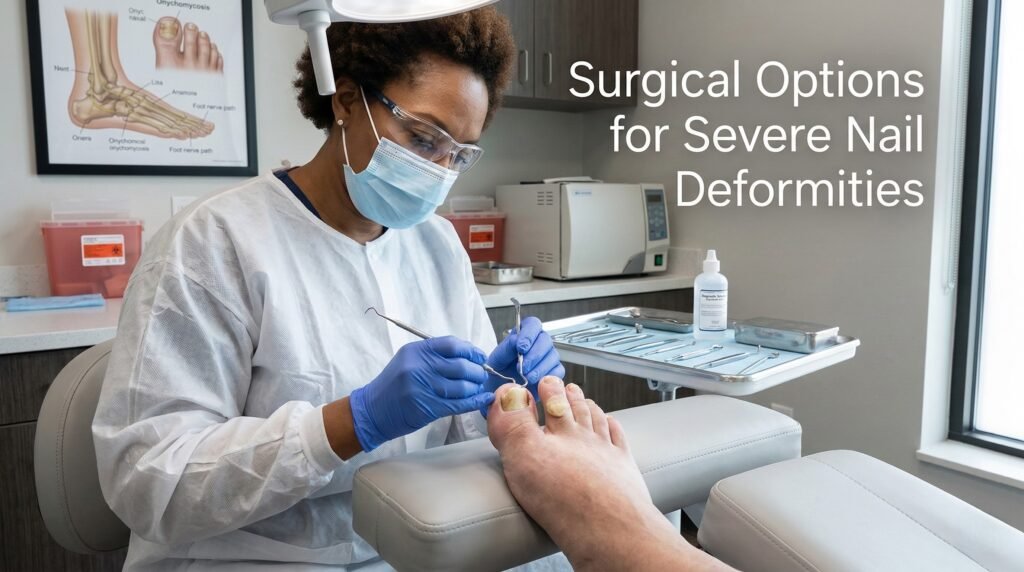
Surgical Options for Severe Nail Deformities
Find a Podiatrist Near You
Get same-day appointments with verified podiatrists. Insurance accepted.
Surgical options for severe nail deformities become necessary when conservative management — antifungal medications, professional debridement, nail bracing, and footwear correction — has been given a fair chance and the nail continues to cause significant pain, functional limitation, or recurrent complications.
Surgery is not the first step in managing nail problems. But for a specific group of patients — those with severely thickened, permanently distorted, chronically infected, or repeatedly ingrown nails — it is the most practical path to lasting relief. Understanding what each surgical procedure actually involves, when each one is appropriate, and what recovery realistically looks like helps patients make informed decisions rather than delaying necessary care or agreeing to surgery prematurely.
This guide explains the 5 main surgical options for severe nail deformities in clear, practical terms — what each procedure does, who it is designed for, and what to expect before, during, and after treatment.
When Do Nail Deformities Require Surgery?
Not every thick, curved, or damaged nail needs surgery. Most nail conditions can be managed effectively with non-surgical approaches given enough time and the right treatment.
Surgery becomes the appropriate consideration when:
Conservative treatment has failed
A patient who has completed full courses of antifungal medication, used nail bracing for an appropriate period, undergone regular professional debridement, and corrected their footwear — and the nail is still causing significant pain or has not improved — has genuinely exhausted the conservative options. Surgical options for severe nail deformities become more justified with each failed conservative attempt.
The nail is causing active harm
When a nail edge is pressing into surrounding skin and causing wounds, when secondary bacterial infection is recurrent, when a diabetic patient’s compromised foot cannot tolerate ongoing nail pressure, or when the nail has become so structurally distorted that it cannot be safely managed through regular debridement — surgery addresses the source of harm directly.
The deformity is permanent and progressive
Some nail changes — particularly those involving significant matrix damage, severe onychogryphosis, or structurally irreversible pincer nail deformity — cannot be improved by any non-surgical approach. In these cases, the realistic conversation is about which surgical option best addresses the specific deformity.
Recurrence is persistent
Ingrown toenails that have been treated surgically once but have recurred because the nail edge was not permanently addressed require a more definitive procedure (matrixectomy) rather than another avulsion alone.
The 5 Main Surgical Options for Severe Nail Deformities
Surgical Option 1: Partial Nail Avulsion
Partial nail avulsion is the most commonly performed nail surgical procedure and the most conservative of the surgical options for severe nail deformities. It removes only the affected portion of the nail — typically one or both lateral edges — while preserving the central nail and the healthy matrix beneath it.
What it involves:
The procedure is performed under local anesthesia — a digital nerve block is administered at the base of the toe, numbing the entire digit. Once the area is completely numb, the podiatrist uses a nail elevator to separate the nail plate from the nail bed along the margin being removed. A straight nail splitter cuts the nail in a straight line from tip to base. The selected nail edge strip is removed cleanly.
The procedure takes approximately 15 to 30 minutes in a clinical setting. No general anesthesia, no hospital admission, and no sutures are typically required.
Who it is designed for:
- Ingrown toenails that have not responded to conservative management
- Severely ingrown nail edges causing recurrent skin infection
- Lateral nail borders that are causing pain through contact with nail fold tissue
- As part of pincer nail management — removing the most curved sections
What to expect with regrowth:
After partial avulsion, the removed nail section grows back. Without matrix treatment alongside the avulsion, the nail will regrow in approximately the same shape as before. If the nail edge regrows and causes the same problem again (which is common with ingrown nails), this indicates that a matrixectomy of the removed portion was needed rather than avulsion alone.
Recovery:
Initial healing of the treated nail fold takes 2 to 4 weeks. The nail itself grows back over 9 to 12 months.
Surgical Option 2: Partial Nail Avulsion With Matrixectomy
This procedure combines partial nail edge removal with permanent destruction of the matrix cells responsible for growing that nail edge. It is the definitive surgical option for severe nail deformities where a specific nail edge segment is causing recurrent problems.
What it involves:
Partial avulsion is performed as described above. After the nail edge strip is removed, the podiatrist treats the exposed matrix tissue at the base of the removed strip to prevent regrowth. The most common method is chemical matrixectomy using phenol:
Phenol matrixectomy:
Liquefied phenol (typically 88 percent concentration) is applied directly to the exposed matrix tissue using a small applicator. Phenol denatures the matrix cells, permanently preventing them from producing nail. The phenol is applied for a precise timed contact — typically in three 30-second applications — and then neutralized with isopropyl alcohol.
Alternative matrixectomy methods:
- Sodium hydroxide — less commonly used, similar mechanism to phenol
- Laser ablation — uses laser energy to destroy matrix cells without chemical agents; useful when phenol is contraindicated
- Surgical excision — physically removing the matrix tissue; more invasive, typically reserved for cases where chemical methods are unsuitable
Who it is designed for:
- Recurrent ingrown toenails where avulsion alone has failed
- Ingrown nail edges that grow back into the same position after simple avulsion
- Pincer nail edges where permanent prevention of the problematic nail segment growing back is the goal
- Cases where the patient wants a definitive, single-procedure solution rather than repeated avulsions
What to expect:
The treated area does not regrow a nail edge. The central nail remains intact. The toe tip at the treated edge heals with a smooth skin margin rather than a nail edge.
Recovery:
The phenol causes a controlled chemical burn at the matrix site. The area produces a small amount of discharge for 2 to 4 weeks while healing. Patients need to change dressings daily, typically using a simple dry or antiseptic dressing. Full healing takes 4 to 6 weeks. Patients can usually walk normally within a few days, wearing open or wide footwear during healing.
Surgical Option 3: Total Nail Avulsion
Total nail avulsion removes the entire nail plate while leaving the nail bed and matrix intact. It is one of the more definitive surgical options for severe nail deformities when the entire nail is significantly damaged or when direct nail bed access is required.
What it involves:
After digital nerve block anesthesia, the entire nail plate is separated from the nail bed from tip to base using a nail elevator. The nail is removed in one piece or in sections if it is too distorted for single-piece removal. The exposed nail bed is examined, treated (antifungal agents if infection is present, wound care otherwise), and dressed.
Who it is designed for:
- Total dystrophic onychomycosis where the entire nail plate is structurally destroyed and non-functional
- Nail plate so severely deformed by onychogryphosis that debridement cannot adequately manage it
- Cases where the nail bed needs to be directly assessed or treated
- As a temporizing measure in elderly or diabetic patients where a problematic nail is causing ongoing complications
What happens after:
The matrix is preserved, so a new nail grows back over 9 to 18 months. The regrown nail will reflect the health and function of the underlying matrix. If the matrix has been damaged by years of infection or deformity, the regrown nail may still be structurally abnormal — managing patient expectations about this is an important part of pre-procedure counseling.
Recovery:
The nail bed is a sensitive, exposed surface after total avulsion. Protective dressing is essential for the first several weeks until new skin and early nail growth provide coverage. Full comfort typically returns within 4 to 6 weeks.
Surgical Option 4: Total Nail Avulsion With Permanent Matrixectomy
This is the most definitive of the surgical options for severe nail deformities — complete removal of the nail plate combined with permanent destruction of the entire matrix, preventing any nail regrowth.
Who it is designed for:
- Permanently deformed nails that are expected to regrow in the same abnormal pattern after simple avulsion (such as severe onychogryphosis where the matrix itself is structurally abnormal)
- Nails causing chronic complications in vulnerable patients (elderly, diabetic) where the ongoing management burden of a repeatedly thickening nail is not appropriate
- Patients with severely painful, chronically infected nails who do not want a nail to regrow on that digit
- Cases where the nail is the source of recurrent harm and permanent removal is the most practical management
Phenol-alcohol matrixectomy of the entire matrix is the most commonly used technique. The procedure follows total avulsion, with phenol applied to the entire nail matrix strip at the base.
What the outcome looks like:
The toe tip heals with smooth skin covering the formerly nail-bearing area. There is no nail edge to cause ingrowth, no nail plate to thicken, and no nail border to press into surrounding tissue. The cosmetic appearance — a bare toe tip — is the trade-off for permanent resolution of the nail problem.
Recovery:
Similar to partial matrixectomy — 4 to 6 weeks of dressing changes and wound care, with gradual complete healing.
Surgical Option 5: Nail Bed Reconstruction
Nail bed reconstruction is the most technically complex of the surgical options for severe nail deformities. It is performed when the nail bed itself has been structurally damaged — from severe trauma, chronic infection reaching the nail bed, or prior surgical complications — and the damaged nail bed is producing abnormal nail or preventing normal nail attachment.
What it involves:
The specific technique depends on the extent of nail bed damage. Options include:
- Nail bed split-thickness skin grafting — a thin skin graft is placed over a damaged nail bed area, allowing it to heal with a smoother, more functional surface
- Nail bed suture repair — lacerated or torn nail bed segments are repaired with fine absorbable sutures
- Flap reconstruction — in more extensive nail bed loss, local tissue flaps from adjacent skin are rotated to provide nail bed coverage
Who it is designed for:
- Severe traumatic nail injuries where the nail bed was lacerated, avulsed, or crushed
- Post-surgical nail bed scarring that is producing irregular nail attachment or abnormal nail growth
- Chronic fungal or bacterial infection that has extended to and damaged the nail bed
Recovery:
More extended than simpler nail procedures — typically 4 to 8 weeks for initial healing, with nail regrowth monitored over the subsequent 6 to 18 months to assess whether the reconstructed nail bed supports normal nail production.
What Happens During Any Nail Surgery Procedure
Regardless of which surgical option for severe nail deformities is being performed, certain elements are standard:
Local anesthesia (digital block)
A digital nerve block numbs all sensation in the toe. This is administered by injection at the base of the toe, not at the nail itself. The procedure waits until the entire digit is fully numb before beginning. Most patients experience no pain during the procedure.
Tourniquet application (optional)
A small elastic tourniquet applied at the toe base reduces blood flow to the nail area during the procedure, improving visibility. This is typically removed at the end of the procedure.
Sterile environment
All instruments are sterile. The toe is cleaned with antiseptic solution before the procedure begins.
Dressing application
After the procedure, a non-adhesive dressing is applied to the treated nail area, protected by gauze and medical tape.
Post-procedure instructions
Written wound care instructions, a follow-up appointment schedule, and information about when to seek care if unexpected symptoms develop are provided before the patient leaves.
Recovery After Surgical Options for Severe Nail Deformities
In the First Few Days
- Some throbbing aching as local anesthetic wears off is normal — manageable with over-the-counter pain relief
- Keep the dressing in place and dry
- Wear open or very wide footwear — no closed shoes that press on the treated area
- Elevate the foot when resting to reduce swelling and discomfort
During the Healing Period (Weeks 2 to 6)
- Daily dressing changes as instructed — typically a simple non-adhesive dressing with light gauze and tape
- Some discharge from the wound site is normal, particularly after phenol matrixectomy (the phenol wound produces serosanguineous discharge while healing)
- The wound gradually closes from the edges inward
- Walking is generally possible within a few days; return to normal footwear depends on the specific procedure and individual healing
Return to Normal Activity
Most patients return to normal daily activity within 2 to 4 weeks depending on the procedure performed. Athletic or high-impact activity is typically delayed until wound healing is confirmed at a follow-up appointment.
Practical Steps After Surgery
Following these steps consistently during healing produces the best outcomes after surgical options for severe nail deformities:
- Change dressings daily or as directed — do not let dressings become soaked or stay on longer than instructed
- Keep the treated foot dry during showering — plastic bag protection over the dressing is practical
- Do not remove any eschar (dry wound tissue) that forms — let the wound heal naturally
- Attend all scheduled follow-up appointments — wound assessment at 1 to 2 weeks and again at 4 to 6 weeks
- Report any significant increase in pain, spreading redness, swelling, or wound discharge that changes significantly to your podiatrist promptly
Frequently Asked Questions About Surgical Options for Severe Nail Deformities
Is nail surgery painful?
The procedure itself is performed under local anesthesia and should be painless. Some throbbing discomfort as the anesthetic wears off is normal and manageable with over-the-counter pain relief. Most patients describe the post-procedure discomfort as mild to moderate for the first 24 to 48 hours.
Will the nail grow back after surgery?
It depends on the procedure. Simple avulsion (without matrixectomy) allows full nail regrowth over 9 to 18 months. Partial matrixectomy prevents regrowth of the treated edge portion while the central nail grows normally. Total matrixectomy permanently prevents any nail regrowth on that digit.
How long does nail surgery take?
Most nail surgical procedures take 15 to 45 minutes as an in-office procedure. No hospital admission is required for standard nail surgical options for severe nail deformities.
Are there risks to nail surgery?
All surgical procedures carry some risk. For nail surgery, the main risks are infection, delayed healing, and in matrixectomy procedures, incomplete destruction of the matrix leading to a small nail spike regrowing. These complications are uncommon when the procedure is performed by an experienced podiatrist with proper aftercare.
Can nail surgery fail or need to be repeated?
Occasionally a treated nail edge regrows after matrixectomy — this occurs in approximately 5 to 10 percent of phenol matrixectomy cases and can be retreated. Complete failure of the procedure is uncommon. Following aftercare instructions precisely reduces the recurrence rate.
How do I know if I need surgery for my nail problem?
If your nail has not responded to conservative treatment including appropriate antifungal therapy, professional debridement, and footwear correction — or if it is causing recurrent infection, significant pain, or skin breakdown — professional podiatric evaluation of whether surgical options for severe nail deformities are appropriate is a reasonable next step.
Summary
Surgical options for severe nail deformities provide definitive solutions for nail conditions that conservative management cannot adequately address. The 5 main procedures — partial avulsion, partial avulsion with matrixectomy, total avulsion, total avulsion with permanent matrixectomy, and nail bed reconstruction — address different deformity patterns with different goals, recovery timelines, and permanence of outcome.
Partial avulsion with chemical matrixectomy is the most commonly performed procedure and provides definitive resolution for recurrent ingrown nails and problematic nail edges. Total avulsion with matrixectomy offers permanent nail removal for nails that cause ongoing harm in vulnerable patients. Nail bed reconstruction addresses the most complex structural nail bed damage.
All procedures are performed under local anesthesia in a clinic setting without hospital admission. Recovery varies from 4 to 6 weeks for simpler procedures to 4 to 8 weeks for more complex reconstruction. Understanding what each surgical option actually involves helps patients make confident, informed decisions alongside their podiatric care team.
Struggling to get an appointment?
We help patients in your area bypass clinic waitlists by instantly finding verified podiatry doctors who accept their insurance.