Can Toenail Fungus Spread to Other Nails?
Find a Podiatrist Near You
Get same-day appointments with verified podiatrists. Insurance accepted.
Toenail fungus spread to other nails is one of the most common progressions of untreated onychomycosis — and one of the most preventable. What begins as a faint yellow discoloration at the tip of a single nail can quietly advance to neighboring nails over weeks and months, often without causing pain until the infection is already well established across multiple toes.
The answer to whether toenail fungus spreads to other nails is straightforward: yes, it does, and it does so through mechanisms that are entirely predictable once you understand how fungal organisms behave. Knowing those mechanisms helps you take targeted action — protecting healthy nails, stopping an existing infection from expanding, and knowing when the situation requires professional intervention.
This guide covers how toenail fungus spread to other nails actually occurs, which factors accelerate it, how to recognize spreading infection early, and what steps consistently prevent it.

Why Toenail Fungus Spreads So Easily Between Nails
Fungal nail infections are caused primarily by dermatophyte organisms — most commonly Trichophyton rubrum — that are specifically adapted to colonize keratin-containing structures: nails, hair, and skin. Their biological design makes toenail fungus spread to other nails an almost inevitable outcome when infection goes untreated.
- Dermatophytes produce abundant microscopic spores that survive on surfaces, skin, and inside footwear for extended periods
- Toenails sit in close physical proximity inside enclosed footwear for most of the day
- The warm, moist interior of a closed shoe creates ideal fungal growth and transfer conditions
- Nail growth is slow — approximately 1.5 mm per month — meaning infected nail tissue remains present for months, continuously shedding spores
- The skin surrounding and between the nails provides a continuous pathway for fungal migration
These factors combine to make toenail fungus spread to other nails a gradual but consistent process in patients who do not receive appropriate treatment.
5 Ways Toenail Fungus Spreads to Other Nails
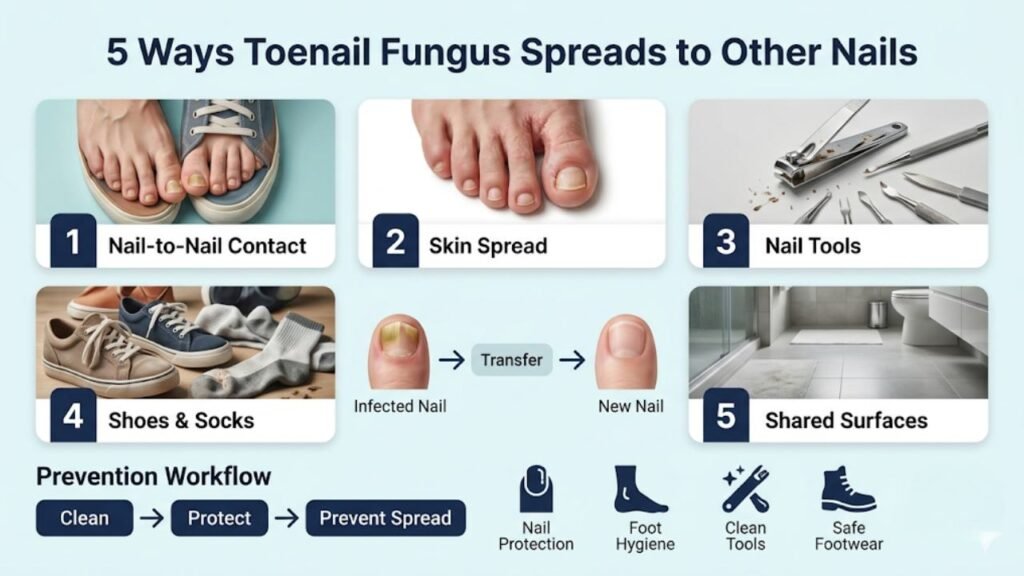
1. Direct Nail-to-Nail Contact Inside Footwear
The most straightforward pathway for toenail fungus spread to other nails is direct physical contact between an infected nail and adjacent nails inside a closed shoe.
Inside footwear, the toes are pressed together for hours at a time. The infected nail continuously sheds fungal spores into the space between adjacent nails. Over time, those spores find entry points — small separations at the nail edge, minor trauma-related cracks, or microscopic gaps at the hyponychium — in neighboring nails.
This mechanism explains a pattern clinicians frequently observe: infections typically spread first to the nails immediately adjacent to the initially infected nail — often the second toe when the great toe is the initial site — before extending further across the foot.
2. Spread Through the Surrounding Skin (Tinea Pedis)
The skin between and around the toes serves as the most important biological highway for toenail fungus spread to other nails.
Athlete’s foot — tinea pedis — is a dermatophyte infection of the skin surrounding the nails. In many patients, onychomycosis and athlete’s foot coexist and are caused by the same organism. The skin infection acts as a continuous reservoir of fungal activity, bathing the base and sides of multiple nails in fungal organisms simultaneously.
When an infected individual’s feet sweat inside footwear, the fungal organisms from the skin spread through the moisture to adjacent nail structures. Each nail fold becomes a potential entry point when the surrounding skin is actively infected.
This is why treating concurrent athlete’s foot is always a necessary part of managing nail fungal infection. Addressing only the nail while leaving skin infection active guarantees ongoing toenail fungus spread to other nails and dramatically increases reinfection rates after treatment.
3. Contaminated Nail Tools
Shared or inadequately sterilized nail care tools are a direct mechanical pathway for toenail fungus spread to other nails — and one of the most commonly overlooked.
When nail clippers, files, cuticle pushers, or scissors are used on an infected nail, fungal spores and infected keratin debris contaminate the tool surface. Using that same tool on a healthy nail immediately afterward deposits those spores directly onto and into the healthy nail structure.
This mechanism is particularly relevant in household settings where family members share nail care tools, and in nail salon settings where professional instruments are not adequately sterilized between clients.
The solution is straightforward but requires deliberate practice: sterilize all nail tools with 70 percent or higher isopropyl alcohol after every use, never use the same tool on a known infected nail and a healthy nail in the same session, and never share nail tools with other household members.
4. Footwear and Sock Contamination
The interior of footwear worn during an active nail fungal infection becomes contaminated with fungal spores. Putting on that same pair of shoes the next day reintroduces those spores directly to all nails simultaneously — including nails that were previously unaffected.
This is one of the primary mechanisms behind treatment failure and reinfection, and it applies equally to toenail fungus spread to other nails during active infection.
Socks function similarly. A sock worn when an infection is present picks up fungal spores from the infected nail and surrounding skin. If those socks are worn again without laundering, or if the contaminated sock area contacts other toes, spore transfer to healthy nails occurs.
- Applying antifungal powder or spray inside footwear regularly during and after treatment
- Allowing shoes to dry completely — at least 24 to 48 hours — between wears through shoe rotation
- Laundering socks after every single wear at the highest temperature the fabric tolerates
- Considering replacement of heavily worn footwear that has been worn throughout a prolonged infection period
5. Shared Surfaces and Autoinoculation
Bathroom floors, shower tiles, and other surfaces in the home environment collect fungal spores shed from infected nails during daily activities. Walking barefoot across these surfaces — then touching other nails, or simply pressing all toenails against the bathroom floor — allows autoinoculation of previously unaffected nails.
Autoinoculation — self-reinfection from one area of the body to another — is the mechanism behind toenail fungus spread to other nails that most patients are least aware of. Scratching an infected nail or touching it and then contacting healthy nails can directly transfer spores.
In shared households, bathroom floors contaminated from one person’s nail infection become a transmission risk for other family members as well — not only an autoinoculation risk for the infected individual.
How Fast Does Toenail Fungus Spread to Other Nails?
The timeline for toenail fungus spread to other nails varies considerably depending on individual factors, but the process is almost always gradual rather than rapid.
| Stage | What Is Happening | Approximate Timeline |
|---|---|---|
| Initial infection | Single nail shows early discoloration at tip | Weeks to months post-exposure |
| Early spread | Mild changes visible in one adjacent nail | 1 to 3 months after initial infection |
| Moderate spread | Two to three nails showing active infection signs | 3 to 6 months untreated |
| Extensive spread | Multiple nails on one or both feet involved | 6 months to several years |
| Severe presentation | Total dystrophic changes across multiple nails | Long-standing untreated infection |
The slow timeline is both encouraging and misleading for patients. Encouraging because early intervention stops the process effectively. Misleading because the gradual nature reduces the sense of urgency — patients often wait until multiple nails are significantly affected before seeking treatment, which makes the recovery process substantially longer and more complex.
Who Is Most Vulnerable to Toenail Fungus Spreading Quickly?
Toenail fungus spread to other nails occurs in any patient, but certain factors accelerate the process significantly.
Diabetes — Peripheral neuropathy reduces sensation, meaning early spreading signs go unnoticed. Reduced circulation impairs the immune response that would normally slow fungal migration. Elevated blood glucose creates favorable conditions for fungal growth throughout the foot environment.
Immune compromise — Patients on immunosuppressive medication, chemotherapy, or with immune-affecting conditions cannot mount the local defense that limits fungal spread in healthy adults.
Age — Older adults have slower nail growth, reduced circulation, and structurally altered nails that provide more fungal entry points. Spread to multiple nails is more common in elderly patients.
Athletes — Repetitive nail trauma creates multiple entry points simultaneously. Communal facility use adds constant reexposure. Heavy athletic footwear traps moisture throughout training sessions.
Prior nail trauma across multiple toes — Patients who have sustained trauma to several nails simultaneously — from ill-fitting footwear or sports impact — have multiple vulnerable entry points that make multi-nail infection more likely from the outset.
Recognizing Early Signs of Toenail Fungus Spreading
Early detection of toenail fungus spread to other nails is the most valuable application of awareness. Catching the spread before it becomes established in a second nail means simpler treatment and a significantly shorter recovery.
- A new faint yellow or white spot appearing at the tip of a previously healthy nail
- Slight surface dulling or roughness developing on nails adjacent to a known infected nail
- Any previously healthy nail beginning to thicken even minimally
- Nail edges on neighboring toes becoming slightly more brittle or irregular than before
- Subungual debris — chalky material under the nail tip — appearing in a nail that previously showed none
These changes are easy to miss during daily life but become apparent during deliberate monthly nail inspection. In patients with a known active infection, monthly inspection of all remaining nails is a practical habit that catches spread early.
How to Stop Toenail Fungus From Spreading to Other Nails
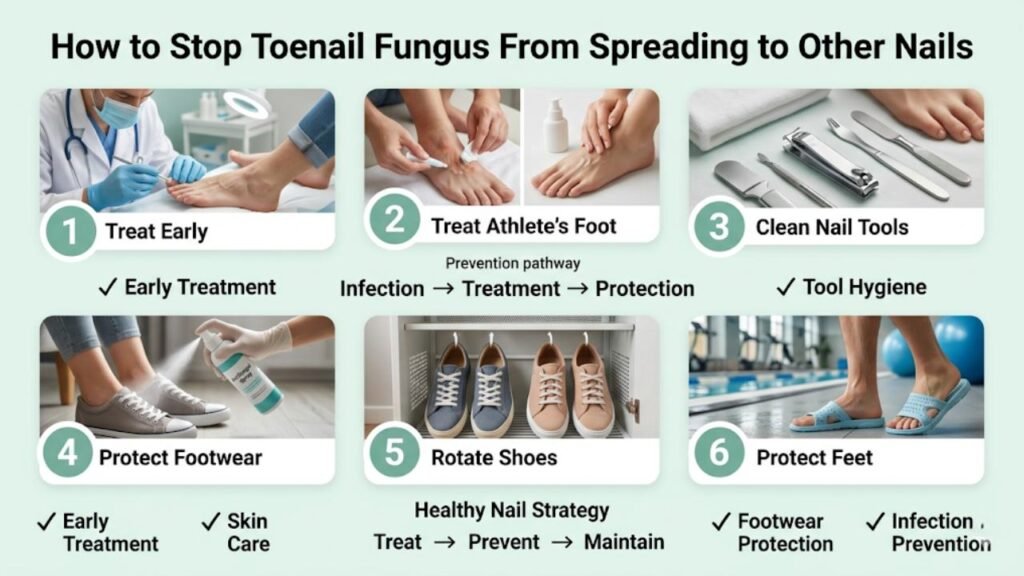
1. Treat the Original Infection Promptly
The most important single step in preventing toenail fungus spread to other nails is treating the initial infection before the fungal load grows large enough to spread effectively.
Early-stage infections limited to one nail, involving less than 50 percent of the nail surface without matrix involvement, often respond well to consistent topical antifungal therapy — ciclopirox, efinaconazole, or tavaborole — applied daily over the full prescribed course.
Moderate to severe infections, or cases where topical therapy has not produced improvement, require oral antifungal medication. Terbinafine remains first-line for dermatophyte infections, with high mycological cure rates and a 12-week standard treatment course.
Delaying treatment directly increases the probability of toenail fungus spread to other nails.
2. Treat Concurrent Athlete’s Foot
Any concurrent tinea pedis must be treated simultaneously with nail infection. As long as active fungal skin infection is present around the nails, the risk of toenail fungus spread to other nails remains high regardless of how effectively the nail infection itself is being addressed.
Topical antifungal creams or sprays for athlete’s foot should be continued for the full recommended course, and continued as maintenance after clearing to prevent recurrence.
3. Maintain Strict Nail Tool Hygiene
Sterilize all nail tools after every use. Use dedicated, separate tools for the infected nail to eliminate any risk of direct tool-mediated toenail fungus spread to other nails.
4. Apply Antifungal Powder to Footwear
Antifungal powder or spray applied to the shoe interior regularly during active infection reduces the spore load inside footwear and breaks the cycle of continuous reexposure that drives spread.
5. Rotate Footwear
Wearing the same shoes every day provides no drying time for the fungal-spore-contaminated interior. Rotating between at least two pairs with a minimum 24 to 48-hour rest between wears reduces spore viability inside footwear significantly.
6. Protect Feet in Communal Areas
During active infection, wearing protective footwear in bathrooms, gym showers, and poolside areas prevents spreading fungal spores from your feet to communal surfaces — and prevents picking up additional spore exposure that accelerates existing infection.
When to See a Podiatrist
Seek professional evaluation for toenail fungus spread to other nails if:
- More than one nail is now showing changes
- The infection has been present for more than 2 to 3 months without improvement
- Over-the-counter products have not produced visible results
- You have diabetes, peripheral vascular disease, or immune compromise
- Nails are becoming painful, significantly thickened, or lifting from the nail bed
- Infection appears to be spreading to the surrounding skin
A podiatrist will confirm the organism through laboratory testing, assess the full extent of infection across all nails, and build a treatment plan matched to your specific infection pattern and health status.
Frequently Asked Questions
Can toenail fungus spread to all toenails if untreated?
Yes. Without treatment, toenail fungus spread to other nails can eventually involve all ten toenails, particularly in patients with risk factors like diabetes or immune compromise. Multi-nail involvement is common in patients who delay treatment by a year or more.
How quickly can toenail fungus spread to an adjacent nail?
Spread to an adjacent nail typically occurs over weeks to months, depending on hygiene practices, footwear habits, and immune status. It rarely happens overnight but progresses steadily if the original infection goes untreated.
Can treating athlete’s foot prevent toenail fungus from spreading?
Yes. Treating concurrent tinea pedis removes one of the primary pathways for toenail fungus spread to other nails. It is an essential component of any complete nail fungus management plan.
Does wearing socks prevent toenail fungus from spreading between nails?
Socks alone do not prevent spread, but moisture-wicking socks that are changed daily reduce the moist environment that facilitates fungal transfer. Contaminated socks worn repeatedly without laundering actively contribute to spread.
Can toenail fungus spread upward from toenails to fingernails?
Toenail fungus spread to fingernails is less common but possible, typically through scratching infected toenails and then contacting fingernails, or through shared nail tools. See our dedicated guide on this topic for full details.
If I treat one nail, will the others heal too?
Treating one nail does not automatically clear infection in others. Each infected nail requires its own treatment. Oral antifungal medication treats all infected nails simultaneously through systemic action, which is one of its primary advantages over topical therapy.
Summary
Toenail fungus spread to other nails is a predictable, consistent progression of untreated or inadequately treated onychomycosis. It occurs through direct nail contact inside footwear, migration through surrounding skin, contaminated nail tools, footwear and sock contamination, and autoinoculation from shared surfaces.
The timeline is gradual — but that gradual pace means early intervention is highly effective at stopping the spread before it reaches additional nails. Treating the initial infection promptly, addressing concurrent athlete’s foot, maintaining strict tool hygiene, and rotating clean footwear are the practical steps that prevent a single-nail infection from becoming a multi-nail problem.
If you have noticed changes in a nail adjacent to one you know is infected, professional evaluation is the right next step. Early confirmed diagnosis and targeted treatment produce better outcomes than waiting for the pattern to declare itself fully.
Struggling to get an appointment?
We help patients in your area bypass clinic waitlists by instantly finding verified podiatry doctors who accept their insurance.