Onychauxis vs Onychogryphosis Differences
Find a Podiatrist Near You
Get same-day appointments with verified podiatrists. Insurance accepted.
Onychauxis vs onychogryphosis — two nail conditions that are frequently confused with each other and with fungal infection, but which are distinct in their appearance, severity, cause, and what treatment they need.
Both conditions involve thick toenails. That is where the similarity ends. Onychauxis describes a nail that has become uniformly thick but kept its basic shape. Onychogryphosis describes a nail that has become extremely thick and dramatically distorted — curved, twisted, and sometimes growing in a spiral or claw-like pattern.
Getting this distinction right matters practically. A thick but straight nail needs very different management from a severely curved and distorted nail. The treatment intensity, the tools needed, and the likely outcomes are all different. And neither condition responds to antifungal medication, which is still the most common thing patients try first when they notice nail thickening.
This guide explains the onychauxis vs onychogryphosis differences clearly — what each one is, what causes each, how each is recognized, and what treatment looks like for both.

What Is Onychauxis?
Onychauxis is the medical term for abnormal thickening of the nail plate where the nail becomes denser and harder than normal, but retains its basic shape and direction of growth.
The word comes from Greek — onycho meaning nail and auxis meaning growth or enlargement. It describes exactly what happens: the nail grows larger than it should in terms of thickness, without the twisting or curving that characterizes more severe conditions.
What onychauxis looks like:
- The nail is noticeably thicker and harder than adjacent nails
- The nail grows forward in the correct direction — it does not curve
- The nail surface may be slightly opaque, yellowed, or rough
- The nail edges generally remain in their normal position relative to the nail fold
- The nail is difficult to trim with standard clippers but is not dramatically distorted
What onychauxis feels like:
- Often painless in mild cases
- Mild pressure inside closed footwear as the nail thickness increases
- Difficulty with self-trimming, particularly for elderly patients with limited dexterity
- No significant discomfort at rest
Onychauxis is common. Many adults develop it gradually — often from a combination of aging, repeated low-level pressure, and changes in how the nail matrix produces nail over time.
What Is Onychogryphosis?
Onychogryphosis is a more severe nail condition where the nail becomes extremely thick and grossly distorted. The nail curves, twists, and sometimes grows at extreme angles — sometimes called “ram’s horn nail” because of the dramatic curving that can develop.
Gryphosis comes from Greek meaning hooked or curved — describing the characteristic shape change that distinguishes this condition from simple thickening.
What onychogryphosis looks like:
- Extreme nail plate thickening — far greater than what is seen in onychauxis
- Severe curving, twisting, or spiraling of the nail
- Yellow-brown or darker discoloration throughout the nail
- A very hard, almost horn-like texture that cannot be cut with standard nail clippers
- Often a layered or ridged surface reflecting disrupted growth over many cycles
- Most commonly affects the great toenail, though other nails can be involved
- In advanced cases, the nail may curve completely under the toe or grow sideways
What onychogryphosis feels like:
- Often causes real pain — from the nail pressing into the nail bed, the surrounding skin, or the inside of footwear
- Difficulty wearing any closed footwear comfortably
- Walking discomfort in advanced cases
- Risk of the nail edge digging into surrounding skin
Onychogryphosis tends to be a more advanced and neglected presentation. It typically develops when nail thickening has progressed without any management over an extended period — sometimes years or even decades.
Onychauxis vs Onychogryphosis: 6 Key Differences
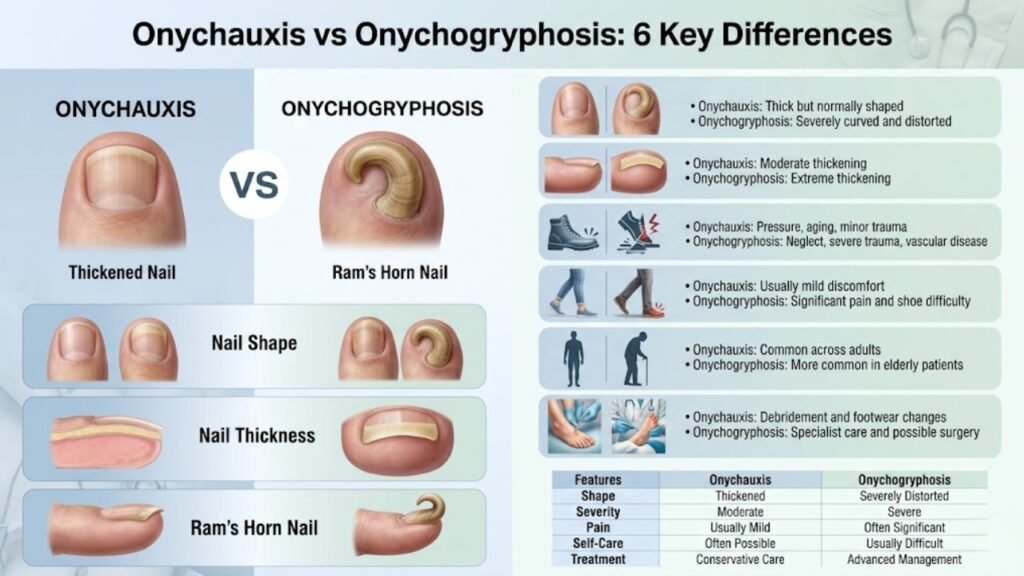
Difference 1: Nail Shape
This is the single most visible distinction in the onychauxis vs onychogryphosis comparison.
Onychauxis: The nail is thicker than normal but grows forward in the correct direction. The basic nail shape — flat or only slightly curved — is preserved. Looking at the nail from above, it looks like a thick version of a normal nail.
Onychogryphosis: The nail is dramatically distorted. It may curve downward toward the toe tip, twist sideways, spiral in multiple directions, or develop an almost layered structure. Looking at the nail, you would not describe it as a thick normal nail — you would describe it as a deformed nail.
Shape is the defining characteristic that separates these two conditions in the onychauxis vs onychogryphosis comparison.
Difference 2: Severity of Thickening
Both conditions produce thick nails, but the degree of thickening differs significantly.
Onychauxis: The nail is noticeably thick — perhaps two to three times the normal nail plate thickness. Difficult to trim but manageable with professional instruments or thick-nail clippers.
Onychogryphosis: The nail can be dramatically thicker — sometimes appearing more like a claw or horn than a nail. The thickness, combined with the curvature and the hardness of the nail material, makes self-care essentially impossible and even professional trimming requires specialized instruments.
Difference 3: Causes
The onychauxis vs onychogryphosis difference in causes explains why one tends to be a milder, more manageable condition while the other is more severe.
Common causes of onychauxis:
- Repeated mild pressure from footwear over months or years
- Age-related changes in nail matrix function
- Minor chronic nail trauma from athletic activity or occupational footwear
- Mild circulatory changes
- Genetic tendency toward thicker nails
Common causes of onychogryphosis:
- Long-term untreated nail thickening that has progressed without management
- Significant nail neglect — extended periods without any nail trimming
- Severe peripheral vascular disease significantly reducing blood supply to the nails
- Major acute trauma that damaged the nail matrix
- Chronic pressure deformities from years of ill-fitting footwear
- Limited mobility or disability preventing nail self-care over extended periods
Onychogryphosis is particularly common in elderly patients with limited mobility, peripheral vascular disease, or those who have had difficulty accessing regular podiatric care.
Difference 4: Symptoms and Functional Impact
Onychauxis:
- Primarily a cosmetic concern in mild cases
- Mild pressure discomfort in tight footwear
- Self-trimming becomes increasingly difficult
- No significant impact on walking or daily activities in most cases
Onychogryphosis:
- Real pain from the distorted nail pressing on surrounding tissue
- Difficulty wearing any standard closed footwear
- Walking altered by nail discomfort
- Risk of the nail edge cutting into surrounding skin, creating pressure sores
- In elderly patients, potential contribution to gait changes and fall risk
The functional impact is the clearest practical distinction in the onychauxis vs onychogryphosis severity comparison.
Difference 5: Who Is Most Commonly Affected
Onychauxis affects a wide range of adults — particularly those who:
- Wear tight or non-breathable footwear regularly
- Are over 50 and have gradual age-related nail changes
- Are athletes or runners with repetitive toe-to-shoe contact
- Work in occupations with sustained foot pressure
Onychogryphosis disproportionately affects:
- Elderly patients, particularly those over 70
- Patients with significant peripheral vascular disease
- Patients with limited mobility preventing normal nail self-care
- Patients with long-standing untreated nail conditions
- Patients who have had difficulty accessing podiatric care regularly
The demographic profile of the two conditions differs substantially, reflecting how much the causes of the underlying nail change differ.
Difference 6: Treatment Needed
This is the most practically important distinction in the onychauxis vs onychogryphosis comparison.
Treatment for onychauxis:
- Professional nail debridement with rotary burr or specialist nippers — reduces thickness safely
- Footwear assessment and modification — wider, deeper toe box
- Regular monitoring and trimming — every 6 to 12 weeks depending on growth rate
- Addressing underlying causes — circulatory assessment if indicated, footwear correction, activity modification
- Home care between appointments — soaking before trimming, gentle filing
Treatment for onychogryphosis:
- Professional debridement with specialist instruments — ordinary clippers are inadequate; electric rotary burrs and heavy-duty instruments are required
- More frequent professional appointments may be needed — the nail accumulates thickness and curvature faster
- Surgical nail avulsion — removal of the grossly distorted nail plate is sometimes the most practical approach, particularly when the nail is so deformed it cannot be adequately reduced through debridement alone
- Matrix ablation — when the nail causing complications cannot be managed effectively with ongoing conservative care, destroying the matrix to prevent regrowth is considered
- Management of underlying vascular disease — essential if poor circulation is contributing to the nail deformity
- Wound care — if the nail has caused skin breakdown in surrounding tissue
Complete Comparison Table: Onychauxis vs Onychogryphosis
| Feature | Onychauxis | Onychogryphosis |
|---|---|---|
| Nail shape | Preserved — thick but straight | Severely distorted — curved, twisted, or spiraled |
| Thickness | Moderately increased | Extremely thick — often claw-like |
| Color | Opaque, yellowish | Yellow-brown to near black |
| Surface | Slightly rough | Deeply ridged, layered |
| Pain | Usually mild | Often significant |
| Footwear difficulty | Mild — tight shoes uncomfortable | Significant — may be unable to wear closed shoes |
| Walking impact | Minimal in most cases | Can meaningfully affect gait |
| Typical age group | Any adult, more common over 50 | Most common over 70 |
| Common causes | Pressure, aging, mild trauma | Neglect, vascular disease, severe trauma |
| Professional trimming | Possible with specialist instruments | Requires specialist instruments; may need surgery |
| Self-management | Possible with care | Not safely manageable at home |
| Fungal testing | Usually negative | Usually negative |
Can Onychauxis Turn Into Onychogryphosis?
Yes — and this is one of the most important clinical reasons the onychauxis vs onychogryphosis distinction matters.
Onychauxis is a milder, earlier stage of nail structural change. Without management, a nail that starts with simple thickening can progressively develop the curvature and distortion that defines onychogryphosis. The nail matrix that is producing thick nail cells in an unmanaged onychauxis presentation continues to receive the same pressure signals, the same reduced circulation, or the same structural disruption — and over time, the output it produces becomes progressively more abnormal.
This progression from onychauxis to onychogryphosis is most common when:
- The underlying cause — poor circulation, chronic pressure, aging — is not addressed
- No professional nail care is accessed for extended periods
- Nail growth is very slow (as in elderly patients) allowing accumulation over long periods without the nail being replaced
This progression is preventable. Regular podiatric care for patients with onychauxis — managing the nail thickness, assessing footwear, and monitoring progress — interrupts the natural history of progression before the nail becomes significantly deformed.
Is It Fungal? The Role of Laboratory Testing
Because both onychauxis and onychogryphosis produce thick, discolored, abnormal-looking nails, they are both frequently mistaken for fungal infection.
In the onychauxis vs onychogryphosis comparison, neither condition is primarily caused by fungal organisms — though fungal infection can coexist with either.
Key points:
- Both conditions require laboratory testing (KOH test, fungal culture) to confirm whether fungus is present
- If fungal testing is negative, antifungal medication will not help
- If testing is positive, there may be concurrent fungal infection in a structurally abnormal nail — both the structural cause and the infection need to be managed
Treating onychauxis or onychogryphosis with antifungal medication alone — without identifying the structural cause — produces no improvement in the nail thickening or deformity.
When to See a Podiatrist
For both onychauxis and onychogryphosis, professional podiatric care is strongly recommended rather than home management alone.
For onychauxis, see a podiatrist if:
- The nail has become too hard to trim safely at home
- Nail pressure is causing discomfort in footwear
- You have diabetes or poor circulation — professional care is safer than home trimming
- The nail has been consistently thick for more than 6 months
- Multiple nails are affected
For onychogryphosis, see a podiatrist promptly if:
- The nail is causing pain with footwear or walking
- The nail edge is pressing into surrounding skin
- You cannot trim the nail at home safely
- The nail has not been professionally managed for an extended period
- You have diabetes, peripheral vascular disease, or immune compromise
Onychogryphosis in elderly patients with limited mobility or circulatory compromise is particularly important to address professionally — the combination of nail deformity, reduced sensation, and impaired healing creates a real risk of complications from neglected nail care.
Frequently Asked Questions
What is the main difference between onychauxis vs onychogryphosis?
The main difference is nail shape. Onychauxis is uniform nail thickening with normal nail direction preserved. Onychogryphosis involves extreme thickening with severe curvature, twisting, or distortion — the nail becomes dramatically deformed rather than simply thick.
Can both conditions be treated without surgery?
Onychauxis is almost always managed successfully with professional debridement, footwear modification, and regular monitoring. Onychogryphosis can often be managed with professional debridement if caught before the deformity becomes extreme, but severe cases may require surgical nail removal or matrix ablation.
Are onychauxis and onychogryphosis caused by fungus?
Neither condition is primarily caused by fungal infection. Both are structural nail changes from trauma, pressure, aging, or poor circulation. Fungal infection can coexist in a structurally abnormal nail, which is why testing matters before starting any treatment.
Which condition is more serious?
Onychogryphosis is significantly more serious in terms of severity, pain, functional impact, and treatment complexity. Onychauxis is milder and more easily managed. However, onychauxis can progress to onychogryphosis if left unmanaged over time.
Can onychauxis or onychogryphosis develop in younger people?
Onychauxis can affect adults of any age — particularly athletes, runners, and people wearing tight occupational footwear. Onychogryphosis is less common in younger adults and is more typical in elderly patients with circulatory changes and limited nail care access.
How often should thick nails from either condition be professionally trimmed?
For onychauxis, professional debridement every 8 to 12 weeks is typically appropriate. For onychogryphosis, more frequent care — every 4 to 8 weeks — may be needed because the nail accumulates thickness and curvature faster and the management is more involved.
Summary
Onychauxis vs onychogryphosis describes two distinct nail conditions that both produce thick toenails but differ significantly in severity, appearance, cause, and management needs.
Onychauxis is the milder condition — thick nail plate, preserved shape, manageable with regular professional debridement and footwear correction. Onychogryphosis is the more severe condition — extreme nail thickening combined with dramatic curvature and distortion, causing functional problems and requiring more intensive professional management, sometimes including surgery.
Neither condition is fungal in origin, and neither responds to antifungal treatment. Laboratory testing confirms whether fungal infection is also present. If not, treatment focuses entirely on the structural nail management appropriate for each condition.
Understanding the onychauxis vs onychogryphosis difference helps patients seek the right type of care, set realistic expectations about management, and recognize that untreated onychauxis can progress to onychogryphosis — making early professional nail care the most practical long-term strategy.
Struggling to get an appointment?
We help patients in your area bypass clinic waitlists by instantly finding verified podiatry doctors who accept their insurance.