Pediatric Thick Toenails Causes
Find a Podiatrist Near You
Get same-day appointments with verified podiatrists. Insurance accepted.
Pediatric thick toenails are something many parents notice with concern — often during bath time, while putting on socks, or when a child complains that their shoes feel tight or uncomfortable. The nail looks different: thicker, harder, sometimes discolored, or a slightly unusual shape. And the natural first question is whether this is a sign of something serious.
The reassuring answer is that most pediatric thick toenails have straightforward, manageable causes. Fungal infection, sports-related nail trauma, and footwear pressure explain the majority of cases. Some children have inherited nail characteristics that make their nails naturally thicker. And occasionally, nail changes in children point to a skin condition like psoriasis or a rare inherited nail disorder that benefits from specialist evaluation.
This guide explains the six most common causes of pediatric thick toenails, how each is recognized, when parents should seek professional evaluation, and what treatment looks like for children — where some adult approaches require significant modification.
Are Thick Toenails Normal in Children?
In very young children — infants and toddlers — slightly thicker or more curved toenails can be a normal developmental variation. Nail structure matures as children grow, and what looks abnormal at age one may normalize by age four or five without any intervention.
In older children and adolescents, however, a clearly thickened toenail — particularly one that is discolored, difficult to trim, or associated with pain — is not a normal finding and deserves evaluation.
- The thickening is in one specific nail rather than affecting all nails uniformly
- Color change accompanies the thickening — yellow, brown, or white discoloration
- The nail has become harder or more brittle than other nails
- The child mentions pain or discomfort in the affected toe, particularly inside footwear
- The change developed gradually over months rather than being consistently present since birth
When these features are present, identifying the cause is the important next step.
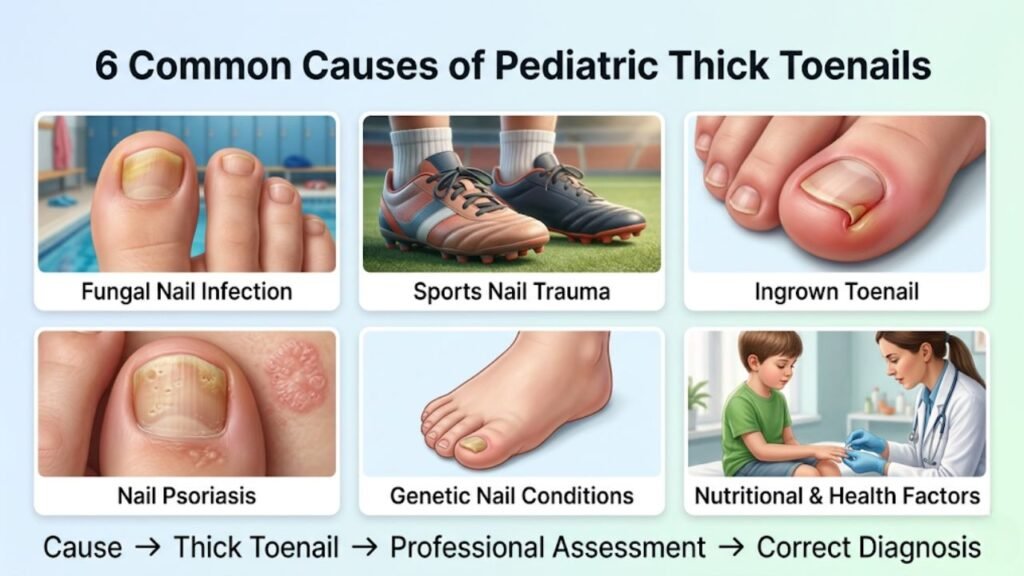
6 Common Causes of Pediatric Thick Toenails
Cause 1: Fungal Nail Infection (Onychomycosis)
Fungal nail infection is less common in children than in adults, but it does occur — and the rate increases significantly in children who participate in sports, use communal swimming pools, or share footwear with infected family members.
The most common causative organisms are the same as in adults — dermatophytes, primarily Trichophyton rubrum and Trichophyton mentagrophytes. In children who spend significant time barefoot in wet environments (swimming, gym class, sports changing rooms), exposure is frequent enough for infection to establish.
What fungal pediatric thick toenails look like:
- Yellowing or browning of the nail plate, usually starting at the tip
- Chalky, crumbly material visible under the nail edge
- Nail surface becoming dull and rough rather than shiny
- In some cases, a faint unpleasant odor from the affected nail
- The nail becomes progressively harder and more difficult to trim
- The affected nail is often the great toenail, though other nails can be involved
Children most at risk:
- Those who use communal pools, locker rooms, and gym showers without protective footwear
- Athletes — particularly swimmers, soccer players, and runners
- Children with a family member who has an active nail fungal infection
- Children who tend to sweat heavily in footwear
Why diagnosis before treatment matters in children:
Pediatric thick toenails from fungal infection require laboratory confirmation before treatment because the medications used — particularly oral antifungals — carry considerations in children that differ from adult prescribing. Treating a non-fungal nail condition with antifungal medication in a child is not only ineffective but potentially exposes the child to medication side effects unnecessarily.
Treatment considerations for children:
Oral terbinafine can be used in children with weight-appropriate dosing. Topical antifungals (ciclopirox, efinaconazole) are appropriate for mild early cases. The treatment duration in children may be shorter than in adults because children’s nails grow faster, meaning new healthy nail replaces infected nail more quickly. Liver function monitoring considerations apply to oral antifungal prescribing in children as in adults.
Cause 2: Sports and Activity-Related Nail Trauma
Nail trauma is one of the most common causes of pediatric thick toenails in school-age children and adolescents, particularly those who are active in sports.
Children’s feet grow quickly, and footwear sizing is often not perfectly optimized — shoes may be too short (parents sometimes buy a size ahead to allow for growth, but this can mean the shoe is too long initially and then becomes too short before replacement), or athletic shoes may not provide adequate toe box protection for the specific sport.
Common scenarios that cause traumatic pediatric thick toenails:
- Running and track — repetitive nail-to-shoe impact, particularly on the great toe
- Soccer — kicking and direct impact trauma to the toe
- Basketball and court sports — rapid stopping and direction changes
- Hiking and climbing — downhill pressure and boot pressure
- Swimming — repeated impact on pool walls during turns
When nail trauma occurs, the nail matrix responds to repeated mechanical stress by producing thicker nail. Subungual hematoma (blood beneath the nail) can also occur from acute impact, initially producing dark discoloration that is sometimes mistaken for fungal infection.
How to recognize traumatic pediatric thick toenails:
- The thickening developed around the same time as new shoes or a new sport
- The specific nail affected corresponds to the toe most likely to impact footwear in the child’s primary activity
- Dark discoloration at the nail tip that appeared after a specific injury event
- Laboratory testing for fungal infection is negative
Management:
Footwear assessment and correction is the primary intervention. Athletic shoes should have one thumb’s width of space between the longest toe and the shoe front. For children who have outgrown their shoes but parents have not yet replaced them, prompt replacement is important. The nail typically grows back progressively more normal once the source of trauma is removed.
Cause 3: Ingrown Toenail With Secondary Nail Changes
Ingrown toenails in children are a common cause of toe pain and, when chronic, can contribute to nail plate changes including thickening and irregular nail growth.
An ingrown nail occurs when the nail edge grows into the surrounding skin at the nail fold. In children, this most commonly results from:
- Incorrect nail trimming — cutting the nail rounded at the corners rather than straight across
- Tight footwear pressing the nail fold into the nail edge
- A naturally curved nail shape with a genetic component
When an ingrown nail causes chronic irritation and inflammation, the surrounding tissue hypertrophies and the nail itself may develop growth irregularities including thickening.
What to look for:
- Pain specifically at one or both corners of the nail, not across the full nail
- Redness and swelling at the nail fold side
- The nail edge digging into the skin, sometimes visible
- In established cases, significant tissue overgrowth (hypergranulation tissue) at the nail corner
Management:
Conservative management — correct nail trimming, cotton wool packing under the nail corner, appropriate footwear — resolves many pediatric ingrown nail cases. Persistent or recurrent cases may require professional podiatric intervention including partial nail avulsion with or without matrixectomy.
Cause 4: Nail Psoriasis in Children
Psoriasis affects an estimated 1 to 2 percent of children and adolescents. When psoriasis involves the nail unit in children, it produces changes that can include nail thickening alongside pitting, oil-drop discoloration, and nail lifting.
Pediatric thick toenails from psoriasis may be the first manifestation of psoriasis — appearing before skin plaques develop. This makes the diagnosis challenging and contributes to nail changes being misdiagnosed as fungal infection.
Distinguishing features of psoriatic pediatric thick toenails:
- Small, regular pits (depressions) scattered across the nail surface — this is characteristic of psoriasis and uncommon in fungal infection
- Oil-drop or salmon-patch discoloration — a yellowish-brown spot under the nail with a clearly defined border
- Nail lifting (onycholysis) that starts in the middle of the nail rather than purely from the tip
- Family history of psoriasis — a first-degree relative with psoriasis significantly increases probability
- Fungal laboratory testing comes back negative
Why this matters:
Antifungal treatment does not help nail psoriasis. If a child’s pediatric thick toenails are incorrectly treated with antifungal medication when the cause is psoriasis, months pass without appropriate care. Additionally, nail psoriasis in children is associated with psoriatic arthritis risk — joint symptoms in a child with nail psoriasis should be taken seriously and prompt rheumatology evaluation.
Management:
Nail psoriasis in children requires dermatology or rheumatology input. Systemic treatment for psoriasis — when sufficiently severe — can produce significant nail improvement. Pediatric biologic therapy is increasingly used for moderate-to-severe psoriasis with nail involvement in children.
Cause 5: Genetic and Congenital Nail Conditions
Some cases of pediatric thick toenails are present from birth or develop in the first years of life and have a hereditary basis. These are less common than acquired causes but important to recognize because they require specialist evaluation.
Pachyonychia congenita:
This rare genetic disorder causes severe nail thickening affecting all nails, typically present from birth or developing in early infancy. It is associated with painful plantar keratoderma (extremely painful thickening of the soles), oral leukokeratosis (white patches in the mouth), and cysts. It is caused by mutations in specific keratin genes. Pachyonychia congenita is often severely disabling from a mobility standpoint due to the foot pain it causes.
Familial nail dystrophy:
Some families show consistent nail structural changes — thickening, irregular surface, altered growth — across generations without the full features of pachyonychia congenita. When multiple family members have similar nail characteristics and laboratory testing is consistently negative, familial nail dystrophy is the likely explanation.
Congenital malalignment of the great toenail:
A specific condition where the great toenail grows in a lateral (sideways) direction due to malalignment between the nail matrix and the bone beneath. This produces a thickened, discolored, and structurally abnormal great toenail that may be present from birth. It can sometimes spontaneously correct as the child grows, but severe cases may benefit from surgical realignment.
Cause 6: Systemic Conditions and Nutritional Factors
In some children, pediatric thick toenails may be associated with broader health factors.
Nutritional deficiencies:
Significant deficiencies in zinc, iron, or biotin affect nail plate production quality. Nails may become brittle, thickened, or structurally irregular. This is most relevant in children with dietary restrictions, malabsorption conditions, or chronic illness affecting nutrition.
Immune compromise:
Children receiving chemotherapy, immunosuppressive medications, or those with immune-affecting conditions face elevated susceptibility to fungal nail infection — which in immunocompromised children can be more extensive and harder to treat than in healthy children.
Eczema and skin conditions:
Chronic eczema or dermatitis around the nail fold creates ongoing inflammation that can disrupt normal nail growth over time, producing mild to moderate nail changes including structural irregularity and thickening.
Comparison: Common Causes of Pediatric Thick Toenails at a Glance
| Cause | Age Most Common | Lab Test | Distinctive Feature |
|---|---|---|---|
| Fungal infection | School age, adolescent | Positive | Yellow/brown discoloration, debris |
| Sports trauma | Active children, any age | Negative | History of activity/shoe change |
| Ingrown nail | Any school age | Not required | Corner pain, nail fold inflammation |
| Nail psoriasis | Any age | Negative | Pitting, family history |
| Genetic/congenital | From birth or early childhood | Negative | Family history, present since infancy |
| Nutritional/systemic | Any age with relevant history | Variable | Other systemic symptoms present |
When to See a Podiatrist or Dermatologist
Most pediatric thick toenails benefit from professional evaluation — both to confirm the diagnosis and to ensure treatment is appropriately calibrated for a child.
Seek professional evaluation when:
- A toenail has been thicker or discolored for more than 4 to 6 weeks without a clear, resolving traumatic cause
- The nail is causing pain or discomfort in footwear
- Multiple nails are affected
- The child is complaining about their nail, even if it looks minor to you
- There is any redness, swelling, or tenderness around the nail fold
- The child has a skin condition or family history suggesting psoriasis
- The nail change has been present since birth or early infancy
Safe Nail Care for Children With Thick Toenails
For parents managing pediatric thick toenails at home while awaiting professional evaluation or alongside professional treatment:
Nail trimming:
- Cut nails straight across — not curved or rounded at the corners
- Use sharp nail scissors or clippers specifically designed for children’s nails
- Trim after bathing when nails are softer
- Do not trim too short — this increases pressure on the nail bed and risk of ingrowth
Foot hygiene:
- Wash feet daily with mild soap
- Dry thoroughly between the toes and around the nail folds after washing
- Change socks daily, and after sports or swimming
- Dry the feet completely after swimming before putting on socks and shoes
Footwear:
- Ensure shoes have adequate toe box space — a thumb’s width between the longest toe and the shoe front when standing
- Replace shoes promptly when outgrown — parents sometimes delay replacement assuming the child will keep growing into shoes, but this directly contributes to nail trauma
- Use protective footwear (flip-flops or water shoes) in communal pool and shower areas
What not to do:
- Do not attempt to aggressively file or trim a significantly thickened nail at home — the risk of nail bed injury is higher with children’s sensitive tissue
- Do not apply adult antifungal products to a child’s nails without confirming the diagnosis with a healthcare professional first
- Do not use nail polish to cover a thick or discolored nail — this hides the nail from monitoring and can trap moisture
Frequently Asked Questions About Pediatric Thick Toenails
Is nail fungus common in children?
Fungal nail infection is less common in children than in adults but occurs regularly, particularly in children who participate in sports, use communal pools, or have infected family members at home. Children’s faster nail growth rate means infections may progress somewhat differently than in adults.
Can my child’s thick toenail be treated without oral medication?
For mild, early fungal infections, prescription topical antifungal treatment may be appropriate and avoids the need for oral medication. However, established fungal infection in a thick nail typically requires oral antifungal therapy for adequate penetration. Your podiatrist or pediatrician will assess which approach is appropriate based on the child’s age, weight, and infection severity.
Will a thick toenail caused by trauma grow back normal in a child?
Yes, in most cases. Children have faster nail growth than adults, which means traumatically thickened nails replace themselves more quickly. If the source of trauma (typically footwear) is corrected, new normal nail typically grows in over 6 to 12 months.
How long does nail treatment take in children?
Because children’s nails grow faster than adults’ — toenails grow approximately 1.5 to 2 mm per month in children versus 1 to 1.5 mm in older adults — treatment courses may be shorter and recovery faster. Full nail replacement in a child’s foot takes approximately 9 to 12 months rather than the 12 to 18 months typical in adults.
Should I be worried if nail changes run in my family?
A family history of nail changes that look similar to your child’s is a useful diagnostic clue. It suggests inherited nail characteristics as a contributing factor rather than infection. This does not mean no treatment is needed, but it does mean antifungal medication is unlikely to produce significant change — and it guides you toward a podiatrist or dermatologist evaluation for proper diagnosis.
When are pediatric thick toenails a sign of something serious?
Most pediatric thick toenails are not signs of serious disease. However, seek prompt evaluation if the nail change is accompanied by joint pain (which could suggest psoriatic arthritis), systemic symptoms (fatigue, weight changes), significant foot pain limiting walking or activity, or if the nail has been present and severely abnormal since infancy — which may suggest a rare inherited nail condition benefiting from genetic specialist input.
Last Words
Pediatric thick toenails have six main causes: fungal infection, sports and activity-related nail trauma, ingrown toenail with secondary nail changes, nail psoriasis, genetic and congenital nail conditions, and systemic health factors. Each requires a different approach and some — particularly nail psoriasis and inherited nail disorders — require specialist evaluation that goes beyond standard antifungal treatment.
The most important practical steps for parents are: do not assume fungus without testing, ensure footwear is correctly sized and replaced promptly when outgrown, maintain simple daily foot hygiene, and seek professional evaluation when nail changes have been present for more than a few weeks without a clear resolving cause.
With appropriate diagnosis and matched treatment, most pediatric thick toenails resolve successfully — and children’s faster nail growth rate means recovery, when treatment is correct, often proceeds more quickly than in adults.
Struggling to get an appointment?
We help patients in your area bypass clinic waitlists by instantly finding verified podiatry doctors who accept their insurance.