Psoriasis Nails vs Normal Ridges – How to Tell the Difference
Find a Podiatrist Near You
Get same-day appointments with verified podiatrists. Insurance accepted.
Psoriasis nails vs normal ridges is one of the most confusing distinctions patients face when they notice changes in their toenail texture. Both conditions produce visible lines and surface irregularities on the nail plate, and without knowing what to look for, it is genuinely difficult to tell them apart at home. But getting this distinction right matters enormously — because psoriasis nails vs normal ridges are not just different in appearance, they are different in cause, in risk level, and in the treatment they require.
Normal nail ridges are a common and often harmless part of aging or mild dehydration. Psoriasis nail changes, on the other hand, are driven by an autoimmune disease that causes the nail matrix to overproduce cells chaotically — leading to pitting, nail lifting, oil drop discoloration, crumbling edges, and severe structural nail damage that worsens without proper medical management. When psoriasis nails vs normal ridges are confused, patients often spend months treating the wrong condition while the real problem quietly progresses.
If your nails are ridged, pitted, discolored, or beginning to lift from the nail bed, you deserve a clear answer about what is actually happening. Understanding psoriasis nails vs normal ridges — the specific differences in appearance, symptoms, and risk — is the first step toward getting the right care before permanent nail damage or secondary infection takes hold.
What Are Psoriasis Nails vs Normal Ridges?
Understanding Normal Nail Ridges
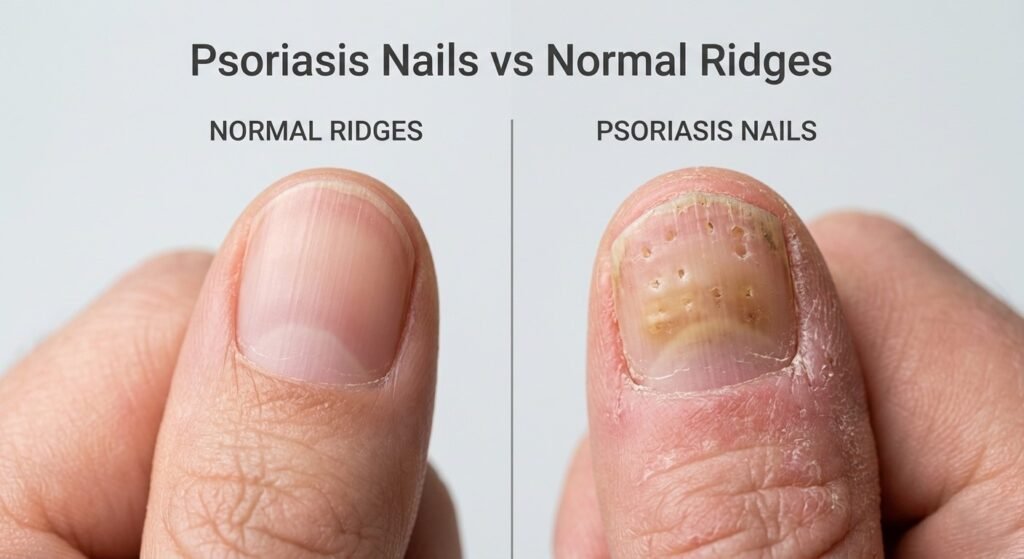
Normal vertical nail ridges are raised lines that run lengthwise from the nail base to the tip. They develop gradually, most commonly as a result of aging, mild dehydration, nutritional gaps, or minor repetitive nail trauma. They affect the nail surface texture but do not typically cause nail discoloration, nail lifting, or nail bed changes. Normal ridges are generally symmetrical, consistent across nails, and do not worsen rapidly.
In the context of psoriasis nails vs normal ridges, normal ridges are essentially a structural issue — the nail matrix producing slightly uneven keratin layers due to moisture or nutritional changes, without any immune system involvement.
Understanding Psoriasis Nail Changes
Psoriasis is a chronic autoimmune condition where the immune system mistakenly attacks healthy skin cells, causing them to multiply far too rapidly. When this process affects the nail matrix and nail bed, it disrupts normal nail formation in multiple simultaneous ways. The result is a nail that does not just have surface ridges — it pits, discolors, thickens, separates from the nail bed, and crumbles at the edges.
Nail psoriasis affects approximately 50% of people with skin psoriasis and up to 80% of those with psoriatic arthritis. In the psoriasis nails vs normal ridges comparison, psoriasis produces a significantly more complex and damaging nail picture that requires dermatological and podiatric management — not just moisturizing or dietary changes.
This YouTube video below explains nail psoriasis, highlighting symptoms, causes, and treatment options. It shows how psoriasis affects the nails. Understanding this helps identify and manage the condition.
Key Visual Differences: Psoriasis Nails vs Normal Ridges
The most important step in distinguishing psoriasis nails vs normal ridges is knowing exactly what each condition looks like on the nail plate and nail bed.
What Normal Ridges Look Like
- Thin, raised lines running vertically from cuticle to nail tip
- Affect the nail surface texture only
- No pitting or crater-like indentations
- No nail discoloration beyond mild paleness
- No separation between nail and nail bed
- Nail edges remain intact — no crumbling or fragmentation
- Condition is stable or very slowly progressing
What Psoriasis Nails Look Like
- Nail pitting — Small, pinhole-sized dents scattered across the nail surface; this is the hallmark sign of nail psoriasis and does not occur with normal ridges
- Oil drop sign — A yellow-orange discoloration visible beneath the nail plate, resembling a drop of oil under the nail; this is caused by psoriatic changes in the nail bed
- Nail lifting (onycholysis) — The nail plate separates from the nail bed, beginning at the tip and progressing toward the cuticle; this creates a gap that collects debris and becomes highly vulnerable to fungal toenail infection
- Subungual hyperkeratosis — A buildup of chalky, white, or yellowish material beneath the nail plate that causes the nail to appear thick and raised off the nail bed
- Crumbling nail edges — The free edge of the nail becomes fragile and breaks apart irregularly, unlike the clean splitting seen in dehydrated nails
- Nail discoloration — Nails may appear yellow, brown, white, or salmon-colored depending on which part of the nail structure is affected
- Beau’s lines — Horizontal grooves crossing the nail that reflect periods of severe nail matrix disruption caused by psoriasis flares
Causes of Psoriasis Nails vs Normal Ridges
What Causes Normal Nail Ridges
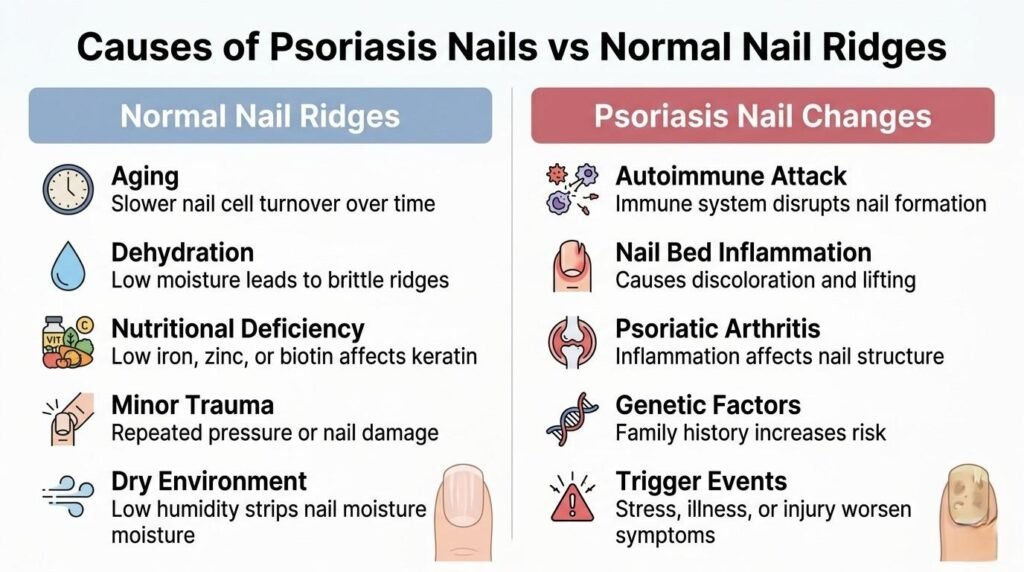
Normal vertical ridges develop from relatively benign causes that affect nail matrix function without immune system involvement:
- Aging — Natural reduction in nail matrix cell turnover rate causes increasingly irregular nail cell layering after the age of 40
- Chronic dehydration — Inadequate fluid intake depletes nail plate moisture, causing brittle, ridged nails that lack normal flexibility
- Nutritional deficiencies — Low iron, zinc, or biotin levels impair keratin production and produce uneven nail surface texture
- Repetitive minor trauma — Ill-fitting shoes, nail biting, or aggressive nail filing causes localized nail matrix disruption
- Dry environmental conditions — Low humidity and frequent chemical exposure strip moisture from the nail plate surface directly
What Causes Psoriasis Nail Changes
In the psoriasis nails vs normal ridges comparison, psoriasis nail changes have a fundamentally different origin:
- Autoimmune nail matrix attack — The immune system targets nail matrix cells, causing chaotic overproduction that creates pitting, ridges, and structural irregularities simultaneously
- Nail bed inflammation — Psoriatic inflammation beneath the nail plate causes the oil drop discoloration and subungual buildup that separate nail psoriasis from normal ridges clearly
- Psoriatic arthritis involvement — Joint inflammation in psoriatic arthritis affects the tendons and soft tissue surrounding the nail, worsening nail deformity from below
- Genetic predisposition — Nail psoriasis has a strong hereditary component; a family history of psoriasis significantly increases personal risk
- Immune trigger events — Stress, illness, certain medications, or skin injury can trigger or worsen psoriasis nail flares unpredictably
Symptoms That Help Distinguish Psoriasis Nails vs Normal Ridges
Signs that point clearly toward psoriasis rather than normal ridges:
- Nail pitting present — Any pinhole denting of the nail surface strongly suggests psoriasis; normal ridges never cause pitting
- Oil drop discoloration under the nail — A yellowish or salmon-colored patch visible through the nail plate indicates nail bed psoriasis specifically
- Rapid nail changes during stress or illness — Psoriasis nail flares can worsen significantly within days following immune triggers; normal ridges change very slowly over months
- Associated skin symptoms — Red, scaly patches on elbows, knees, scalp, or other skin areas alongside nail changes strongly suggest systemic psoriasis
- Nail lifting without trauma or infection — When the nail separates from the nail bed without any injury or confirmed toenail fungus, psoriasis is a primary suspect
- Joint pain or swelling near affected nails — Pain or stiffness in the finger or toe joints nearest to changing nails may indicate psoriatic arthritis
- Multiple nail types of change simultaneously — Psoriasis produces pitting, discoloration, thickening, and lifting at the same time; normal ridges produce only surface texture changes
Risks of Misidentifying Psoriasis Nails vs Normal Ridges
Getting psoriasis nails vs normal ridges wrong carries serious consequences that extend well beyond cosmetic concern.
- Secondary fungal toenail infection — Nail lifting caused by psoriasis creates an open space beneath the nail plate where fungal organisms establish rapidly; many patients with nail psoriasis develop concurrent toenail fungus that requires separate treatment
- Permanent nail matrix scarring — Untreated nail psoriasis flares repeatedly damage the nail matrix, leading to permanently deformed nail growth that cannot be reversed even with successful treatment later
- Psoriatic arthritis progression — Nail psoriasis is one of the strongest predictors of developing psoriatic arthritis; missing the nail diagnosis delays joint protection strategies that prevent irreversible joint damage
- Bacterial nail infection — Nail bed separation and crumbling nail edges in psoriasis create multiple entry points for bacteria; infections under psoriatic nails are particularly difficult to treat because the nail structure is already compromised
- Wasted treatment time — Treating psoriasis nails with moisturizers and hydration protocols — appropriate for normal ridges — does nothing to control the autoimmune inflammation driving nail psoriasis, allowing it to worsen for months unaddressed
- Emotional and psychological impact — Psoriasis nail changes are visibly abnormal and affect daily confidence significantly; the embarrassment of visible, worsening nail damage is well-documented and should not be underestimated
Psoriasis Nails vs Normal Ridges: Side-by-Side Comparison Table
| Feature | Normal Nail Ridges | Psoriasis Nail Changes |
|---|---|---|
| Ridge direction | Vertical (lengthwise) | Vertical + pitting + horizontal |
| Nail pitting | Never present | Classic hallmark sign |
| Nail discoloration | Mild paleness only | Yellow, brown, salmon, oil drop sign |
| Nail lifting | Not present | Common — onycholysis |
| Nail thickening | Rare | Common — subungual hyperkeratosis |
| Nail crumbling | Not typical | Common at nail edges |
| Cause | Aging, dehydration, nutrition | Autoimmune — immune system attack |
| Speed of change | Very slow — months to years | Can worsen within days during flare |
| Associated symptoms | None systemic | Skin plaques, joint pain possible |
| Treatment required | Hydration, nutrition, nail care | Dermatologist + podiatrist management |
| Risk of infection | Low | High — nail lifting creates entry points |
| Reversible? | Yes — fully reversible | Partially — early treatment prevents scarring |
Treatment Options for Psoriasis Nails vs Normal Ridges
Treating Normal Nail Ridges at Home
When the cause is confirmed as normal aging or dehydration rather than psoriasis, home management is appropriate and effective:
- Increase daily water intake — Consistent hydration restores nail plate moisture and supports smooth new nail growth
- Apply nail and cuticle oil twice daily — Jojoba, argan, or vitamin E oil replenishes surface moisture and reduces brittleness
- Eat a keratin-supportive diet — Biotin-rich foods, omega-3 sources, and zinc-rich foods strengthen nail plate structure from within
- Switch to acetone-free nail polish remover — Reduces external moisture stripping that worsens surface ridging
- Wear protective gloves for cleaning — Blocks chemical exposure that accelerates nail dehydration
- Use a fine-grit nail buffer gently — Temporarily smooths the nail surface without dangerously thinning the nail plate
Professional Treatment for Psoriasis Nails
Psoriasis nail changes require professional medical management that goes well beyond home care:
- Topical corticosteroids — Applied directly to the nail matrix area to reduce inflammation driving nail pitting and discoloration
- Topical vitamin D analogues — Calcipotriol formulations applied under the nail edge reduce subungual hyperkeratosis buildup effectively
- Intralesional steroid injections — Corticosteroid injections into the nail matrix area are one of the most effective treatments for severe nail psoriasis, particularly for pitting and nail lifting
- Biologic medications — For moderate to severe systemic psoriasis with nail involvement, biologic therapies target the specific immune pathways driving the autoimmune attack
- Nail debridement by a podiatrist — Safely thinning and cleaning thickened, crumbling psoriatic nail tissue reduces pain, prevents secondary infection, and improves the effectiveness of topical treatments
- Treatment of concurrent fungal infection — When toenail fungus is confirmed alongside nail psoriasis, antifungal treatment must be added; the two conditions require simultaneous management
When to See a Podiatrist or Dermatologist
The psoriasis nails vs normal ridges question should be answered professionally — not guessed at home. Book an appointment when:
- You notice nail pitting, oil drop discoloration, or rapid nail changes
- One or more nails are separating from the nail bed
- Nail edges are crumbling without a clear trauma cause
- You have a known or suspected diagnosis of skin psoriasis and your nails are changing
- You experience foot pain associated with thickened or lifting nails
- Home care for ridging has produced no improvement after 6–8 weeks
A podiatrist evaluates structural nail damage, manages debridement and infection risk, and coordinates with your dermatologist for comprehensive psoriasis nail care. Early professional involvement prevents the progression from manageable nail changes to permanent nail matrix scarring.
Frequently Asked Questions
Can psoriasis nails look exactly like normal ridges at first?
Yes — in very early stages, nail psoriasis may present as subtle ridging before pitting and discoloration develop. This is exactly why professional evaluation is important when ridges appear suddenly or worsen faster than expected.
Can toenail fungus be mistaken for psoriasis nails?
Absolutely. Toenail fungus and nail psoriasis share several features — thickening, discoloration, and nail lifting. A podiatrist uses clinical testing, including a KOH test or fungal culture, to distinguish between them accurately.
Will psoriasis nail changes go away on their own?
Rarely. Nail psoriasis is driven by an ongoing autoimmune process that continues without treatment. Some mild cases improve temporarily, but without proper management, nail psoriasis typically progresses and causes increasing structural damage.
Can I use nail polish to cover psoriasis nail changes?
Covering the nails with polish is not recommended during active psoriasis nail changes. Polish traps moisture, blocks topical treatment penetration, and can worsen nail lifting and infection risk beneath the plate.
How long does treatment take to improve psoriasis nails?
Because nails grow slowly — approximately 1.5mm per month — visible improvement in psoriasis nails takes 6–12 months of consistent treatment. Improvement in pitting and discoloration may be seen earlier with effective systemic treatment.
Is nail psoriasis contagious?
No. Psoriasis is an autoimmune condition, not an infection. It cannot be spread to another person through contact. However, secondary fungal or bacterial nail infections that develop alongside nail psoriasis can spread if not treated.
Conclusion
Psoriasis nails vs normal ridges is not a distinction you should leave to guesswork. The difference between the two determines your entire treatment approach — and confusing one for the other means the actual condition continues to worsen while ineffective home remedies are applied. Psoriasis nails carry real risks: secondary infection, permanent nail matrix damage, and the possibility of undetected psoriatic arthritis progressing beneath the surface.
The right professional assessment removes all uncertainty. A podiatrist or dermatologist can confirm the diagnosis, address any structural nail damage, treat or prevent secondary infection, and connect you with the systemic treatment your nails actually need. This is not a situation that improves by waiting — nail psoriasis causes cumulative damage with every untreated flare.
Book your consultation today. Whether your nail changes turn out to be normal ridges or early nail psoriasis, getting a clear professional answer protects your nails, your joints, and your quality of life. The sooner you act, the more your nails can recover.
Struggling to get an appointment?
We help patients in your area bypass clinic waitlists by instantly finding verified podiatry doctors who accept their insurance.