Horizontal Nail Grooves (Beau’s Lines) Causes
Find a Podiatrist Near You
Get same-day appointments with verified podiatrists. Insurance accepted.
Horizontal nail grooves (Beau’s Lines) are one of the most clinically fascinating nail findings — because they are not simply a sign of what is happening now, but a record of what happened to the body in the past. When a deep horizontal groove appears running across a toenail, it marks a specific point in time when the nail matrix stopped producing nail — and that stoppage was significant enough to show up as a physical indentation in the nail plate months later.
Named after French physician Joseph Honoré Simon Beau, who first described them in 1846, these transverse grooves appear when any significant physiological stress interrupts or severely slows the highly active cell production in the nail matrix. The nail records the disruption in the same way a tree records drought years — as a visible structural change in the growth pattern.
Understanding horizontal nail grooves (Beau’s Lines) means understanding not just what caused the disruption, but when it happened, and what it tells you about the body’s health history. This guide covers all of that.
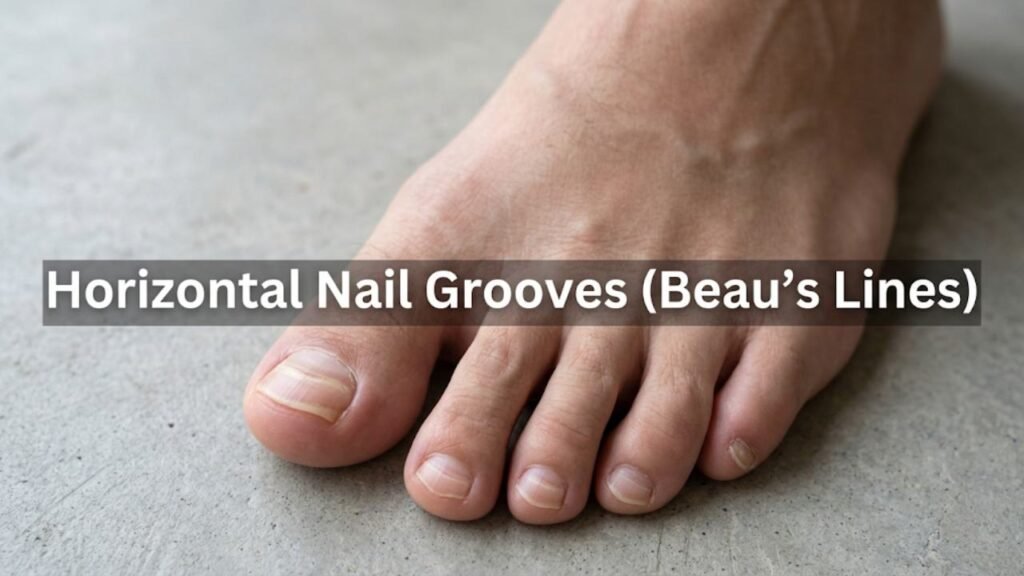
What Horizontal Nail Grooves (Beau’s Lines) Actually Are
The nail matrix — the tissue beneath the cuticle at the nail base — produces nail plate cells at a continuous, high rate. In healthy conditions, this production is steady and organized, producing a smooth, uniform nail plate.
When the body experiences significant physiological stress — severe illness, systemic disease, major surgery, extreme nutritional deprivation — it prioritizes essential organ systems over peripheral tissue maintenance. Non-essential processes, including the rapid cell production of the nail matrix, are temporarily downregulated. The matrix slows or halts nail production for the duration of the stress event.
When the stress resolves, nail production resumes. But the nail plate produced during the interruption is thinner, or missing entirely at that point. As nail growth continues, this thin zone — or absent zone — progresses forward from the nail base toward the nail tip, eventually becoming visible as a horizontal groove crossing the full width of the nail.
This is horizontal nail grooves (Beau’s Lines): physical evidence of a past matrix shutdown, moving toward the nail tip at the nail’s growth rate of approximately 1.5 mm per month.
How to Date a Horizontal Nail Groove (Beau’s Line)
One of the most clinically useful aspects of horizontal nail grooves (Beau’s Lines) is that their position on the nail allows estimation of when the disruption occurred — essentially reading the nail as a timeline.
Since toenails grow approximately 1.5 mm per month, and the nail matrix is located beneath the cuticle:
- A groove at the nail base (just ahead of the cuticle) = disruption occurred approximately 1 to 2 months ago
- A groove in the middle of the nail = disruption occurred approximately 4 to 6 months ago
- A groove near the nail tip = disruption occurred approximately 8 to 12 months ago
In practice, measuring the groove’s distance from the cuticle in millimeters and dividing by the expected monthly nail growth rate (approximately 1.5 mm) provides a rough estimate of when the disrupting event occurred. This can be correlated with the patient’s medical history — illness, hospitalization, chemotherapy, surgery — to identify the causative event.
Multiple parallel grooves — when there are two or more horizontal grooves on the same nail — indicate that multiple separate disruption events occurred, or that a single prolonged disruption produced a graduated severity pattern.
All nails affected simultaneously — when horizontal nail grooves (Beau’s Lines) appear across all or most nails at the same position, the cause was almost certainly a systemic event (whole-body illness, systemic chemotherapy, severe nutritional deprivation) that affected the entire body simultaneously.
Single nail affected — when only one nail shows horizontal nail grooves (Beau’s Lines), the cause is more likely local — trauma to that specific nail, localized nail surgery, or focused pressure affecting one digit.
8 Real Causes of Horizontal Nail Grooves (Beau’s Lines)
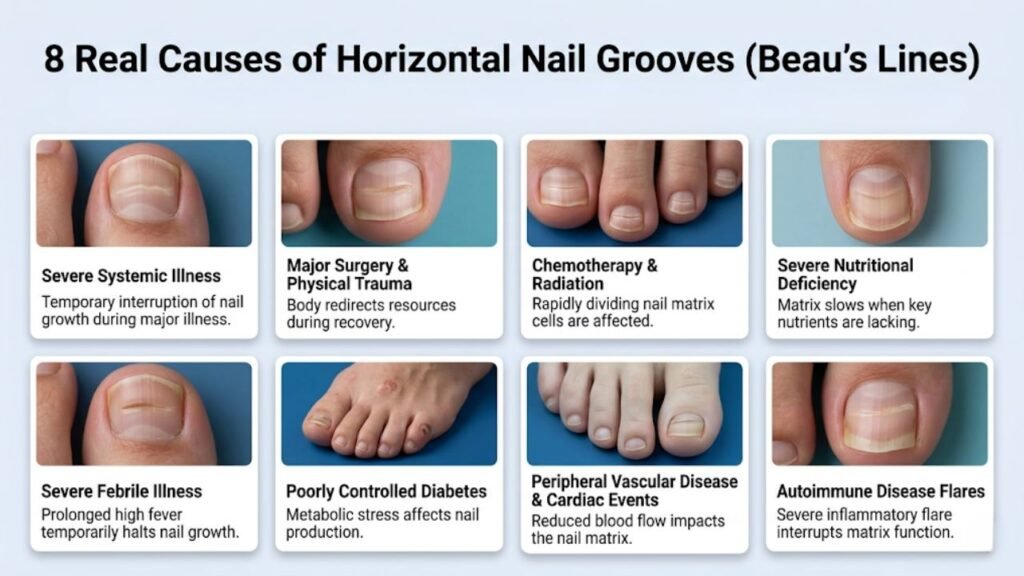
1. Severe Systemic Illness
This is the most common cause of horizontal nail grooves (Beau’s Lines) affecting multiple nails simultaneously. Any illness severe enough to significantly tax the body’s metabolic resources can temporarily halt nail production.
The illness typically needs to be genuinely severe — not a common cold — to produce visible Beau’s lines. The nail matrix resumes production when the body’s metabolic reserves recover, leaving a groove that marks the illness duration.
Common illnesses associated with Beau’s lines:
- Severe viral infections — historically, COVID-19 produced numerous documented cases of Beau’s lines in patients who experienced significant acute illness. The grooves appeared approximately 4 to 6 weeks after the peak illness, consistent with the matrix disruption timeline.
- Severe bacterial infections including sepsis
- Pneumonia
- High-grade malaria
- Classic childhood infections — measles and scarlet fever were historically recognized causes; Joseph Beau himself documented these associations
Why this matters clinically:
When a patient presents with horizontal nail grooves (Beau’s Lines) across multiple nails and cannot identify a recent illness, clinicians use the groove position to date the event and ask about the relevant time period — a period the patient may not have connected to the nail change because the groove appears weeks to months after the illness.
2. Major Surgery and Physical Trauma
Major surgical procedures represent one of the most reliable causes of horizontal nail grooves (Beau’s Lines). The combination of anesthesia, physiological stress, pain, blood loss, and the metabolic demands of healing produces exactly the type of systemic stress that temporarily halts nail production.
Why surgery produces Beau’s lines:
The physiological response to major surgery — elevated cortisol, redistribution of metabolic resources toward healing, reduced peripheral circulation during the operative and early recovery period — all contribute to matrix downregulation.
Which surgeries most commonly produce Beau’s lines:
- Cardiac surgery (including coronary artery bypass and valve replacement)
- Major abdominal surgery
- Orthopedic procedures with significant blood loss or prolonged anesthesia
- Any procedure requiring prolonged intensive care recovery
Acute physical trauma — particularly crush injuries, major fractures, or severe traumatic events — can produce the same systemic physiological stress response.
3. Chemotherapy and Radiation Therapy
Chemotherapy drugs target rapidly dividing cells throughout the body — their mechanism. The nail matrix is one of the fastest-dividing tissues in the body, making it highly sensitive to cytotoxic agents.
Chemotherapy-induced horizontal nail grooves (Beau’s Lines) are one of the most predictable and consistent nail changes in oncology patients. They appear across all nails, typically at the same position, reflecting the systemic nature of the treatment.
Characteristic features of chemotherapy Beau’s lines:
- Multiple nails affected simultaneously
- The groove position corresponds to the chemotherapy cycle timing
- Multiple grooves may appear from repeated chemotherapy cycles
- Often accompanied by nail discoloration, nail thinning, and in some cases nail loss (onycholysis)
- The grooves move toward the nail tip over subsequent months as new nail grows
The timing correlation:
Because chemotherapy is a precisely dated intervention, Beau’s lines from chemotherapy provide a particularly accurate demonstration of the dating principle — the groove is measurably consistent with the treatment timeline.
4. Severe Nutritional Deficiency
The nail matrix requires adequate nutritional substrate to maintain its high-rate cell production. When nutrition falls below the threshold the matrix needs to function, nail production slows or stops.
Most relevant nutritional causes of horizontal nail grooves (Beau’s Lines):
Protein-calorie malnutrition:
The most common nutritional cause globally. When total caloric and protein intake is severely restricted — through famine, extreme dieting, eating disorders (particularly anorexia nervosa), or malabsorption — the matrix cannot produce nail at normal rates.
Zinc deficiency:
Zinc is specifically required for the rapid cell division of the nail matrix. Acute zinc deficiency is directly associated with horizontal nail grooves (Beau’s Lines).
Multiple deficiencies from malabsorption:
Celiac disease, severe inflammatory bowel disease, or post-bariatric surgery can produce such comprehensive nutritional deficiency that nail production halts, producing Beau’s lines alongside other nutritional deficiency nail signs.
The characteristic pattern:
Nutritional-cause horizontal nail grooves (Beau’s Lines) typically affect multiple nails. When the nutritional deficiency is corrected, new nail grows normally from the base, progressively moving the groove toward the tip.
5. Severe Febrile Illness
High fever — particularly prolonged high fever — is a recognized independent cause of horizontal nail grooves (Beau’s Lines), historically one of the most commonly documented. The metabolic demands of sustained high fever, combined with the systemic inflammatory response, are sufficient to interrupt nail production.
In the pre-antibiotic era, conditions like typhoid fever and scarlet fever regularly produced Beau’s lines in recovered patients. In contemporary practice, influenza with high fever, complicated urinary tract infections, and severe COVID-19 infections are among the more common febrile causes.
The timing:
The fever must typically be high (above 39 to 40°C in many documented cases) and sustained (days rather than hours) to produce visible horizontal nail grooves (Beau’s Lines). Brief febrile illnesses rarely produce grooves.
6. Diabetes — Particularly Poorly Controlled
Diabetes affects nail health through multiple mechanisms — vascular compromise reducing nutrient delivery to the matrix, metabolic disruption affecting keratin production, and immune impairment. In poorly controlled diabetes, particularly during episodes of significant metabolic decompensation (diabetic ketoacidosis, hyperosmolar states), the physiological stress can be sufficient to produce horizontal nail grooves (Beau’s Lines).
Additionally, the peripheral circulatory compromise of diabetic peripheral vascular disease chronically reduces blood flow to the nail matrix, producing a persistently stressed production environment where Beau’s lines may appear from less severe triggering events than would be required in a healthy person.
7. Peripheral Vascular Disease and Cardiac Events
Significant reductions in cardiac output or peripheral blood flow can produce horizontal nail grooves (Beau’s Lines) by depriving the nail matrix of adequate oxygen and nutrient delivery.
Cardiac events:
Major myocardial infarction (heart attack) is documented to produce Beau’s lines — the combination of acute hemodynamic compromise, physiological stress, and hospitalization creates a major matrix-disrupting event.
Peripheral artery disease:
Severe peripheral artery disease — where blood flow to the extremities is chronically and significantly reduced — can produce Beau’s lines as a manifestation of ongoing matrix hypoperfusion.
The clinical relevance:
A patient presenting with horizontal nail grooves (Beau’s Lines) whose estimated timing corresponds with a cardiac event they experienced months ago provides retrospective confirmation of the clinical significance of that event.
8. Autoimmune Disease Flares
Autoimmune conditions produce systemic inflammation that can disrupt nail matrix function. The key here is severity — mild autoimmune disease activity typically does not produce Beau’s lines. A severe flare — of lupus, rheumatoid arthritis, inflammatory bowel disease — that produces significant physiological stress is what triggers the matrix disruption.
Why flares specifically:
During a significant disease flare, the body’s inflammatory response, combined with the medications used to manage it (particularly systemic corticosteroids in high doses), can produce metabolic stress comparable to acute illness.
The connection to treatment:
Some of the medications used to treat autoimmune conditions — particularly high-dose corticosteroids and chemotherapy-class agents — independently cause horizontal nail grooves (Beau’s Lines) through direct matrix suppression. Disentangling whether the disease flare or the treatment caused the grooves is sometimes clinically challenging.
Comparing Causes of Horizontal Nail Grooves (Beau’s Lines)
| Cause | Nails Affected | Timing Correlation | Key Identifying Features |
|---|---|---|---|
| Severe systemic illness | Multiple, all at same position | 4 to 8 weeks post-illness | History of significant acute illness |
| Major surgery | Multiple, all at same position | Precisely correlates with surgery date | Clear surgical history |
| Chemotherapy | All nails, predictable | Correlates with treatment cycles | Oncological history |
| Nutritional deficiency | Multiple | Corresponds to deficiency period | Low albumin, zinc, other markers |
| Severe fever | Multiple | 4 to 8 weeks post-fever | History of high-grade prolonged fever |
| Diabetes (decompensation) | Multiple | Corresponds to acute metabolic event | Diabetes history, elevated HbA1c |
| Peripheral vascular event | May be bilateral | Corresponds to vascular event | Cardiac or vascular disease history |
| Autoimmune flare | Multiple | Corresponds to severe flare period | Known autoimmune condition |
| Local nail trauma | Single nail | Immediate to weeks after injury | Clear localized injury history |
When Horizontal Nail Grooves (Beau’s Lines) Are Not a Cause for Concern
A single, shallow horizontal groove in one nail with a clear traumatic explanation — an impact injury, an ingrown nail procedure — is typically benign and grows out without clinical significance.
Similarly, horizontal nail grooves (Beau’s Lines) that appeared following a known severe illness (COVID-19, major surgery, chemotherapy) and that the patient is already aware of require no further investigation beyond monitoring their progression toward the nail tip.
When Horizontal Nail Grooves (Beau’s Lines) Warrant Medical Evaluation
- Multiple nails show deep grooves and there is no obvious explanation in the relevant time period
- Multiple grooves appear on multiple nails — suggesting recurrent significant events or a persistent underlying condition
- The grooves are accompanied by other nail changes (discoloration, thinning, significant brittleness)
- You have known systemic conditions (diabetes, autoimmune disease, cardiovascular disease) and grooves are appearing regularly
- You have had unexplained significant fatigue, weight loss, or other systemic symptoms in the time period corresponding to the groove position
- A groove appears without any illness history and you are concerned about what caused it
Treatment and Management
Treatment of horizontal nail grooves (Beau’s Lines) focuses entirely on the underlying cause. The grooves themselves do not require treatment — they are historical marks that grow out naturally as the nail progresses toward the tip.
- Resolve any underlying systemic illness
- Correct nutritional deficiencies through dietary improvement and targeted supplementation
- Optimize management of chronic conditions (diabetes, autoimmune disease)
- Protect nails from further local trauma during the growth period
- No topical product prevents or reverses an existing Beau’s line — it must grow out
Timeline: A groove near the cuticle takes 12 to 18 months to reach the nail tip. There is no way to accelerate this beyond allowing normal nail growth to proceed.
Frequently Asked Questions About Horizontal Nail Grooves (Beau’s Lines)
What causes horizontal grooves across all toenails at the same time?
Simultaneous grooves across all nails at the same position indicate a systemic event — severe illness, chemotherapy, major surgery, or significant nutritional deprivation — that affected the entire body at the same time. Local causes only affect individual nails.
Can COVID-19 cause Beau’s lines?
Yes. COVID-19 has been extensively documented to cause horizontal nail grooves (Beau’s Lines) in patients who experienced significant illness. The grooves typically appear approximately 4 to 6 weeks after the acute illness period, and their position on the nail is consistent with that timing.
Do Beau’s lines go away by themselves?
Yes. Horizontal nail grooves (Beau’s Lines) grow out naturally as the nail progresses toward the tip. Once the underlying cause is resolved and normal nail production resumes, the groove moves forward at approximately 1.5 mm per month until it is trimmed off at the nail tip.
How do you calculate when a Beau’s line formed?
Measure the distance in millimeters from the cuticle to the groove. Divide by approximately 1.5 mm per month (toenail growth rate). This gives the approximate number of months since the disruption occurred. Correlate this with medical history to identify the causative event.
Are Beau’s lines the same as vertical nail ridges?
No. Beau’s lines are horizontal grooves crossing the nail width — they reflect a past systemic disruption and grow out over time. Vertical ridges run lengthwise from cuticle to tip — they are common with aging, nutritional factors, and dehydration, and do not grow out. They are produced by completely different mechanisms.
Can stress alone cause Beau’s lines?
Physical stress — severe illness, surgery, trauma — consistently causes Beau’s lines. Psychological stress alone rarely produces significant enough physiological disruption to halt nail production, though extreme psychological stress combined with poor nutrition and sleep deprivation in conditions like severe depression may contribute.
Summary
Horizontal nail grooves (Beau’s Lines) are transverse indentations in the nail plate that form when significant physiological stress temporarily halts nail matrix production. They are a retrospective record of past events — with the groove’s position on the nail encoding when the disruption occurred.
The 8 most important causes are severe systemic illness, major surgery, chemotherapy, severe nutritional deficiency, high febrile illness, diabetic decompensation, significant peripheral vascular events, and autoimmune disease flares. In each case, the groove appears weeks after the event and moves toward the nail tip over months.
For grooves with a clear explainable history — a documented illness, a known surgery, a chemotherapy course — no additional investigation is typically needed. For grooves without an obvious explanation, professional evaluation to identify what the nail is recording is the most appropriate response.
Struggling to get an appointment?
We help patients in your area bypass clinic waitlists by instantly finding verified podiatry doctors who accept their insurance.