Brittle Nails Vertical Ridges – Nutrient Deficiency or Fungal Infection?
Find a Podiatrist Near You
Get same-day appointments with verified podiatrists. Insurance accepted.
Brittle nails vertical ridges are one of the most common nail complaints podiatrists encounter — and one of the most frequently misunderstood. Those raised lines running along your nail surface combined with nails that snap, peel, or crack without warning are not simply signs of aging or dryness. They are your body communicating that something is wrong — either internally, through a nutritional deficiency affecting nail structure, or externally, through an active fungal toenail infection that is quietly destroying your nail plate from within.
The problem with brittle nails vertical ridges is that nutrient deficiency and toenail fungus can look remarkably similar in the early stages. Both cause surface texture changes, both produce nail discoloration, and both make nails fragile and prone to breaking. But the cause matters enormously — because treating a fungal nail infection with vitamins will accomplish nothing, and treating a nutritional deficiency with antifungal medication is equally ineffective. Getting this distinction wrong means weeks or months of wasted effort while the actual condition silently worsens.
If you have been staring at brittle nails vertical ridges and wondering what is really going on, you are not alone. Many patients feel embarrassed about the appearance of their nails and avoid sandals, open shoes, or even close contact with others because of it. The good news is that both conditions are diagnosable and treatable — but the clock matters. The longer either cause goes unaddressed, the greater the risk of permanent nail damage, spreading infection, and complications that become significantly harder to reverse.

What Are Brittle Nails Vertical Ridges?
Brittle nails vertical ridges describe a combined nail condition where the nail plate is simultaneously structurally weakened — snapping, peeling, and cracking easily — and marked by raised lines running lengthwise from the nail base to the free edge. Together, these two features indicate that the nail matrix, which produces every new nail cell, is not functioning normally.
In a healthy nail, keratin cells are produced in smooth, consistent layers that bond tightly together, giving the nail its characteristic flexibility, shine, and strength. When either nutritional supply to the nail matrix is inadequate or a fungal organism is digesting the keratin within the nail plate, this orderly production breaks down. The result is brittle nails vertical ridges — a surface reflection of structural failure happening at the cellular level of the nail.
The critical distinction is what is driving the breakdown. Nutritional deficiency disrupts nail matrix function from inside the body. Toenail fungus attacks and digests the keratin structure from outside, moving progressively deeper into the nail plate over time. Both produce brittle nails vertical ridges — but through entirely different mechanisms that require entirely different treatments.
Nutrient Deficiency as a Cause of Brittle Nails Vertical Ridges
How Nutritional Gaps Damage Nail Structure
The nail matrix is a metabolically active tissue that requires a consistent supply of specific vitamins and minerals to produce healthy keratin. When key nutrients fall below optimal levels, the matrix produces structurally compromised nail cells — thinner, weaker, and less uniformly shaped — that accumulate into the brittle nails vertical ridges visible on the nail surface.
Brittle nails vertical ridges caused by nutritional deficiency tend to develop gradually, affect multiple nails simultaneously, and occur without the odor, thickening, or nail bed separation typically associated with toenail fungus.
Key Nutrients Whose Deficiency Causes Brittle Nails Vertical Ridges
- Biotin (Vitamin B7) — Biotin is directly involved in keratin synthesis; low biotin is one of the most clinically recognized causes of brittle nails vertical ridges, producing thin, easily splitting nails that lack normal structural integrity
- Iron — Iron deficiency reduces oxygen delivery to the nail matrix, disrupting cell production and causing brittle nails vertical ridges alongside pale nail discoloration and, in severe cases, spoon-shaped nails (koilonychia)
- Zinc — Zinc supports nail cell division and matrix repair; deficiency produces white spots, brittle nails vertical ridges, and slow nail growth that worsens progressively as stores deplete
- Vitamin C — Essential for collagen production that supports nail structure; low vitamin C causes nail fragility, increased splitting, and ridging alongside other deficiency symptoms
- Protein — The nail plate is almost entirely protein; inadequate dietary protein reduces keratin quality and quantity, directly weakening the nail plate and producing brittle nails vertical ridges over time
- Vitamin D — Emerging research links low vitamin D to nail brittleness and abnormal nail texture, particularly in individuals with limited sun exposure
Toenail Fungus as a Cause of Brittle Nails Vertical Ridges
How Fungal Infection Destroys Nail Structure
Toenail fungus — most commonly caused by dermatophyte organisms — infects the nail plate by consuming keratin as a food source. As the fungal infection progresses deeper into the nail structure, it physically destroys the organized keratin layers, producing the crumbling, thickening, and discoloration that separates fungal brittle nails vertical ridges from nutritional causes.
Fungal nail infections affect an estimated 10% of the general population and are significantly more common in individuals who frequent gyms, pools, or communal shower areas, or who wear occlusive footwear for extended periods. Left untreated, toenail fungus spreads to adjacent nails, penetrates deeper into the nail bed, and becomes progressively more difficult to eradicate.
Signs That Brittle Nails Vertical Ridges Are Caused by Toenail Fungus
- Yellow, brown, or white nail discoloration — Fungal organisms produce characteristic pigment changes that nutritional deficiency does not; discoloration is typically deeper and more opaque than deficiency-related paleness
- Nail thickening — Toenail fungus causes the nail plate to thicken significantly over time; nutritional deficiency causes thinning rather than thickening
- Crumbling nail edges — The free edge of a fungally infected nail breaks apart in chunks or powder rather than cleanly splitting as in dehydration or deficiency
- Unpleasant nail odor — Active fungal metabolism within the nail plate produces a distinctive musty or unpleasant smell absent in nutritional deficiency cases
- Nail lifting from the nail bed (onycholysis) — Toenail fungus progressively separates the nail plate from the nail bed, creating a gap that traps debris and allows deeper infection
- Infection spreading to adjacent nails — Fungal organisms spread through shared nail tools, footwear, and direct contact; nutritional deficiency affects all nails uniformly without spreading
- Worsening despite improved nutrition — If brittle nails vertical ridges continue to worsen despite dietary improvements and supplementation, toenail fungus is a strongly likely cause
Side-by-Side Comparison: Deficiency vs. Fungal Infection
| Feature | Nutrient Deficiency | Toenail Fungus |
|---|---|---|
| Nail ridges | Vertical, fine, gradual | Vertical + crumbling + thickening |
| Nail discoloration | Pale, dull, whitish | Yellow, brown, white opacity |
| Nail thickness | Thinning, fragile | Thickening progressively |
| Nail odor | None | Musty, unpleasant |
| Nail lifting | Not typical | Common — onycholysis |
| Nails affected | Multiple, uniformly | Starts one nail, spreads |
| Nail edge texture | Clean splits, peeling | Crumbling, powder-like |
| Response to nutrition | Improves with correction | No improvement |
| Confirmed by | Blood panel | KOH test, fungal culture |
| Treatment | Diet, supplements | Antifungal — topical or oral |
| Risk if untreated | Worsening deficiency, matrix damage | Spreading infection, permanent damage |
Warning Signs That Require Immediate Podiatrist Attention
Not all brittle nails vertical ridges carry equal urgency. These warning signs indicate that professional evaluation is needed without delay:
- Nail separation from the nail bed — Any gap between the nail plate and nail bed creates immediate risk of secondary bacterial nail infection and must be evaluated professionally
- Rapid spread to multiple nails — If brittle nails vertical ridges are appearing on previously healthy nails over weeks, active toenail fungus spreading between nails is a likely cause
- Foot pain affecting your walking — Thickened, ridged nails pressing against shoe interiors cause progressive foot pain that worsens with every step and requires podiatrist management
- Signs of active infection — Redness, warmth, swelling, or discharge around a nail with brittle nails vertical ridges indicates bacterial infection requiring immediate antibiotic treatment
- No improvement after 8 weeks of home care — When nutritional correction and topical moisturizing fail to produce any improvement in new nail growth, professional diagnosis is essential to rule out toenail fungus
- Nail changes alongside fatigue or other body symptoms — When brittle nails vertical ridges occur with persistent tiredness, hair loss, or pale skin, a systemic nutritional deficiency requiring medical management may be present
Treatment Options for Brittle Nails Vertical Ridges
Home Treatment for Nutritional Deficiency
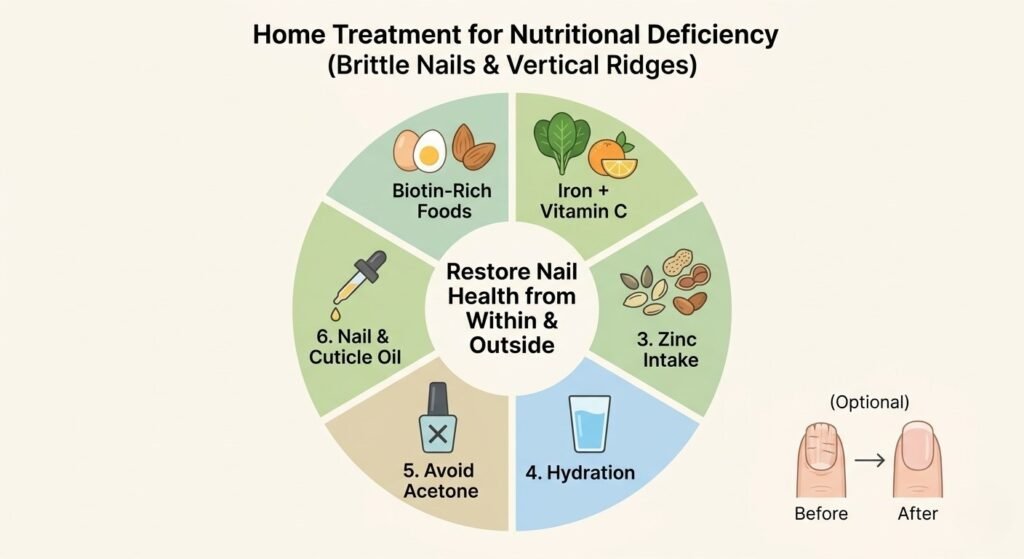
When nutritional deficiency is the confirmed or likely cause of brittle nails vertical ridges, these home strategies support recovery:
- Increase biotin-rich foods — Eggs, almonds, sweet potato, and salmon directly support keratin production and are the most studied dietary intervention for brittle nails vertical ridges
- Eat iron-rich foods with Vitamin C — Pairing iron sources like lean red meat, spinach, and lentils with citrus fruits maximizes iron absorption and supports nail matrix oxygenation
- Add zinc-rich foods to daily meals — Pumpkin seeds, beef, chickpeas, and cashews support nail cell division and matrix repair
- Stay consistently hydrated — Water makes up approximately 18% of healthy nail composition; chronic dehydration worsens brittle nails vertical ridges regardless of nutritional status
- Avoid acetone nail polish remover — Acetone aggressively strips moisture and structural integrity from already-brittle nail plates, accelerating surface damage
- Apply nail and cuticle oil twice daily — Jojoba or vitamin E oil restores surface moisture and reduces the brittleness that causes nail splitting alongside vertical ridging
Professional Treatment for Toenail Fungus
When toenail fungus is confirmed as the cause of brittle nails vertical ridges, professional treatment is essential:
- Topical antifungal medications — Prescription-strength topical antifungals penetrate the nail plate and treat surface-level fungal infections; effective for mild to moderate cases caught early
- Oral antifungal therapy (terbinafine or itraconazole) — Systemic oral antifungals treat moderate to severe toenail fungus by eliminating the organism from within; requires liver monitoring during treatment
- Laser antifungal treatment — Laser therapy targets and destroys fungal organisms within the nail plate without systemic medication; effective for patients who cannot tolerate oral antifungals
- Nail debridement — A podiatrist safely thins and cleans infected, thickened nail surfaces to reduce pressure, improve topical treatment penetration, and lower the fungal load within the nail
- Combination therapy — For severe or resistant toenail fungus causing brittle nails vertical ridges, combining oral medication with laser or topical treatment produces significantly higher cure rates
Recovery Expectations
Recovery timelines differ significantly depending on which cause is driving brittle nails vertical ridges:
For nutrient deficiency:
- Weeks 1–4: Energy and systemic symptoms improve with nutritional correction
- Weeks 4–8: New nail growth at the base begins appearing smoother
- Months 3–6: Visible improvement as healthy nail replaces ridged plate
- Months 12–18: Full toenail replacement with normal texture
For toenail fungus:
- Weeks 1–8: Oral antifungals begin clearing infection; no visible nail change yet
- Months 2–4: New, uninfected nail growth becomes visible at the nail base
- Months 6–12: Significant clearing of infected nail as healthy nail grows in
- Months 12–18: Full nail replacement — toenails grow approximately 1.5mm per month
Frequently Asked Questions
Can brittle nails vertical ridges be caused by both deficiency and fungus at the same time?
Yes — and this is more common than most patients realize. Nutritional deficiency weakens the nail plate, making it significantly more vulnerable to fungal invasion. A podiatrist can test for both simultaneously.
How does a podiatrist confirm whether it is deficiency or toenail fungus?
A KOH test or fungal culture confirms toenail fungus clinically. Blood panels ordered by your physician identify specific nutritional deficiencies. Both tests are straightforward and provide clear answers quickly.
Can I treat brittle nails vertical ridges from toenail fungus with over-the-counter products?
Over-the-counter antifungals have limited penetration through the nail plate and are rarely effective for established toenail fungal infections. Prescription treatment from a podiatrist produces significantly better results.
Will brittle nails vertical ridges grow out on their own without treatment?
Existing ridges grow out with the nail over 12–18 months — but only if the root cause is corrected. Without addressing the deficiency or infection, new nail growth will continue to show the same brittle nails vertical ridges.
Is toenail fungus contagious within my household?
Yes. Toenail fungus spreads through shared nail tools, bathroom floors, towels, and footwear. During active infection, avoid sharing these items and always wear footwear in communal areas.
Conclusion
Brittle nails vertical ridges deserve more than guesswork and over-the-counter products. Whether the cause is a nutritional deficiency quietly disrupting your nail matrix or a toenail fungal infection steadily digesting your nail plate, both conditions worsen with time and both carry risks — permanent nail damage, spreading infection, and foot pain that affects your daily life — that make early professional evaluation essential.
The treatments available for both causes are safe, effective, and far less complicated than most patients expect. Correcting a nutritional deficiency or clearing a fungal infection with proper professional guidance gives your nails the best possible chance of full recovery — and protects them from the long-term complications that come with delayed care.
Book your consultation with a verified podiatrist today. A single professional appointment identifies the exact cause of your brittle nails vertical ridges, eliminates the uncertainty, and starts you on the right treatment path immediately. Your nails — and your confidence — are absolutely worth protecting.
Struggling to get an appointment?
We help patients in your area bypass clinic waitlists by instantly finding verified podiatry doctors who accept their insurance.