Green Toenail Infection (Pseudomonas) Guide
Find a Podiatrist Near You
Get same-day appointments with verified podiatrists. Insurance accepted.
Green toenail infection is one of the most commonly misdiagnosed nail conditions — because the immediate assumption when a toenail changes color is always fungus. Patients apply antifungal lacquers for months. Nothing improves. The nail stays green. Sometimes it gets worse.
The reason is straightforward: green toenail infection is almost always caused by bacteria, not by fungal organisms. Specifically, it is caused by Pseudomonas aeruginosa — a bacterium that thrives in warm, moist environments and produces distinctive blue-green pigments that stain the nail plate from beneath. No amount of antifungal medication will eliminate a Pseudomonas infection because the organism is not a fungus.
Understanding this distinction — and understanding how green toenail infection actually develops, progresses, and is treated — is the foundation of resolving it effectively. This guide covers everything you need to know.

What Is a Green Toenail Infection?
Green toenail infection is the common name for a condition clinically known as green nail syndrome or chloronychia. It develops when Pseudomonas aeruginosa colonizes the space between the nail plate and the nail bed — a space that forms when the nail partially separates from the underlying tissue.
Pseudomonas aeruginosa is a gram-negative bacterium that exists widely in soil, water, and moist environments. It is also present on human skin without typically causing problems. It becomes a nail pathogen when given the right conditions: a warm, moist, poorly oxygenated space sheltered from normal cleaning and immune surveillance.
When Pseudomonas establishes in the subungual space, it produces two pigments that give green toenail infection its characteristic color:
- Pyocyanin — a blue-green pigment that is the primary source of the green coloration
- Pyoverdine — a yellow-green fluorescent pigment that contributes secondary coloration
These pigments penetrate into the nail plate from beneath, staining it green. The shade varies depending on how established the infection is — ranging from pale yellow-green in early infection to deep green, green-black, or even nearly black in severe or long-standing cases.
How Green Toenail Infection Develops: The Sequence
Green toenail infection does not appear out of nowhere. It follows a consistent biological sequence that, once understood, explains both why it develops and how to prevent it.
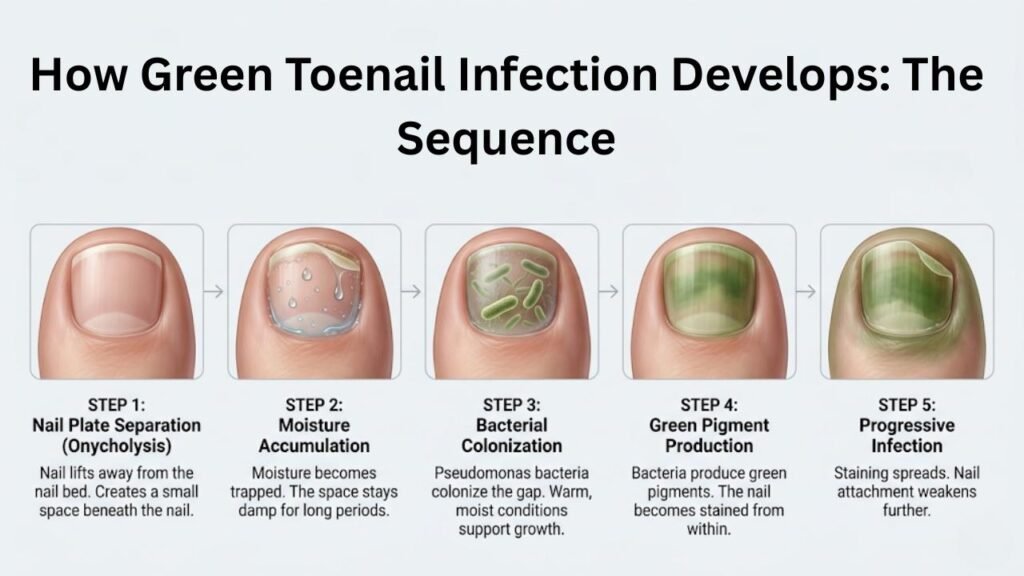
Step 1: Nail plate separation (onycholysis)
The process begins when the nail plate separates from the nail bed. This separation — called onycholysis — creates a gap between the nail plate above and the nail bed tissue below. The gap can range from a tiny separation at the nail tip to significant lifting along the nail sides.
Onycholysis occurs from various causes: repeated nail trauma, over-aggressive nail cleaning, fungal infection that previously lifted the nail, psoriasis, allergic reactions to nail products, or repetitive water exposure that weakens the nail-bed attachment.
Step 2: Moisture accumulation in the gap
The separated space is not naturally self-draining. Water and sweat from daily activity accumulate in the gap and are difficult to remove through normal washing. The enclosed space retains moisture even when the nail surface looks dry.
Step 3: Pseudomonas colonization
Pseudomonas aeruginosa is an aerotolerant organism — it can grow in low-oxygen environments like the subungual space. When this moisture-filled space provides the warm, humid microenvironment the bacterium requires, it colonizes the area and begins multiplying. Pseudomonas specifically has adherence factors that allow it to attach to keratin surfaces within the subungual space.
Step 4: Pigment production and nail staining
As the bacterial colony establishes and grows, it produces pyocyanin and pyoverdine. These pigments diffuse into the nail plate from the nail bed surface, staining the nail from the inside out. The green color is not on the nail surface — it is within the nail plate itself, which is why it does not wipe off and why topical products applied to the nail surface do not easily penetrate to where the bacteria are.
Step 5: Progressive staining and potential nail damage
Without intervention, the bacterial colony continues to grow. The staining spreads further into the nail. The infection can also weaken the nail attachment further, increasing the onycholysis and creating more favorable conditions for the infection to expand.
What Green Toenail Infection Looks Like
Color: The defining feature. The discoloration ranges from pale lime green or yellow-green in early infection to a deeper, more vivid green, and in severe or long-standing cases, a green-black or near-black color.
Location of discoloration: The green color is seen through the nail plate — it is beneath the nail, not on its surface. The most commonly affected area is near the nail tip or along the nail sides where the separation and bacterial colonization began.
Nail surface texture: Unlike fungal nail infection, the nail plate surface in green nail syndrome may be relatively intact and smooth — at least initially. The nail does not typically crumble at the edges or feel hollow in the way a fungally infected nail does. However, if the green toenail infection is long-standing, some nail plate weakening and structural change can occur.
Nail lifting: Visible onycholysis — the nail plate is lifted away from the nail bed, particularly at the edges or tip. This lifted area may appear whitish (from air beneath) with green staining in adjacent areas.
Odor: Pseudomonas produces a characteristic musty or sweet-musty odor. Not always noticeable to the patient, but clinically detectable during professional examination.
Pain: Green toenail infection is typically painless unless secondary inflammation or a concurrent bacterial skin infection develops.
Green Toenail Infection vs Fungal Nail Infection: A Critical Distinction

This comparison is essential because the two conditions are frequently confused and require completely different treatments.
| Feature | Green Toenail Infection (Pseudomonas) | Fungal Nail Infection (Onychomycosis) |
|---|---|---|
| Causative organism | Pseudomonas aeruginosa (bacteria) | Dermatophytes, yeasts, molds (fungi) |
| Nail color | Green, yellow-green, green-black | Yellow, white, brown, opaque |
| Nail surface texture | Often smooth or near-normal | Thick, crumbling, friable |
| Subungual debris | Moist accumulation | Chalky, dry, powdery debris |
| Nail lifting | Present — essential to development | Present in advanced cases |
| Odor | Musty, sweet-musty Pseudomonas odor | Occasional unpleasant odor |
| Spread to other nails | Uncommon | Common over time |
| Response to antifungals | No improvement | Gradual improvement |
| Required treatment | Antibacterial | Antifungal |
| Laboratory confirmation | Bacterial culture | KOH/fungal culture |
The bottom line: if a toenail is green and antifungal medication has produced no improvement after weeks of consistent use — green toenail infection from Pseudomonas is the most likely explanation, and a completely different treatment approach is needed.
Can Green Toenail Infection and Fungal Infection Occur Together?
Yes — and this is clinically important. Fungal nail infection (onychomycosis) can cause nail plate lifting (onycholysis) as the infection progresses. This lifting creates exactly the type of subungual space that allows Pseudomonas to colonize secondarily.
So the sequence can be:
- Fungal infection begins → 2. Nail plate lifts from fungal damage → 3. Pseudomonas colonizes the lifted space → 4. Green coloration appears on top of existing yellow/fungal discoloration
In these mixed infection cases, treating only the fungal component or only the bacterial component will be insufficient. Both organisms need to be addressed simultaneously, with antifungal medication for the fungal component and antibacterial treatment for the Pseudomonas component.
Laboratory testing — bacterial culture alongside KOH microscopy or fungal culture — distinguishes which organisms are present in a given nail.
Who Is Most Susceptible to Green Toenail Infection?
Certain situations and populations face elevated risk:
People with hands or feet regularly in water (wet work)
Healthcare workers, swimmers, dishwashers, and anyone who regularly immerses their feet in water have higher rates of nail onycholysis and subsequent Pseudomonas colonization. This is actually more common in fingernails than toenails for this population.
Athletes and runners
Repetitive nail trauma from training creates the nail separation that allows Pseudomonas to colonize. The combination of nail trauma and sweat-filled footwear provides both the structural entry point and the moist microenvironment.
People who wear nail products (artificial nails, gel polish)
Acrylic and gel nail products can trap moisture beneath them and damage the nail plate, creating the conditions for green toenail infection. This is a particularly common presentation in fingernails from salon services.
Patients with pre-existing onycholysis from any cause
Psoriasis, thyroid disease, and various medications can produce onycholysis as a side effect. Any patient with nail separation from these causes is at elevated risk for secondary Pseudomonas colonization.
Patients with diabetes or immunocompromise
Impaired immune function reduces the body’s ability to limit Pseudomonas colonization once the organism establishes in the subungual space.
How Green Toenail Infection Is Diagnosed
Clinical examination is the primary diagnostic step. An experienced podiatrist or physician can often identify green toenail infection from the characteristic green-to-green-black coloration, the pattern of nail lifting, and the clinical context.
Bacterial culture confirms the diagnosis definitively. A swab taken from the subungual space — or a scraping from the undersurface of the lifted nail plate — is cultured on standard bacterial growth media. Pseudomonas aeruginosa grows readily within 24 to 48 hours and produces its characteristic green-pigmented colonies on culture.
Fungal testing (KOH and culture) should be performed alongside bacterial culture to determine whether concurrent fungal infection is present.
The combination of bacterial culture confirming Pseudomonas and negative fungal testing establishes a clear green toenail infection diagnosis. This guides treatment selection precisely.
Treatment for Green Toenail Infection
The Foundation: Eliminate the Moisture
Green toenail infection cannot resolve while the moist subungual space that supports bacterial growth is maintained. The fundamental treatment requirement is eliminating the conditions that allowed Pseudomonas to colonize.
- Dry the feet completely after every shower and bathing — particularly between and around the toes
- Avoid submerging the affected foot in water where possible during active treatment
- Wear moisture-wicking socks
- Rotate footwear — allow shoes to dry completely between wears (24 to 48 hours minimum)
- Choose breathable footwear materials
This alone — without any medication — can sometimes resolve a mild green toenail infection when the nail separation is caught early and the bacterial colony is not yet established.
Topical Antibacterial Treatment
Acetic acid (dilute vinegar) soaks
Pseudomonas aeruginosa is sensitive to acidic environments. Soaking the affected nail in a dilute acetic acid solution — typically white vinegar diluted to 1 to 2 percent acetic acid in water — for 10 to 15 minutes twice daily is a first-line conservative treatment. The acidic environment inhibits Pseudomonas growth and, over several weeks, can clear mild to moderate green toenail infection.
Topical antibiotics
- Gentamicin drops — an aminoglycoside antibiotic with good Pseudomonas activity, applied to the nail twice daily
- Tobramycin drops — similarly effective against Pseudomonas
- Ciprofloxacin drops — a fluoroquinolone with excellent Pseudomonas coverage
These are sometimes available as optic or otic drops, which are appropriately formulated for application to narrow spaces.
Sodium hypochlorite (bleach) soaks
Dilute sodium hypochlorite solutions have antibacterial activity against Pseudomonas and are sometimes used similarly to acetic acid soaks. Very dilute concentrations are used for brief soak periods.
Nail Trimming and Debridement
Trimming the lifted nail plate back to the point of firm attachment reduces the size of the subungual space available for bacterial colonization. Less space means less moisture retention and a smaller area for bacteria to occupy. This is performed by a podiatrist using appropriate instruments — home attempts at aggressive nail trimming in the context of significant onycholysis carry injury risk.
Professional nail debridement — reducing the nail thickness and removing the loosely attached nail material — exposes the bacterial colony more directly to topical treatment and air, significantly improving treatment effectiveness.
Oral Antibiotics in Resistant Cases
When topical treatment fails to clear green toenail infection after an appropriate treatment course, oral antibiotics with Pseudomonas coverage may be indicated.
Ciprofloxacin is the most commonly used oral antibiotic for Pseudomonas nail infection. It achieves good tissue penetration and has reliable Pseudomonas activity.
Oral antibiotic therapy is typically reserved for cases that have not responded to topical treatment, cases with concurrent soft tissue involvement (redness, swelling, spreading infection), or immunocompromised patients where more aggressive treatment is appropriate.
Addressing the Underlying Cause
Treating the green toenail infection without addressing what caused the initial nail separation will result in recurrence. Identifying and managing the original source of onycholysis is an essential component of definitive treatment:
- Fungal infection: antifungal medication
- Footwear trauma: footwear assessment and correction
- Psoriatic onycholysis: dermatological management of the psoriasis
- Nail product-related damage: cessation of the causative nail product
Prevention of Green Toenail Infection
Keep nails at an appropriate length
Nails that are too long are more likely to catch on footwear and experience trauma that begins the separation process. Trim toenails straight across at a moderate length.
Dry feet completely after all water exposure
Including between the toes and around the nail folds. This is the single most impactful preventive measure.
Wear breathable footwear
Materials that allow moisture to escape from the shoe interior — leather, canvas, mesh — maintain a drier internal environment.
Avoid aggressive nail cleaning under the nail plate
Using sharp implements to clean beneath the nail tip can initiate the separation that creates the Pseudomonas entry point. Cleaning underneath the nail tip during regular washing is sufficient.
Treat nail trauma promptly
Any nail that begins to lift from the nail bed should be protected and evaluated before the separation creates conditions for Pseudomonas colonization.
Do not apply nail polish over a lifted or potentially infected nail
Polish traps moisture and reduces the aerobic environment beneath the nail, creating more favorable conditions for Pseudomonas. Existing nail polish should be removed to allow proper inspection and treatment access.
Frequently Asked Questions About Green Toenail Infection
Will antifungal medication clear a green toenail infection?
No. Pseudomonas aeruginosa is a bacterium — antifungal medications have no activity against bacteria. This is the most important fact about green toenail infection. If a toenail is green and has not responded to antifungal treatment, the cause is almost certainly bacterial and requires antibacterial treatment.
Is green toenail infection contagious?
Pseudomonas aeruginosa is present widely in the environment and is not typically spread from person to person in the way that dermatophyte fungal infections are. However, Pseudomonas thrives in shared moist environments — pools, showers, locker rooms — so indirect environmental exposure is possible. The infection is not directly transmitted through nail-to-nail contact.
How long does it take to clear a green toenail infection?
The active bacterial infection typically responds to appropriate treatment within 2 to 4 weeks. However, the green discoloration within the nail plate does not clear immediately — it grows out with the nail over the following months. Full nail replacement takes 9 to 18 months, so the nail will appear to have green discoloration well into treatment even when the bacteria have been eliminated. The key indicator of successful treatment is new, clear nail growing in from the base.
Can green toenail infection heal without treatment?
Mild cases where the nail separation is minimal and the infection is caught very early may partially improve with moisture elimination alone. However, established Pseudomonas colonization of the subungual space does not typically self-resolve without antibacterial treatment because the bacteria produce biofilm structures that protect them from normal environmental challenges.
Should I see a podiatrist or my regular doctor for green toenail infection?
Either can evaluate and manage green toenail infection. A podiatrist has specific expertise in nail conditions and can perform professional nail debridement alongside initiating treatment. If the infection is severe, spreading, or not responding to initial treatment, consultation with both a podiatrist and your primary care physician is appropriate.
Can I paint my nails during treatment for green toenail infection?
No. Nail polish should be removed and the nails left bare during treatment. Polish traps moisture against the nail, reduces air exposure, and prevents topical antibacterial treatments from reaching the affected area. Any existing polish should be removed before beginning treatment.
Summary
Green toenail infection is a bacterial nail condition caused by Pseudomonas aeruginosa producing green pigments within the nail plate. It develops when nail separation (onycholysis) from any cause creates a moist, sheltered subungual space where Pseudomonas can establish and grow.
The critical clinical point is that green toenail infection requires antibacterial treatment — not antifungal medication. Topical acetic acid soaks, prescription topical antibiotics (gentamicin, ciprofloxacin), and in resistant cases oral ciprofloxacin, form the treatment backbone. Equally important is eliminating the moisture environment and addressing the cause of the original nail separation.
If your toenail is green and has not improved with antifungal products, professional podiatric evaluation — including bacterial culture alongside fungal testing — is the definitive next step toward the correct diagnosis and effective treatment.
Struggling to get an appointment?
We help patients in your area bypass clinic waitlists by instantly finding verified podiatry doctors who accept their insurance.