Brittle Toenails and Nutrient Deficiency
Find a Podiatrist Near You
Get same-day appointments with verified podiatrists. Insurance accepted.
Brittle toenails and nutrient deficiency are more closely connected than most people realize — and the connection is frequently missed because brittle nails are so easily attributed to aging, water exposure, or everyday wear. When multiple nails are consistently fragile, splitting, peeling, or breaking despite careful nail care, the cause may not be external at all.
The nail plate is made almost entirely of keratin — a structural protein that the nail matrix produces continuously using raw materials delivered through the bloodstream. Every nutrient involved in keratin synthesis, cell division in the matrix, and the maintenance of healthy nail plate structure depends on what the body has available. When specific nutrients fall below the threshold the matrix needs, the nails it produces are structurally compromised.
The clinically important question is: which nutrients matter, what do they do specifically, and how do you know if deficiency is behind your brittle toenails? This guide answers all three.

What Brittle Toenails Actually Mean
Brittle toenails and nutrient deficiency are not the only possible connection — brittle nails have multiple causes, and understanding which type of brittleness you have points toward the right cause.
Dry-type brittleness (onychorrhexis):
The nail breaks and chips at the free edge. The nail surface may show vertical ridges running from the cuticle toward the tip. The nail feels hard and dry. Chipping and splitting occur horizontally at the nail tip.
This type is most commonly associated with dehydration, aging, and systemic conditions affecting keratin quality — including nutritional deficiency.
Soft-type brittleness (onychoschizia):
The nail peels in thin layers at the tip rather than breaking cleanly. The nail surface may appear relatively smooth. The nail tip separates into thin translucent sheets.
This type is most commonly associated with repeated wet-dry cycling (frequent water exposure), chemical exposure, and dehydration of the nail plate.
Why this distinction matters for brittle toenails and nutrient deficiency:
Nutrient deficiency-related brittle toenails most commonly produce the dry-type pattern — the nail plate is genuinely thin or weak because its structural composition is compromised by inadequate nutritional substrate. However, nutritional deficiency can also reduce nail plate integrity generally, making the nail more vulnerable to the soft-type peeling pattern from environmental factors.
Why the Nail Is Nutritionally Sensitive
The nail matrix is one of the most metabolically active tissues in the body relative to its size. It continuously produces nail cells at a high rate — the nail plate is replenished completely every 9 to 18 months for toenails.
- Amino acids (protein building blocks) for keratin synthesis
- B vitamins for the enzymatic processes of keratin production
- Minerals (zinc, iron) for cell division, oxygen delivery, and structural support
- Antioxidants (vitamins C and E) to protect matrix cells from oxidative damage
- Adequate blood supply to deliver all of the above
When any of these inputs falls below the level the matrix needs, the quality of the keratin it produces changes. The nail plate may be thinner, have disrupted layering, be structurally less dense, or have altered water content — all of which translate clinically into brittle toenails.
An important nuance: the nail plate is a record of what the matrix was producing weeks to months ago. Because toenails grow slowly, a nutrient deficiency that developed 3 to 6 months ago may only now be producing visible nail changes. This time lag means the nail provides a retrospective window into nutritional status rather than a real-time assessment.
6 Key Nutrient Connections in Brittle Toenails and Nutrient Deficiency

1. Biotin (Vitamin B7) — The Most Studied Link
Biotin is the nutrient most strongly associated with brittle toenails and nutrient deficiency in the clinical literature. It is a water-soluble B vitamin that serves as a cofactor for carboxylase enzymes — enzymes that are essential for the metabolic pathways involved in fatty acid synthesis and amino acid metabolism.
In the context of nail health, biotin’s importance relates to its role in keratin infrastructure. Biotin is required for the proper synthesis and cross-linking of keratin proteins that make up the nail plate. When biotin is insufficient, the keratin produced is structurally less robust — producing nails that are thinner, more fragile, and more prone to splitting.
Clinical evidence:
Multiple small clinical studies have evaluated biotin supplementation in patients with confirmed brittle nails. The most cited showed measurable improvement in nail plate firmness and reduced splitting in a significant proportion of supplemented patients compared to placebo. This makes biotin one of the few nutritional interventions for nail health with actual clinical trial evidence supporting it.
Who is at risk for biotin deficiency:
- People who eat raw eggs frequently (raw egg white contains avidin, which binds biotin and prevents its absorption)
- Patients on long-term antibiotic therapy (disrupts intestinal bacteria that produce some biotin)
- Patients who have had bariatric surgery or gastrointestinal resection
- People with inflammatory bowel disease affecting the small intestine
- Patients on anticonvulsant medications (some interfere with biotin metabolism)
Signs biotin may be involved in your brittle toenails:
Brittle nails affecting multiple nails, possibly accompanied by hair thinning or hair loss (biotin affects hair keratin through the same mechanism), and skin rash in severe deficiency. Isolated brittle nails without these accompanying signs have a lower probability of being biotin-related.
Food sources: Egg yolk, salmon, liver, whole grains, sunflower seeds, almonds, sweet potato. Raw egg white consumption consistently undermines biotin absorption.
2. Iron — Oxygen Delivery to the Matrix
Iron is required for hemoglobin — the protein in red blood cells that carries oxygen. When iron is deficient, hemoglobin production falls and oxygen delivery to all tissues is reduced, including the nail matrix.
The matrix cells that produce keratin are aerobically active — they require oxygen for normal function. Iron deficiency reduces the oxygen available to matrix cells, impairing their ability to produce normal, well-organized keratin. The result is a nail plate with reduced structural integrity.
The specific nail findings in iron deficiency:
Iron deficiency produces the most characteristic nail finding in nutritional nail pathology — koilonychia (spoon nails): the nail becomes concave, curving upward at the edges like a spoon rather than having the normal gentle downward convexity. In milder deficiency without overt koilonychia, the nails may simply be thin, brittle, pale, and prone to breaking.
Pale nail bed: The nail bed normally appears pink because oxygenated blood shows through the translucent nail plate. In iron deficiency anemia, the nail bed may appear pale — a reflection of reduced hemoglobin in the underlying capillaries.
Who is at risk:
- Women with heavy menstrual periods
- Pregnant women
- Vegetarians and vegans (non-heme iron from plant sources is less bioavailable than heme iron from animal sources)
- Patients with inflammatory bowel disease, celiac disease, or other malabsorption conditions
- Long-distance runners (exercise-induced hemolysis can deplete iron)
- Blood donors who donate frequently
Important: Iron supplementation should only be started after blood testing confirms deficiency (specifically ferritin levels, which reflect iron stores). Iron toxicity from excessive supplementation is a real risk. Do not supplement iron without confirmed deficiency.
Food sources for iron: Red meat, organ meats (liver), shellfish (particularly oysters), dark leafy greens (spinach, kale), lentils and legumes, fortified cereals.
3. Zinc — Cell Division and Structural Integrity
Zinc is a cofactor for over 300 enzymatic reactions in the body, including those governing cell division and protein synthesis. In the nail matrix, zinc is specifically required for the rapid cell division that produces new nail plate cells continuously.
When zinc is deficient, nail matrix cell division is impaired. The resulting nail plate has a lower density of cells, is thinner, and lacks the structural integrity of a zinc-adequate nail.
Specific nail changes from zinc deficiency:
- Brittle nails prone to splitting
- White spots or white banding (Muehrcke’s-like changes from zinc deficiency are less defined than those from hypoalbuminemia)
- Irregular surface texture
- Nail growth may slow visibly
Who is at risk:
- Vegans and vegetarians
- People with alcohol use disorder
- Patients with inflammatory bowel disease or malabsorption
- Elderly adults
- Patients on certain medications including diuretics and some antibiotics
Food sources: Oysters (highest zinc source), red meat, poultry, pumpkin seeds, hemp seeds, legumes, nuts.
4. Protein and Essential Amino Acids — The Structural Foundation
This connection may seem obvious — nails are made of keratin, keratin is a protein, so inadequate protein produces weak nails — but it is worth explaining the specifics.
Keratin in the nail is not built from generic protein. It is assembled from specific amino acids in specific proportions — particularly cysteine, which forms the disulfide bonds that give keratin its structural rigidity. When dietary protein is inadequate — either in total amount or in the specific amino acid composition — the matrix cannot produce fully cross-linked, structurally robust keratin.
Specific nail findings in protein deficiency:
- Brittle, thin nail plates
- Leukonychia (white nail changes) in severe protein deficiency
- Beau’s lines (horizontal grooves) across the nail if protein deficiency was severe and transient
- In severe malnutrition: Muehrcke’s lines from associated hypoalbuminemia
Who is at risk:
- People following very low-calorie or severely restricted diets
- Elderly adults with poor appetite and reduced intake
- Patients recovering from surgery or severe illness with increased protein requirements
- People with protein malabsorption from gastrointestinal conditions
- Some vegan and vegetarian diets if not carefully planned for complete protein
Assessment:
Serum albumin and prealbumin (transthyretin) are clinical markers of protein nutritional status. Low albumin in the context of brittle nails suggests protein deficiency as a contributing factor — and also directly produces nail bed changes (Muehrcke’s lines) through reduced oncotic pressure in the nail bed capillaries.
Food sources: Complete proteins — meat, fish, poultry, eggs, dairy. Plant-based complete proteins — soy, quinoa, hemp seed. Combining plant protein sources provides complete amino acid profiles.
5. Vitamin B12 — Red Blood Cell Production and Neural Function
Vitamin B12 is required for red blood cell production and DNA synthesis. Its mechanism in brittle toenails and nutrient deficiency is somewhat similar to iron — B12 deficiency produces megaloblastic anemia, reducing oxygen delivery to nail matrix cells through an anemia-mediated pathway rather than hemoglobin deficiency.
B12 deficiency may also produce distinctive nail changes beyond brittle nails: hyperpigmentation of the nails — increased brown or blue-black pigmentation of the nail plate — is a recognized finding in vitamin B12 deficiency, particularly noted in patients with pernicious anemia.
Who is at risk:
- Strict vegans and vegetarians
- Adults over 50
- Patients on metformin
- Patients on proton pump inhibitors long-term
- Patients with pernicious anemia
- Anyone who has had gastric surgery
Assessment: Serum B12 and methylmalonic acid.
Food sources: Meat, fish, shellfish, eggs, dairy, fortified plant milks and nutritional yeast for vegans.
6. Vitamin C — Collagen Support and Antioxidant Protection
Vitamin C plays two roles relevant to brittle toenails and nutrient deficiency: it is required for collagen synthesis, and it is an antioxidant protecting cells from oxidative damage.
While the nail plate is keratin rather than collagen, the nail bed and the connective tissue supporting the nail unit are collagen-dependent structures. Vitamin C deficiency (scurvy) produces characteristic nail changes including splinter hemorrhages — small longitudinal hemorrhages beneath the nail — alongside the more classic signs of corkscrew hairs, perifollicular hemorrhages, and gingival swelling.
Beyond scurvy-level deficiency, sub-optimal vitamin C levels may reduce the antioxidant protection available to nail matrix cells and contribute modestly to the general brittleness associated with nutritional inadequacy.
Food sources: Citrus fruits, kiwi, strawberries, bell peppers, broccoli, Brussels sprouts.
Comparing Nutritional Causes of Brittle Toenails
| Nutrient | Primary Nail Finding | Other Signs of Deficiency | Testing |
|---|---|---|---|
| Biotin | Brittle, splitting nails | Hair thinning, skin rash (severe) | Urinary 3-hydroxyisovaleric acid, serum biotin |
| Iron | Brittle, pale nails; koilonychia | Fatigue, pallor, cold intolerance | Ferritin, serum iron, TIBC |
| Zinc | Brittle nails, white banding | Poor wound healing, hair loss | Serum zinc |
| Protein | Thin, brittle nails | Weight loss, muscle loss | Serum albumin, prealbumin |
| Vitamin B12 | Brittle nails, hyperpigmentation | Fatigue, neurological symptoms | Serum B12, methylmalonic acid |
| Vitamin C | Splinter hemorrhages, brittle nails | Gum disease, wound healing impairment | Serum ascorbic acid |
How to Know If Deficiency Is Behind Your Brittle Toenails
Several patterns suggest that brittle toenails and nutrient deficiency are genuinely connected rather than coincidental:
Multiple nails affected simultaneously — Local causes like trauma or fungal infection typically start in one nail. Nutritional deficiency affects all nails from the same matrix-level impairment.
Slow nail growth across all nails — Not just brittle but also noticeably slow growing. The matrix is producing less nail plate per month because its production capacity is reduced.
Other deficiency signs present — Hair thinning, unusual fatigue, frequent illness, poor wound healing, or skin changes alongside brittle nails increase the probability of a nutritional cause.
Restricted or unvaried diet — A diet that excludes significant food categories (veganism without supplementation, very low-calorie dieting, food aversion, or difficulty eating from any cause) creates nutrient deficiency risk.
Medical history of malabsorption — Celiac disease, Crohn’s disease, bariatric surgery, small bowel resection, and chronic use of certain medications all reduce nutrient absorption.
No improvement with nail care — If moisturizing, protective footwear, careful trimming, and avoiding chemical exposure have not improved brittle nails over 2 to 3 months, the cause is more likely internal than environmental.
What to Do If You Suspect Brittle Toenails and Nutrient Deficiency
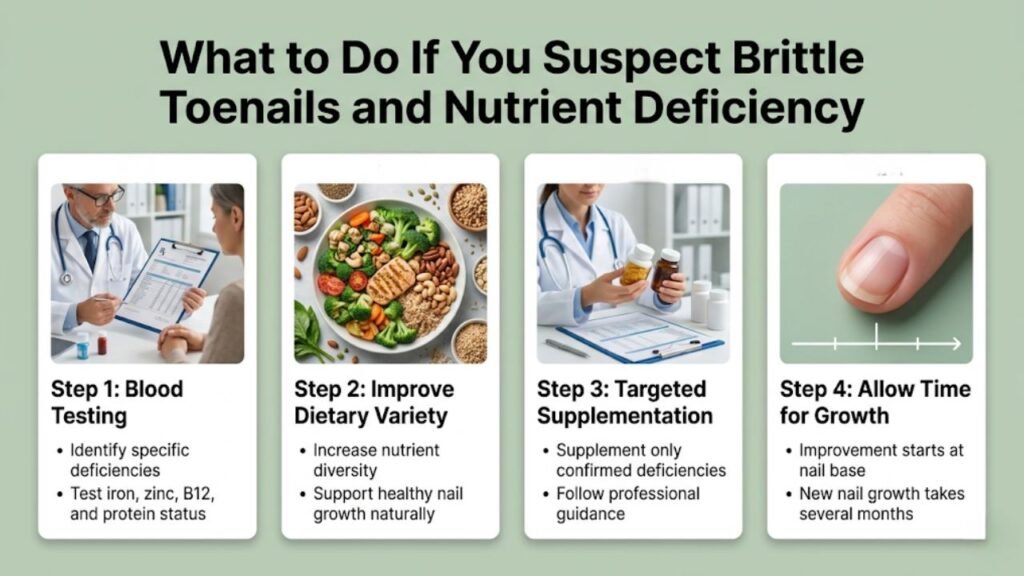
Step 1: See your doctor for blood testing
Before starting supplements, confirm which specific nutrients are deficient. Useful tests include: ferritin (iron stores), serum zinc, serum B12 and methylmalonic acid, complete blood count (identifies anemia patterns), and albumin (protein status). Your doctor can order a panel appropriate to your symptoms and history.
Step 2: Improve dietary variety
A varied diet including adequate animal protein (or well-planned plant protein), leafy green vegetables, legumes, nuts, seeds, and whole grains covers most nutritional bases relevant to nail health. This is the most sustainable and comprehensive approach.
Step 3: Targeted supplementation for confirmed deficiencies
Supplement specifically what is deficient, at appropriate doses. Do not take broad multivitamins as a substitute for testing — you may be addressing nutrients that are adequate while missing the one that is actually low.
Step 4: Allow time
Toenail improvement from correcting nutritional deficiency takes months. The nail matrix needs time to produce new, better-quality nail plate, and that new plate needs to grow out to replace the previously compromised nail. Improvement is visible first at the nail base — where new nail grows from — not at the nail tip.
Frequently Asked Questions About Brittle Toenails and Nutrient Deficiency
Which deficiency most commonly causes brittle toenails?
Biotin deficiency has the most clinical evidence linking it directly to brittle nails. Iron deficiency is the most common nutritional deficiency overall and produces well-characterized nail changes including brittleness and koilonychia. Both are worth evaluating when brittle toenails and nutrient deficiency is suspected.
Will taking biotin supplements improve my brittle toenails?
Biotin supplementation can improve nail brittleness in patients with brittle nails — but the effect is more reliable when biotin deficiency is actually present. In patients with normal biotin status, the effect is modest. It is safe to trial biotin supplementation, but do not expect dramatic results if biotin is not actually deficient.
Should I take iron supplements for brittle toenails?
Only if blood testing confirms iron deficiency (low ferritin). Iron toxicity from over-supplementation is a genuine risk — excess iron accumulates in organs. Never supplement iron based on nail symptoms alone without confirming deficiency first.
How long before nutritional improvements show in the nails?
The nail matrix begins producing better-quality nail as soon as nutritional status improves. But toenails grow approximately 1.5 mm per month, so new, stronger nail from the base takes 6 to 9 months to visibly replace the previously brittle nail. Improvement is gradual and monitored at the nail base, not the tip.
Can vegan diets cause brittle toenails from deficiency?
Yes — particularly if B12 and iron (both predominantly found in animal products) and zinc (lower bioavailability from plant sources) are not adequately supplemented or sourced from fortified foods. A well-planned vegan diet with appropriate supplementation avoids these deficiencies, but poorly planned vegan diets frequently produce them.
Are brittle toenails always from nutritional deficiency?
No. Aging, dehydration from wet-dry cycling, fungal nail infection, thyroid disorders, and certain medications also cause brittle nails. Nutritional deficiency is one important cause among several — it is most likely when multiple nails are affected without obvious local cause and when dietary history or symptoms suggest inadequate intake or absorption.
Summary
Brittle toenails and nutrient deficiency share a specific biological connection — the nail matrix requires adequate nutritional substrate to produce structurally sound keratin, and when specific nutrients fall below the level the matrix needs, the nail plate it produces is genuinely weaker, thinner, and more prone to breaking.
The six most clinically important nutrient connections are biotin, iron, zinc, protein, vitamin B12, and vitamin C.
Before supplementing broadly, blood testing to identify specific deficiencies ensures that the right nutrients are being addressed. Dietary improvement is the most comprehensive foundation. And patience is essential — nail improvement from nutritional correction takes months, visible first at the base of the nail where new, healthier nail grows in.
Struggling to get an appointment?
We help patients in your area bypass clinic waitlists by instantly finding verified podiatry doctors who accept their insurance.