Insurance Coding for Nail Procedures
Find a Podiatrist Near You
Get same-day appointments with verified podiatrists. Insurance accepted.
Insurance coding for nail procedures is a topic most patients never think about until they receive an unexpected bill — or discover that a procedure they expected to be covered was denied. Understanding how nail treatment procedures get coded for insurance billing, what makes a procedure medically necessary (versus cosmetic), and what documentation supports coverage can save patients both money and frustration.
This guide is written for patients and caregivers — not billing specialists. It explains insurance coding for nail procedures in plain language: what the codes mean, which procedures typically get covered, what conditions qualify, and what you can do if a claim is denied.
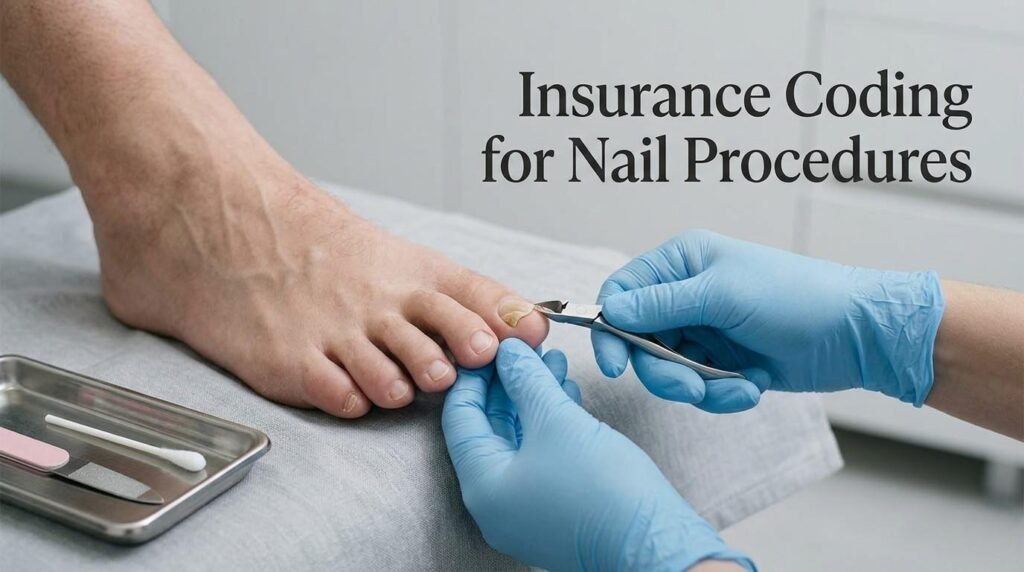
Why Insurance Coding Matters for Nail Procedure Patients
When your podiatrist performs a nail procedure — whether that is nail debridement for thick fungal nails, removal of an ingrown toenail, or nail avulsion for a severely damaged nail — they submit a claim to your insurance company using standardized medical codes.
These codes tell the insurance company:
- What procedure was done (using CPT codes — Current Procedural Terminology)
- Why it was done (using ICD-10 diagnosis codes)
Insurance coding for nail procedures directly determines whether your claim is approved, partially covered, or denied. The same physical procedure can be covered or not covered based entirely on how it is coded and documented — which means the medical record and diagnosis codes matter as much as the procedure itself.
The Two Code Systems in Insurance Coding for Nail Procedures
CPT Codes: What Was Done
CPT (Current Procedural Terminology) codes are five-digit numbers that describe specific medical procedures. In the context of insurance coding for nail procedures, the most commonly used CPT codes are:
CPT 11720 — Debridement of nail(s), any method; 1 to 5 nails
Used when a podiatrist thins and reduces the thickness of 1 to 5 nails. This code is used for nail debridement of a smaller number of nails.
CPT 11721 — Debridement of nail(s), any method; 6 or more nails
Used when nail debridement is performed on 6 or more nails in the same session. Patients with widespread nail fungal infection affecting most or all toenails most commonly qualify for this code.
CPT 11730 — Avulsion of nail plate, partial or complete, simple; single
Used for the removal of part or all of a single nail plate — most commonly for ingrown toenail treatment (partial nail avulsion) or early-stage nail trauma management.
CPT 11732 — Avulsion of nail plate, partial or complete, simple; each additional nail plate
An add-on code used when the same procedure is performed on additional nails in the same session beyond the first nail billed under 11730.
CPT 11750 — Excision of nail and nail matrix, partial or complete (eg, ingrown or deformed nail), for permanent removal
Used for procedures that include permanent destruction of the nail matrix — partial or total matrixectomy — to prevent regrowth of a specific nail section or the entire nail. Most commonly used for definitive treatment of recurrent ingrown toenails with phenol matrixectomy.
CPT 11755 — Biopsy of nail unit (eg, plate, bed, matrix, hyponychium, proximal and lateral nail fold)
Used when a sample of nail tissue is taken for laboratory pathological examination — to rule out or confirm melanoma, assess unusual nail changes, or diagnose specific nail conditions.
CPT 11740 — Evacuation of subungual hematoma
Used for draining blood collected beneath the nail after trauma (subungual hematoma decompression/trephination).
ICD-10 Codes: Why It Was Done
ICD-10 (International Classification of Diseases, 10th Revision) codes describe the medical diagnosis that made the procedure necessary. In insurance coding for nail procedures, the ICD-10 code is what establishes medical necessity — the clinical justification for the procedure.
Common ICD-10 codes used in nail procedures:
| ICD-10 Code | Condition |
|---|---|
| B35.1 | Onychomycosis (fungal infection of the nail) |
| L60.0 | Ingrown nail |
| L60.1 | Onycholysis (nail plate separation from nail bed) |
| L60.2 | Onychogryphosis (thickened, curved nail — ram’s horn nail) |
| L60.3 | Nail dystrophy (general term for nail structural abnormality) |
| L60.8 | Other specified nail disorders |
| E11.628 | Type 2 diabetes mellitus with other skin complications |
| E11.40 | Type 2 diabetes mellitus with diabetic neuropathy |
| I73.9 | Peripheral vascular disease, unspecified |
The ICD-10 code selected must match the clinical finding documented in the patient’s medical record. Insurance coding for nail procedures fails — and claims are denied — when the diagnosis code does not match what the medical record documents.
Medical Necessity: The Central Concept in Insurance Coding for Nail Procedures
The most important concept for patients to understand in insurance coding for nail procedures is medical necessity. Insurance companies cover nail procedures only when they are medically necessary — not when they are performed for cosmetic reasons.
What medical necessity means for nail procedures:
A nail procedure is medically necessary when the nail condition:
- Causes or is likely to cause pain or functional impairment
- Poses a risk of infection or serious complication
- Is associated with an underlying medical condition that increases the risk of nail-related complications
- Cannot be managed adequately with home nail care
What does NOT qualify as medically necessary:
- Routine nail trimming in a healthy adult with no complicating medical conditions
- Nail thinning performed purely for cosmetic improvement
- Laser nail treatment when performed solely for cosmetic nail appearance
Which Nail Procedures Are Most Commonly Covered by Insurance?
Nail Debridement (CPT 11720/11721)
Nail debridement — professional thinning and cleaning of thick, infected, or damaged nails — is one of the most commonly performed nail procedures in podiatry and is frequently covered by insurance under specific conditions.
When nail debridement is typically covered:
Onychomycosis (fungal nail infection): Nail debridement for fungal nails is covered when there is documented clinical evidence of fungal infection — typically a positive KOH test or fungal culture. Debridement alone is not curative for onychomycosis, but it is a medically appropriate adjunct treatment that reduces nail fungal burden and improves topical antifungal penetration.
Diabetic foot care: This is one of the most consistently covered indications for nail debridement. Medicare and most commercial insurance plans recognize that diabetic patients with peripheral neuropathy, peripheral vascular disease, or a history of foot complications are at elevated risk of nail-related complications — including skin breakdown and infection from thick nails pressing on adjacent tissue. For qualifying diabetic patients, nail debridement is typically covered every 60 to 62 days.
Peripheral vascular disease: Similar to diabetes, documented peripheral vascular disease with reduced sensation or circulation in the feet creates medical necessity for professional nail care.
Onychogryphosis (ram’s horn nail): Severely thickened, curved nails that create footwear pressure and skin contact risk are generally considered medically necessary to professionally manage.
Documentation requirements for nail debridement coverage:
The medical record must document:
- The specific nails treated
- The clinical condition observed (nail thickness, fungal characteristics, surrounding skin condition)
- The underlying diagnosis justifying treatment (fungal infection, diabetes, vascular disease)
- The treatment plan and intended follow-up
Nail Avulsion (CPT 11730/11732)
Partial nail avulsion for ingrown toenails — removing the ingrown nail edge under local anesthesia — is typically covered when the ingrown nail is causing pain, infection, or granulation tissue formation. Coverage requires documentation of the clinical presentation.
When typically covered:
- Ingrown nail with documented pain, swelling, or infection
- Recurrent ingrown nail following previous conservative treatment
- Ingrown nail in a diabetic patient or patient with vascular disease where complications are elevated
Permanent Nail Removal With Matrixectomy (CPT 11750)
Partial or total nail avulsion with chemical matrixectomy (phenol) for permanent removal is covered when the nail is chronically causing problems that conservative and simple avulsion approaches have failed to resolve — most commonly recurrent ingrown toenails with documented treatment history.
Documentation needed:
Evidence of prior treatment attempts, documentation of recurrence, clinical justification for permanent resolution rather than repeat avulsion.
Medicare-Specific Considerations for Insurance Coding for Nail Procedures
Medicare has specific rules about nail care coverage that patients — particularly older adults who are the primary Medicare population — should understand.
Medicare Local Coverage Determinations (LCDs) for nail care:
Medicare covers routine foot care including nail debridement only when specific systemic conditions are documented. Without these qualifying conditions, Medicare considers routine nail care a non-covered service.
Qualifying systemic conditions for Medicare nail care coverage:
Class A conditions (automatically qualify when documented):
- Diabetes mellitus with peripheral neuropathy (confirmed by examination)
- Arteriosclerotic vascular disease with claudication or documented diminished pulses
- Buerger’s disease (thromboangiitis obliterans)
- Raynaud’s disease or phenomenon
Class B conditions (qualify when combined with another Class B or Class C condition, or when documented with podiatric examination findings):
Various conditions including peripheral vascular disease, chronic venous stasis, lymphedema, and others
The “Class Finding” documentation:
Medicare requires documentation of “Class Findings” — specific clinical findings recorded during examination that support nail care medical necessity:
- Absent/diminished posterior tibial or dorsalis pedis pulse
- Foot temperature changes
- Nail changes (thickening, dystrophy, hypertrophy)
- Skin changes (hyperkeratosis, pigmentation, hair growth changes)
- Presence of ulceration or gangrene
Insurance coding for nail procedures under Medicare requires this Class Finding documentation alongside the appropriate diagnosis codes or claims are denied as non-covered routine nail care.
Common Reasons Insurance Claims for Nail Procedures Are Denied
Understanding why insurance coding for nail procedures leads to claim denials helps patients know when to appeal and what to ask their provider.
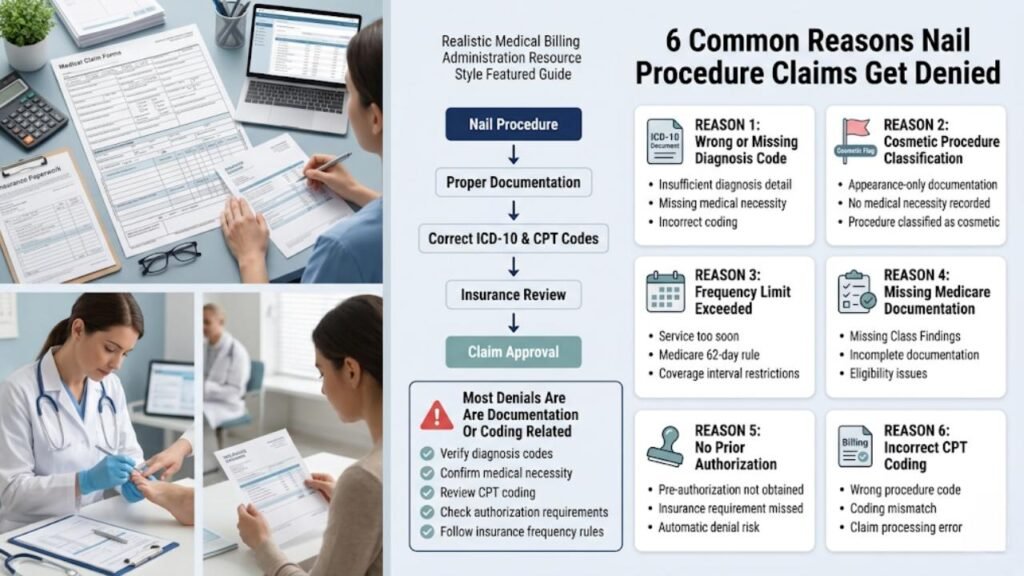
Wrong or missing diagnosis code: The most common reason. If the ICD-10 code does not clearly establish medical necessity for the procedure, the claim is denied. A claim for nail debridement coded only with a cosmetic or insufficiently specific diagnosis will be denied.
Cosmetic procedure flag: If the clinical documentation does not support medical necessity — if the visit note describes a desire for improved nail appearance without documenting the clinical condition — the procedure is categorized as cosmetic and denied.
Frequency limitations: Medicare limits nail debridement to every 62 days. Claims submitted within that interval are denied for frequency.
Missing Class Finding documentation (Medicare): For Medicare patients, the absence of documented Class Findings despite appropriate diagnosis codes is a common Medicare-specific denial reason.
Lack of prior authorization: Some plans require prior authorization for certain nail procedures. Submitting a claim without obtaining required pre-authorization results in denial.
Incorrect CPT code: Using 11720 (1 to 5 nails) when 11721 (6 or more nails) applies — or vice versa — creates claim discrepancies. Similarly, using 11730 when the procedure also included matrixectomy (which should use 11750) results in incorrect billing.
What Patients Can Do to Help Their Claims Succeed
Ask About Insurance Verification Before the Appointment
Most podiatry offices will verify your insurance benefits before your appointment. Specifically ask about:
- Is nail debridement covered under my plan?
- Are there documentation requirements I should know about?
- Is prior authorization required for any nail procedures?
Make Sure the Visit Includes a Thorough Medical History
The more complete the documented clinical picture, the stronger the medical necessity case. Ensure your podiatrist knows about:
- Diabetes, peripheral vascular disease, or any circulatory condition
- Any history of foot complications, ulcers, or infections
- All medications (relevant to establishing systemic risk factors)
- Previous nail treatments and their results
Keep Records of Previous Treatments and Recurrences
If you have had ingrown toenails treated before, or have had nail debridement previously, documentation of prior treatment and recurrence supports medical necessity for continued or escalated treatment.
Understand Your Right to Appeal
If a nail procedure claim is denied, you have the right to appeal. The appeal process typically involves:
- Requesting the denial reason in writing
- Having your podiatrist provide additional documentation or supporting clinical information
- Submitting a formal appeal to the insurance company
Many nail procedure denials are successfully appealed with appropriate supporting documentation. Ask your podiatrist’s billing office to assist with appeal letters when claims are initially denied.
Frequently Asked Questions About Insurance Coding for Nail Procedures
Does insurance cover nail fungus laser treatment?
Laser nail fungus treatment is generally not covered by insurance and is considered cosmetic. FDA clearance for laser devices describes “temporary increase in clear nail” — which insurance companies typically classify as cosmetic rather than medically necessary treatment. This is one of the most consistent coverage limitations across all major insurers.
Why was my nail debridement claim denied if my nails are thick and painful?
The most common reasons include: insufficient documentation of the underlying qualifying diagnosis in the medical record, absence of Class Finding documentation for Medicare patients, or diagnosis codes that do not specifically establish the qualifying condition. Request the specific denial reason from your insurance company and ask your podiatrist’s billing team to review the documentation and appeal if appropriate.
Does Medicare cover routine nail trimming?
No. Medicare explicitly excludes routine nail care — trimming, cutting, or clipping of nails — unless the patient has a documented qualifying systemic condition (Class A or Class B condition with Class Findings). Without these qualifying factors, nail trimming is considered a non-covered service under Medicare.
How often can nail debridement be billed to insurance?
The frequency limitation varies by insurer. Medicare limits nail debridement coverage to every 62 days. Many commercial insurance plans have similar frequency limitations. Claims submitted for nail debridement within these intervals are denied regardless of documentation quality.
What is the difference between medical nail care and cosmetic nail care for insurance purposes?
Medical nail care addresses a documented clinical condition — fungal infection, diabetic neuropathy, vascular disease, ingrown nail causing pain or infection, structural nail deformity causing functional impairment. Cosmetic nail care is performed for appearance improvement without a qualifying clinical indication. The documentation in the medical record — not the appearance of the nail — is what determines which category applies.
Summary
Insurance coding for nail procedures determines coverage through the combination of CPT procedure codes, ICD-10 diagnosis codes, and clinical documentation that establishes medical necessity. The most commonly covered nail procedures — debridement for fungal or thick nails, partial nail avulsion for ingrown nails, and matrixectomy for permanent nail removal — require clear documentation of qualifying clinical conditions and, for Medicare patients, specific Class Finding documentation.
Patients can support their coverage by ensuring their medical history is thoroughly documented at each appointment, asking about insurance verification before procedures, keeping records of prior treatment and recurrence, and understanding their right to appeal denials. Laser nail treatment is the most notable coverage exception — consistently classified as cosmetic across virtually all insurers.
Understanding how insurance coding for nail procedures works puts patients in a stronger position to navigate their coverage, ask the right questions, and advocate for appropriate reimbursement of medically necessary care.
Struggling to get an appointment?
We help patients in your area bypass clinic waitlists by instantly finding verified podiatry doctors who accept their insurance.