Thick Toenails and Circulation Problems
Find a Podiatrist Near You
Get same-day appointments with verified podiatrists. Insurance accepted.
Thick toenails and circulation problems are connected in ways that go well beyond appearance. When blood flow to the feet is reduced — whether from peripheral artery disease, venous insufficiency, diabetes-related vascular damage, or other circulatory conditions — the nails are among the first structures to show the effects. They grow more slowly, become denser and more brittle, and respond more poorly to both fungal infection and treatment.
For many patients, thick toenails and circulation problems coexist silently for years. The nails change gradually. No dramatic event occurs. The thickening is easy to attribute to aging or minor injury. But the consistent pattern of slow nail growth, brittle texture, and resistance to antifungal treatment in a patient with known vascular risk factors tells a clinical story that matters for how the nail is managed and how the underlying health problem is addressed.
This guide explains the four main ways circulation problems contribute to nail thickening, which conditions are most commonly involved, what symptoms suggest circulation rather than infection as the primary cause, and what management actually looks like when both issues are present.
Why Nails Need Good Circulation
The nail depends on blood supply more than most people realize. The nail matrix — the growth center at the base of the nail that produces the nail plate — receives blood from the posterior tibial and dorsalis pedis arterial branches, supplying oxygen, nutrients, and immune cells. The nail bed beneath the nail plate is similarly dependent on this blood supply for tissue health.
What adequate circulation provides to the nail:
- Oxygen for the metabolic activity of matrix cells producing nail keratin
- Nutrients — including protein, zinc, iron, and vitamins — required for normal nail cell production
- Immune cells that patrol the nail bed tissue and defend against early infection
- Efficient removal of metabolic waste products from active nail matrix cells
- Adequate growth factor delivery that helps maintain normal nail production rate
What reduced circulation does to the nail:
When blood flow decreases, all of these functions are impaired simultaneously. The matrix receives less oxygen and fewer nutrients. Nail cell production slows and becomes less efficient. The nail plate produced is structurally different — denser, more irregular, and more prone to brittleness. The compromised immune delivery means infections establish more easily and are harder to clear.
This is the fundamental biological explanation for why thick toenails and circulation problems so consistently occur together.
4 Key Links Between Thick Toenails and Circulation Problems
Link 1: Peripheral Artery Disease (PAD) and Nail Changes
Peripheral artery disease occurs when arteries supplying the legs and feet become narrowed from atherosclerosis — the accumulation of fatty deposits within arterial walls. The result is reduced blood flow to the lower extremities, with the feet — the furthest point from the heart — most severely affected.
PAD-related nail changes reflect the chronic nutrient and oxygen deprivation that the nail matrix experiences when blood supply is significantly reduced.
Nail changes associated with PAD:
- Very slow nail growth — sometimes only 0.5 to 1 mm per month versus the normal 1.5 mm
- Progressive nail thickening that develops gradually over years
- Nails that are opaque and pale or yellowish rather than translucent
- Very dry, brittle nail texture that tends to flake or crumble rather than cut cleanly
- All nails affected relatively symmetrically across both feet, reflecting the bilateral nature of PAD
- Surrounding skin that is often thin, dry, and hairless — reflecting the same ischemic changes affecting other peripheral tissue
Associated symptoms that suggest PAD alongside nail thickening:
- Calf or foot pain when walking that is relieved by rest (claudication)
- Cold feet consistently, even in warm environments
- Pale or bluish skin on the feet
- Slow-healing wounds on the feet or lower legs
- Absent or reduced foot pulses on clinical examination
The critical clinical point about PAD and thick toenails and circulation problems is that the treatment of the nail alone does not address the underlying arterial disease. Podiatric nail management — regular professional debridement — keeps the nail comfortable and reduces complication risk. But vascular assessment and management are what address the underlying cause.
Link 2: Diabetic Vascular and Immune Compromise
Diabetes produces multiple overlapping mechanisms that create the thick toenails and circulation problems combination seen so frequently in diabetic patients.
Microvascular disease:
Chronically elevated blood glucose damages the small blood vessels (capillaries) supplying peripheral tissue, including the nail bed and nail matrix. This microvascular damage reduces oxygen and nutrient delivery at the tissue level even when larger arterial flow appears adequate.
Macrovascular disease:
Diabetes significantly accelerates atherosclerosis in the larger arteries supplying the legs and feet. Diabetic peripheral artery disease develops earlier, progresses faster, and affects more distal vessels than PAD in non-diabetic individuals.
Immune cell dysfunction:
Beyond circulation, elevated blood glucose directly impairs the function of neutrophils and other immune cells. These cells are delivered to the nail bed through the circulation — so reduced blood flow compounds their already-impaired function, creating a double vulnerability to fungal infection.
The result:
Diabetic patients develop thick toenails from multiple simultaneous mechanisms — circulatory compromise altering nail growth, increased fungal susceptibility from immune impairment, and often concurrent neuropathy that means nail changes advance further before being noticed.
This is why thick toenails and circulation problems in diabetic patients represent a more medically serious combination than in otherwise healthy adults. The nail problem is one component of a broader foot vulnerability that requires professional management rather than home care.
Link 3: Chronic Venous Insufficiency and Nail Changes
Venous insufficiency occurs when the veins in the legs fail to efficiently return blood to the heart. Valves within the leg veins normally prevent backflow — when these valves fail, blood pools in the lower legs and feet, creating chronic venous hypertension.
The connection between venous insufficiency and thick toenails and circulation problems is somewhat different from the arterial circulation link. Venous insufficiency does not reduce oxygen and nutrient delivery in the same way arterial disease does — the problem is with blood return rather than delivery. But the chronic pooling of blood in the feet creates tissue congestion that still affects nail health through different mechanisms:
Increased interstitial fluid pressure:
Chronic venous congestion causes fluid to leak into surrounding tissue (edema). This increased fluid pressure in the tissue surrounding the nail affects how the nail matrix functions and how nutrients reach matrix cells through tissue fluid.
Secondary changes:
Chronic venous insufficiency often produces skin changes in the lower legs — pigmentation, thickening, and fibrosis of the skin (lipodermatosclerosis). These skin changes can extend to the foot and nail fold area, altering the local nail environment.
Reduced local immune function:
Chronically congested tissue has impaired immune function because the stagnant microenvironment is less effective at clearing early infections.
What venous insufficiency-related nail changes look like:
- Nail thickening that develops alongside visible leg or ankle swelling
- Brownish pigmentation of the skin on the lower legs or feet
- Varicose veins visible in the legs
- Leg heaviness, aching, or cramp, particularly after prolonged standing
- Sometimes thickening accompanied by nail discoloration from hemosiderin deposits in surrounding tissue
Link 4: Raynaud’s Phenomenon and Episodic Nail Change
Raynaud’s phenomenon produces episodic vasospasm — sudden, temporary narrowing of small blood vessels in the extremities — triggered by cold exposure or emotional stress. During an episode, the toes (and fingers) lose blood supply temporarily, turning white or blue, then red as blood flow returns.
Repeated episodes of this temporary blood supply reduction can affect nail health over time, contributing to nail brittleness, slow growth, and in some individuals, nail thickening that reflects the cumulative effect of repeated ischemic episodes.
Raynaud’s phenomenon is often associated with underlying connective tissue diseases — lupus, scleroderma, mixed connective tissue disease — which themselves may cause nail changes through additional mechanisms. When Raynaud’s is present, the connection between thick toenails and circulation problems reflects the episodic nature of the blood supply disruption rather than the continuous reduction seen in PAD.
How Circulation-Related Thick Toenails Differ From Fungal Thick Toenails
Many patients with circulation-related nail changes are first treated for suspected fungal infection. This is understandable because the nail changes overlap visually. But the distinction is clinically important because antifungal treatment addresses a fungal organism — it does not restore circulation.
| Feature | Circulation-Related Thick Nails | Fungal Thick Nails |
|---|---|---|
| Nails affected | Usually multiple, both feet | Often starts in one nail, spreads |
| Nail growth rate | Very slow | Slow but more variable |
| Nail debris under nail | Less typical | Very common — chalky accumulation |
| Surrounding skin | Thin, dry, sometimes hairless | More normal unless athlete’s foot present |
| Foot pulse assessment | Reduced or absent in PAD | Normal |
| Associated symptoms | Claudication, cold feet, leg swelling | Athlete’s foot often present |
| Fungal laboratory test | Negative | Positive |
| Response to antifungal | No improvement | Gradual improvement with treatment |
Fungal testing — KOH microscopy or fungal culture — is the essential step that distinguishes the two. It is also important to note that thick toenails and circulation problems create conditions where secondary fungal infection is more likely — patients with circulation-related nail changes have elevated fungal infection risk because immune delivery to the nail is reduced. Both conditions can coexist, which is why testing matters even when circulation disease is known.
The Implications for Treatment
When thick toenails and circulation problems are both present, treatment must address both dimensions — the nail itself and the circulation.

Managing the Nail
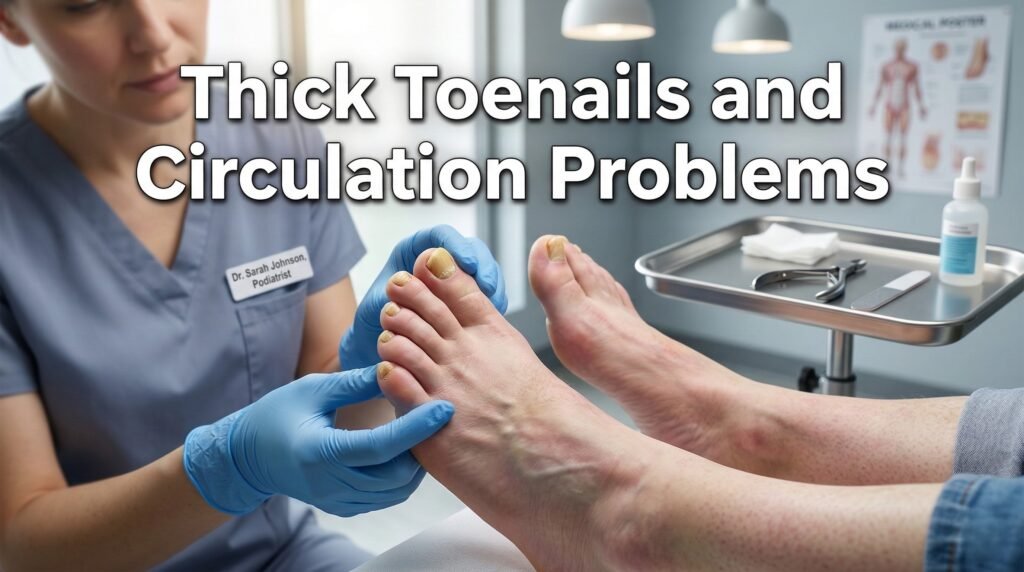
Professional nail debridement is the cornerstone of managing circulation-related thick toenails. Regular reduction of nail thickness by a podiatrist:
- Removes the physical bulk that creates pressure inside footwear
- Reduces the risk of nail edges causing skin pressure or breakdown
- Makes the nail safe to manage — self-trimming of extremely thick, brittle nails in patients with reduced foot sensation creates injury risk
- Allows visual monitoring of the nail and surrounding skin at each appointment
For patients with PAD, diabetes, or venous insufficiency, professional nail care every 6 to 10 weeks is typically more appropriate than self-management at home.
Managing concurrent fungal infection:
If laboratory testing confirms fungal infection alongside circulation-related nail changes, appropriate antifungal treatment is necessary. However, several considerations apply:
- Oral antifungal medications (terbinafine, itraconazole) may interact with medications commonly used in vascular and cardiac conditions — prescribing requires awareness of the full medication list
- Treatment may take longer in patients with poor circulation because medication reaches the nail through blood supply that is already reduced
- Cure rates may be lower than in healthy adults — realistic expectations should be set
- Topical antifungals are an alternative for patients on multiple medications where drug interactions are a concern
Addressing the Underlying Circulation
For PAD:
Vascular assessment with ankle-brachial index measurement, duplex ultrasound, and angiography if indicated. Management includes lifestyle modification (smoking cessation, exercise, dietary change), medications (antiplatelet agents, statins), and in significant cases, revascularization procedures.
For diabetes:
Optimizing glycemic control directly improves microvascular function and immune response. HbA1c closer to target levels produce meaningful improvements in foot tissue health over time.
For venous insufficiency:
Compression therapy — graduated compression stockings worn throughout the day — is the primary management. Elevating legs above heart level during rest reduces venous congestion. Exercise, particularly walking, supports venous return through the calf muscle pump.
For Raynaud’s:
Avoiding cold exposure, wearing warm footwear, and in moderate-to-severe cases, medications (calcium channel blockers, phosphodiesterase inhibitors) that reduce vasospasm frequency and severity.
Why Self-Trimming Thick Nails Is Risky With Circulation Problems
Patients with significant peripheral vascular disease, diabetes, or neuropathy face specific risks when attempting to trim very thick toenails at home.
The risks include:
- Cutting into the nail fold or surrounding skin rather than just the nail — the loss of protective sensation makes the boundary between nail and skin harder to identify
- Creating wounds that heal poorly due to impaired circulation and immune function
- Sharp nail edges after trimming that cause pressure sores on adjacent skin with every step
- Aggressive filing of very brittle circulation-affected nails causing nail plate damage
Professional podiatric nail care for patients with significant circulation problems is not a luxury — it is a safety consideration. This is reflected in Medicare and many insurance plans, which provide coverage for routine nail care in patients who have documented circulatory or neurological conditions affecting the foot.
When to Seek Medical Evaluation
When thick toenails and circulation problems are suspected together, two types of professional evaluation are relevant:
Podiatric evaluation:
- To assess the nail condition, confirm or rule out fungal infection through testing, provide professional nail care, and monitor the nail and surrounding skin
- Podiatrists often identify signs of reduced circulation during foot examination — absent pulses, skin changes, reduced capillary refill — and can refer appropriately
Primary care or vascular specialist evaluation:
- When symptoms suggest active circulatory disease — claudication, rest pain, poorly healing wounds, significant foot swelling, or cold extremities
- Ankle-brachial index testing screens for significant PAD
- Comprehensive assessment of cardiovascular risk factors — blood pressure, lipids, glucose
Frequently Asked Questions
Can circulation problems alone cause thick toenails?
Yes. Poor blood flow alters how the nail matrix produces nail cells, slowing growth and producing a thicker, more brittle nail plate. This happens even without any fungal infection. Fungal testing negative results alongside the pattern of nail changes described above confirm circulation rather than infection as the primary cause.
Will treating my circulation problems improve my thick nails?
Improving circulation — through better diabetes control, management of PAD, or compression therapy for venous insufficiency — creates a better environment for healthier nail growth over time. However, the improvement in nails is gradual and often partial, because some nail changes from long-standing circulation impairment reflect established matrix alterations rather than purely reversible circulation-driven changes.
Are thick toenails from circulation problems contagious?
No. Circulation-related nail thickening is not caused by an infectious organism and cannot spread to other people. If concurrent fungal infection is confirmed, that component is potentially contagious, but the circulation-related nail changes themselves are not.
Should I see a podiatrist or a cardiologist for thick nails and poor circulation?
Both have a role. A podiatrist manages the nail condition directly — testing, professional nail care, and monitoring. A primary care physician or vascular specialist manages the underlying circulatory condition. In most cases, starting with a podiatrist who can assess both the nail and the foot circulation provides a useful entry point, with referral to vascular medicine when significant PAD or other vascular disease is suspected.
How often should someone with poor circulation have their nails professionally trimmed?
Most patients with significant circulation problems — PAD, diabetic vascular disease, venous insufficiency — benefit from professional podiatric nail care every 6 to 10 weeks. The frequency may increase if the nails grow particularly thickly, if the patient has limited ability to inspect or care for their own feet, or if there is a history of nail-related complications.
Can thick nails from circulation problems grow back normal?
In some cases, yes — particularly if the circulation improves through successful treatment of the underlying condition and the nail matrix has not sustained permanent damage. In patients with long-standing severe PAD or chronic venous insufficiency with established nail changes, some degree of nail abnormality may persist even with optimized circulation management.
Summary
Thick toenails and circulation problems are connected through four main pathways: peripheral artery disease reducing arterial blood delivery to the nail matrix, diabetic vascular and immune compromise creating multiple overlapping nail vulnerabilities, chronic venous insufficiency creating tissue congestion that affects the nail environment, and Raynaud’s phenomenon producing episodic blood supply reduction that accumulates into nail changes over time.
Managing thick toenails and circulation problems effectively requires addressing both dimensions simultaneously — the nail through regular professional podiatric care, and the circulation through appropriate vascular, diabetic, or venous management. Antifungal treatment should be considered only when laboratory testing confirms concurrent fungal infection, because circulation-related nail changes do not respond to antifungal medication.
For patients with known vascular conditions who notice nail changes, professional podiatric evaluation provides the dual benefit of nail management and recognition of concerning circulation signs that may warrant further vascular assessment.
Struggling to get an appointment?
We help patients in your area bypass clinic waitlists by instantly finding verified podiatry doctors who accept their insurance.