Toenail Care Mistakes That Lead to Infection
Find a Podiatrist Near You
Get same-day appointments with verified podiatrists. Insurance accepted.
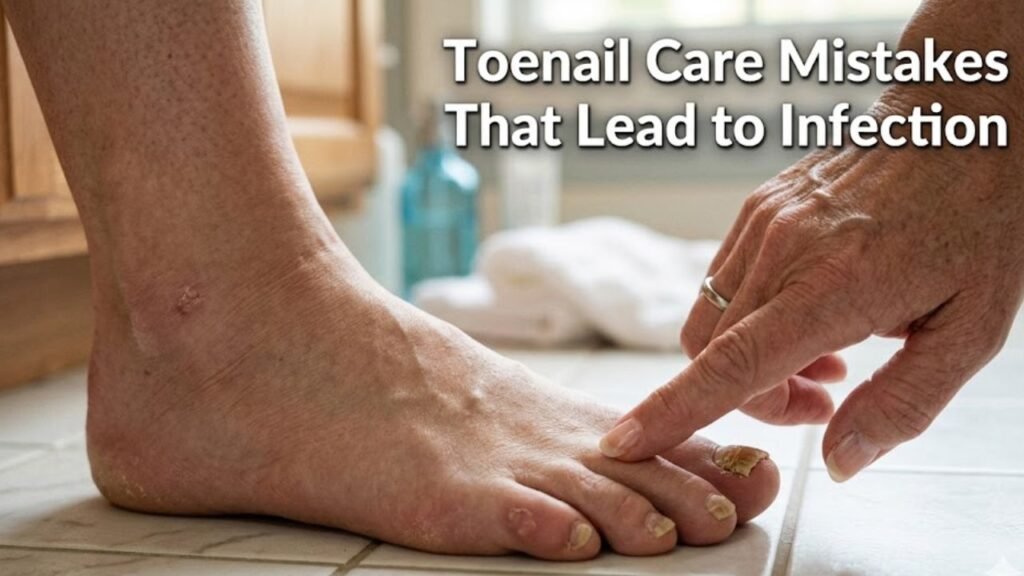
Toenail care mistakes that lead to infection are surprisingly common — and most of them are things people do without any awareness that they are creating a problem. Nail fungal infection, ingrown toenails, bacterial nail fold infections, and progressive nail damage rarely appear suddenly from nowhere. In most cases, they develop gradually from specific, repeatable mistakes in how the nails are cared for, trimmed, or protected.
The frustrating reality is that many of these toenail care mistakes that lead to infection are things people were never specifically taught to avoid. Rounding the nail corners, wearing the same shoes every day, treating all nail products as interchangeable, ignoring early nail changes — these habits feel neutral or even sensible until the consequences show up months later as a painful ingrown nail or a nail that has been slowly turning yellow for longer than anyone noticed.
Correcting toenail care mistakes that lead to infection does not require elaborate protocols or expensive products. It requires knowing which specific habits are creating risk and replacing them with better-chosen alternatives.
Mistake 1: Rounding the Nail Corners When Trimming
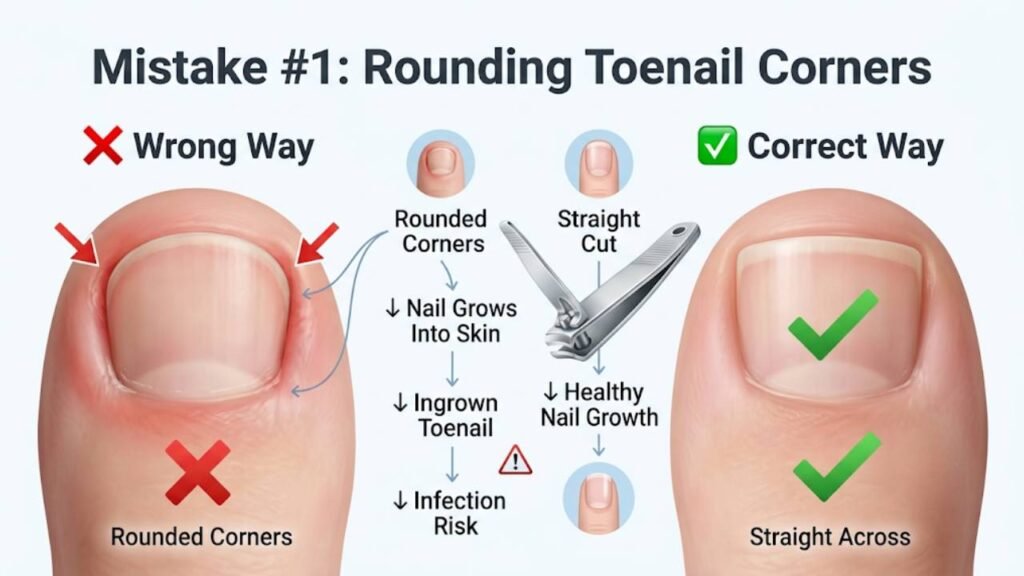
This is the single most common toenail care mistake that leads to infection — specifically to ingrown toenails and the bacterial nail fold infections that follow.
Why people do it: Most people trim toenails the same way they trim fingernails — following the natural shape of the nail edge, which produces a curved cut. For fingernails, this rounded shape is generally fine because fingernails do not live inside enclosed footwear experiencing the same mechanical pressures as toenails.
Why it causes problems: When the corners of the toenail are cut shorter than the center of the nail, the nail edge at the corner sits below the level of the surrounding skin. As the nail grows forward, the corner grows beneath the adjacent nail fold skin rather than over it — it literally grows into the skin. This is the mechanism of ingrown toenail.
The nail fold skin that is penetrated by the nail edge becomes inflamed and tender, then secondarily infected by bacteria that find the disrupted tissue a hospitable environment. This progression from a nail trimming habit to an ingrown nail to a bacterial nail fold infection is one of the clearest examples of toenail care mistakes that lead to infection.
The correction: Cut toenails straight across. The cut should run approximately perpendicular to the direction of nail growth — not following the nail’s natural curve. The corners should remain at approximately the same length as the center of the nail. Both nail corners should be visible — not tucked under the surrounding skin.
Mistake 2: Cutting Nails Too Short
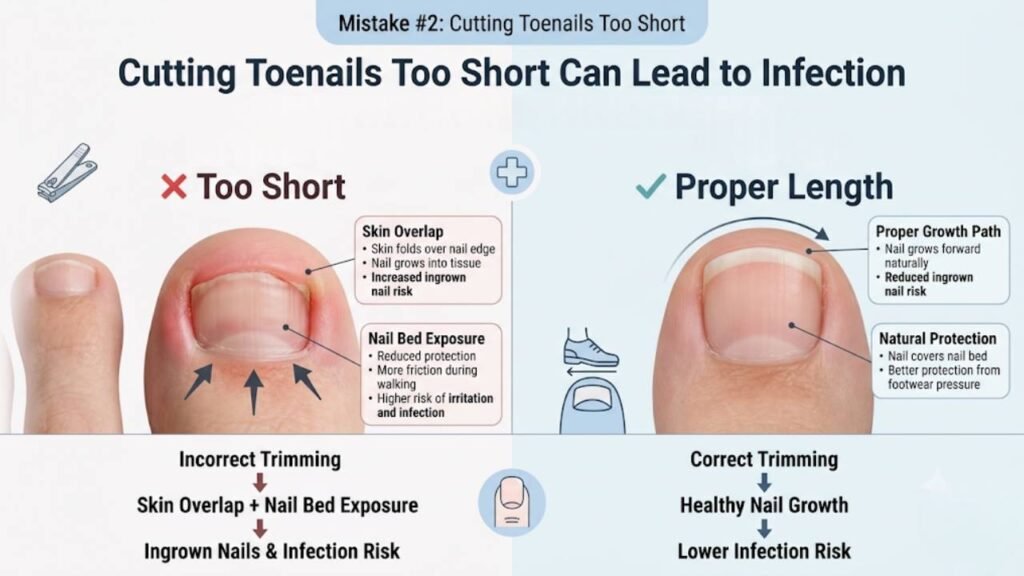
Cutting toenails too short is one of the toenail care mistakes that lead to infection through two related mechanisms.
Mechanism 1 — skin overlap:
When the nail is trimmed so short that the free edge is at or below the level of the surrounding skin, the soft tissue on either side of the nail tip begins to fold over the nail edge. As the nail grows forward, it grows beneath this overhanging tissue — creating an ingrown nail from the nail’s inability to grow forward freely.
Mechanism 2 — nail bed exposure:
The nail plate protects the sensitive nail bed (the skin directly beneath the nail) from direct mechanical pressure during walking. When the nail is trimmed extremely short, this protective function is lost. The nail bed is then exposed to direct pressure from footwear, making it vulnerable to micro-injury and the bacterial contamination that follows.
The correction: Leave a thin white rim of nail extending just beyond the surrounding skin after trimming. When you look at the trimmed nail from the side, the nail tip should extend slightly beyond the toe — not be flush with the skin or below it.
Mistake 3: Wearing the Same Shoes Every Day Without Rotation
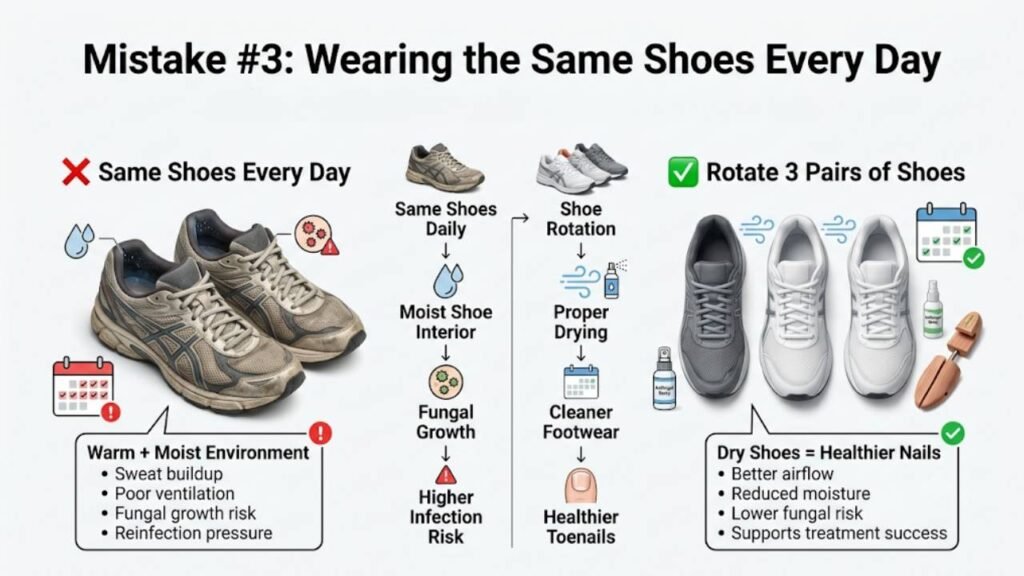
This toenail care mistake that leads to infection operates through the fungal biology of the shoe interior.
What happens inside daily-worn shoes:
A shoe worn every day never fully dries between wears. Foot sweat accumulates in the foam insole and fabric lining, creating a warm, moist, poorly ventilated environment — exactly what dermatophyte fungi need to remain viable and multiply. Fungal spores deposited from any source (environmental exposure, athlete’s foot on the skin, previous nail infection) find continuous hospitable conditions when shoes are worn daily without drying intervals.
For patients actively treating nail fungal infection, this is a particularly important toenail care mistake that leads to infection — the treated nails are reintroduced to a heavily contaminated shoe interior with every wearing, creating continuous reinfection pressure that defeats even the most carefully taken oral antifungal.
The correction: Rotate between a minimum of three pairs of shoes, with each pair getting at least 24 to 48 hours of air drying between wears. Insert cedar shoe trees or newspaper to absorb moisture during the drying interval. Apply antifungal spray to shoe interiors weekly, particularly during treatment for any nail or skin fungal infection.
Mistake 4: Using Dull Nail Clippers
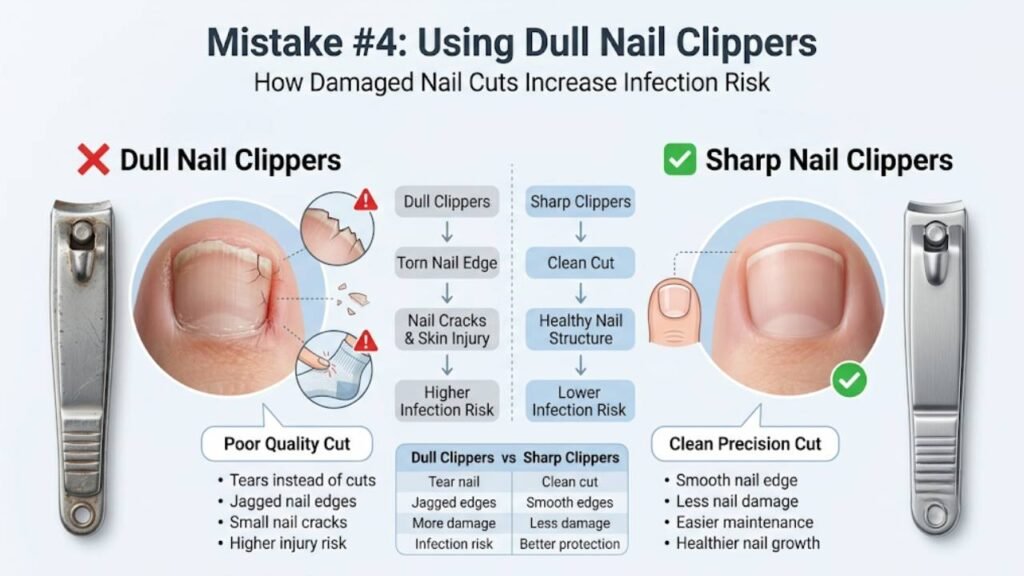
Dull nail clippers are one of the toenail care mistakes that lead to infection through the quality of the cut they produce.
What dull clippers do: A sharp nail clipper closes cleanly through the nail, producing a smooth, flat cut surface with no jagged edges. A dull clipper cannot close cleanly — it compresses and tears the nail rather than cutting it. The resulting nail edge is irregular, jagged, and often has small cracks propagating from the cut line into the nail plate.
These jagged, irregular edges:
- Catch on socks and bedding, tearing the nail further and creating sharp nail fragments that penetrate the surrounding skin
- Create micro-fractures in the nail plate that extend over time as the nail grows and flexes
- Leave the nail edge structurally compromised, making it more susceptible to lifting and secondary fungal colonization
The correction: Use sharp, high-quality toenail clippers specifically designed for toenails (wider jaw, more leverage than fingernail clippers). Replace clippers when they begin to tear rather than cut cleanly — most consumer-grade clippers lose their optimal cutting edge after 1 to 2 years of regular use. Sterilize with isopropyl alcohol before each use.
Mistake 5: Not Drying Between the Toes After Showering
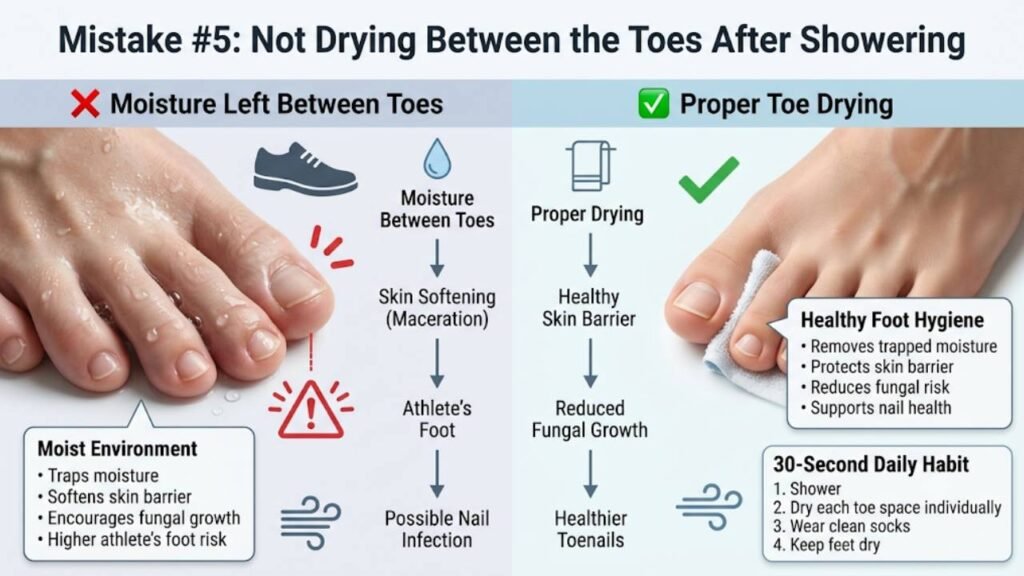
Among all the toenail care mistakes that lead to infection related to daily hygiene, inadequate post-shower drying in the interdigital spaces is the most consistently impactful.
The biology: The spaces between the toes are anatomically narrow, poorly ventilated, and designed to trap moisture. Skin surfaces face each other with minimal air circulation. When moisture is not removed after showering, these spaces remain damp — sometimes for hours — inside closed footwear. This sustained moisture:
- Provides the germination conditions for dermatophyte fungal spores
- Softens (macerates) the interdigital skin, reducing its mechanical barrier function
- Creates the ideal environment for athlete’s foot to develop, which then spreads to the nails
The correction: After every shower, use a corner of a dedicated small towel to pat between each pair of toes individually — not a single swipe of the main body towel across all the toes simultaneously. Each interdigital space needs direct contact with absorbent material. This takes approximately 30 seconds and is the highest-value 30 seconds in foot hygiene.
For people particularly prone to interdigital moisture or athlete’s foot, directing cool air from a hair dryer briefly to the interdigital spaces after towel drying is an effective additional step.
Mistake 6: Ignoring Early Nail Changes
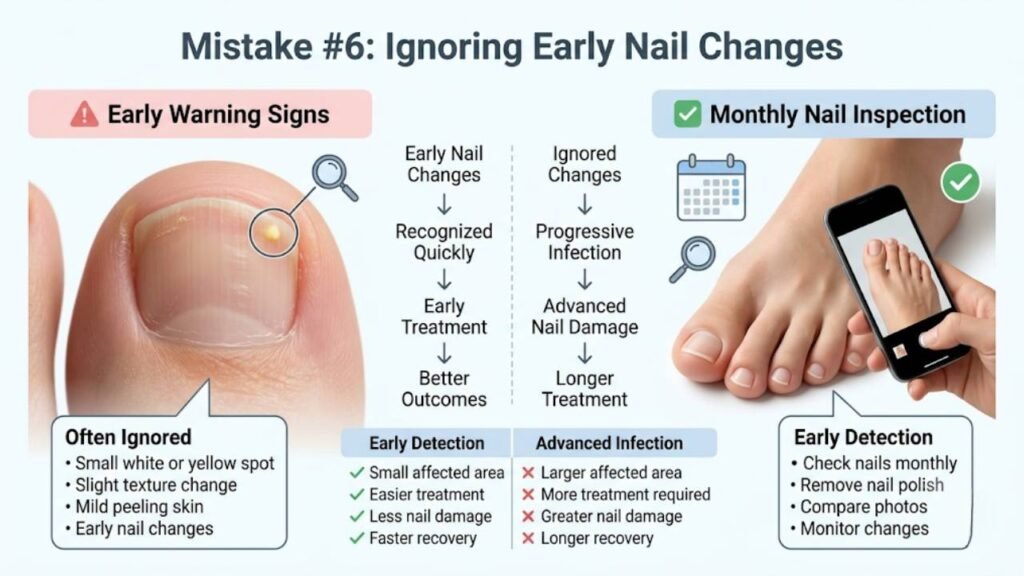
Of all the toenail care mistakes that lead to infection progressing to advanced disease, delayed recognition of early changes is the most consequential.
What early nail changes look like:
- A faint white or yellow spot at the nail tip
- A slightly rough or dull nail surface that was previously smooth
- A nail edge that feels just slightly different in texture when trimmed
- Mild interdigital itching or peeling
These changes are subtle enough that most people rationalize them — attributing them to nail polish staining, minor trauma, or normal variation. In the majority of cases where nail fungal infection is diagnosed at moderate or advanced stages, patients can look back and identify early signs that were noticed but not acted on.
Why early intervention matters: Early-stage nail fungal infection limited to the nail tip, without matrix involvement, may respond to prescription topical antifungal therapy alone. Advanced infection with matrix involvement requires oral antifungal medication with liver monitoring, 12 weeks of treatment, and 12 to 18 months of nail growth-out. The difference in treatment burden between early and late intervention is substantial.
The correction: Implement monthly nail inspection as a routine. Remove all nail polish and examine each toenail in good light, comparing to the previous month. Any change that persists beyond 4 to 6 weeks without a clear and resolving traumatic explanation warrants professional evaluation — not continued monitoring.
Mistake 7: Sharing Nail Care Tools
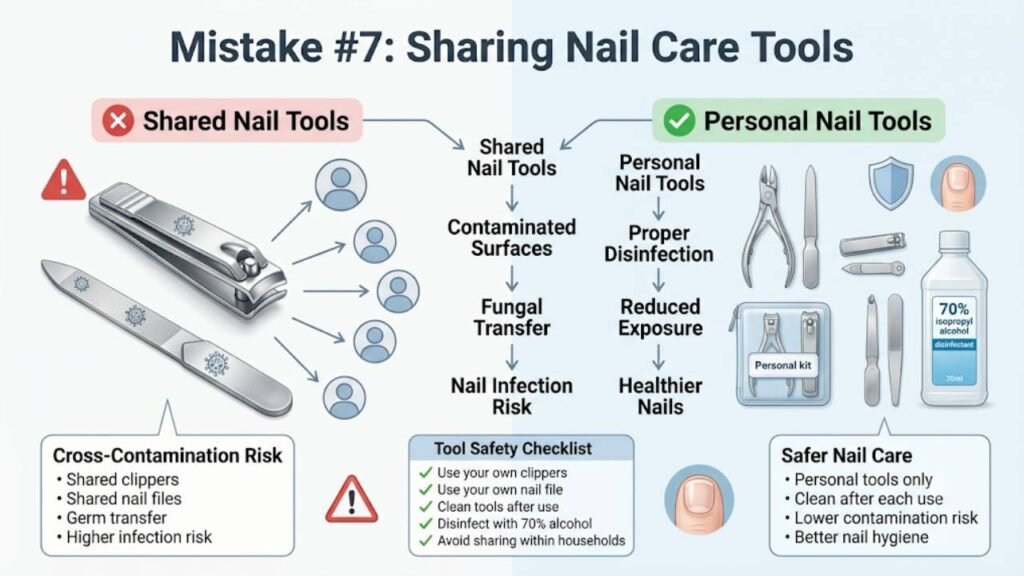
Sharing nail clippers, files, and cuticle tools is among the most direct toenail care mistakes that lead to infection through person-to-person transmission.
The transmission mechanism: Metal nail implements that contact infected nail tissue become contaminated with viable dermatophyte spores and organism fragments. Dermatophyte organisms survive on metal surfaces for weeks. A contaminated clipper used on the next person deposits these organisms directly onto or adjacent to nail tissue — bypassing the environmental transmission steps that normally require barefoot contact with contaminated surfaces.
Who this affects most: Within households, shared nail clippers are a documented route for fungal infection transmission between family members. In nail salons, inadequately sterilized professional implements create client-to-client transmission.
The correction: Personal nail care tools should not be shared between household members. Each person in a household should have their own dedicated nail clipper and file. Sterilize tools with 70 percent isopropyl alcohol after each use. At nail salons, bring your own tools or confirm that the salon uses autoclave sterilization between clients.
Mistake 8: Walking Barefoot in High-Risk Areas
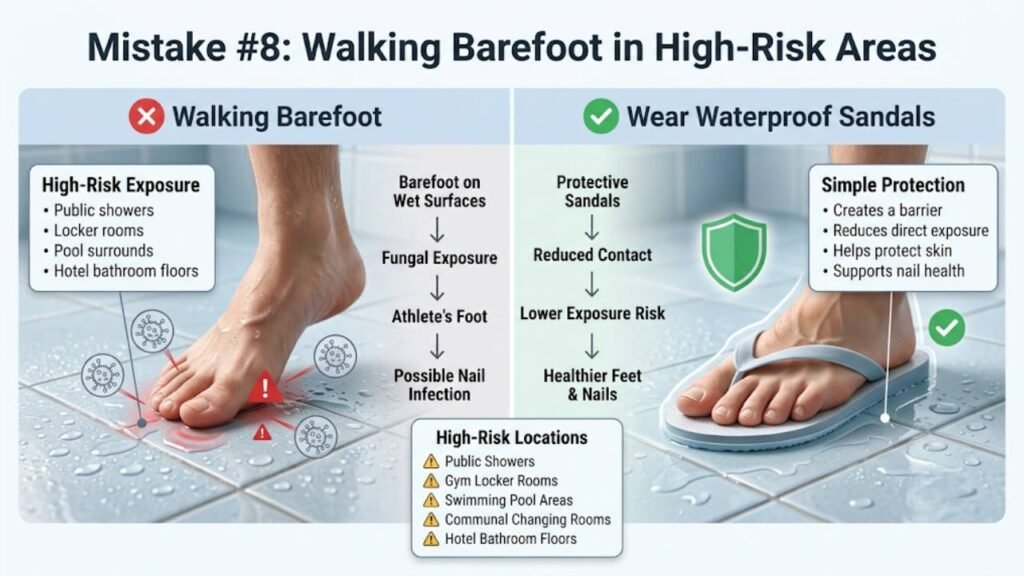
Barefoot contact with contaminated surfaces is the primary environmental mechanism by which dermatophyte spores transfer to the foot — making barefoot walking in specific environments one of the toenail care mistakes that lead to infection that is most easily prevented with a single habit.
The highest-risk environments:
- Gym and fitness center locker rooms and showers
- Public pool surrounds and changing rooms
- Hotel bathroom floors
- Communal shower facilities
These surfaces accumulate dermatophyte spores from multiple users’ feet throughout the day. The combination of high spore load, warm moisture, and the barefoot skin exposure creates ideal infection conditions.
The specific risk: Athlete’s foot acquired from these environments is often the first step toward nail fungal infection. The same fungi that colonize the interdigital skin from environmental contact then spread to the nails — typically entering through the hyponychium (the skin seal at the nail tip) or through damaged nail fold skin.
The correction: Wear waterproof sandals in all communal wet areas without exception — inside the shower, on the shower floor, on the pool surround, in the changing room floor. This is one habit that prevents more fungal infections than almost any other single change.
Mistake 9: Cutting the Cuticle
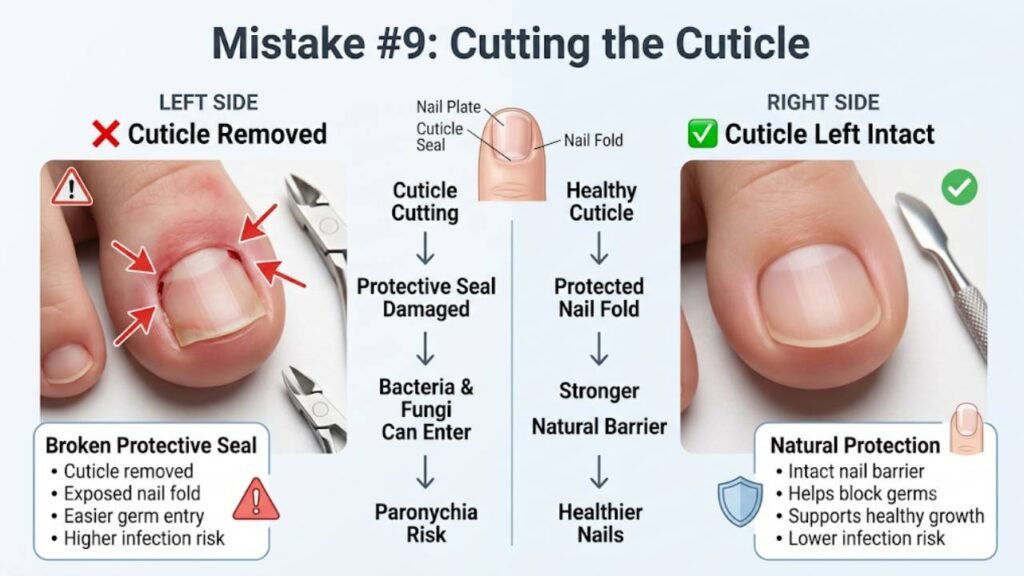
Cutting or aggressively removing the cuticle is one of the toenail care mistakes that lead to infection that many people do deliberately because they believe it improves nail appearance.
What the cuticle actually does: The cuticle is not cosmetic tissue — it is a seal that closes the gap between the nail plate and the surrounding nail fold skin. This seal prevents organisms from accessing the nail bed beneath the nail plate. An intact cuticle is part of the nail unit’s infection defense system.
What cuticle cutting does: Removing the cuticle breaches this seal, creating an open wound at the nail fold. In the period following cuticle removal, the nail fold is directly accessible to any organisms present on the skin surface or in the environment. This is why nail fold bacterial infections (paronychia) so commonly follow manicures and pedicures that include cuticle cutting.
The correction: Do not cut the cuticle. The cuticle can be gently pushed back with a soft implement after soaking — this minimizes its appearance without removing it. Instruct any nail technician performing professional pedicures that you do not want the cuticle cut.
Mistake 10: Treating Nail Changes With Cosmetics Rather Than Medicine
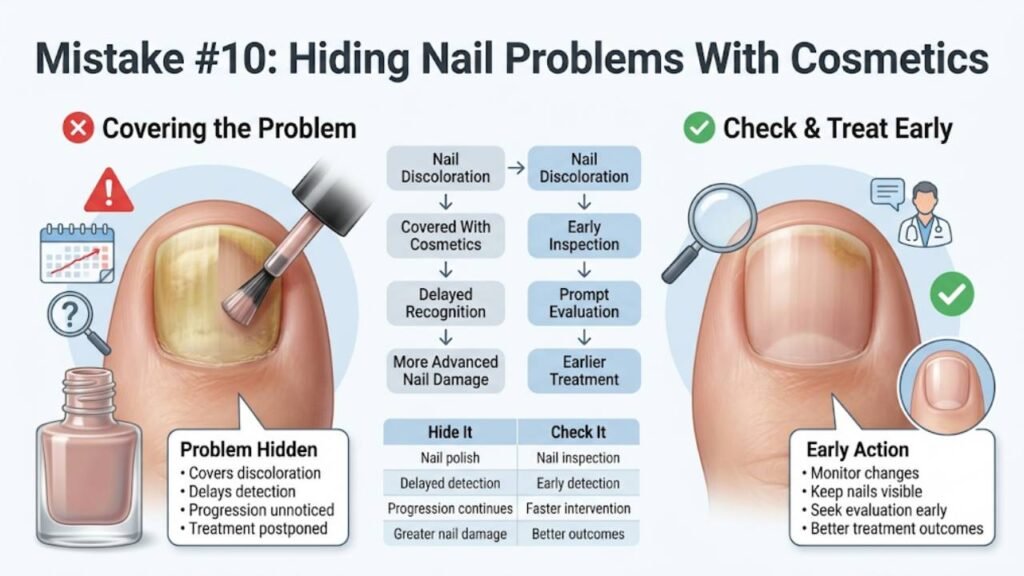
Applying nail polish over nail discoloration, using nail hardeners on infected nails, or trying home remedies in place of professional evaluation when nail changes appear — these are toenail care mistakes that lead to infection becoming significantly advanced before treatment begins.
What happens when nail changes are hidden:
- Nail polish applied over early fungal discoloration prevents visual monitoring of progression
- Each subsequent pedicure that applies fresh polish over growing fungal infection deepens the infection before it is recognized
- Patients who have been covering discolored nails for months often present with moderate to advanced onychomycosis that would have been caught at an earlier, more easily treatable stage if the nail had been left visible
The correction: If you notice nail discoloration, remove nail polish and do not reapply it until the cause of the discoloration has been evaluated and addressed. A nail that is discolored from fungal infection needs antifungal treatment — not concealment.
Frequently Asked Questions
What is the most common toenail care mistake that leads to infection?
Rounding the nail corners when trimming and wearing the same shoes daily without rotation are the two most consistently prevalent toenail care mistakes that lead to infection in otherwise healthy adults. Rounding corners directly causes ingrown nails and bacterial nail fold infections. Daily shoe wearing maintains the moist environment that supports fungal infection.
Can nail care tools spread fungal infection?
Yes — sharing unsterilized nail clippers and files is a direct transmission route for dermatophyte organisms between household members and between salon clients. Sterilize personal tools with isopropyl alcohol after each use and never share them.
Why do my nails keep getting infected even though I treat them?
Recurring or persistent nail infection despite treatment is often linked to ongoing toenail care mistakes that lead to infection — particularly contaminated shoes that reinfect treated nails and failure to treat concurrent athlete’s foot on the surrounding skin. Addressing these perpetuating factors alongside the nail infection itself is essential for durable clearance.
How early should I act on nail changes?
Any nail change that persists beyond 4 to 6 weeks without a clear resolving traumatic cause warrants professional evaluation. Early intervention produces better outcomes with less intensive treatment than catching infection after it has progressed to involve the nail matrix.
Summary
Toenail care mistakes that lead to infection are consistent, predictable, and correctable. The 10 mistakes covered in this guide — rounding nail corners, cutting too short, daily shoe wearing, dull clippers, inadequate interdigital drying, ignoring early changes, sharing tools, barefoot exposure in high-risk areas, cutting the cuticle, and concealing nail changes cosmetically — account for the vast majority of preventable nail infections and nail damage seen in clinical practice.
Most of these toenail care mistakes that lead to infection require only a single behavioral change to correct. The cumulative impact of correcting several of them simultaneously is meaningful protection against the nail problems that many people experience repeatedly throughout their lives.
Struggling to get an appointment?
We help patients in your area bypass clinic waitlists by instantly finding verified podiatry doctors who accept their insurance.