Shoe Rotation Strategy to Prevent Fungus
Find a Podiatrist Near You
Get same-day appointments with verified podiatrists. Insurance accepted.
A shoe rotation strategy to prevent fungus is one of the most consistently recommended and most consistently ignored pieces of foot care advice in podiatry. Patients who have completed antifungal treatment and want to protect their results are told to rotate their shoes. Patients who have never had nail fungus and want to keep it that way should be told the same thing. Yet most people wear the same pair of shoes every day, or alternate between two pairs without much thought about drying time.
This matters because the interior of a shoe that is worn daily without adequate drying time is, from a fungal organism’s perspective, a nearly ideal habitat: warm, dark, moist, and with a continuous supply of keratin-containing debris (skin cells) as a food source. Understanding the shoe rotation strategy to prevent fungus requires understanding what fungi need to survive in footwear — and what removes that ability.
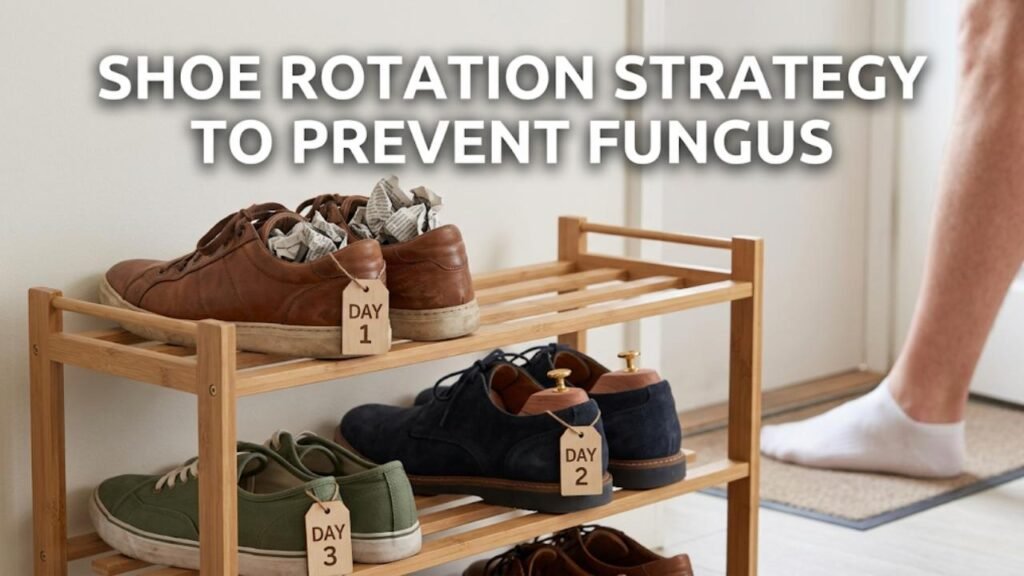
The Biological Reason Shoe Rotation Works
Dermatophyte fungi — the organisms responsible for both athlete’s foot (tinea pedis) and nail fungal infection (onychomycosis) — have specific environmental requirements for survival and reproduction.
What dermatophytes need inside a shoe:
- Moisture: Water is essential for fungal spore germination and hyphal growth. Without sufficient moisture, dermatophyte organisms cannot actively reproduce. They can persist as dormant spores, but active infection requires adequate water activity.
- Warmth: Dermatophytes grow optimally at temperatures between approximately 25 and 37°C — precisely the range of temperatures inside a closed shoe on a human foot.
- Keratin substrate: The protein in skin cells and nail debris provides nutrition for dermatophyte metabolism.
Inside a shoe worn daily without rotation, all three conditions are continuously maintained. Fresh moisture from sweat is delivered every day before the previous day’s moisture has dried. Temperature never drops below ambient room temperature. Keratin debris accumulates continuously.
What a shoe rotation strategy to prevent fungus actually does:
By allowing 24 to 48 hours of drying time between wears, the rotation breaks the moisture continuity. Dermatophyte spores present in the shoe environment cannot germinate without adequate moisture. Extended drying time reduces the water activity inside the shoe to levels below the threshold for active fungal growth. The shoe becomes less hospitable rather than a continuously supportive fungal environment.
The shoe rotation strategy to prevent fungus does not kill all fungal spores in the shoe — dormant spores can persist for extended periods. But it prevents those spores from germinating and colonizing the foot with each wear, which is the actual infection risk.
How Much Drying Time Is Actually Needed?
The most common question patients ask about a shoe rotation strategy to prevent fungus is: how long does a shoe need to dry?
The answer depends on several factors:
The shoe material: Leather and natural materials are more breathable and allow moisture to evaporate more readily. Dense foam insoles and synthetic linings trap moisture more effectively and require longer drying times.
The activity level during wear: A shoe worn for an office workday absorbs significantly less sweat than a running shoe after a 10-kilometer run. The heavier the sweat load, the longer the drying requirement.
The ambient environment: A dry climate at room temperature with good air circulation allows faster drying than a humid climate, a warm humid climate, or a shoe stored in a closed wardrobe immediately after removal.
As a practical guideline:
- Casual shoes in a dry environment: minimum 24 hours
- Dress shoes or moderate activity shoes: 24 to 36 hours
- Athletic shoes after significant exercise: 48 hours minimum
- Boots or heavily insulated footwear: 48 to 72 hours
The shoe rotation strategy to prevent fungus must account for actual drying time — not assumed drying time. A shoe that feels dry on the outside may still have significant moisture retained in the foam insole, heel counter, and lining.
How Many Pairs Do You Need for an Effective Rotation?
The minimum number of pairs required for a shoe rotation strategy to prevent fungus depends on how frequently you wear each type of footwear.
For everyday casual or work shoes: Three pairs provides the most practical and effective rotation. With three pairs:
- Day 1: Pair A worn
- Day 2: Pair B worn (Pair A drying — first 24 hours)
- Day 3: Pair C worn (Pair A still drying — second 24 hours if needed)
- Day 4: Pair A worn again (fully dried)
This three-pair rotation ensures at least 48 hours of drying time for each pair before it is worn again — adequate for most shoe types and moderate activity levels.
For athletes or regular exercisers: A dedicated rotation of three athletic shoes is the minimum — ideally more. Athletic shoes after significant exercise need a minimum of 48 hours to dry adequately. A runner who trains daily needs at minimum three pairs of running shoes to allow each pair sufficient recovery time. Many experienced athletes rotate four or five pairs.
Two-pair rotation: Two pairs rotated every other day provides approximately 24 hours between wears — adequate for low-sweat casual wear in a dry environment, but insufficient for athletic footwear or humid climates. A shoe rotation strategy to prevent fungus is meaningfully more effective with three or more pairs.
Which Shoes Benefit Most From Rotation?
While all shoes benefit from a shoe rotation strategy to prevent fungus, certain types create higher fungal risk from limited drying time:
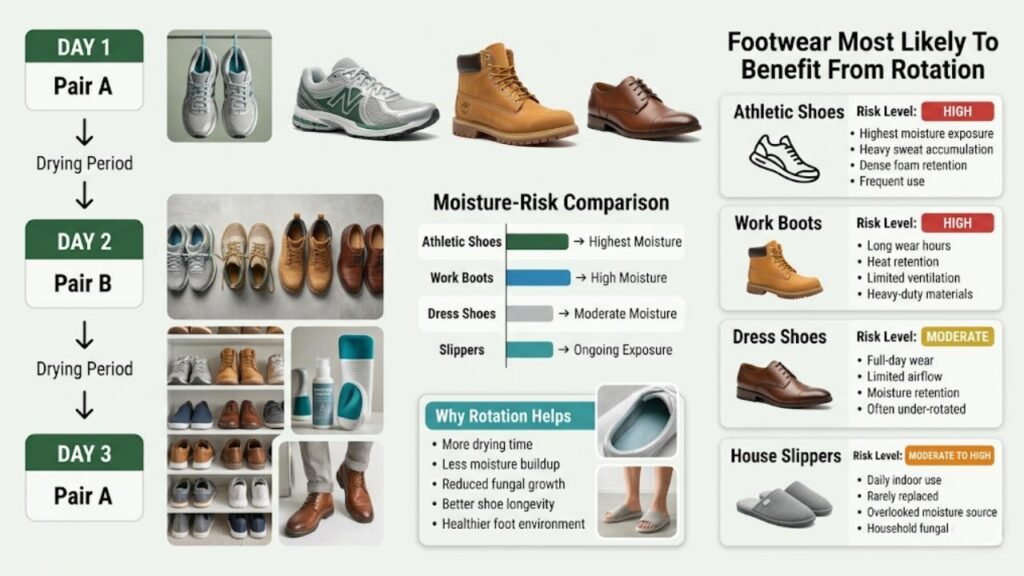
Athletic shoes: The highest-risk category. Running shoes, court shoes, cross-trainers, and cycling shoes absorb the most sweat during use and have dense foam materials that retain moisture the longest. Athletes who wear the same shoes for every training session are continuously introducing their feet to a progressively more contaminated shoe environment.
Closed work boots: Construction boots, safety boots, and similar occupational footwear trap heat and sweat throughout long working days and have limited ventilation from thick leather or rubber materials. The longer wearing hours combined with restricted air circulation make these high-priority for a shoe rotation strategy to prevent fungus.
Dress shoes: Leather dress shoes often lack ventilation features and are worn for full working days. The interior linings of dress shoes — particularly cheaper synthetic linings — can absorb and retain moisture effectively. Many people own fewer pairs of dress shoes and therefore rotate them less.
Slippers and casual house footwear: Often overlooked in a shoe rotation strategy to prevent fungus, house slippers are worn for many hours daily, rarely fully dried, and rarely replaced. They represent a persistent household fungal reservoir that barefoot walking in the home then contacts.
Practical Shoe Rotation Schedules
A simple, labeled rotation schedule makes the shoe rotation strategy to prevent fungus easy to maintain:
Three-Pair Daily Rotation (Standard)
| Day | Pair Worn | Pair A Status | Pair B Status | Pair C Status |
|---|---|---|---|---|
| Monday | A | Worn today | Resting (48h remaining) | Resting (24h remaining) |
| Tuesday | B | Resting (24h remaining) | Worn today | Resting (48h remaining) |
| Wednesday | C | Resting (48h remaining) | Resting (24h remaining) | Worn today |
| Thursday | A | Worn today | Resting (48h remaining) | Resting (24h remaining) |
This schedule gives each pair approximately 48 hours between wears.
Athletic Training Rotation (Four-Pair)
For athletes training 5 to 6 days per week, a four-pair rotation allows each pair approximately 72 hours between uses — particularly important if training sessions involve significant sweating:
Pair A: Monday training
Pair B: Tuesday training
Pair C: Wednesday training
Pair D: Thursday training
Pair A: Friday training (72 hours since Monday)
Accelerating Drying: What Actually Works
A shoe rotation strategy to prevent fungus is most effective when paired with practices that actively accelerate drying during the rotation interval:
Cedar Shoe Trees
Cedar shoe trees — wooden inserts shaped to the shoe interior — serve two functions relevant to the shoe rotation strategy to prevent fungus:
- Moisture absorption: Cedar naturally absorbs moisture from shoe interiors. Inserting cedar shoe trees immediately after removing shoes begins the drying process from the inside of the shoe rather than relying entirely on surface evaporation.
- Maintaining shape: Cedar trees maintain the shoe’s structure during the drying period, which incidentally keeps the shoe interior open to air circulation.
The combination of cedar shoe trees and adequate rotation time is more effective than rotation alone.
Newspaper Stuffing (Budget Alternative)
Crumpled newspaper balls inserted into shoes absorb moisture from the interior. Change the newspaper after several hours if the shoe was particularly wet. This provides significant moisture absorption at minimal cost — a practical alternative to cedar shoe trees for athletic shoes specifically.
Boot Dryers or Fan Drying
Electric boot dryers — fan-based devices that direct warm (not hot) air into the shoe interior — can reduce athletic shoe drying time from 48 hours to 8 to 12 hours. This is particularly useful for athletes who train daily and would otherwise need very large shoe rotations.
Important: The temperature should be warm rather than hot. Excessive heat from hair dryers or direct heat sources can delaminate shoe glue, shrink materials, and damage shoe structure.
Proper Air Storage During Rotation
Shoes not being worn should be stored where air can circulate around them — not stacked in a pile, not stored in plastic bags, not placed in a sealed box immediately after removal while still wet.
An open shoe rack provides the most effective air circulation during the rotation interval. The shoe rotation strategy to prevent fungus is compromised if shoes are immediately stored in sealed environments during their drying period.
Antifungal Shoe Treatments: What They Add to Rotation
Antifungal sprays and powders applied to the shoe interior during the rotation interval add chemical antifungal activity to the physical drying benefit. These products are most relevant in two situations:
During active nail fungal infection treatment: Shoes worn during an active infection have accumulated significant fungal contamination. Antifungal spray applied to shoe interiors during the rotation interval reduces viable fungal spore load — reducing recontamination of treated nails with each subsequent wearing.
Post-treatment prevention: For patients who have completed antifungal treatment and want to prevent recurrence from footwear, antifungal shoe spray applied once or twice per week during the rotation interval is an appropriate additional measure.
Antifungal shoe treatments do not substitute for rotation — the drying interval is still necessary. They are an adjunct that reduces the fungal load during the drying period.
Replacing Shoes That Cannot Be Adequately Decontaminated
One of the most important and most often resisted recommendations in the shoe rotation strategy to prevent fungus context is replacing heavily contaminated shoes.
Shoes worn throughout an extended period of active nail or skin fungal infection accumulate fungal spores in the foam insole, the lining fabric, and the shoe structure. These reservoirs cannot be adequately decontaminated by surface sprays or drying alone — the spores are embedded in porous materials.
For patients completing fungal nail treatment, the scenario is:
- Antifungal treatment successfully clears the nail
- Patient resumes wearing the same shoes worn throughout the infection
- Those shoes continuously reintroduce viable fungal spores to the cleared nail with each wearing
- The nail infection appears to “come back” — but is actually a continuous reinfection from the footwear reservoir
Replacing heavily contaminated shoes after completing treatment removes this ongoing reinfection source. This applies particularly to athletic shoes that have been used through multiple months of active infection.
The recommendation to replace shoes after treatment is part of a comprehensive shoe rotation strategy to prevent fungus — the new shoes begin the rotation with no accumulated contamination.
Socks: The Interface Between Foot and Shoe
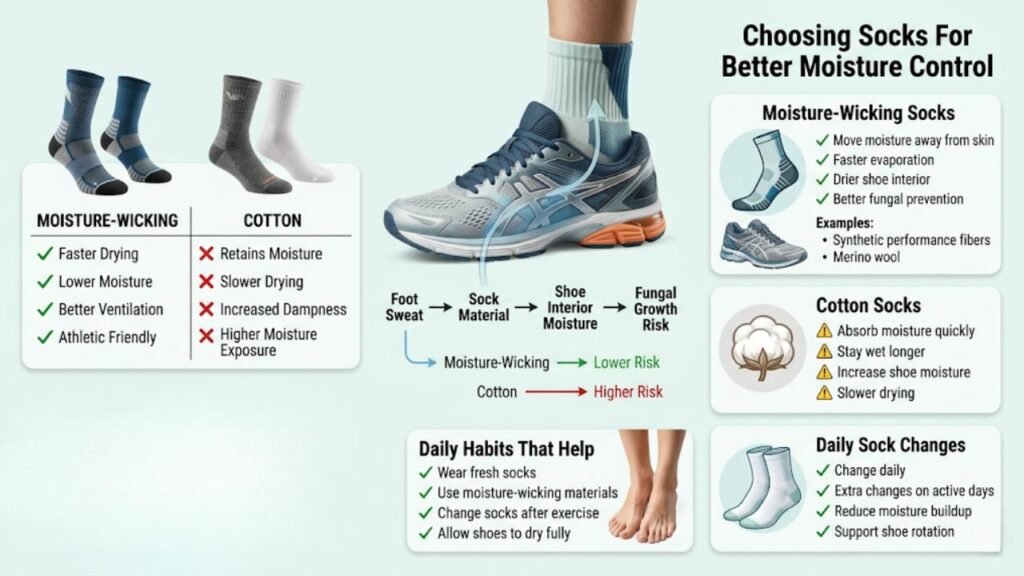
The sock worn inside the shoe significantly influences how much moisture accumulates in the shoe during wear and how effectively the shoe rotation strategy to prevent fungus works.
Moisture-wicking socks: Performance socks made from synthetic moisture-wicking fibers or merino wool actively move moisture away from the skin surface and to the outer sock layer where it can evaporate more readily. Wearing moisture-wicking socks reduces the total moisture deposited into the shoe interior per wearing session — meaning the shoe rotation strategy to prevent fungus requires less drying time to be effective.
Cotton socks: Cotton absorbs moisture readily but releases it slowly — cotton socks worn during exercise accumulate sweat and remain wet against both the skin and the shoe interior for extended periods. The shoe rotation strategy to prevent fungus is less effective when cotton socks contribute prolonged moisture saturation.
Daily sock changes: Wearing fresh socks every day is the minimum baseline. Changing socks midday during particularly active or sweating days further reduces moisture accumulation in the shoe.
Frequently Asked Questions
How many pairs of shoes do I need for an effective shoe rotation to prevent fungus?
A minimum of three pairs for everyday footwear is the standard recommendation. Three pairs allows approximately 48 hours of drying time between wears, which is adequate for moderate-sweat situations in typical environments. Athletes training daily benefit from four or more pairs.
Does a shoe rotation strategy prevent fungus on its own?
Shoe rotation is one component of a comprehensive fungal prevention approach — not a standalone solution. Treating concurrent athlete’s foot, maintaining foot hygiene, wearing protective footwear in communal wet areas, and sterilizing nail tools are all parallel prevention measures. Shoe rotation specifically addresses the footwear environment as a fungal reservoir.
Should I throw away my shoes after nail fungus treatment?
If shoes were worn throughout an extended period of active nail fungal infection, replacing them after treatment significantly reduces reinfection risk. This is particularly true for athletic shoes with porous foam insoles and lining fabric that cannot be adequately decontaminated by surface treatments. Budget permitting, new shoes begin the post-treatment period without accumulated fungal contamination.
Do antifungal shoe sprays work instead of rotation?
Antifungal sprays reduce viable fungal spore counts in the shoe interior and are a useful adjunct — but they do not address the moisture that supports ongoing fungal viability. The shoe rotation strategy to prevent fungus (providing adequate drying time) combined with antifungal spray is more effective than either alone.
Summary
A shoe rotation strategy to prevent fungus works by breaking the continuous moisture cycle inside frequently worn footwear — the moisture that dermatophyte fungi require to germinate and infect the foot. By allowing 24 to 48 hours of drying time between wears, using three or more pairs in rotation, actively accelerating drying with cedar shoe trees or newspaper, and combining rotation with antifungal shoe treatment during active infection management, the footwear environment becomes substantially less hospitable to fungal growth.
For patients who have completed nail fungal treatment, shoe rotation — combined with replacement of heavily contaminated shoes — removes one of the most consistent and most overlooked sources of treatment failure and recurrence. For patients without current infection, a consistent shoe rotation strategy to prevent fungus reduces the probability that the shoe interior becomes a functional fungal reservoir in the first place.
Struggling to get an appointment?
We help patients in your area bypass clinic waitlists by instantly finding verified podiatry doctors who accept their insurance.