Nail Care for Immunocompromised Individuals
Find a Podiatrist Near You
Get same-day appointments with verified podiatrists. Insurance accepted.
Nail care for immunocompromised individuals is a clinical priority that goes beyond ordinary foot hygiene — because the consequences of a nail infection in someone whose immune system is compromised are categorically more serious than the same infection in an otherwise healthy adult. What presents as a manageable cosmetic nuisance in a healthy person can escalate to a systemic complication in someone with significantly reduced immune function.
Immunocompromised individuals include patients on chemotherapy, those taking biologic medications for autoimmune conditions, solid organ transplant recipients on immunosuppressive regimens, people living with HIV and AIDS, patients on long-term high-dose corticosteroids, and others whose immune function is measurably reduced. Each of these populations faces elevated susceptibility to nail fungal infection, secondary bacterial nail infections, and the complications that follow.
This guide provides specific, actionable guidance on nail care for immunocompromised individuals — covering daily practices, professional care requirements, infection recognition, and when to seek urgent evaluation.

Why Nail Care for Immunocompromised Individuals Is Different
The difference between nail care for immunocompromised individuals and standard nail hygiene comes down to the body’s ability to contain infections before they escalate.
In an immunocompetent (healthy) adult:
A minor nail fold injury from aggressive cutting — a small break in the skin around the nail — activates an immediate local immune response. Neutrophils and other immune cells flood the area within minutes, containing any organisms that entered through the break. The area may be briefly red and tender, then heals within days without incident.
In an immunocompromised individual:
The same minor nail fold injury activates a reduced or delayed immune response. Organisms entering through the break face significantly less opposition. What would have been contained in an hour in a healthy person may begin establishing an infection over days. By the time visible signs of infection appear, the organism load may already be significant.
This difference explains why nail care for immunocompromised individuals must prevent even minor nail and nail fold injuries — because the consequences of those injuries are not self-limiting in the way they are in healthy adults.
Additionally, the organisms that opportunistically infect immunocompromised patients’ nails are sometimes different from those affecting healthy patients. Non-dermatophyte molds, Candida species, and unusual fungal organisms that healthy immune systems would clear before establishing infection can cause serious nail disease in immunocompromised individuals.
Who Needs Modified Nail Care for Immunocompromised Individuals
Chemotherapy patients:
Cytotoxic chemotherapy suppresses bone marrow production of all blood cells including neutrophils — the primary first responders to infection. During and after chemotherapy cycles, neutropenia (low neutrophil count) makes even minor infections potentially life-threatening. Chemotherapy drugs also cause direct nail changes — onycholysis (nail lifting), nail banding, nail color changes, and nail fragility — that create additional entry points for infection.
Biologic medication users:
TNF-alpha inhibitors (adalimumab, etanercept, infliximab), IL-17 inhibitors (secukinumab, ixekizumab), IL-6 inhibitors, and other biologic agents used for autoimmune conditions suppress specific immune pathways. While these drugs are designed to reduce damaging inflammation, they simultaneously reduce the immune surveillance that contains infections. Patients on biologics have documented elevated rates of opportunistic infections including fungal nail infections.
Organ transplant recipients:
To prevent organ rejection, transplant patients take immunosuppressive medications (tacrolimus, mycophenolate, cyclosporine, corticosteroids) indefinitely. These medications broadly suppress immune function. Fungal infections — including nail and skin infections — are among the most common infectious complications of solid organ transplantation, occurring in 5 to 30 percent of recipients depending on the transplant type and immunosuppressive regimen.
HIV/AIDS patients:
HIV specifically depletes CD4+ T helper cells, which coordinate the adaptive immune response against fungal organisms. Nail fungal infections are one of the most visible early markers of immune function decline in HIV-positive patients, and their prevalence and severity correlates with CD4 count. Nail care for immunocompromised individuals in this population requires attention to both prevention and early recognition.
Long-term corticosteroid users:
Systemic corticosteroids (prednisone, prednisolone, methylprednisolone) at doses used for chronic inflammatory conditions suppress multiple components of immune function including neutrophil activity and T-cell function. Patients who have taken corticosteroids at meaningful doses for months or years have clinically relevant immune compromise affecting their nail infection susceptibility.
Daily Nail Care for Immunocompromised Individuals: The Foundation
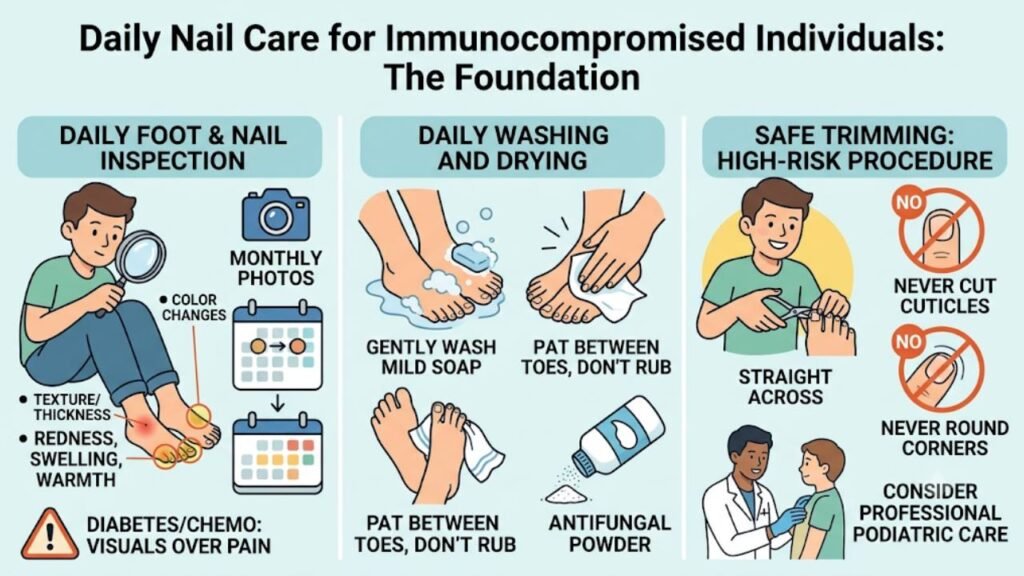
Daily Foot and Nail Inspection
The most important daily practice in nail care for immunocompromised individuals is systematic visual inspection of all toenails and surrounding skin. This should occur every day — not weekly or when something becomes symptomatic — because reduced immune function means symptoms may be delayed or absent even when infection is progressing.
What to inspect:
- All toenails: any new color change (white, yellow, brown, or dark discoloration), any change in nail texture or thickness, any nail lifting from the nail bed
- Nail folds (the skin immediately surrounding each nail): redness, swelling, warmth, tenderness
- Interdigital spaces (between the toes): scaling, peeling, whitened macerated skin, redness
- Any skin break near the nail: however minor, a break in the skin surrounding the nail represents a potential infection entry point that warrants attention
For patients with peripheral neuropathy (common in diabetics and some chemotherapy patients), reduced sensation means pain may not reliably signal a problem. Visual inspection compensates for this by not relying on pain as a warning.
Documentation: Monthly photographs of the nails provide a visual baseline for comparison. Progressive changes that are too gradual to notice day-to-day often become apparent when comparing photos across months.
Daily Foot Washing and Drying
Daily washing of the feet with mild soap, followed by thorough drying — particularly in the interdigital spaces — is foundational to nail care for immunocompromised individuals.
The drying step is not optional:
The interdigital spaces retain moisture that cannot evaporate inside closed footwear. In immunocompromised patients, sustained moisture against the skin in these spaces provides the germination conditions for any fungal spores present — conditions that a healthy immune system would contain but that a compromised one cannot.
Technique: After washing, use a dedicated small towel or washcloth to pat each interdigital space individually — inserting cloth between each toe pair. Pat, do not rub aggressively (aggressive rubbing can create micro-breaks in macerated interdigital skin).
Antifungal powder after drying: For immunocompromised patients — particularly those on chemotherapy or at highest-risk periods — applying antifungal powder (miconazole or tolnaftate) to the interdigital spaces after drying provides ongoing antifungal chemical protection. This is appropriate as a daily routine rather than only when infection is suspected.
Nail Trimming: The High-Risk Procedure
Of all regular nail care for immunocompromised individuals activities, nail trimming carries the highest risk of creating injury — and therefore requires the most careful modification.
Why trimming is high-risk:
A minor cut to the nail fold during trimming — the kind that would be briefly uncomfortable and then forgotten in a healthy person — creates a wound that, in an immunocompromised patient, may not close effectively, may not activate a prompt local immune response, and may allow organisms to establish before containment occurs.
Safe trimming modifications:
Soften nails before trimming: Always trim immediately after bathing or soaking the feet in warm water for 5 to 10 minutes. Soft nails require less cutting force and produce cleaner cuts with less risk of the nail cracking in unpredictable directions.
Use sharp, sterilized instruments: Sharp nail clippers produce clean cuts. Dull clippers require more force, increase the risk of the nail shattering or tearing rather than cutting cleanly, and create ragged edges that catch and tear further. Sterilize clippers with 70 percent isopropyl alcohol before each use.
Cut straight across: Never round the corners in immunocompromised patients — the ingrown nail risk and associated nail fold skin break is particularly dangerous in this population.
Never cut the cuticle: The cuticle is the seal between the nail plate and the surrounding skin. In immunocompromised patients, removing this seal creates an entry point that the immune system cannot adequately defend. Push back gently if needed — never cut.
Consider not self-trimming: For many immunocompromised patients — particularly those with neutropenia from chemotherapy, reduced dexterity, poor vision, or significant peripheral neuropathy — professional podiatric nail trimming is safer than self-trimming. A podiatrist performing nail care for immunocompromised individuals uses appropriate instruments, appropriate technique, and can assess the surrounding tissue at each visit.
Professional Nail Care for Immunocompromised Individuals
Professional podiatric nail care is often the appropriate standard rather than the exception for immunocompromised individuals — not only during acute periods of most intense immunosuppression, but as ongoing maintenance.
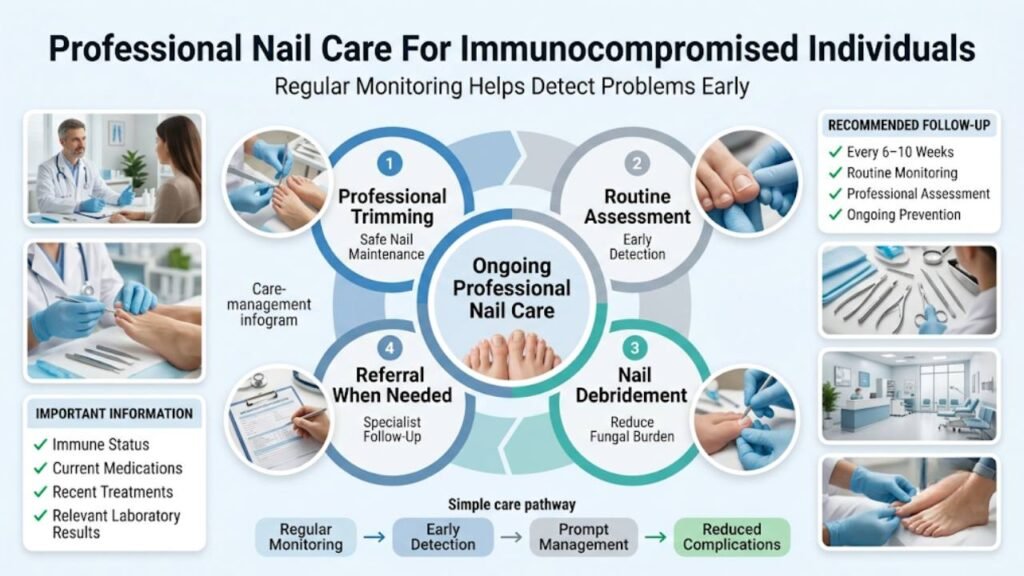
What professional podiatric nail care provides:
- Safe, clinical-grade nail trimming and thinning using appropriate instruments
- Assessment of the nails and surrounding tissue at each visit — catching early changes that home monitoring might miss
- Professional nail debridement to reduce nail fungal burden when infection is present
- Appropriate documentation and referral if concerning changes are identified
Frequency: Most immunocompromised patients benefit from professional nail care every 6 to 10 weeks. During periods of most intense immunosuppression (actively undergoing chemotherapy, immediately post-transplant), more frequent visits may be appropriate.
Communicating immune status to the podiatrist: Before any professional nail care, inform the podiatrist of your immune status, current medications, and any relevant recent laboratory values (neutrophil count if known). This information affects what interventions are appropriate and how carefully the surrounding tissue needs to be examined.
Footwear and Environmental Protection
Nail care for immunocompromised individuals extends to the footwear environment — reducing the external fungal spore exposure that the immune system is less able to contain.
Closed-toe protective footwear:
Immunocompromised patients should wear properly fitting closed-toe shoes in any environment where there is trauma risk to the toes. Even minor impacts to the toenails that would be inconsequential in a healthy person create nail damage entry points in patients who cannot mount an adequate immune response to contain organisms that enter.
Waterproof sandals in communal wet areas — without exception:
Gym locker rooms, pool areas, hotel showers, spa facilities — any communal wet area where barefoot contact creates fungal spore exposure must be approached with waterproof sandals. For immunocompromised patients, this is not a recommendation — it is a clinical requirement. The same spore load that a healthy immune system would contain without establishing infection can produce rapidly progressing nail disease in an immunocompromised host.
Footwear hygiene:
Rotate footwear to allow 24 to 48 hours of drying between wears. Apply antifungal spray to shoe interiors weekly. Wear moisture-wicking socks and change them after any activity that produces significant sweating.
Recognizing Nail Problems Early: The Warning Signs
For nail care for immunocompromised individuals, the recognition threshold must be lower than for healthy individuals — because infections that would remain localized and self-limiting in healthy patients may progress significantly before becoming symptomatic in immunocompromised ones.
Seek professional evaluation promptly (within 1 to 3 days) if you notice:
Any new nail discoloration: White, yellow, brown, dark green, or dark streaks appearing in previously normal nails. Do not wait for the discoloration to worsen or spread — evaluate it early.
Nail fold redness or swelling: Any redness, warmth, or swelling of the skin immediately surrounding a nail. In immunocompromised patients, even early paronychia (nail fold infection) requires prompt professional evaluation and likely antibiotic treatment.
Nail lifting: The nail plate separating from the nail bed creates a space where organisms can accumulate without the normal immune surveillance of intact nail-bed attachment.
Any skin break near the nail: A cut, tear, or skin break around the nail — however minor — should be cleaned with antiseptic, covered with a bandage, and monitored closely. If it does not begin healing within 24 hours, professional evaluation is appropriate.
Seek emergency evaluation if:
- Redness spreads beyond the immediate nail fold area
- Red streaks develop tracking away from the nail area
- Fever develops alongside nail area redness or swelling
- Increasing pain, significant swelling, or discharge develops
These signs may indicate spreading bacterial infection that requires urgent medical attention — not simply podiatric nail care.
Antifungal Prophylaxis: The Medical Conversation
For patients at highest immune compromise risk — particularly those with anticipated or ongoing neutropenia from chemotherapy, or recipients of stem cell transplantation — prophylactic antifungal medications may be prescribed by the managing specialist to prevent fungal infections systemically, not just at the nail level.
This is a medical decision made by the physician managing the underlying immunosuppressive treatment. For nail care for immunocompromised individuals, the relevant point is:
- If you are prescribed antifungal prophylaxis by your oncologist, transplant specialist, or infectious disease physician, comply with it consistently
- Prophylactic antifungals are not the same as treating an established nail infection — if you develop nail changes during prophylactic therapy, report them to your specialist
- Do not start or stop antifungal medications based on nail appearance without consulting the prescribing physician
Frequently Asked Questions About Nail Care for Immunocompromised Individuals
Can immunocompromised patients get regular pedicures?
Professional pedicures at commercial nail salons carry significant infection risk for immunocompromised individuals due to shared equipment and basins. Podiatric nail care at a medical foot care clinic provides the same functional benefits with appropriate infection control. If commercial pedicures are desired, bringing personal sterilized tools, requesting pipeless basins with verified disinfection, and ensuring no cuticle cutting are minimum requirements — and the decision should be discussed with the managing specialist.
How quickly can nail infections progress in immunocompromised patients?
Significantly faster than in healthy individuals. A nail fold infection (paronychia) that might take a week to become noticeably problematic in a healthy person may progress to a more serious cellulitis within 24 to 48 hours in a severely neutropenic patient. This is why nail care for immunocompromised individuals emphasizes prompt evaluation at the earliest sign of any nail area change.
Is it safe to trim nails at home if I’m on chemotherapy?
Self-trimming is higher-risk during periods of neutropenia. If your neutrophil count is significantly reduced, professional nail care rather than home trimming is the safer option. During periods of better immune function between chemotherapy cycles, careful self-trimming with sterilized sharp clippers and straight-across cutting is generally appropriate. Discuss with your oncology team if unsure.
What should I do if I notice a nail change while my immune system is suppressed?
Contact your specialist promptly — do not wait for a routine appointment. Nail changes in immunocompromised patients may represent infections that need treatment earlier than in healthy individuals. Your oncologist, transplant specialist, or infectious disease physician should be informed of any new nail changes so they can assess whether evaluation and treatment are indicated.
Summary
Nail care for immunocompromised individuals is a clinically meaningful extension of routine foot hygiene — not an optional extra. The reduced immune function that defines immunocompromised status directly affects how the body responds to the organisms, minor injuries, and environmental exposures that ordinarily healthy feet manage without consequence.
Daily visual inspection, thorough interdigital drying, antifungal powder application, careful straight-across nail trimming with sterilized sharp instruments, consistent use of waterproof sandals in communal environments, and professional podiatric nail care every 6 to 10 weeks form the core of safe nail care for immunocompromised individuals.
Early recognition of any nail or nail fold change — and prompt professional evaluation when changes appear — prevents the escalation from minor nail problem to serious complication that the impaired immune response cannot reliably stop on its own.
Struggling to get an appointment?
We help patients in your area bypass clinic waitlists by instantly finding verified podiatry doctors who accept their insurance.