Spoon-Shaped Nails (Koilonychia) Explained
Find a Podiatrist Near You
Get same-day appointments with verified podiatrists. Insurance accepted.
Spoon-shaped nails (koilonychia) are one of the most clinically recognizable nail findings in medicine — and one of the most diagnostically meaningful. When a toenail develops the characteristic concave shape — curving upward at the edges while dipping inward at the center, forming a dish or spoon shape — it is rarely a cosmetic coincidence. This nail shape reflects a specific structural change in how the nail matrix is producing the nail plate, and that change almost always has an identifiable cause.
The name comes from Greek: koilos meaning hollow, and onyx meaning nail. The resulting shape is exactly as described — a hollowed nail that, in classic teaching, can hold a drop of water on its surface without it immediately rolling off.
Understanding spoon-shaped nails (koilonychia) means understanding not just what causes the nail to look this way, but what that shape tells you about what is happening elsewhere in the body — particularly with iron status, which remains the most common and most important cause to investigate.

What Spoon-Shaped Nails (Koilonychia) Actually Look Like
Healthy toenails have a gentle convex curve — the nail arches slightly upward from the nail bed. In spoon-shaped nails (koilonychia), this normal convexity is replaced by concavity — the nail plate becomes flat or curves inward, producing the characteristic hollow shape.
- The nail plate is thinner than normal — not thickened
- The edges of the nail turn upward (like the curved edges of a spoon)
- The center of the nail dips downward (like the bowl of the spoon)
- The nail may feel soft and pliable compared to normal nails
- The nail tip may lift slightly upward
- Severity ranges from mild flattening to obvious full concavity
How to assess at home:
Place a water droplet gently on the nail surface. In a healthy nail with normal convexity, the droplet runs off immediately. In true koilonychia with significant concavity, the droplet remains on the nail surface — the spoon-like bowl holds it.
Which nails are affected:
Spoon-shaped nails (koilonychia) most commonly involve fingernails in adults with iron deficiency — particularly the thumbs and index fingers. Toenail involvement can occur, particularly the great toenails. The pattern of involvement (fingernails vs toenails, which specific digits) provides useful diagnostic clues.
The Biology Behind Spoon-Shaped Nails (Koilonychia)
The nail plate normally maintains its convex shape through two mechanisms: the structural properties of the nail plate keratin itself, and the shape of the nail bed beneath it which the nail plate conforms to.
When iron is deficient, the keratin produced by the nail matrix has altered structural properties. Specifically, iron deficiency affects the enzyme systems involved in keratin cross-linking — the formation of the disulfide bonds between keratin proteins that give the nail plate its mechanical rigidity and shape. Without adequate cross-linking, the keratin is softer, thinner, and more pliable. The nail plate cannot maintain its normal convex shape against the mechanical forces of daily use — it deforms into concavity, producing spoon-shaped nails (koilonychia).
This mechanism explains why treating the underlying iron deficiency typically allows the nail to gradually recover its normal convex shape over the subsequent nail growth cycle.
7 Causes of Spoon-Shaped Nails (Koilonychia)
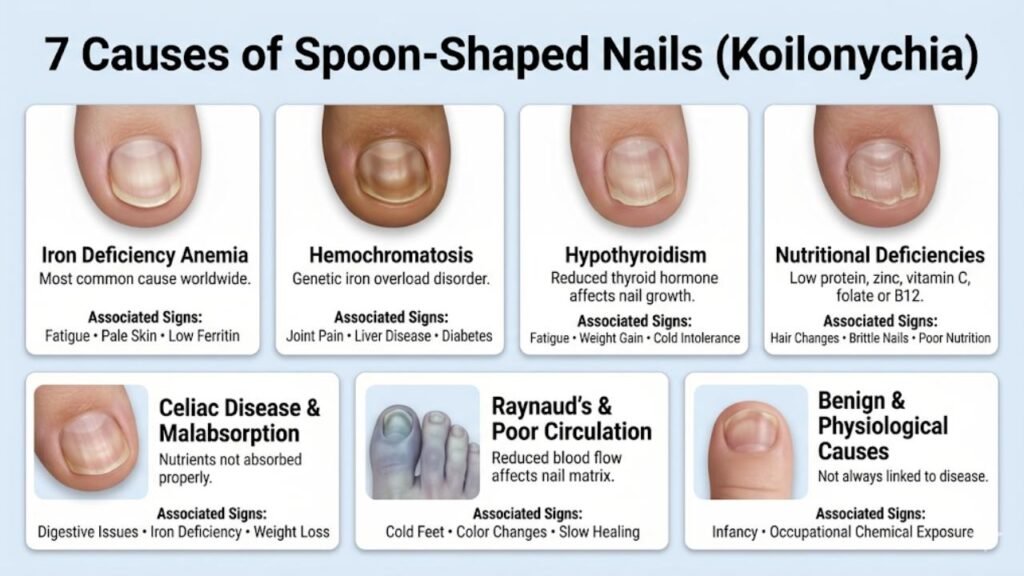
1. Iron Deficiency Anemia — The Most Important Cause
Iron deficiency is the most common cause of spoon-shaped nails (koilonychia) globally and the cause most important to identify because it is both treatable and, if untreated, has meaningful health consequences beyond the nails.
The connection to iron:
Iron is a cofactor for multiple enzymes involved in keratin synthesis and cross-linking. It is also required for hemoglobin production — when iron is deficient, hemoglobin levels fall, reducing oxygen delivery to all tissues including the nail matrix. Both mechanisms — direct enzymatic effects and indirect oxygen deprivation — contribute to the production of structurally inferior, thinner nail plate that develops the spoon shape.
Who is most at risk:
- Women with heavy menstrual periods — chronic monthly iron loss is the most common cause of iron deficiency in pre-menopausal women
- Pregnant women — dramatically increased iron demands during pregnancy
- Vegetarians and vegans — plant-based iron (non-heme iron) is significantly less bioavailable than animal-source iron
- Patients with gastrointestinal blood loss — from peptic ulcers, gastritis, colorectal cancer, or inflammatory bowel disease
- Patients with malabsorption — celiac disease, inflammatory bowel disease, or post-bariatric surgery
- Distance runners — exercise-induced hemolysis and foot-strike hemolysis deplete iron stores
Accompanying signs of iron deficiency anemia:
- Fatigue, weakness, and reduced exercise tolerance
- Pallor — pale skin, pale nail beds, pale conjunctivae
- Shortness of breath on exertion
- Headaches
- Cold intolerance
- Brittle hair alongside brittle nails
- In severe or prolonged deficiency: pica (craving for non-food substances like ice, clay, or starch)
The diagnostic priority:
When spoon-shaped nails (koilonychia) are identified, checking ferritin levels — the most sensitive indicator of iron stores — alongside hemoglobin and full blood count should be the first clinical step.
Iron supplementation should only be started after confirming deficiency — iron toxicity from over-supplementation is a genuine risk. Testing before treating is essential.
2. Hemochromatosis — Too Much Iron, Similar Nail Effect
Hereditary hemochromatosis is a genetic condition where the intestine absorbs too much iron from food. The body has no good mechanism for excreting excess iron, which accumulates in tissues — particularly the liver, heart, pancreas, and joints.
Paradoxically, despite having too much iron overall, hemochromatosis produces spoon-shaped nails (koilonychia) — the same nail change as iron deficiency. This apparent paradox reflects the complexity of iron metabolism: the excess iron in hemochromatosis is stored in organs rather than available at the tissue level in a form the nail matrix can use efficiently.
Associated features of hemochromatosis:
- Liver disease (hepatomegaly, cirrhosis)
- Bronze or gray skin pigmentation
- Joint pain (particularly knuckles)
- Diabetes from iron deposition in the pancreas
- Cardiac arrhythmias from cardiac iron deposition
- Family history of hemochromatosis
Hemochromatosis is diagnosed by elevated serum ferritin and transferrin saturation, confirmed by genetic testing for HFE gene mutations.
3. Hypothyroidism — Thyroid Hormone Effects on Nail Growth
Thyroid hormones regulate the rate of cellular metabolism throughout the body, including in the nail matrix. Hypothyroidism — an underactive thyroid — slows metabolic processes everywhere.
In the nail matrix, hypothyroidism slows nail growth, reduces the metabolic efficiency of keratin production, and produces nail changes including brittleness, thickening, and in some cases koilonychia. The mechanism is less direct than iron deficiency — hypothyroidism affects nail keratin quality by globally reducing the metabolic capacity of matrix cells.
Associated features of hypothyroidism:
- Fatigue and sluggishness
- Weight gain despite no change in diet
- Cold intolerance
- Dry skin and hair
- Hair loss — particularly outer third of eyebrows
- Constipation
- Slow pulse (bradycardia)
- Depression
Thyroid function testing (TSH, free T4) is appropriate when spoon-shaped nails (koilonychia) appear alongside these systemic symptoms.
4. Nutritional Deficiencies Beyond Iron
While iron deficiency is the most common nutritional cause, other nutritional deficiencies can contribute to the thin, pliable nail plate that allows koilonychia to develop.
Protein deficiency:
Severe protein restriction limits the amino acid availability for keratin production. Poorly cross-linked, thin nail keratin is more susceptible to deforming into the spoon shape.
Zinc deficiency:
Zinc is required for nail matrix cell division and keratin enzyme function. Zinc deficiency produces structurally fragile nails that may develop concavity alongside other nail changes.
Vitamin C deficiency:
Scurvy from vitamin C deficiency affects collagen throughout the body including the subungual connective tissue that supports the nail plate, contributing to nail structural changes.
B vitamin deficiencies:
Folate and B12 deficiency affect rapidly dividing cells — including nail matrix cells. These deficiencies typically affect nail quality more broadly rather than specifically causing koilonychia, but they can contribute to the overall nail fragility that allows the spoon shape to develop.
5. Celiac Disease and Malabsorption Conditions
Celiac disease and other malabsorption conditions are among the most commonly missed causes of nutritional deficiency-related spoon-shaped nails (koilonychia) — because the deficiency is not from inadequate diet but from inadequate absorption.
A patient eating an iron-rich diet who still develops koilonychia may have undiagnosed celiac disease. The gluten-triggered immune reaction damages the intestinal villi responsible for iron, folate, zinc, and calcium absorption — producing multiple nutritional deficiencies despite apparently adequate dietary intake.
The clinical significance:
When spoon-shaped nails (koilonychia) occur in someone with an apparently good diet, or when iron supplementation does not correct iron levels as expected, screening for malabsorption is appropriate.
Other malabsorption conditions producing similar presentations: Crohn’s disease, post-bariatric surgery (particularly gastric bypass), and small intestinal bacterial overgrowth.
6. Raynaud’s Phenomenon and Peripheral Vascular Disease
Vascular conditions that chronically reduce blood flow to the extremities can produce spoon-shaped nails (koilonychia) through a different mechanism — oxygen and nutrient deprivation at the nail matrix level from insufficient blood delivery rather than from systemic deficiency.
Raynaud’s phenomenon, peripheral artery disease, and scleroderma (which causes both Raynaud’s and vascular disease) are all associated with koilonychia through this vascular mechanism.
In these cases, the koilonychia may be accompanied by other signs of peripheral vascular compromise — cold hands and feet, color changes in the toes with temperature exposure, slow healing wounds, and thin dry skin on the extremities.
7. Physiological and Benign Causes
Not all spoon-shaped nails (koilonychia) indicate underlying disease. Two benign causes exist:
Koilonychia in infants:
Newborn toenails — particularly the great toenails — may naturally have a concave shape. This is a developmental variation that typically resolves spontaneously within the first few years of life as the nail plate matures and thickens. No investigation or treatment is required.
Occupational koilonychia:
Chronic contact with petroleum-based products, solvents, or chemical exposures can soften and alter nail keratin structure, producing a concave nail shape in workers with sustained hand chemical exposure. Changing occupation or using appropriate protective gloves allows the nail to recover.
Comparing Causes of Spoon-Shaped Nails (Koilonychia)
| Cause | Mechanism | Key Associated Features | Primary Investigation |
|---|---|---|---|
| Iron deficiency anemia | Impaired keratin cross-linking | Fatigue, pallor, breathlessness | Ferritin, CBC |
| Hemochromatosis | Iron accumulation in organs | Liver disease, bronze skin, joint pain | Transferrin saturation, HFE gene |
| Hypothyroidism | Slowed metabolic keratin production | Fatigue, weight gain, cold intolerance | TSH, free T4 |
| Nutritional deficiency | Insufficient substrate for keratin | Poor diet, malabsorption symptoms | Multiple nutritional blood tests |
| Celiac disease | Malabsorption of multiple nutrients | GI symptoms, weight loss, family history | Anti-tTG antibodies |
| Vascular disease (Raynaud’s) | Reduced blood supply to matrix | Cold extremities, color changes, scleroderma | Clinical assessment, ABI, vascular studies |
| Physiological (infants) | Developmental variation | Normal otherwise, resolves spontaneously | Clinical assessment only |
How Spoon-Shaped Nails (Koilonychia) Are Diagnosed
When a patient presents with spoon-shaped nails (koilonychia), the evaluation follows a logical sequence:
Step 1: Clinical assessment
The podiatrist or physician examines the nails — assessing the degree of concavity, which nails are affected, nail thickness and color, and any other nail abnormalities. They also examine the skin, hair, and mucous membranes for signs of nutritional deficiency or systemic disease.
Step 2: Blood testing — first-line
- Ferritin (most sensitive indicator of iron stores)
- Hemoglobin and full blood count (identifies anemia pattern)
- Serum iron and transferrin saturation (distinguishes iron deficiency from iron overload)
- Thyroid function (TSH, free T4)
- B12 and folate
- Serum albumin and protein markers
Step 3: Targeted additional testing
Based on initial results:
- Low ferritin → iron supplementation and investigation for source of blood loss
- Elevated transferrin saturation → hemochromatosis investigation
- Abnormal TSH → thyroid investigation
- Multiple nutritional deficiencies → malabsorption investigation including celiac serology
Treatment of Spoon-Shaped Nails (Koilonychia)
Treatment of spoon-shaped nails (koilonychia) focuses on addressing the confirmed underlying cause. The nail shape itself does not require direct intervention — as the cause is treated, the nail matrix begins producing structurally more normal nail plate, and the concave shape is progressively replaced by new normal nail growing in from the base.
Iron deficiency:
Oral iron supplementation (ferrous sulfate or ferrous gluconate) for 3 to 6 months. The cause of the iron deficiency also needs investigation — particularly gastrointestinal blood loss in adults, where colorectal cancer screening may be appropriate.
Hypothyroidism:
Levothyroxine replacement therapy, titrated to achieve normal thyroid function. Nail improvement follows metabolic normalization over months.
Hemochromatosis:
Regular therapeutic phlebotomy (blood removal) to reduce iron stores. May require ongoing maintenance phlebotomy.
Celiac disease:
Strict gluten-free diet, which allows intestinal recovery and restoration of normal nutrient absorption. Nutritional deficiencies are treated alongside dietary management.
Vascular causes:
Management of the underlying vascular condition — calcium channel blockers for Raynaud’s, lifestyle modification and vascular intervention for PAD.
Physiological infant koilonychia:
No treatment — reassure parents that the nail shape typically normalizes spontaneously.
Timeline for Recovery
Toenails grow approximately 1.5 mm per month. Full nail plate replacement from matrix to tip takes 12 to 18 months. This means:
- Even with effective treatment of the underlying cause, the existing spoon-shaped nail plate does not immediately reshape
- New nail growing from the base — from the treated matrix — will be progressively more normal in shape
- Visible improvement requires following the new nail growth from the cuticle area over months
- Full normalization of nail shape takes up to 18 months from when the underlying cause is resolved
Frequently Asked Questions About Spoon-Shaped Nails (Koilonychia)
What is the most common cause of spoon-shaped nails (koilonychia)?
Iron deficiency anemia is the most common cause worldwide. It should be the first condition investigated when koilonychia is identified, using ferritin levels and a full blood count.
Can spoon-shaped nails return to normal?
Yes — when the underlying cause is successfully treated, the nail matrix begins producing structurally normal nail. The new nail growing from the base progressively replaces the concave nail over 12 to 18 months. The nail shape typically normalizes with effective treatment of the cause.
Do spoon-shaped nails in babies need treatment?
Not usually. Concave toenails in infants are a common developmental variation — particularly in the great toenails — that typically resolves spontaneously as the child grows. If koilonychia persists beyond age 5 or is accompanied by other concerns, pediatric evaluation is appropriate.
Is koilonychia painful?
The nail shape change of koilonychia is not inherently painful. However, very thin nails may be more sensitive to pressure, and the underlying conditions causing koilonychia (like inflammatory arthritis or vascular disease) may produce pain independently.
Summary
Spoon-shaped nails (koilonychia) are a clinically important nail finding that reflects specific disruptions in nail plate structural integrity — most commonly from iron deficiency and its effect on keratin cross-linking, but also from hemochromatosis, hypothyroidism, nutritional deficiency, malabsorption conditions, and peripheral vascular disease.
The nail shape — concave, upward-curving edges with a central dip — is diagnostically specific enough that its presence alone should trigger an evaluation focused on the underlying cause rather than the nail itself. Treatment of the confirmed cause typically allows the nail to recover its normal convex shape over the subsequent growth cycle.
If you have noticed your toenails becoming concave or spoon-shaped — particularly if fatigue, pallor, or other systemic symptoms are present — blood testing for iron deficiency is the most important first step.
Struggling to get an appointment?
We help patients in your area bypass clinic waitlists by instantly finding verified podiatry doctors who accept their insurance.