Dented or Pitted Toenails Meaning
Find a Podiatrist Near You
Get same-day appointments with verified podiatrists. Insurance accepted.
Dented or pitted toenails are a nail finding that most people have never been told about — which means that when they first notice the small depressions scattered across their nail surface, they have no framework for understanding what they are looking at. Some dismiss it as rough nail texture. Others assume it is from trauma. A significant number search online and encounter the word psoriasis for the first time in relation to their nails.
The clinical reality is that dented or pitted toenails are one of the most diagnostically specific nail findings in podiatry and dermatology — because the pattern of the pitting, combined with which other nail changes are present, can point very clearly toward specific underlying conditions. Nail pitting does not usually happen for vague or general reasons. It happens because something specific is disrupting the organized production of the nail plate’s outer surface at the nail matrix.
This guide explains what dented or pitted toenails actually are at a biological level, the 6 most important conditions that cause them, how to interpret different patterns of pitting, and what evaluation and management looks like.

What Causes Dented or Pitted Toenails — The Biology
The nail plate is built in organized layers by the nail matrix. The outermost layer — the dorsal nail plate — is produced by the most proximal portion of the matrix, the part closest to the cuticle at the nail base.
Pits in the nail plate form when clusters of cells in this proximal matrix region are disrupted and fail to produce normal, smooth keratin. Instead of forming a coherent, flat nail plate surface, they produce an irregular cluster that is either lost (creating a depression — the pit) or retained as a soft, friable plug that later falls out (also leaving a pit).
The pit is literally a physical hole in the nail plate outer surface — a small crater where normal organized keratin was supposed to be.
The diagnostic significance of this mechanism:
Because the pits form at the proximal nail matrix and the nail plate grows forward, the pattern of pitting across the nail surface reflects the pattern of disruption at the matrix over time. Regularly scattered pits suggest a chronic, ongoing disruption. Pits arranged in horizontal lines suggest a periodic disruption corresponding to the growth cycle. Very numerous, large, or deeply irregular pits suggest more severe matrix involvement.
This spatial and temporal encoding of matrix disruption in the nail plate is why dented or pitted toenails carry specific diagnostic information.
6 Conditions That Cause Dented or Pitted Toenails
1. Psoriasis — The Most Common and Most Specific Cause
Nail psoriasis is the most important cause of dented or pitted toenails in clinical practice. It is estimated that 50 to 80 percent of people with psoriasis will develop nail involvement at some point — and pitting is the most common and most diagnostically characteristic nail sign of psoriasis.
Why psoriasis produces pitting:
Psoriasis drives abnormal acceleration of skin cell turnover throughout the body. In the nail matrix, this acceleration produces parakeratotic cells — immature, abnormally keratinized cells — in clusters within the proximal matrix. These parakeratotic cell clusters are incorporated into the nail plate as it forms but do not have the structural integrity of normal nail cells. They eventually fall out of the nail plate surface as it grows, leaving pits.
What psoriatic pitting looks like:
- Multiple, fairly regular small depressions scattered across the nail surface
- The pits may be shallow or moderately deep
- Typically affect multiple nails, often with varying degrees of involvement
- Associated nail changes help confirm psoriasis: oil-drop discoloration, nail lifting (onycholysis) with a distinctively defined proximal border, subungual hyperkeratosis, and crumbling nail plate
Critically: nail psoriasis can appear before skin psoriasis. A patient presenting with dented or pitted toenails and no visible skin plaques may nonetheless have psoriasis affecting the nail matrix without yet having cutaneous manifestations. This makes the history of skin psoriasis in family members a clinically useful question.
The treatment implication: Antifungal medication does nothing for nail psoriasis. This is the most important treatment mistake in dented or pitted toenails associated with psoriasis. The nail pitting does not respond to antifungals because it is immune-mediated, not infection-mediated. Appropriate management involves dermatological or rheumatological care addressing the underlying psoriasis.
2. Alopecia Areata — The Overlooked Nail Connection
Alopecia areata is an autoimmune condition where the immune system attacks hair follicles, producing patchy hair loss. What is less widely known is that the same immune mechanism also attacks nail matrix cells in a significant proportion of affected individuals — producing a characteristic nail pitting pattern.
Why alopecia areata produces pitting:
The autoimmune attack in alopecia areata targets the hair follicle, but the immunological mechanism can cross-react with nail matrix keratinocytes. This produces a disruption in nail plate production that results in pitting.
What alopecia areata pitting looks like:
The pitting pattern in alopecia areata is often distinctive — described as geometric or regular pitting, where the pits are arranged in regular rows or grids across the nail surface. This organized, regular pattern is in contrast to the somewhat more scattered and irregular pitting of psoriasis. The pits are typically small and uniform.
Severity in alopecia:
In severe alopecia totalis or universalis (where all body hair is affected), the nail changes may be more dramatic — progressing to trachyonychia, the rough sandpaper-like nail surface where virtually the entire nail is affected by multiple overlapping pits and surface disruption.
The clinical connection:
A patient presenting with dented or pitted toenails and any history of patchy hair loss should have this connection explored. Nail pitting in alopecia areata may respond to treatment of the underlying alopecia, though the response is variable.
3. Eczema (Atopic Dermatitis) — Inflammatory Disruption
Atopic dermatitis (eczema) can produce nail changes including pitting when the inflammatory process involves the skin immediately surrounding the nail fold — the tissue adjacent to the nail matrix.
Why eczema produces pitting:
Chronic inflammation in the skin around the nail fold can spread to the immediately adjacent nail matrix tissue, disrupting the organized production of nail plate cells. The pitting from eczema tends to be milder and more variable than the pitting of psoriasis — reflecting the episodic nature of eczema flares rather than the sustained matrix disruption of psoriasis.
What eczema-related pitting looks like:
- Fewer pits than typically seen in psoriasis
- May fluctuate with eczema flares — worse during active skin inflammation, improved during remission
- Accompanied by dry, itchy, inflamed skin around the nail fold and between the toes
- Peeling or cracking cuticle skin
- Less likely to show the oil-drop sign or significant onycholysis that accompanies psoriatic nail changes
4. Lichen Planus — The Nail Matrix Scarring Risk
Lichen planus is an inflammatory condition that can affect skin, mucous membranes, and nails. When it involves the nail unit, it represents one of the more concerning causes of dented or pitted toenails because of its potential to cause permanent nail matrix scarring.
Why lichen planus produces pitting:
Lichen planus triggers a T-cell-mediated immune attack on the basal layer of the epithelium. In the nail matrix, this attacks the very cells responsible for producing the nail plate. The resulting inflammation disrupts nail plate production, creating pits, ridges, and in more severe cases, the sandpaper-like trachyonychia.
The scarring concern:
Severe or untreated lichen planus affecting the nail matrix can produce pterygium — where scar tissue from the nail fold grows over the nail plate, permanently adhering to it. If pterygium develops and the nail is lost, the resulting scarring may permanently prevent nail regrowth in that area. This makes lichen planus one of the nail conditions where early specialist involvement is most important.
What lichen planus nail changes look like:
- Nail thinning alongside pitting
- Longitudinal ridges running from cuticle to tip, sometimes breaking into splits
- The trachyonychia pattern in severe cases
- Possible pterygium — visible as tissue advancing from the cuticle over the nail surface
- Lichen planus may also cause white or purple streaks in the mouth (lichen planus of the oral mucosa) — worth asking about
5. Reactive Arthritis — Post-Infectious Nail Changes
Reactive arthritis (formerly called Reiter’s syndrome) is an inflammatory arthritis that develops in response to an infection elsewhere in the body — typically urogenital or gastrointestinal infection. It produces a triad of joint inflammation, urogenital inflammation, and eye inflammation — with nail changes being a recognized additional feature.
Why reactive arthritis produces pitting:
Reactive arthritis drives systemic inflammation that can affect the nail unit in a pattern similar to psoriatic inflammation. The nail changes of reactive arthritis closely resemble those of psoriasis — which reflects the overlapping immunological mechanisms of the two conditions.
What reactive arthritis nail changes look like:
- Nail pitting similar to psoriasis
- Nail thickening
- Onycholysis
- A specific finding called keratoderma blennorrhagicum — thickened, horny skin plaques — may also affect the soles of the feet
The clinical context:
Dented or pitted toenails appearing alongside new joint pain (particularly affecting large joints), recent history of gastrointestinal infection or urogenital symptoms, and eye redness should prompt physician evaluation for reactive arthritis.
6. Nail Trauma — Localized Matrix Disruption
While systemic conditions produce pitting that affects multiple nails, physical trauma to the nail matrix in a localized area can produce pitting in a single nail or a specific region of a nail corresponding to the area of impact.
Why trauma produces pitting:
A direct impact to the nail that reaches the matrix disrupts the organized cell production at the impact site. The nail plate produced from that disrupted area has an irregular surface corresponding to the zone of matrix damage — which may appear as isolated pits or a group of pits in a localized nail area.
What trauma-related pitting looks like:
- Localized — often affects a specific area of one nail rather than multiple nails
- Corresponds to a recognizable injury event
- Moves forward with nail growth over months — the affected area migrates toward the nail tip
- No other nail changes suggesting psoriasis or autoimmune cause
- Resolves as the nail grows through the disrupted area and new normal nail grows in from the matrix
Comparing Causes of Dented or Pitted Toenails
| Cause | Pitting Pattern | Other Nail Signs | Key Associated Features |
|---|---|---|---|
| Psoriasis | Multiple, scattered, variable depth | Oil-drop sign, onycholysis, subungual debris | Skin psoriasis (may be absent), family history |
| Alopecia areata | Regular, geometric rows | Trachyonychia in severe cases | Patchy hair loss |
| Eczema | Fewer pits, variable | Rough surface, mild changes | Inflamed skin around nail fold, skin eczema |
| Lichen planus | Pits with ridges and thinning | Pterygium possible, longitudinal ridges | Oral lichen planus, significant scarring risk |
| Reactive arthritis | Similar to psoriasis | Thickening, onycholysis | Joint pain, prior infection |
| Trauma | Localized, single nail | Moves forward with growth | Clear injury history, resolves |
The Difference Between Nail Pitting and Nail Ridges
Patients sometimes confuse dented or pitted toenails with nail ridges. These are distinct findings with different causes:
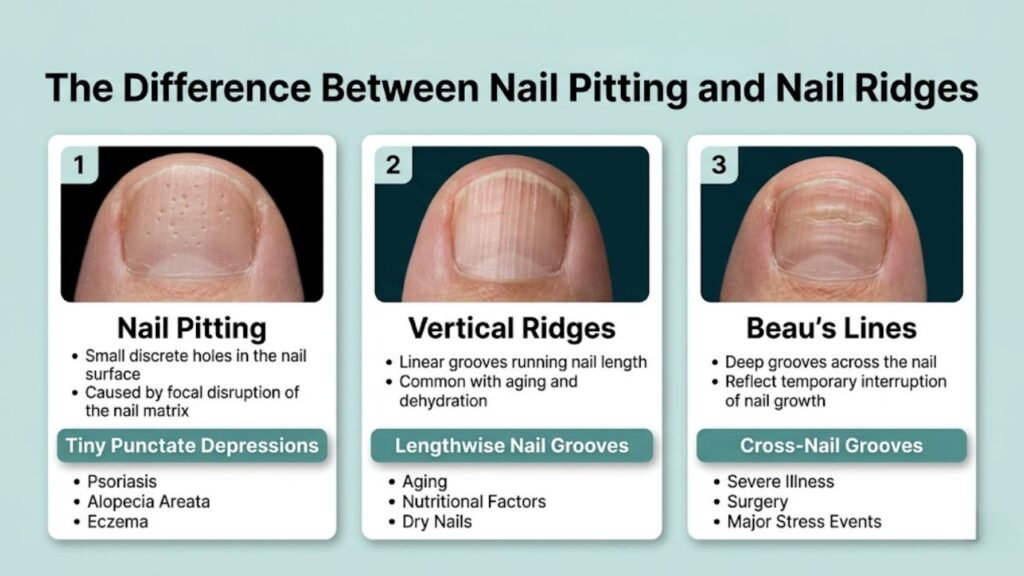
Pits: Small, discrete, punctate depressions in the nail surface — tiny holes. Involve the outermost nail plate layer. Caused by focal disruptions in the proximal nail matrix.
Vertical ridges (onychorrhexis): Linear grooves running lengthwise from cuticle to tip. Reflect aging, nutritional factors, or dehydration affecting the matrix more broadly. Not the same as pitting.
Horizontal ridges (Beau’s lines): Deep grooves crossing the full width of the nail. Reflect a period of significant systemic stress interrupting matrix function.
A nail can have both pitting and ridges simultaneously — particularly in nail psoriasis and lichen planus.
When Dented or Pitted Toenails Need Medical Evaluation
Schedule evaluation if:
- Pitting affects multiple nails
- Pitting has developed progressively over months
- Other nail changes are present — oil-drop discoloration, nail lifting, crumbling
- There is any family history of psoriasis
- Skin rashes, joint pain, or hair loss accompany the nail changes
- The nail surface is becoming increasingly rough or sandpaper-like (suggesting trachyonychia)
- You have been told previously that your nail issues are fungal but antifungal treatment has produced no improvement
Seek more urgent evaluation if:
- Tissue appears to be growing from the cuticle over the nail surface (possible pterygium from lichen planus — this needs early intervention)
- Joint pain, eye redness, and nail changes appear together (possible reactive arthritis)
What to Expect at a Professional Evaluation
A podiatrist or dermatologist evaluating dented or pitted toenails will typically:
Clinical examination: Assess the number, distribution, depth, and pattern of pits. Examine for associated nail findings (oil-drop, onycholysis, trachyonychia). Examine surrounding skin for evidence of psoriasis, eczema, or lichen planus. Examine scalp and body hair (alopecia areata).
Medical history: Family history of psoriasis. Personal history of skin conditions, joint pain, hair loss, or autoimmune conditions. Any prior infections.
Dermoscopy: Magnified examination of the nail surface and nail bed. Psoriatic nail findings have characteristic dermoscopic patterns that help confirm the diagnosis.
Laboratory testing: Fungal testing (KOH/culture) to exclude fungal infection as a concurrent or alternative diagnosis. Blood tests if systemic disease is suspected.
Nail biopsy (in selected cases): When the diagnosis remains uncertain, a small nail specimen can be examined histologically. This is particularly useful for distinguishing psoriasis from lichen planus, as the treatment approach differs significantly.
Frequently Asked Questions About Dented or Pitted Toenails
What do dented or pitted toenails usually mean?
Dented or pitted toenails most commonly indicate nail psoriasis — particularly when multiple nails are affected with multiple pits. Other important causes include alopecia areata, lichen planus, eczema, and reactive arthritis. Localized pitting in a single nail may result from trauma.
Can nail pitting be caused by a fungal infection?
Fungal infection does not typically produce pitting as its primary nail finding — it produces thickening, discoloration, and crumbling. However, fungal infection can coexist with psoriatic nail disease, and laboratory testing helps distinguish the two. Antifungal treatment does not address pitting from psoriasis or other inflammatory causes.
Do dented or pitted toenails go away on their own?
Trauma-related pitting grows out as the nail grows and typically resolves without treatment. Pitting from ongoing inflammatory conditions like psoriasis and lichen planus does not resolve without treating the underlying condition. Alopecia areata pitting may partially improve during remission periods.
How many pits on a nail is considered abnormal?
Any pitting is worth noting, but isolated occasional pits can occur from minor trauma and are not necessarily clinically significant. Multiple pits across multiple nails that have appeared progressively, particularly with other nail changes, warrants professional evaluation.
Is nail pitting from psoriasis reversible?
When psoriasis is effectively managed through systemic treatment — particularly biologic therapy — the nail pitting from psoriasis can significantly improve or resolve as new nail grows in from the treated matrix. Full nail replacement and visible normalization takes 9 to 18 months even with effective treatment.
What is the difference between nail pitting and nail ridges?
Pits are discrete, small, punctate holes in the nail surface — tiny depressions. Ridges are linear grooves running the length (vertical ridges) or width (horizontal ridges) of the nail. Both can occur from inflammatory nail conditions, but ridges also occur commonly from aging and dehydration. They are produced by different mechanisms in the nail matrix.
Summary
Dented or pitted toenails are a clinically specific nail finding produced when focal disruptions in the proximal nail matrix create gaps in the outermost nail plate layer. The six main causes — psoriasis, alopecia areata, eczema, lichen planus, reactive arthritis, and localized trauma — each produce pitting through distinct mechanisms and are associated with characteristic accompanying features that help distinguish them.
Psoriasis is the most important and most common cause of dented or pitted toenails. The presence of pitting alongside oil-drop discoloration, onycholysis, or subungual debris in multiple nails is a strong clinical indicator of nail psoriasis — even in patients with no visible skin plaques.
Antifungal medication does not treat pitting from inflammatory causes. When pitting affects multiple nails, is progressive, or is accompanied by other nail or skin changes, professional evaluation by a dermatologist or podiatrist provides the diagnosis that guides effective treatment.
Struggling to get an appointment?
We help patients in your area bypass clinic waitlists by instantly finding verified podiatry doctors who accept their insurance.