Best Foot Drying Practices After Showering
Find a Podiatrist Near You
Get same-day appointments with verified podiatrists. Insurance accepted.
Foot drying practices after showering represent one of the simplest and most consistently overlooked steps in foot health maintenance. Most people wash their feet reasonably well — but the drying step is treated as an afterthought: a quick pass with a towel before stepping onto the bath mat and putting socks on. That approach leaves the most fungal-infection-prone area of the foot — the spaces between the toes — damp for the next hour or more while socks trap that moisture against the skin.
This matters because the mechanism of athlete’s foot (tinea pedis) and the skin-to-nail transmission of nail fungal infection both depend on two things: fungal spore exposure and sufficient moisture to allow those spores to germinate and establish in the skin. Proper foot drying practices after showering directly address the moisture component — one of only two requirements for infection to occur.
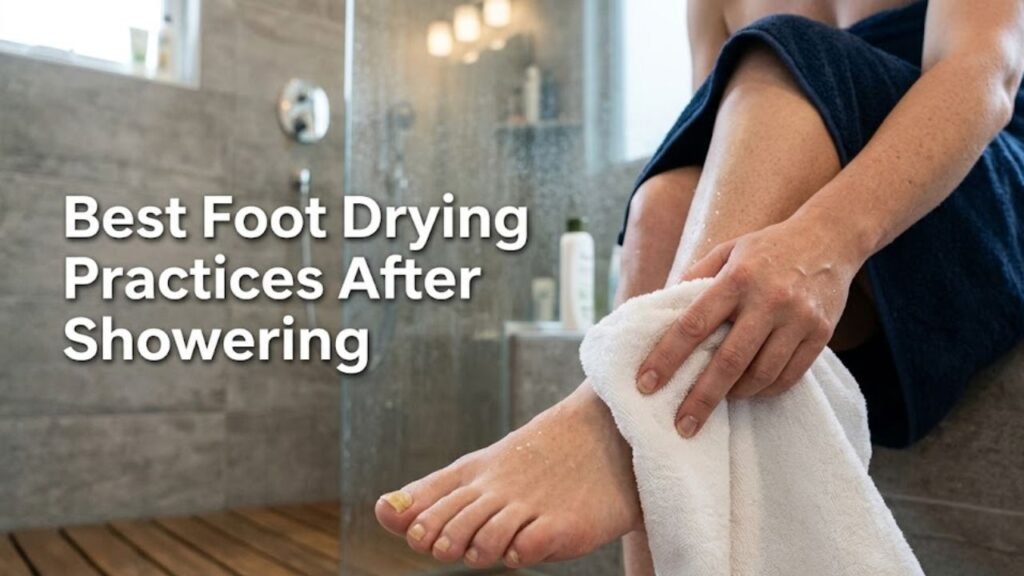
Why Moisture After Showering Creates Real Infection Risk
The biological case for thorough foot drying practices after showering comes down to what dermatophyte fungi require to infect the skin.
When fungal spores contact the skin of the foot — from a contaminated shower floor, bath mat, or shoe — they cannot immediately penetrate intact, dry skin. They require:
- Sufficient moisture — to trigger spore germination from dormant to active form
- Sustained contact time — to allow germinated hyphae to begin penetrating the outer skin layer
The interdigital spaces between the toes are anatomically designed to trap and retain moisture. They are narrow, poorly ventilated, and often pressed together inside footwear immediately after showering. When feet are not thoroughly dried, these spaces provide precisely the warm, moist, sustained contact environment that allows fungal spores to transition from dormant to infectious.
Additionally, skin that remains wet for extended periods begins to macerate — it softens and loses its mechanical barrier integrity. Macerated skin is more permeable to fungal penetration than intact, dry skin, reducing the effective resistance to infection even further.
This is why dermatologists and podiatrists identify the interdigital spaces as the most common initial site of dermatophyte infection — not because fungal spores concentrate there more than elsewhere, but because moisture concentrates there, providing the germination environment that the dry skin of the rest of the foot does not.
Where Most People Go Wrong: The Specific Mistakes
Before covering the correct foot drying practices after showering, identifying the specific errors that undermine them helps clarify what actually matters:
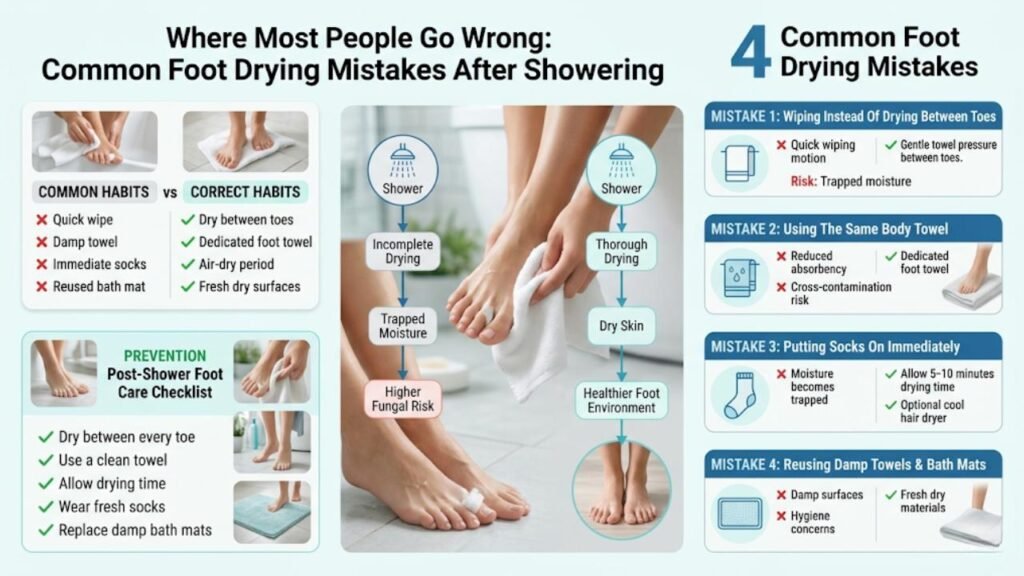
Mistake 1: Wiping Rather Than Patting in the Toe Spaces
The common motion of rubbing a towel across the top of the foot and between the toes simultaneously applies friction and movement in directions that do not effectively wick moisture from the narrow interdigital spaces. The towel passes across the opening of the space but does not remove moisture from within it.
Effective foot drying practices after showering in the interdigital spaces require inserting a corner of the towel or a separate cloth between each pair of toes and gently pressing — using the absorbent surface to contact the actual moist skin within the space.
Mistake 2: Using the Same Towel as the Rest of the Body
When the same towel dries the groin, underarms, and body before reaching the feet, it has already absorbed significant moisture and reduced its absorbency. More importantly, the towel has contacted other body surfaces that may carry organisms — using a towel that has already contacted the body on the feet is a hygiene inconsistency that dedicated foot drying practices after showering should address.
Using a separate small towel dedicated specifically to feet is a practical improvement that most podiatrists recommend.
Mistake 3: Putting Socks On Immediately
This is perhaps the most consequential error in post-shower foot care. Putting socks on immediately after showering — before the skin has reached actual dryness (not just surface dryness) — encloses remaining moisture against the skin for hours. Inside closed footwear, that moisture cannot evaporate. The interdigital spaces particularly retain moisture this way.
Effective foot drying practices after showering include an air-drying interval of 5 to 10 minutes before putting on socks — or using a hair dryer on a cool setting to accelerate drying of the interdigital spaces before enclosing the foot in a sock.
Mistake 4: Reusing Damp Bath Mats and Towels
A bath mat that has been used by multiple household members, or a towel that has been damp for several days between uses, is not simply ineffective for drying — it may be actively depositing organisms onto the foot being “dried.” Effective foot drying practices after showering require regularly laundered, dry towels and bath mats.
The Correct Technique: Step-by-Step Foot Drying Practices After Showering
Step 1: Prepare a Clean, Dry Towel or Dedicated Foot Cloth
Have a clean, dry towel available before you step out of the shower. Ideally, use a separate smaller towel or washcloth dedicated to the feet — not the same towel used on the rest of the body. This foot towel should be laundered at least every 2 to 3 uses.
Step 2: Step Onto a Clean, Dry Bath Mat
The bath mat you step onto after showering should be clean and dry. Damp bath mats shared by multiple household members are one of the most consistent routes of interdigital dermatophyte transfer within families. Replace or launder bath mats regularly.
Step 3: Dry the Dorsal (Top) Foot Surface First
Pat — do not rub — the top of the foot, the heel, and the ankle area with the towel. The dorsal surface dries relatively quickly because it is more open and accessible. This step primarily ensures the large surface areas are addressed.
Step 4: The Critical Step — Dry Each Interdigital Space Individually
This is the single most important of all foot drying practices after showering.
Technique: Fold a corner of the towel or use a separate thin cloth. Insert it between each pair of toes — great toe and second toe, second and third, third and fourth, fourth and fifth — and press gently, allowing the absorbent material to contact the moist skin within the space. Do not scrub or pull aggressively on the towel between toes — this can irritate the delicate interdigital skin. A gentle press and gentle sideways move to wick moisture is the correct motion.
Work through all ten interdigital spaces systematically. This takes approximately 20 to 30 seconds — the most valuable 20 to 30 seconds in foot hygiene.
Step 5: Dry the Plantar Surface (Sole) and Heel
Pat the sole and heel area. The heel is a common site for hyperkeratosis (thickened skin) and can retain moisture in skin crevices. The metatarsal heads (ball of the foot) may also retain moisture from the shower.
Step 6: Check Under and Around the Toenails
The hyponychium — the skin beneath the nail tip — and the nail folds around the nail can retain moisture. Gently dry these areas with a corner of the towel.
Step 7: Allow Air Drying Before Putting On Socks
After towel drying, stand or sit in a warm, ventilated area for 5 to 10 minutes before putting on socks. This brief air-drying interval allows residual moisture — particularly in the interdigital spaces — to evaporate.
For patients who are particularly prone to interdigital moisture or have history of athlete’s foot, a hair dryer on the cool or warm (not hot) setting directed at the interdigital spaces for 30 to 60 seconds after towel drying is an effective way to completely dry these areas before enclosing in footwear.
High-Risk Situations for Inadequate Post-Shower Drying
Some situations create elevated risk that foot drying practices after showering need to specifically address:
Communal and Gym Shower Situations
Showering in gym locker rooms, hotel bathrooms, pool changing facilities, or communal showers introduces both increased fungal spore exposure and typically hurried, less careful drying. The combination of high spore environments and inadequate drying is precisely how gym-related foot fungal infections develop.
Specific adaptations for communal shower situations:
- Wear waterproof sandals during the shower
- Have a dedicated foot towel in your gym bag — separate from the body towel
- Take the extra time for complete interdigital drying even in the hurry of a gym locker room
- Consider applying antifungal powder to the foot after drying in high-exposure environments
Diabetes and Peripheral Neuropathy
For diabetic patients with peripheral neuropathy, thorough foot drying practices after showering are a clinical safety measure, not just hygiene preference. Reduced sensation means maceration from inadequate drying may not be felt. Macerated skin combined with reduced healing capacity and immune function makes diabetic patients particularly vulnerable to infection from inadequate post-shower drying.
For diabetic patients, foot drying includes inspecting the interdigital spaces and entire foot surface after drying — to identify any redness, maceration, or early skin breakdown that reduced sensation may have masked.
People Who Have Had Nail or Skin Fungal Infection
Anyone with a history of athlete’s foot or nail fungal infection has demonstrated that their immune environment allows these infections to establish. More careful foot drying practices after showering — every time, not just when remembering — reduces the frequency of moisture exposure that in these individuals can result in reinfection.
What to Apply After Proper Drying
Once the foot is genuinely dry, two optional but clinically useful steps enhance the protection from foot drying practices after showering:
Antifungal powder between the toes: Products containing miconazole or tolnaftate applied to the interdigital spaces after drying provide ongoing antifungal activity during the day — reducing the effect of any moisture that does accumulate during activity. This is most relevant for people prone to interdigital athlete’s foot or who will be wearing closed footwear for extended periods.
Emollient moisturizer on the heel and sole (not between toes): The heel and plantar foot benefit from moisturizing after drying to prevent hyperkeratosis and skin cracking — which themselves can create entry points for infection. Apply only to the heel and sole, not between the toes where any additional moisture is counterproductive.
Towel and Bath Mat Hygiene: The Overlooked Component
The effectiveness of foot drying practices after showering depends on the cleanliness of the tools used for drying:
Towel laundering frequency: A foot towel should be laundered every 2 to 3 uses — not left damp and reused for a week. A damp towel is a growth medium for bacteria and fungi. Using it on the foot transfers whatever has grown on it to the skin.
Separate towels for infected and uninfected household members: When a household member has active athlete’s foot or nail fungal infection, their towels should be laundered separately from other household members’ towels. The foot towel of an infected person can transfer viable fungal organisms to a shared laundry pile that then contacts other members’ towels.
Bath mat replacement and laundering: Bath mats — particularly those used by multiple household members — should be laundered at least weekly. A bath mat that has absorbed moisture from multiple people’s feet after showering and not been laundered is a persistent source of interdigital spore transfer between household members.
Frequently Asked Questions About Foot Drying Practices After Showering
Why is drying between the toes the most important step?
The interdigital spaces are anatomically positioned to trap and retain moisture — they are narrow, poorly ventilated, and pressed together in footwear. This makes them the primary site where moisture supports fungal spore germination and infection establishment. Adequate foot drying practices after showering in the interdigital spaces removes this moisture before it can support infection.
Should I use a hair dryer on my feet after showering?
Yes — a hair dryer on a cool or warm (not hot) setting directed at the interdigital spaces for 30 to 60 seconds after towel drying is an effective technique, particularly for people prone to athlete’s foot. Never use the hot setting as it can burn delicate interdigital skin.
How long should I wait before putting socks on after showering?
Five to ten minutes of air drying after towel drying is recommended as part of effective foot drying practices after showering. This allows residual moisture — particularly in the interdigital spaces — to evaporate before being enclosed in a sock.
Does antifungal powder replace proper foot drying?
No. Antifungal powder is an adjunct — it provides ongoing antifungal activity during the day and helps manage moisture accumulation from activity. It does not substitute for thorough mechanical drying after showering. Foot drying practices after showering remain the primary moisture management step.
Summary
Foot drying practices after showering are simple, take less than 2 minutes to do correctly, and represent one of the most consistently impactful daily habits for preventing fungal foot and nail infections. The technique — patting individual interdigital spaces with a dedicated clean towel, then allowing air drying before putting on socks — directly addresses the moisture conditions that fungal organisms require to germinate and infect.
The most common failures are skipping or rushing the interdigital drying step, immediately putting on socks while the foot is still moist, and using damp or shared towels. Correcting these three specific habits turns foot drying from an afterthought into one of the most effective daily infection prevention practices available.
For people with diabetes, history of fungal infection, or high communal exposure (gym users, pool swimmers), thorough foot drying practices after showering are a clinical priority, not just a hygiene preference.
Struggling to get an appointment?
We help patients in your area bypass clinic waitlists by instantly finding verified podiatry doctors who accept their insurance.