Crumbly Toenails vs Fungal Nails
Find a Podiatrist Near You
Get same-day appointments with verified podiatrists. Insurance accepted.
Crumbly toenails vs fungal nails is a comparison that matters enormously for treatment — because antifungal medication does nothing for a nail that is crumbling due to structural weakness, psoriasis, or aging. And months of applying antifungal products to a nail that is genuinely infected will also fail if the wrong product is selected for the wrong organism.
The problem is that these two situations can look almost identical from the outside. Both produce a nail that crumbles at the edges, appears discolored, and feels structurally compromised. This surface similarity is why the crumbly toenails vs fungal nails question consistently comes up — and why getting the answer right before choosing a treatment is the most clinically important step.
This guide explains what actually makes the two conditions different, how to assess which one you are dealing with at home, what professional testing confirms, and what the appropriate treatment looks like for each.

What Crumbling in a Toenail Actually Means
Before comparing crumbly toenails vs fungal nails, it helps to understand what crumbling in the nail plate actually reflects at a structural level.
The nail plate is made of tightly packed keratin cells organized in distinct layers. Healthy keratin is flexible enough to absorb mechanical stress without fracturing, yet dense enough to resist deformation. When the keratin structure loses its organization — whether because fungal enzymes are breaking it down, because the matrix is producing structurally inferior keratin from nutritional causes, or because the nail plate has dried and lost its lipid content — the nail becomes brittle and crumbles under the mechanical stress of daily use.
The crumbling is the end result of weakened keratin, but the cause of that weakness is what separates the crumbly toenails vs fungal nails comparison into genuinely different clinical situations.
What Crumbly Toenails Look Like (Without Fungal Infection)
Crumbly toenails without fungal infection reflect a nail plate that has become structurally fragile from causes other than microbial invasion. The keratin layers may separate, break apart at the nail tip, or produce a chalk-like powdery texture.
Causes of crumbly toenails without fungal infection:
Nail psoriasis:
One of the most commonly overlooked causes of crumbly toenails. Nail psoriasis disrupts the organized production of keratin at the matrix, producing nail plate cells that are irregularly structured and prone to crumbling. The psoriatic nail often shows additional features: pitting (small depressions on the nail surface), an oil-drop discoloration visible through the nail plate, and nail lifting with a clearly defined border.
Lichen planus:
This inflammatory condition can damage the nail matrix significantly, producing nails that have a sandpaper-like surface texture (trachyonychia), thin out, and crumble. Severe lichen planus can produce scarring of the matrix with permanent nail changes.
Severe nutritional deficiency:
As discussed in the brittle toenails guide, deficiencies in biotin, zinc, iron, and protein all affect keratin quality. A sufficiently compromised matrix produces nail plate that crumbles more readily than a nutritionally replete nail.
Age-related nail dystrophy:
Aging produces progressive changes in nail plate structure — reduced lipid content, slower growth, and changes in keratin organization that increase crumbling tendency.
Repetitive trauma:
Chronic mechanical damage to the nail matrix — from footwear, running, or occupational stress — disrupts normal keratin production, producing structurally weakened nail plate.
What non-fungal crumbly toenails typically look like:
- The nail crumbles or chips but does not show the characteristic debris accumulation beneath the nail edge
- Discoloration is present (pale, dull white, or yellowish) but less pronounced than in fungal infection
- The nail may be thin rather than thickened
- Multiple nails affected symmetrically suggests a systemic cause
- No associated athlete’s foot on surrounding skin
- Laboratory testing for fungal organisms is negative
What Fungal Nails Look Like (Onychomycosis With Crumbling)
Fungal nail infection (onychomycosis) produces crumbling through a specific mechanism: dermatophyte fungi produce keratinases — enzymes that break down the keratin of the nail plate as a nutrient source. As the fungal colony expands within the nail plate and subungual space, it progressively degrades the keratin structure, producing a nail that becomes progressively thicker, more crumbly, and more friable.
What fungal nail crumbling looks like:
- Crumbling at the nail tip and edges, often accompanied by chalky, powdery debris beneath the nail edge
- Progressive thickening of the nail plate alongside the crumbling
- Discoloration: yellow, brown, or white — often starting at the nail tip and spreading toward the base
- Subungual debris: accumulation of white, chalky material between the nail plate and the nail bed, visible as material that falls out when the nail edge is trimmed
- Nail lifting (onycholysis) at the tip or sides as the nail plate separates from the nail bed
- Possible mild odor from the subungual debris
- Often starts in one nail and spreads to others over months
- Athlete’s foot (tinea pedis) frequently present on surrounding skin
- Laboratory testing (KOH or fungal culture) positive for fungal organisms
5 Key Differences: Crumbly Toenails vs Fungal Nails
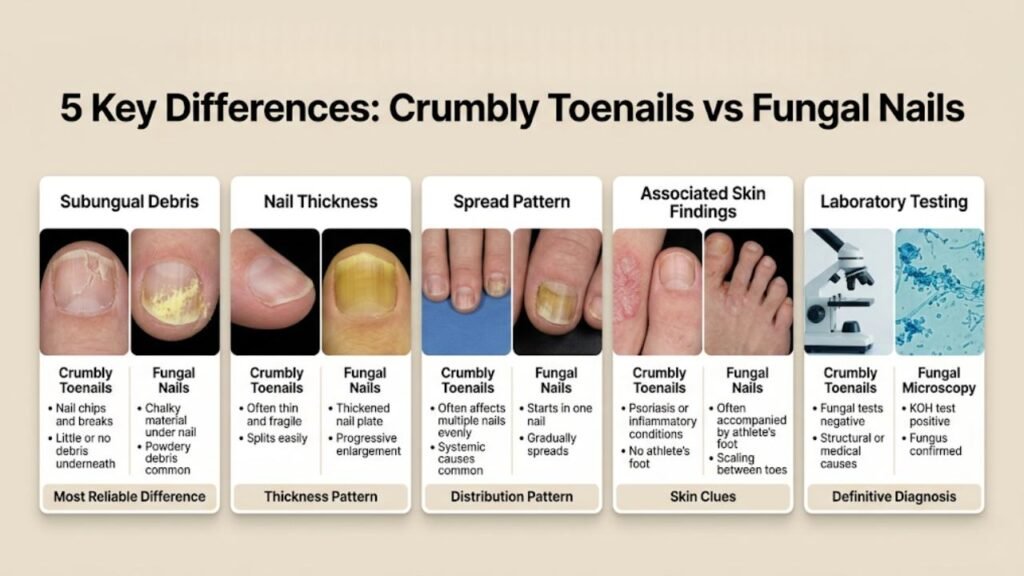
Difference 1: Subungual Debris — The Most Reliable Distinguishing Feature
The single most clinically reliable differentiator in the crumbly toenails vs fungal nails comparison is the presence of subungual debris.
Fungal nails: Produce chalky, powdery, whitish-yellow debris that accumulates in the space beneath the nail plate. This debris consists of keratin breakdown products mixed with fungal organisms. It falls out when the nail edge is trimmed. It has a characteristic chalky or powdery quality. It is typically visible at the nail tip as material beneath the nail edge.
Non-fungal crumbly nails: The nail plate itself may crumble and chip, but there is no significant accumulation of loose, chalky debris in the subungual space. The crumbling happens to the nail plate from above — the plate breaks — rather than producing debris from beneath the plate.
Test you can do at home: Trim the affected nail and look carefully at what comes away. If chalky, powdery material falls from beneath the nail plate — this is subungual debris and strongly suggests fungal infection. If the nail simply chips and the cut surface of the nail is the source of the crumbled material — this is more consistent with structural nail fragility.
Difference 2: Nail Thickness Pattern
Fungal nails: The nail plate becomes progressively thicker as the infection advances. This thickening results from subungual debris accumulation physically raising the nail plate, and from the nail bed’s reactive hyperkeratosis (increased keratin production in response to the infection). Fungal nails are typically thick AND crumbly simultaneously.
Non-fungal crumbly nails: Many causes of non-fungal crumbling produce nails that are thinner than normal — or at most the same thickness — rather than thicker. A nail that is crumbling but noticeably thin and fragile (rather than thick and fragile) is more likely to reflect a structural or nutritional cause.
Exception: Nail psoriasis can produce nail thickening through subungual hyperkeratosis alongside crumbling, making thickness less reliable for distinguishing psoriatic nails from fungal nails.
Difference 3: Spread Pattern Across Multiple Nails
Fungal nails: Typically start in one or two nails — often the great toenail or a nail with prior trauma — and spread to adjacent nails over months. The spread follows a logical pattern (nail to nail) and is progressive if untreated. Multiple nails in different states of involvement (some just beginning, some more advanced) is a characteristic fungal pattern.
Non-fungal crumbly nails: Systemic causes (nutritional deficiency, psoriasis, lichen planus, aging) affect all nails simultaneously and relatively uniformly — the same degree of change across all nails at the same time. Traumatic causes affect specific nails corresponding to the area of greatest mechanical stress.
Clinical implication: Multiple nails in different states of involvement (one severely crumbly, others just starting to change) suggests fungal spreading. Multiple nails identically affected suggest a systemic cause.
Difference 4: Associated Skin Findings
Fungal nails: Frequently coexist with tinea pedis (athlete’s foot) — scaling, peeling, or redness between the toes or on the plantar surface. This is because the same dermatophyte fungi causing the nail infection typically also infect the surrounding skin. In the crumbly toenails vs fungal nails assessment, checking the inter-digital spaces for scaling or redness is a useful clinical step.
Non-fungal crumbly nails: Psoriatic nails may accompany skin psoriasis elsewhere on the body (elbows, knees, scalp). Lichen planus affecting nails may accompany lichen planus lesions on the skin or inside the mouth. Neither produces tinea pedis.
Difference 5: Laboratory Test Results
Fungal nails: KOH microscopy of nail clippings or subungual debris reveals fungal hyphae under microscope. Fungal culture grows visible fungal colonies within days to weeks. This is the definitive test.
Non-fungal crumbly nails: All fungal laboratory tests come back negative. This confirms that the crumbling has a non-fungal cause and redirects the clinical evaluation toward structural, inflammatory, or systemic causes.
The importance of this test: Many patients with crumbly toenails from psoriasis have been treated with antifungal medication for months or years without improvement because the diagnosis was never confirmed. A negative KOH test immediately changes the management direction.
Crumbly Toenails vs Fungal Nails: Complete Comparison
| Feature | Crumbly Toenails (Non-Fungal) | Fungal Nails (Onychomycosis) |
|---|---|---|
| Subungual debris | Absent or minimal | Present — chalky, powdery accumulation |
| Nail thickness | Often thin or normal | Usually thick (thickened by subungual debris and hyperkeratosis) |
| Discoloration | Pale, dull, mild yellow or white | Yellow, brown, or white — often more pronounced |
| Spread pattern | All nails similarly affected | One nail starts, spreads progressively |
| Athlete’s foot alongside | Usually absent | Frequently present |
| Nail pitting | Present in psoriasis | Uncommon |
| Oil-drop sign | Present in psoriasis | Absent |
| Odor | Usually absent | Sometimes present |
| Laboratory test | Negative | Positive |
| Response to antifungal | No improvement | Gradual improvement |
Why Getting the Diagnosis Right Matters
If you have fungal nails and treat them as structural crumbling:
You apply moisturizers and nail oils. You improve nutrition. Nothing improves because the fungal organisms continue breaking down the nail. The infection spreads to additional nails over months.
If you have non-fungal crumbly nails and treat them as fungal:
You apply antifungal topicals for months. Nothing improves because there are no fungal organisms to eliminate. If psoriasis is the cause, it continues affecting the nail matrix without appropriate anti-inflammatory treatment. If nutritional deficiency is the cause, it continues without dietary correction.
The cost of misdiagnosis in the crumbly toenails vs fungal nails assessment is months of ineffective treatment and ongoing nail damage.
How Crumbly Toenails vs Fungal Nails Are Professionally Diagnosed
A podiatrist or dermatologist evaluating nail crumbling will typically use:
Clinical examination:
Assessing the nail’s appearance — thickness, color, debris pattern, nail surface (pitting suggests psoriasis), nail fold skin (surrounding skin in athlete’s foot), and overall pattern across multiple nails.
Dermoscopy:
A magnifying device with polarized light allows detailed visualization of the nail surface, subungual space, and pigment patterns, helping distinguish psoriatic patterns from fungal patterns.
KOH microscopy:
Nail clippings or subungual debris dissolved in potassium hydroxide and examined under microscope. Fungal hyphae are visible in positive cases. The fastest and most available initial test.
Fungal culture:
Material cultured on appropriate media. Identifies the specific organism — distinguishing dermatophytes from yeasts or molds, which guides antifungal selection.
PAS histopathology:
Most sensitive test — a nail biopsy processed with periodic acid-Schiff staining. Also useful for detecting psoriatic nail changes in the biopsy specimen.
In cases of genuine diagnostic uncertainty in the crumbly toenails vs fungal nails question, running both bacterial culture, fungal culture, and pathological examination on the same sample provides the most comprehensive answer.
Treatment Based on the Correct Diagnosis
If Fungal Nails Are Confirmed:
Topical antifungal (mild cases):
Prescription efinaconazole, ciclopirox, or tavaborole applied daily for 48 weeks. Appropriate for infections involving less than 50 percent of the nail without matrix involvement.
Oral antifungal (moderate to severe):
Terbinafine (first-line for dermatophytes) or itraconazole (broader spectrum). Completed for the full prescribed course without early stopping.
Professional debridement:
Reduces nail thickness, removes subungual debris, and improves topical medication penetration. An essential adjunct.
Concurrent athlete’s foot treatment:
Eliminates the primary fungal reservoir and prevents reinfection.
If Non-Fungal Crumbling Is Confirmed:
For psoriasis:
Dermatology referral for systemic psoriasis management. Topical steroid or vitamin D analog applications to the nail fold. Biologic therapy for moderate to severe psoriasis may produce significant nail improvement.
For nutritional deficiency:
Blood testing to confirm specific deficiencies. Targeted supplementation and dietary improvement based on results.
For lichen planus:
Dermatology referral. Intralesional corticosteroid injections to the nail matrix may preserve function. Topical calcineurin inhibitors to the nail fold.
For age-related and structural crumbling:
Regular professional nail debridement to keep nails manageable. Daily nail oil application for moisture. Correct nail trimming technique. No antifungal medication needed.
When to See a Professional
Stop waiting and schedule evaluation if:
- Nail crumbling has been present for more than 2 to 3 months without clear improvement
- Multiple nails are affected with no obvious cause
- You have tried over-the-counter antifungal products for 2 to 3 months without any improvement
- The crumbling is accompanied by nail thickening, subungual debris, or spreading to other nails
- You have diabetes, poor circulation, or immune compromise
- The nail is causing pain or difficulty with footwear
- You have other skin conditions that may affect the nail (psoriasis, lichen planus)
Professional diagnosis resolves the crumbly toenails vs fungal nails question definitively and guides the appropriate treatment from the start.
Frequently Asked Questions
How can I tell at home if my crumbly toenail is fungal?
Check for subungual debris — chalky, powdery material that falls from beneath the nail edge when trimmed. Its presence strongly suggests fungal infection. Also look for associated athlete’s foot between the toes, nail thickening alongside crumbling, and whether the change started in one nail and spread to others.
Why did antifungal products not improve my crumbly nails?
If antifungal products have not produced any improvement after 2 to 3 months of consistent use, the most likely explanations are: the crumbling is not from fungal infection (testing would confirm this), the product used does not reach the infection depth (topical agents have limited penetration in thick, established infections), or the organism is a mold or yeast not covered by the product used.
Can nail psoriasis cause crumbling like fungal nails?
Yes — nail psoriasis can produce significant nail crumbling, thickening, and discoloration that closely mimics fungal nail infection. The distinguishing features are nail pitting (small depressions on the nail surface), the oil-drop sign beneath the nail, and negative fungal laboratory testing. Treating psoriatic nail disease with antifungals produces no improvement.
Is it possible to have both crumbly nails from psoriasis and a fungal infection at the same time?
Yes. Psoriatic nails have a structurally compromised architecture that makes them more susceptible to fungal colonization. Concurrent psoriasis and fungal infection is documented. This is why laboratory testing matters even when psoriasis is known — both conditions may need treatment simultaneously.
How long does treatment take once the correct diagnosis is made?
For confirmed fungal nails: oral antifungal courses run 12 weeks, but full nail regrowth takes 12 to 18 months. For psoriatic nail crumbling with systemic treatment: improvement is visible over months as the nail slowly grows in with better organization. For nutritional deficiency: new, stronger nail grows from the base over months.
Do crumbly toenails ever resolve without treatment?
Non-fungal structural crumbling from temporary causes (short-term nutritional deficiency corrected by diet, cessation of a nail-damaging medication) can improve as new nail grows in. Fungal nail crumbling does not resolve without antifungal treatment.
Summary
Crumbly toenails vs fungal nails represents one of the most practically important distinctions in nail health — because the two conditions look similar on the surface but require completely different management approaches.
The five key differences — subungual debris presence, nail thickness pattern, spread across multiple nails, associated skin findings (athlete’s foot vs psoriatic skin), and laboratory test results — reliably distinguish fungal crumbling from structural, inflammatory, or nutritional crumbling when evaluated together.
Testing before treating is the most important practical step. KOH microscopy and fungal culture resolve the crumbly toenails vs fungal nails question definitively and prevent months of ineffective treatment. When antifungal products have not helped, the most likely explanation is that the crumbling is not from fungal infection — which changes the entire treatment direction.
Struggling to get an appointment?
We help patients in your area bypass clinic waitlists by instantly finding verified podiatry doctors who accept their insurance.