Does Sweating Increase Fungus Risk?
Find a Podiatrist Near You
Get same-day appointments with verified podiatrists. Insurance accepted.
Sweating increase fungus risk in a direct and well-established way — and understanding the specific mechanism explains both why some people develop repeated fungal foot and nail infections despite reasonable hygiene, and what specific interventions actually work to break the cycle. The relationship is not simply “wet equals infected.” It is more nuanced than that, which is why the answer matters for making practical decisions about footwear, socks, hygiene habits, and medical treatment.
The short answer: yes, sweating increases fungus risk — but sweat itself is not the problem. The problem is what sweat does to the environment inside the shoe when it cannot evaporate.

The Biology: How Sweating Increase Fungus Risk Actually Works
To understand why sweating increase fungus risk is a genuine clinical concern, the biology of dermatophyte infection needs to be clear.
Dermatophyte fungi — the organisms responsible for athlete’s foot (tinea pedis) and nail fungal infection (onychomycosis) — require three conditions to infect the skin:
- Spore contact with the skin surface — available from contaminated floors, shoes, and soil
- Adequate moisture — to trigger germination from dormant spore form to active, infectious hyphal form
- Sustained contact time — long enough for germinated hyphae to begin penetrating the outer skin layer (stratum corneum)
The foot’s sweat glands — approximately 250,000 per foot — produce moisture throughout the day. Inside a closed shoe, that moisture cannot evaporate at the same rate it is produced. The result is a progressively more humid microenvironment within the shoe as the day progresses.
This is how sweating increase fungus risk creates the conditions for infection:
The accumulated moisture in the shoe interior maintains the water activity on the skin surface above the threshold needed for spore germination. When foot sweat keeps the skin surface continuously moist inside the shoe, dormant fungal spores that contact the foot through the shoe lining or floor surface encounter the moisture condition they need to become infectious immediately.
Additionally, prolonged skin moisture causes maceration — the skin softens and swells, reducing the mechanical barrier that intact, dry skin provides against hyphal penetration. Macerated skin allows fungal organisms to invade more easily than dry skin would.
This explains why sweating increase fungus risk is particularly pronounced when:
- Socks or shoes remain damp for hours without changing
- The same shoes are worn daily without adequate drying time
- Activity produces heavy sweat that exceeds the shoe’s moisture management capacity
- Tight footwear compresses the toes, trapping sweat in the interdigital spaces
The High-Risk Interdigital Spaces
The interdigital spaces — between the toes — concentrate the sweating increase fungus risk effect more than any other area of the foot.
These narrow spaces have poor natural ventilation. Sweat produced in the interdigital skin has essentially no evaporative pathway — the skin surfaces face each other with minimal air circulation, and the shoe’s interior surfaces are immediately adjacent. The moisture produced there has nowhere to go.
This is why tinea pedis (athlete’s foot) typically begins in the interdigital spaces — specifically the fourth and fifth toe space, which is the narrowest and most poorly ventilated. The skin becomes macerated, begins to peel, and provides the entry point through which the infection then spreads to the plantar surface and nails.
The sweating increase fungus risk effect is most concentrated precisely where the foot’s anatomy prevents moisture from escaping naturally.
Who Is Most Affected by Sweating-Related Fungal Risk?
While sweating increase fungus risk affects everyone to some degree, several groups face significantly elevated risk:
Athletes and Regular Exercisers
Athletes produce substantially more foot sweat than sedentary individuals — both from the physical exertion and from the combination of athletic footwear and moisture. A distance runner may produce several times the foot sweat of someone walking during a normal day.
The sweating increase fungus risk for athletes is compounded by several additional factors:
- Regular use of communal locker rooms and showers (high environmental spore load)
- Repeated wearing of the same athletic shoes without adequate drying time between uses
- Tight athletic footwear that concentrates moisture at the toe area
- The frequency and duration of time spent in the high-sweat footwear environment
People With Hyperhidrosis (Plantar Hyperhidrosis)
Hyperhidrosis is a condition of excessive sweating beyond what is needed for temperature regulation. Plantar hyperhidrosis specifically affects the feet, producing sweat quantities that far exceed what any footwear can manage through normal moisture transmission.
For people with plantar hyperhidrosis, sweating increase fungus risk is a constant and significant concern. The baseline moisture level on the skin surface inside footwear remains persistently high regardless of footwear choice, sock selection, or hygiene habits — though all of these still provide some reduction in risk.
Signs that sweating may be at a level worth medical evaluation:
- Feet are visibly sweaty even at rest and at cool temperatures
- Socks are soaked through within an hour or two of putting them on
- Recurrent fungal skin or nail infections occur despite good hygiene
- Sweat soaks through shoes, producing visible moisture on the shoe surface
Plantar hyperhidrosis can be managed medically with topical aluminum chloride preparations, iontophoresis (a device that passes a mild electric current through water to the feet), botulinum toxin injections, or oral medications — all of which reduce sweat production and therefore reduce sweating increase fungus risk.
Workers in Occupational Footwear
People who wear heavy occupational boots — construction workers, factory workers, security personnel — spend long hours in footwear with limited breathability. Rubber and synthetic work boots are often among the least breathable footwear options available, and the working conditions involve physical activity that increases sweat production.
The sweating increase fungus risk for these workers is compounded by the fact that their footwear is often not changed or removed during the working day, and may not fully dry overnight before the next day’s use.
People in Hot or Humid Climates
Ambient temperature and humidity directly affect how much foot sweat is produced and how effectively shoe materials can transmit that moisture vapor to the outside environment. In hot humid climates, both sweat production increases and the external humidity gradient that drives moisture vapor transmission through breathable materials decreases — moisture leaves the shoe more slowly when the external air is already saturated.
The Mechanism Beyond Just Moisture: Skin pH and Microbiome
Sweating increase fungus risk operates through one additional mechanism beyond simple moisture: skin pH alteration.
Healthy skin maintains an acidic pH (approximately 4.5 to 5.5) through the activity of normal skin bacteria and the chemical composition of sweat and sebum. This acidic environment provides some natural resistance to fungal organisms, which prefer more neutral pH conditions.
When feet sweat heavily for extended periods, the sustained moist environment alters the skin surface microbiome — reducing the populations of normal beneficial bacteria that help maintain skin acidity. This microbiome disruption reduces one component of the skin’s natural anti-fungal defense, further contributing to how sweating increase fungus risk beyond the simple mechanical moisture effect.
What Actually Reduces Sweating-Related Fungal Risk
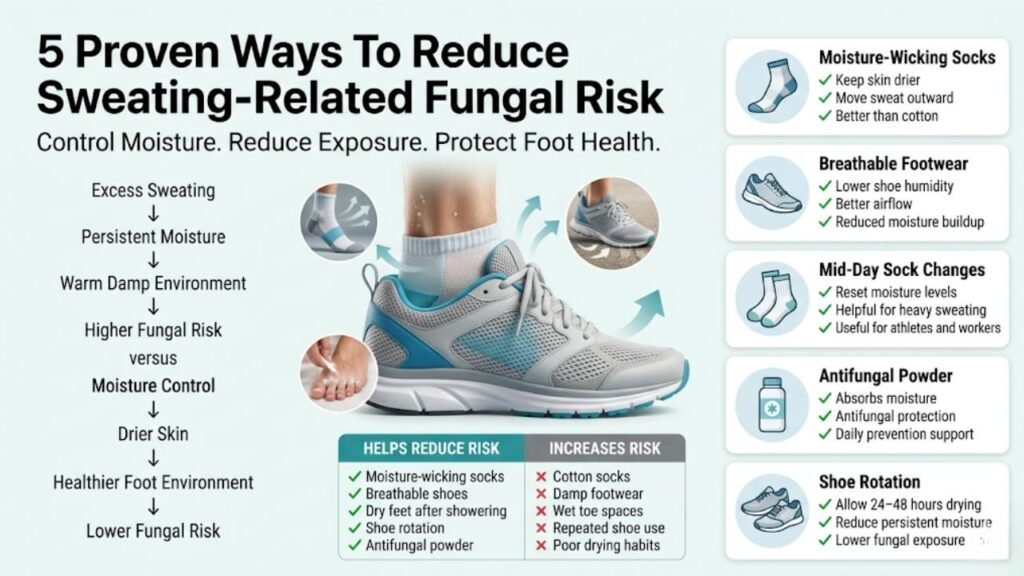
Understanding the mechanism of how sweating increase fungus risk works makes the relevant prevention interventions clear — and explains why some commonly recommended steps matter more than others:
Moisture-Wicking Socks — Managing the Moisture at the Skin Interface
Moisture-wicking socks move sweat away from the skin surface to the outer sock layer through capillary action. This reduces the sustained moisture contact at the skin surface — directly interrupting the first step in how sweating increase fungus risk operates.
Why cotton socks worsen the risk: Cotton absorbs sweat effectively but releases it slowly, maintaining saturated sock material against the skin. This extends the period of sustained skin moisture contact — the opposite of what is needed to reduce sweating increase fungus risk.
Breathable Footwear — Allowing Moisture Vapor to Escape
Performance mesh and engineered knit footwear allow moisture vapor to pass through the shoe wall to the outside environment. This reduces the buildup of humidity inside the shoe and keeps the internal moisture level lower throughout the day.
No footwear completely eliminates the sweating increase fungus risk — but highly breathable materials maintain meaningfully lower internal humidity than non-breathable alternatives.
Mid-Day Sock Changes for High-Sweat Individuals
For people with hyperhidrosis or those in physically demanding occupations, changing socks midday — before the sock is completely saturated — resets the moisture environment and reduces the sustained high-moisture skin contact that drives sweating increase fungus risk.
This simple intervention can meaningfully reduce infection risk for individuals who produce sweat at rates that single-sock wear cannot manage.
Antifungal Powder in Shoes and Interdigital Spaces
Antifungal powder in the shoe interior and between the toes provides two benefits:
- Moisture absorption — powder reduces the liquid moisture present on the skin surface
- Antifungal activity — kills or inhibits dermatophyte organisms that contact the powder
For people in whom sweating increase fungus risk is particularly significant — athletes, hyperhidrosis patients, workers in non-breathable footwear — daily antifungal powder application is one of the most practically impactful preventive measures available.
Complete Drying of the Interdigital Spaces After Showering
After any foot washing or shower, thorough drying of the interdigital spaces removes the moisture that would otherwise persist in these high-risk areas. This is where sweating increase fungus risk overlaps with shower hygiene — the interdigital spaces that were already moist from sweat during the day are then rewetted during showering, and if not dried, remain continuously moist.
Using a dedicated small towel to pat each interdigital space individually — inserting a corner of cloth between each toe pair — addresses this directly.
Shoe Rotation and Drying
Shoes worn when sweating is significant need 24 to 48 hours to dry adequately between wears. Wearing the same shoes daily — particularly athletic shoes — maintains a persistently moist shoe interior that extends the sweating increase fungus risk even after the foot is removed.
When Sweating-Related Risk Has Led to Infection
Recognizing that the sweating increase fungus risk has resulted in actual infection — so treatment can begin promptly — is important:
Athlete’s foot (tinea pedis) — early signs in high-sweat individuals:
- Itching between the toes, particularly the fourth and fifth toe space
- White, macerated (wet, softened) skin between the toes
- Peeling of skin at the toe spaces or on the sole
- Redness and scaling developing on the plantar skin
Nail involvement — early signs:
- White or yellow discoloration beginning at the nail tip
- Any nail change appearing after a period of high-sweat footwear use
Early athlete’s foot in otherwise healthy adults responds well to OTC antifungal creams (clotrimazole, terbinafine cream) when started promptly. Nail changes warrant professional evaluation for laboratory confirmation.
Frequently Asked Questions
Does sweating directly cause nail fungal infection?
Sweating does not directly cause infection — the fungal organism must first contact the skin or nail. But sweating increase fungus risk works by creating the moist conditions that allow any fungal spores present (from shoe interiors, floors, or environmental surfaces) to germinate and infect the tissue. Without adequate moisture, spores cannot become infectious regardless of contact.
If I dry my feet completely after showering, does sweating during the day still increase fungus risk?
Yes. Post-shower drying addresses shower-related moisture. But the sweating increase fungus risk from daytime foot sweat accumulating inside footwear is a separate and ongoing exposure that requires moisture management through sock selection, footwear breathability, and potentially midday sock changes for high-sweat individuals.
Do people with normal sweating levels need to worry about this?
People with normal sweat rates who wear reasonably breathable footwear, change socks daily, and allow shoes to dry between wears face modest sweating-related fungal risk — manageable with basic hygiene. The sweating increase fungus risk becomes more clinically significant for those with hyperhidrosis, those who exercise intensively, those in non-breathable occupational footwear, or those who use communal shower facilities regularly.
Can treating hyperhidrosis reduce nail fungal infection rates?
Yes. There is clinical logic supporting that reducing plantar sweat production in hyperhidrosis patients reduces the sustained high-moisture skin environment that drives their elevated sweating increase fungus risk. Patients with plantar hyperhidrosis who also have recurrent tinea pedis or onychomycosis often see improvement in infection frequency when hyperhidrosis is effectively managed.
Summary
Sweating increase fungus risk operates through a clear biological mechanism: foot sweat trapped inside footwear creates sustained moisture at the skin surface that allows dormant dermatophyte spores to germinate and infect the skin and nail. The interdigital spaces are the highest-risk site because their anatomy concentrates moisture with no evaporative pathway.
The most effective interventions directly target this moisture mechanism: moisture-wicking socks that move sweat away from the skin, breathable footwear that allows vapor to escape, midday sock changes for high-sweat individuals, antifungal powder in shoes and interdigital spaces, and shoe rotation to allow full drying between wears. For individuals with hyperhidrosis, medical management of the sweating itself is an appropriate additional step.
Understanding how sweating increase fungus risk actually works — rather than simply knowing that “wet feet are risky” — allows targeted interventions at each step in the infection pathway.
Struggling to get an appointment?
We help patients in your area bypass clinic waitlists by instantly finding verified podiatry doctors who accept their insurance.