How Often Should You Trim Toenails?
Find a Podiatrist Near You
Get same-day appointments with verified podiatrists. Insurance accepted.
Knowing when to trim toenails seems simple — until you realize that most foot problems caused by nail length are preventable, and most people have no clear schedule for when they actually do it. Some trim toenails every week out of habit. Others wait until the nails are visibly long and pressing on the shoe. Both approaches get the timing wrong in different directions.
When to trim toenails is not arbitrary. Toenails grow at a predictable rate, create predictable problems when left too long or cut too short, and the timing of trimming interacts with footwear use, physical activity level, age, and whether any underlying conditions affect nail growth. Getting this right is a practical foundation of nail health.

How Fast Do Toenails Actually Grow?
The frequency with which you need to trim toenails is determined primarily by how fast they grow — so that number matters.
Average toenail growth rate: Approximately 1.5 mm per month in healthy adults. This is roughly half the growth rate of fingernails (which grow approximately 3 mm per month).
What this means practically: A toenail grows approximately the thickness of a credit card every month. If you trim toenails to an appropriate length today, in four weeks that nail will have grown roughly 1.5 mm — enough to warrant reassessment.
Factors that slow nail growth:
- Advancing age — nail growth rate declines progressively after middle age, becoming significantly slower in adults over 70
- Poor peripheral circulation — reduced blood supply to the nail matrix slows growth
- Nutritional deficiency — particularly protein, zinc, and iron
- Illness or significant physiological stress — the nail may temporarily slow or pause growth (leaving a Beau’s line when it resumes)
- Cold environments — nail growth is slower in cold temperatures
Factors that increase nail growth:
- Dominant hand/foot — slightly faster growth on the dominant side
- Physical activity and warm climates — increased circulation to the nail
- Younger age — nail growth is fastest in children and young adults
- Pregnancy — hormonal stimulation of nail growth is well-documented
- Nail biting or repetitive nail trauma — paradoxically stimulates growth in affected nails
Understanding your individual nail growth rate is the most accurate way to determine how frequently you need to trim toenails.
The Right Answer: How Often to Trim Toenails
For most healthy adults: every 4 to 6 weeks
This range accounts for the average 1.5 mm monthly growth rate and the target nail length for most adults. At the 4-week mark, most people’s nails have grown enough to warrant trimming. At 6 weeks, nails are typically at the upper boundary of an appropriate length for most footwear situations.
Trim toenails more frequently (every 2 to 3 weeks) if you:
- Are an athlete who regularly runs, hikes, or engages in court sports where nail-to-shoe contact is a factor
- Have noticed that your nails consistently feel pressure inside footwear before the 4-week mark
- Are in your twenties or thirties with faster nail growth rates
- Are pregnant and notice accelerated nail growth
- Are preparing for a period of intensive physical activity (a marathon, extended hiking trip)
Trim toenails less frequently (every 6 to 8 weeks) if you:
- Are over 65, where slower growth rate means a longer interval is appropriate
- Have peripheral vascular disease or conditions that significantly slow nail growth
- Are not physically active and wear loose-fitting footwear with no nail-to-shoe contact issues
- Have recently trimmed to a shorter length and are monitoring growth
Important: Trim toenails based on length, not just calendar time
The schedule above is a guide, not a fixed rule. The best indicator of when to trim toenails is not the date but the actual nail length. At each trimming, you should be able to see that the nail has grown enough to require attention — visible growth beyond the target length, or beginning to feel against the shoe interior.
The Right Length: What You’re Aiming For
How often you trim toenails matters less than what you’re cutting them to. Getting the length wrong — either too short or too long — creates the problems that nail trimming is supposed to prevent.
Too Long — The Problems It Causes
A toenail that extends significantly beyond the tip of the toe creates mechanical problems with every step:
Footwear contact: The nail tip strikes the shoe front during walking, particularly during downhill movement. The repetitive impact applies force to the nail tip that is transmitted to the nail bed — causing subungual hematoma (blood beneath the nail), nail plate thickening over time, and pain during athletic activity. This is one of the primary mechanisms behind runner’s black toenail.
Nail catching: Long toenail edges catch on socks, bed sheets, and other fabrics — creating sudden force that can tear the nail, cause nail plate separation (onycholysis), or produce pain at the nail fold.
Hygiene: Longer nails accumulate debris beneath the nail tip more readily, creating a less clean environment.
Too Short — The Problems It Causes
Cutting too short is responsible for a significant proportion of ingrown toenail problems:
Skin overlap: When the nail is cut below the level of the surrounding skin, the soft tissue on either side of the nail edge begins to fold over the nail tip. As the nail grows forward, it grows beneath this overhanging tissue rather than over it — literally growing into the surrounding skin.
Nail bed exposure: Very short nails leave the nail bed without its protective covering. The nail bed skin is not designed to bear direct mechanical pressure — making walking painful.
Sensitive nail fold irritation: Even without a frank ingrown nail, cutting too short allows the nail edge to be positioned at the level of the sensitive nail fold, making any regrowth direction uncomfortable.
The Target Length
When you trim toenails correctly, the resulting nail should show a thin white rim extending just beyond the surrounding skin. This rim is the free edge of the nail plate — visible, but not extending significantly beyond the toe. The corners of the nail should remain above the level of the skin, not curved beneath it.
A practical test: after trimming, run your finger from the skin at the corner of the nail across to the nail tip. You should feel a small, smooth step from skin to nail — the nail edge is present and above skin level. If you feel the nail tip at the same level as or below the skin, the nail has been cut too short.
When to Trim Toenails: Timing Within Your Routine
Beyond frequency, the timing of when within your routine you trim toenails affects how well the procedure works.
Trim toenails after bathing or soaking
Hydrated nails are measurably more pliable than dry nails. The same cutting pressure on a hydrated nail produces a cleaner, smoother cut than on a dry nail, where brittleness causes more irregular edges and greater splitting risk. Waiting 5 to 10 minutes after bathing — before the nail fully dries again — produces the best cutting conditions.
Do not trim toenails immediately before intense athletic activity
Freshly trimmed nails may have slightly irregular or rough edges that haven’t been smoothed. For runners or hikers, this can cause minor friction issues at the nail tip on the first outing after trimming. Trim 2 to 3 days before a major athletic event if possible, or ensure thorough smoothing with a nail file after cutting.
Trim in good lighting
This sounds basic, but inadequate lighting is one of the more common causes of trimming errors — cutting at an unintended angle or misjudging corner depth. Always trim toenails in good light.
Trim Toenails Differently by Life Stage

Children
Children’s toenails grow faster than adult toenails and are softer. The target length is the same — just beyond the skin line — but the frequency needs to match their faster growth:
- Toddlers and young children: check every 2 to 3 weeks
- School-age children (particularly those in sports): check every 3 to 4 weeks
- Adolescents: similar to young adult rates, check every 4 weeks
Children’s softer nail tissue also cuts more easily, which means less force is needed and the risk of unintended angular cuts is lower — but also that very sharp edges result from poor technique if the nail is cut at an angle.
Active Adults (Athletes, Runners, Hikers)
For people whose feet undergo significant mechanical load during athletic activity, nail length directly affects performance and nail health:
Too-long nails during running create repetitive nail-to-shoe contact that accumulates into significant trauma across a training run. Distance runners and hikers should trim toenails to a shorter-than-casual length before events and trim more frequently during heavy training periods.
Target length for athletes: The nail tip should not contact the shoe during walking. Test by wearing training footwear, pressing your foot into its normal impact position (slightly forward), and checking whether the nail tip contacts the shoe ceiling. If it does, the nail is too long for that footwear.
Older Adults (65+)
Several factors change the trim toenails routine in older adults:
Slower growth: The 4 to 6 week window extends naturally — nails may not require trimming as frequently.
Thicker nails: Age-related onychauxis (nail thickening) makes trimming harder with standard clippers. Heavy-duty toenail nippers or professional nail care become more appropriate.
Reduced dexterity and reach: Many older adults cannot safely trim their own toenails due to reduced flexibility, visual impairment, or hand dexterity limitations. Professional podiatric nail care every 6 to 10 weeks is the most appropriate option for these patients — safer and more consistent than home trimming that compromises accuracy.
Underlying conditions: Diabetes and peripheral vascular disease in older adults make nail trimming a clinical safety concern, not just a hygiene routine. Reduced sensation means trimming errors may not be felt; reduced circulation means minor injuries heal slowly and carry higher infection risk. Professional nail care is strongly preferred.
Tools Matter: What to Use When You Trim Toenails
Using the right tool makes trimming faster, safer, and more effective:
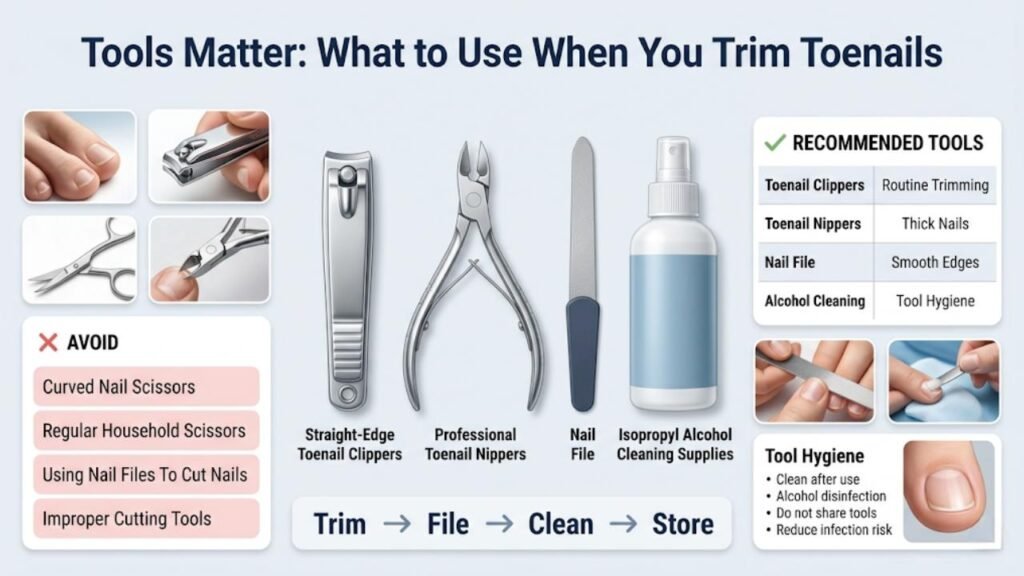
Toenail clippers (straight-edged): Designed specifically for toenails — wider jaw than fingernail clippers, less curvature in the cutting edge, more leverage for thick nail material. The tool of choice for most adults for routine nail trimming.
Toenail nippers (podiatric style): The professional-grade version — spring-loaded, long handles, precision cutting edge. Better for thickened nails or nails that standard clippers struggle with.
Nail file (emery board or metal): Used after cutting to smooth edges. File in one direction from the corner toward the nail center — back-and-forth sawing creates micro-fractures in the nail edge.
What to avoid: Scissors designed for fingernails (too much curvature), regular scissors, nail files used as the primary cutting tool, or nail cutters designed for a different purpose.
Tool hygiene: Sterilize clippers with isopropyl alcohol after each use — or at minimum before use on any other person’s nails. Contaminated clippers are a documented transmission route for nail fungal infection.
Trim Toenails Checklist: The Complete Routine
A practical reference for getting this right consistently:
- Trim toenails every 4 to 6 weeks (adjust based on individual growth rate and activity level)
- Check nail length weekly — if nail extends beyond toe tip significantly, trim regardless of schedule
- Trim after bathing while nails are still slightly hydrated
- Use straight-edged toenail clippers appropriate for nail thickness
- Cut straight across — no deep curves, no angular cuts
- Leave a thin white rim of nail just beyond the skin at the corners
- File rough edges smooth after cutting
- Inspect the area around the nail fold for any redness or soreness
- Sterilize clippers after each use
- For any persistent nail pain, redness at the corners, or signs of ingrown nail — seek podiatric evaluation rather than trying to trim more aggressively at home
When Professional Nail Care Is the Right Answer
Some patients should not self-trim toenails at home — and knowing when to seek professional care is part of appropriate nail management.
- Diabetes with any peripheral neuropathy or vascular compromise
- Very thick nails (onychauxis or onychogryphosis) that cannot be cut cleanly with available tools
- Active ingrown toenail — do not attempt to cut this yourself
- Reduced dexterity, poor vision, or difficulty reaching your feet safely
- Any condition where a minor nail-trimming injury could have serious consequences
Professional podiatric nail care provides not just trimming but clinical assessment of the nails and surrounding tissue at each visit — catching early changes that home care might miss.
Frequently Asked Questions
How often should you trim toenails for normal healthy feet?
Every 4 to 6 weeks is the standard recommendation for most healthy adults based on average toenail growth of approximately 1.5 mm per month. Athletes and younger adults may need to trim toenails every 3 to 4 weeks; older adults may find 6 to 8 weeks more appropriate.
Is it bad to trim toenails too often?
Trimming more frequently than growth warrants is less of a problem than trimming too short. If you trim toenails every 2 weeks but maintain appropriate length each time, no harm results. The problem is over-cutting to too short a length, which happens more easily when trimming too frequently because there is less nail to work with.
Should you trim toenails before or after a shower?
After a shower is significantly better. Hydrated nails cut more cleanly, producing smoother edges and less risk of splitting. Trim within a few minutes of showering before the nail fully dries again.
Can neglecting to trim toenails cause nail fungal infection?
Not directly — fungal infection is caused by fungal organism exposure, not nail length. However, long toenails press against shoe interiors, creating microtrauma that disrupts the nail tip seal (hyponychium), providing entry points for fungal organisms. There is also more subungual debris beneath longer nails, creating a favorable environment. So while long nails don’t cause fungal infection directly, they create conditions that increase susceptibility.
Summary
The right answer to how often to trim toenails is every 4 to 6 weeks for most adults — adjusted based on individual growth rate, activity level, age, and health conditions. The goal of trimming is maintaining a consistent nail length: a thin white rim just beyond the skin, cut straight across with corners not curved under the skin level.
Too long causes nail-to-shoe impact, catching, and trauma. Too short causes skin overlap and ingrown toenail risk. The timing within your routine matters too — trim after bathing with appropriate tools in good light.
For older adults, diabetic patients, or anyone with conditions that make self-trimming risky or difficult, professional podiatric nail care on a 6 to 10 week schedule is the appropriate alternative.
Struggling to get an appointment?
We help patients in your area bypass clinic waitlists by instantly finding verified podiatry doctors who accept their insurance.