Reinfection vs Treatment Failure – What’s the Difference?
Find a Podiatrist Near You
Get same-day appointments with verified podiatrists. Insurance accepted.
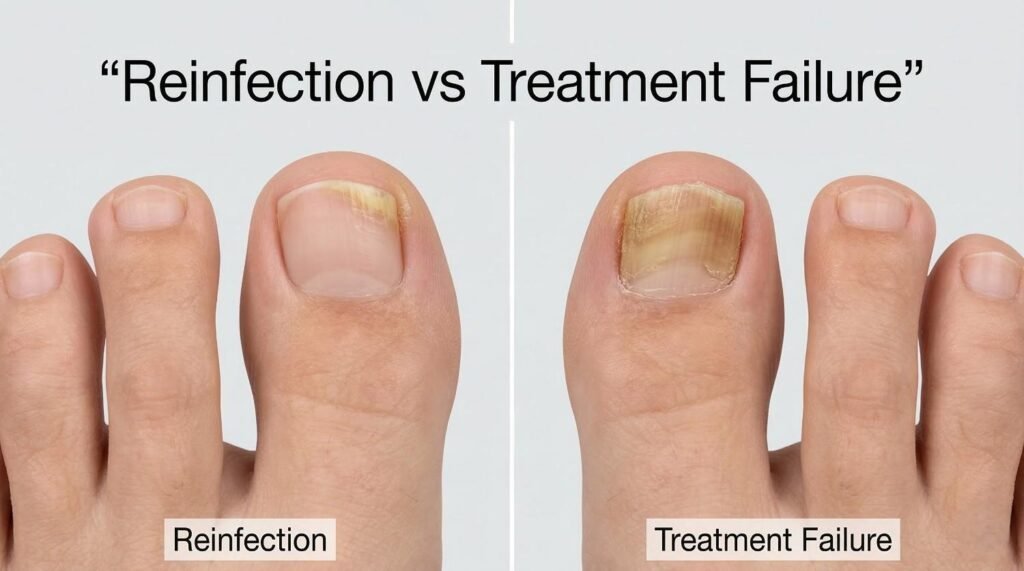
Reinfection vs treatment failure is a distinction that determines whether a returning toenail fungus infection needs a completely different treatment approach or a focused environmental prevention strategy. Most patients who experience recurring nail fungus assume the situation is the same as before. In reality, these are two fundamentally different clinical scenarios that require entirely different responses — and confusing one for the other is one of the most common reasons patients remain trapped in cycles of recurring infection.
When a toenail that appeared to be clearing starts showing fungal changes again, the immediate question is whether the original infection was ever truly eliminated. If it was not, that is treatment failure. If it was cleared and then new infection established itself from environmental re-exposure, that is reinfection. The nail changes in both situations can look virtually identical. The causes, prevention strategies, and next steps are not.
This guide explains reinfection vs treatment failure in clinical and practical terms — how each develops, how they are distinguished, what causes each, and what the appropriate response to each looks like.
Why the Reinfection vs Treatment Failure Distinction Matters
Before explaining how to tell the difference, it is worth establishing why the distinction is clinically significant beyond academic interest.
If you have treatment failure and treat it as reinfection:
You will focus on environmental hygiene and avoiding re-exposure — all sensible steps, but entirely insufficient if the fungus was never actually cleared. The original infection will continue progressing while you improve your shoe rotation and change your socks more frequently. You will not be addressing the actual problem.
If you have reinfection and treat it as treatment failure:
You may conclude that your previous medication did not work and request a different or stronger antifungal. You may undergo unnecessary testing or extended combination therapy when in reality the original treatment worked perfectly and the new infection is from a fresh environmental exposure that better prevention would address.
The practical consequence of confusing reinfection vs treatment failure:
Most patients with recurring nail fungus end up in an indefinite loop — treating, improving, relapsing, treating again — because the correct diagnosis of what type of recurrence they are experiencing is never made, and therefore the correct specific intervention is never implemented.
Making the reinfection vs treatment failure distinction correctly moves you from that loop to a targeted solution.
What Is Treatment Failure?
Treatment failure in the context of onychomycosis means the original fungal infection was not fully eliminated during the treatment course. The fungal organisms remained viable within the nail plate or nail bed throughout and after treatment, and the nail never achieved true mycological clearance — confirmed absence of viable fungal organisms.
What Treatment Failure Looks Like
The defining characteristic of treatment failure is that the nail never returned to a genuinely healthy state. Even during treatment — or immediately after completing it — the nail showed only partial improvement or no meaningful improvement.
Clinical signs suggesting treatment failure rather than reinfection:
- The nail appeared better but never looked fully healthy during or after treatment
- New healthy nail growing from the base showed abnormalities rather than appearing clear
- The infection appeared to halt temporarily but then resumed progressing
- Multiple nails that were previously involved continued showing changes
- The nail returned to its previous appearance within weeks to a few months of completing treatment
The last point is particularly important for the reinfection vs treatment failure distinction. When nail changes return within 4 to 8 weeks of finishing treatment, treatment failure is far more likely than reinfection. Environmental exposure and establishment of a new infection takes time — weeks to months — before producing visible nail changes. A nail that is showing fungal signs within a few weeks of treatment completion almost certainly harbored viable organisms throughout the treatment course.
Why Treatment Failure Occurs
Stopping medication before completing the full course
This is the most common cause of treatment failure. Oral terbinafine at 12 weeks is designed to maintain therapeutic drug concentrations in the nail plate for long enough to eliminate the entire fungal colony. Stopping at week 8 because the nail looks better leaves surviving organisms that immediately resume growing when medication is withdrawn.
Poor topical penetration in established infection
Topical antifungal agents — ciclopirox, efinaconazole, tavaborole — struggle to penetrate a thick, heavily infected nail at therapeutic concentrations. Using topical-only therapy for an infection that requires oral medication is a mismatch that produces partial improvement without clearance.
Wrong organism — mismatched treatment
Non-dermatophyte molds (Fusarium, Scopulariopsis, Aspergillus) and Candida species do not respond reliably to terbinafine, which is specifically effective against dermatophytes. A mold infection treated with terbinafine will not clear — not because of resistance in the traditional sense, but because the drug simply does not have meaningful activity against that organism at standard doses.
Dermatophytoma — dense fungal colony formation
When compact, biofilm-like masses of fungal hyphae form within the nail plate, they create physical barriers to drug penetration. The core of a dermatophytoma may receive insufficient drug exposure even with full oral antifungal compliance, leaving viable organisms that sustain the infection.
Underlying health conditions reducing drug effectiveness
Diabetes, peripheral vascular disease, and immune suppression all reduce antifungal medication delivery to the nail and the immune system’s role in clearing residual organisms. Standard treatment protocols may not achieve adequate drug levels or immune support in these patients, producing treatment failure despite good compliance.
Inconsistent topical application
For topical-only treatment, missing applications reduces the sustained antifungal concentration at the nail surface that is needed to progressively eliminate the infection. Gaps of several days in daily application create conditions for fungal recovery between applications.
What Is Reinfection?
Reinfection means the original nail fungal infection was successfully eliminated — the nail achieved true mycological clearance — and then a new infection established itself from external fungal spore exposure after treatment was completed.
In genuine reinfection, there is a period of time after treatment when the nail was demonstrably healthy — or at least significantly improved with new clear nail growing from the base — before fungal changes appeared again.
What Reinfection Looks Like
The defining characteristic of reinfection is the interval of genuine improvement between the cleared infection and the new infection. New nail that grew in after completing treatment was clear and structurally normal. The fungal changes appearing now are new changes developing in previously healthy nail tissue.
Clinical signs suggesting reinfection rather than treatment failure:
- The nail appeared genuinely healthy — or significantly improved with clear new nail — for several months after completing treatment
- Fungal changes appear in previously clear nail area rather than in nail that was continuously abnormal
- The new infection started at the nail tip or edge, consistent with a new entry-point infection rather than continued progression from the nail base
- The timeline from completing treatment to recurrence spans 6 months or more
- A specific new exposure event is identifiable — a new gym membership, hotel stay, salon visit, or period of intensive athletic activity
The reinfection vs treatment failure timeline distinction — months of clear nail versus quick return of changes — is one of the most practically useful clinical differentiators.
Why Reinfection Occurs
Contaminated footwear
The most overlooked source of reinfection. Shoes worn throughout an active nail infection accumulate significant dermatophyte spore contamination in the interior fabric and lining. Unless decontaminated with antifungal spray or replaced, these shoes reintroduce spores to treated nails every time they are worn.
Untreated concurrent athlete’s foot (tinea pedis)
Athlete’s foot is the most common source of nail reinfection. If tinea pedis was present during the nail infection — which it is in the majority of onychomycosis patients — and was not definitively treated and cleared alongside the nail, the skin infection persists as a continuous spore source for the nails even after antifungal treatment is complete.
This is the single most important preventable cause of reinfection, and it is consistently underemphasized in standard treatment guidance.
Communal wet area re-exposure
Returning to gym locker rooms, public pools, spa facilities, and hotel showers without protective footwear after completing treatment exposes treated nails to the same fungal spore environments that produced the original infection.
Shared or contaminated nail tools
Nail clippers, files, and cuticle tools contaminated during the infection period carry viable spores. Using these tools on treated nails without sterilization directly deposits spores onto the nail surface.
Household environment
Bath mats, bathroom floor tiles, and shared towels in the home accumulate spores from the infected individual during the treatment period. After treatment, using the same contaminated bath mat or walking barefoot on an unclean bathroom floor reintroduces environmental spores to treated nails.
How to Distinguish Reinfection vs Treatment Failure
Distinguishing reinfection vs treatment failure in clinical practice involves combining the timeline of recurrence, the pattern of nail changes, and where available, laboratory testing.
The Timeline Test
| Timeline Feature | Suggests Treatment Failure | Suggests Reinfection |
|---|---|---|
| Time from treatment completion to recurrence | Less than 4 months | More than 6 months |
| Was the nail ever clearly healthy after treatment? | No — improvement was partial only | Yes — clear new nail had grown in |
| Pattern of new changes | Continuous with previous infection zone | New changes in previously clear nail |
| Proximity to cuticle | Changes appearing from the nail base forward | New changes starting at the nail tip |
Laboratory Confirmation
The most definitive approach to reinfection vs treatment failure is laboratory testing at two time points:
At treatment completion: KOH microscopy or fungal culture of nail clippings. Negative results at this point confirm mycological clearance — ruling out treatment failure as the explanation for any subsequent recurrence.
At recurrence: KOH microscopy or culture from the affected nail. Positive results confirm active fungal infection. Species identification tells you whether the same organism is responsible (consistent with either scenario) or a different organism (strongly suggesting reinfection from a different environmental source rather than survival of the original infection).
Many patients who present with apparent recurrence have never had laboratory confirmation of clearance at treatment completion — making the reinfection vs treatment failure distinction impossible to make retrospectively with certainty. This is why end-of-treatment laboratory confirmation is clinically valuable, not just a formality.
Pattern of Nail Involvement
In reinfection, new infection typically starts at the nail tip — the most common entry point — and spreads proximally over subsequent months, following the classic distal subungual pattern of progression.
In treatment failure, changes often originate closer to the nail matrix or appear in the mid-nail rather than beginning clearly at the tip, because the surviving fungal organisms were already deeper within the nail plate when treatment ended.
Treatment Response: Reinfection vs Treatment Failure
Managing Confirmed Treatment Failure
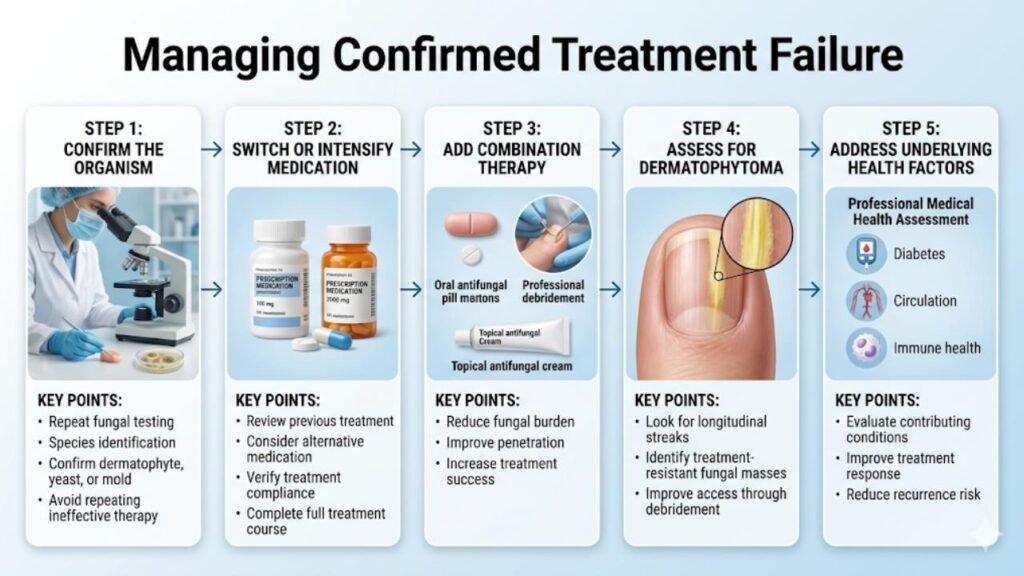
When treatment failure is the diagnosis, the approach must address why the original treatment did not work — not simply repeat it.
Confirm the organism: Fungal culture with species identification before initiating a new treatment course. If terbinafine was used and failed, ruling out a mold or yeast infection is essential before prescribing it again.
Switch or intensify medication: If the organism is confirmed as a dermatophyte and terbinafine was used correctly for the full course, consider itraconazole as an alternative. If compliance was the issue, reinforce the importance of the complete course before retrying.
Add combination modalities: Treatment failure cases benefit from combination approaches — oral antifungal plus professional nail debridement plus topical antifungal. Debridement physically reduces fungal load and removes the dense nail structure that limited drug penetration in the failed first course.
Assess for dermatophytoma: If a longitudinal yellow or white streak is present in the nail, consider whether dermatophytoma is contributing to treatment resistance. Physical disruption through debridement before resuming antifungal therapy may improve outcomes.
Address underlying health factors: Assess whether diabetes, vascular disease, or immune compromise is contributing to inadequate treatment response and address these factors as part of the management plan.
Managing Confirmed Reinfection
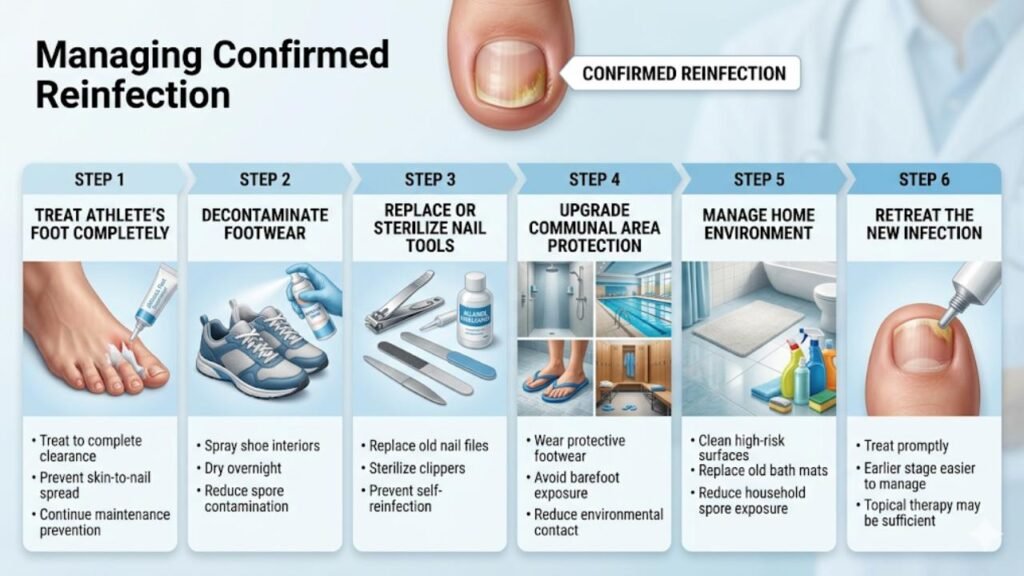
When reinfection is the diagnosis, the focus shifts to identifying and eliminating the environmental and behavioral sources of re-exposure — not simply retreating the nail.
Treat athlete’s foot definitively: If tinea pedis is present on the plantar surface or interdigital spaces, it must be treated to complete clearance and maintained with prophylactic topical antifungal application afterward. This step is non-negotiable in reinfection management.
Decontaminate or replace footwear: Apply antifungal spray to the interior of all footwear that was worn during the previous infection period. Allow to dry overnight before wearing. Consider replacement for shoes worn daily throughout the original infection.
Replace potentially contaminated nail tools: Nail files cannot be adequately sterilized and should be replaced. Nail clippers should be sterilized with isopropyl alcohol or replaced.
Upgrade protection in communal areas: Evaluate whether protective footwear is being worn consistently — not occasionally — in all communal wet environments. If not, this is the likely environmental exposure point.
Household environmental management: Clean bathroom floors with antifungal-containing cleaners. Replace old bath mats. Consider whether a household member also has active nail or skin fungal infection that is contributing to the home environment’s spore load.
Retreat the nail infection: The new reinfection still requires appropriate antifungal treatment — but because it is a fresh infection rather than a persistent one, it is likely at an earlier stage than the original infection when caught promptly, making topical-only therapy potentially sufficient if less than 50 percent of the nail is involved.
Preventing Both Reinfection and Treatment Failure
Some prevention strategies are universally applicable regardless of which scenario a patient is managing.
During active treatment (prevents treatment failure):
- Complete the full prescribed oral antifungal course without exception
- Apply topical medication daily without missing applications
- Attend scheduled monitoring appointments
- Treat concurrent athlete’s foot simultaneously
After completing treatment (prevents reinfection):
- Apply topical antifungal to previously infected nails twice weekly as maintenance
- Continue treating athlete’s foot until fully clear
- Decontaminate all footwear
- Maintain protective footwear in all communal wet areas indefinitely
- Inspect nails monthly for early signs of new infection — catching reinfection early makes retreatment simpler
Universal (prevents both):
- Never share nail tools
- Launder socks at high temperature
- Keep feet consistently dry
- Treat any nail changes that persist beyond 4 to 6 weeks professionally rather than waiting
Frequently Asked Questions
How can I tell if I have reinfection vs treatment failure?
The key indicator is whether your nail ever fully or significantly improved after treatment. If it was clear or noticeably better for several months before changes returned — reinfection is more likely. If it never fully cleared and returned quickly after stopping medication — treatment failure is more likely. Laboratory testing at treatment completion and at recurrence provides the most definitive answer.
Does reinfection mean my treatment failed?
No. Reinfection means the treatment worked — the original infection was cleared — and a new infection developed from fresh environmental exposure. The distinction is important because it means the treatment approach was correct and the focus for next steps is prevention rather than treatment modification.
Can the same treatment be used for reinfection?
If laboratory testing confirms the organism is the same species and the previous treatment was completed fully and correctly, the same treatment can be appropriate for reinfection since the organism demonstrated susceptibility. However, the treatment course needs to be accompanied by intensive environmental prevention to address the re-exposure source.
What does it mean if my fungus returned within weeks of finishing treatment?
Very rapid recurrence — within 4 to 8 weeks — is a strong indicator of treatment failure rather than reinfection. A new environmental exposure producing visible nail changes that quickly is biologically very unlikely. This timeline strongly suggests the infection was never fully cleared during the treatment course.
Should I get laboratory testing before retreating recurring nail fungus?
Yes — particularly for the reinfection vs treatment failure distinction and to rule out a change in the causative organism. Culture results guide whether the same medication is appropriate or whether a different agent is needed, and whether the ongoing infection is the same species or a new environmental organism.
Can reinfection be prevented completely?
Not absolutely — fungal spores are present in many environments that cannot be fully controlled. However, treating concurrent athlete’s foot, decontaminating footwear, using maintenance topical antifungal, and consistently wearing protective footwear in communal areas substantially reduces reinfection probability to a manageable level for most patients.
Summary
Reinfection vs treatment failure is not a subtle academic distinction — it is a clinically meaningful difference that determines the correct next steps for patients dealing with recurring toenail fungus. Treatment failure means the original infection was never fully cleared, requiring evaluation of why the treatment was inadequate and modification of the approach before retrying. Reinfection means the treatment worked but environmental re-exposure produced a new infection, requiring intensive prevention measures to address the source of ongoing fungal spore contact.
The timeline of recurrence relative to treatment completion, the pattern of nail involvement, and laboratory confirmation at key time points are the tools that make this distinction reliably. Using those tools — rather than assuming all recurrence is the same — is what allows patients to finally move from a cycle of recurring infection to sustained nail health.
Struggling to get an appointment?
We help patients in your area bypass clinic waitlists by instantly finding verified podiatry doctors who accept their insurance.