Pincer Nail Stages Explained
Find a Podiatrist Near You
Get same-day appointments with verified podiatrists. Insurance accepted.
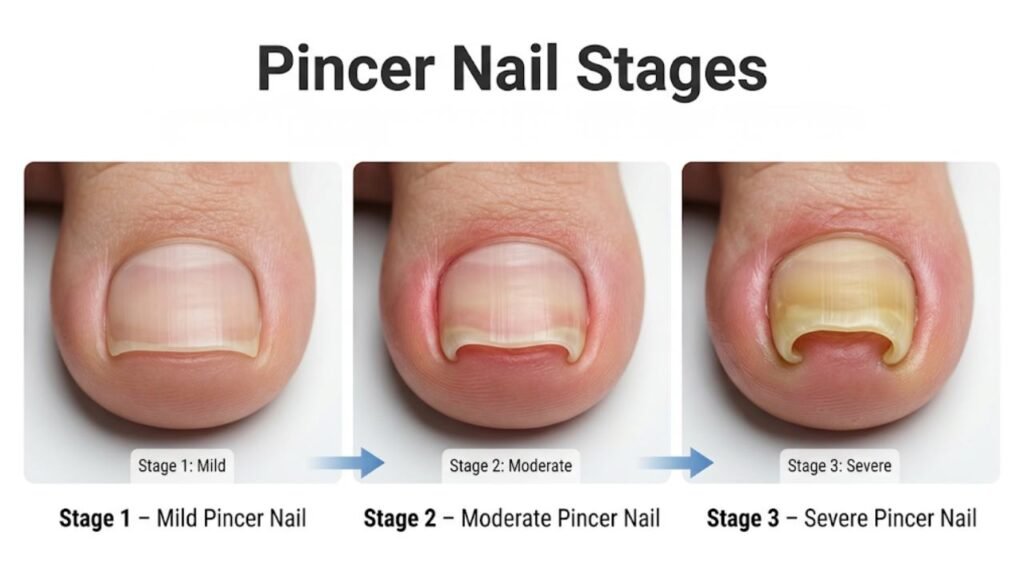
Pincer nail stages describe how a nail deformity progresses from a subtle inward curve at the nail edges to a severely compressed, painful nail that digs into the surrounding tissue. Understanding where your nail sits in this progression — and what it means for treatment — is the most practical starting point for anyone dealing with this condition.
Pincer nail, also called trumpet nail or tile nail depending on the shape, is a deformity where the edges of the nail plate curve inward and downward. Instead of growing flat, the nail curls toward the nail bed from both sides. At mild stages, this may be a cosmetic concern with minimal discomfort. At severe stages, the nail compresses the nail bed tissue beneath it, causes significant pain, and creates a risk of secondary infection in the surrounding skin.
This guide explains each of the pincer nail stages in clear detail — what the nail looks like, what symptoms develop, what causes the progression, and what treatment is actually appropriate at each level.
What Is Pincer Nail?
Pincer nail is a structural nail deformity where the lateral edges of the nail plate curve inward in an exaggerated way. A normal toenail is relatively flat — or only very gently curved across its width. In pincer nail, the curve becomes progressively more pronounced, with the edges bending downward and toward each other.
This inward curving creates a pinching effect on the nail bed — the soft tissue beneath the nail plate. As the nail curves more severely, it compresses this tissue progressively, reducing blood flow to the nail bed, causing pain, and in advanced stages, damaging the surrounding skin.
The great toenail is most commonly affected, though pincer nail can occur in other toes. It can affect one foot or both, sometimes symmetrically.
Pincer nail is not the same as an ingrown nail, though the two are sometimes confused. In an ingrown nail, the nail edge grows into the skin at the side of the nail. In pincer nail, the entire nail plate curves inward — it is a deformity of the nail’s shape rather than just its growth direction at one edge.
What Causes Pincer Nail?
Understanding the causes helps explain why pincer nail stages tend to progress in predictable ways and what interventions can slow or stop that progression.
Genetic Factors
A hereditary tendency toward this nail shape is one of the most common causes. Patients who ask “why does my pincer nail keep coming back?” often have a genetic predisposition — the shape is what their nail matrix is designed to produce. When pincer nail runs in families and affects multiple toenails symmetrically, genetics is typically the primary explanation.
Tight or Narrow Footwear
Shoes that compress the forefoot — narrow toe boxes, pointed styles, shoes that are too short — apply lateral pressure to the nail continuously during wear. This ongoing pressure gradually pushes the nail edges inward, reinforcing a curved growth pattern. Over months and years, the nail shape responds to this constant lateral force.
Age-Related Changes
Nail growth slows with age, and the characteristics of the nail plate change. Age-related pincer nail often develops gradually across the fourth, fifth, and sixth decades as the nail structure becomes more curved and dense over time.
Systemic Health Conditions
Several systemic conditions affect nail shape and contribute to or worsen pincer nail:
- Osteoarthritis — particularly affecting the distal interphalangeal joint beneath the nail
- Psoriasis — affecting nail matrix function and nail plate structure
- Diabetes — through its effects on circulation and tissue characteristics in the foot
- Peripheral vascular disease — reducing blood flow and altering tissue in the nail unit
Subungual Osteophyte
In some patients, a bony spur (osteophyte) growing from the bone beneath the nail pushes up against the nail plate from below. This upward pressure from beneath forces the nail edges to curl inward — the nail deforms outward and downward at the sides in response to the pressure from below. This cause of pincer nail stages is particularly important to identify because treating the nail alone without addressing the underlying bone spur will not produce lasting improvement.
Trauma
A significant injury or repeated mechanical stress to the nail unit can alter the nail matrix and produce a curved nail pattern in subsequent growth cycles.
The 3 Pincer Nail Stages
Stage 1: Mild Pincer Nail
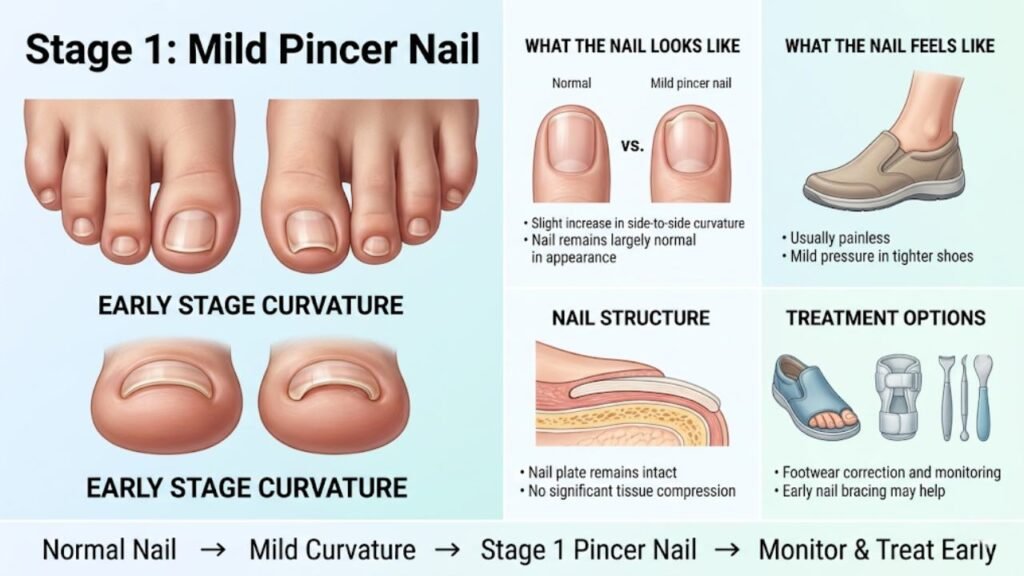
What the nail looks like:
At the mild stage, the nail plate has a slightly more curved profile than normal across its width. Looking at the nail from the toe end, it has more of an arc than a healthy flat nail — but it is subtle enough that most people do not notice it until they are specifically looking for it.
The nail tip may show the curvature more clearly than the base — where the nail emerges from under the cuticle, it often still looks relatively flat, with the curving increasing toward the nail tip.
What the nail feels like:
Mild pincer nail is often painless or causes only very minor pressure sensation along the nail sides, particularly inside tight footwear. Many patients at this stage are either not aware of the deformity or notice it only as a cosmetic concern.
Nail structure:
The nail plate is present and structurally intact. No compression of the nail bed is occurring yet — the nail is curved but not yet creating significant force against the tissue beneath it.
Risk of complications:
Low. At the mild stage, secondary infection and nail bed damage are uncommon.
Treatment at Stage 1:
- Footwear correction — wider toe box shoes to reduce lateral nail pressure
- Regular professional nail trimming to keep the nail at a short, manageable length
- Nail bracing (orthonyxia) can be started early and is most effective when the deformity is mild
- Monitoring — checking whether the curvature is increasing or stable over time
Mild pincer nail caught at Stage 1 has the best prognosis. Many patients who address footwear and begin nail bracing at this stage can maintain the nail at a mild, manageable level without progression.
Stage 2: Moderate Pincer Nail
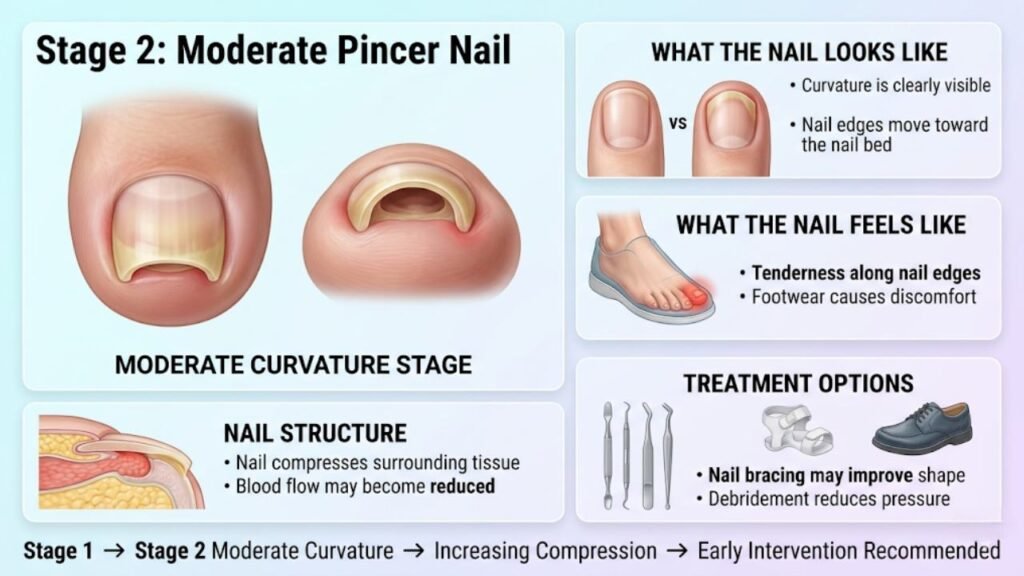
What the nail looks like:
At the moderate stage, the inward curvature of the nail is clearly visible. The nail plate curves significantly across its width — the nail tip area may look almost tunnel-shaped when viewed straight on. The nail edges are moving toward the nail bed on both sides, and the nail plate is often also becoming thicker and harder.
The nail may have taken on a more yellowish or opaque appearance. The nail folds on the sides of the nail — the skin around the nail edges — may show signs of irritation from the increasing nail pressure.
What the nail feels like:
Moderate pincer nail causes noticeable discomfort. Patients at this stage typically report:
- Tenderness or aching along the nail sides
- Discomfort inside closed footwear, particularly shoes that are not wide
- Sensitivity when pressure is applied to the nail or surrounding area
Pain at rest is not usually prominent at Stage 2, but activity and footwear consistently provoke discomfort.
Nail structure:
The nail plate is compressing the nail bed tissue on both sides. This compression reduces blood flow to the nail bed edges. Over time, the nail bed tissue begins to respond — it may become more fibrous and the blood supply changes.
Risk of complications:
Moderate. The nail edges are creating enough pressure that skin breakdown and secondary infection become more realistic risks, particularly if the nail edge is sharp or jagged.
Treatment at Stage 2:
- Professional nail debridement — thinning and reshaping the nail to relieve compression pressure
- Nail bracing with a spring-type or glue-type nail brace — these are attached to the nail plate and apply a gentle corrective force to flatten the nail over time
- Footwear assessment — proper fitting shoes with adequate width
- Monitoring the nail fold skin for signs of irritation or early infection
Nail bracing at Stage 2 is less simple than at Stage 1 because the deformity is more established, but it can still produce meaningful improvement in nail curvature over the 6 to 12 months of brace wear.
Stage 3: Severe Pincer Nail
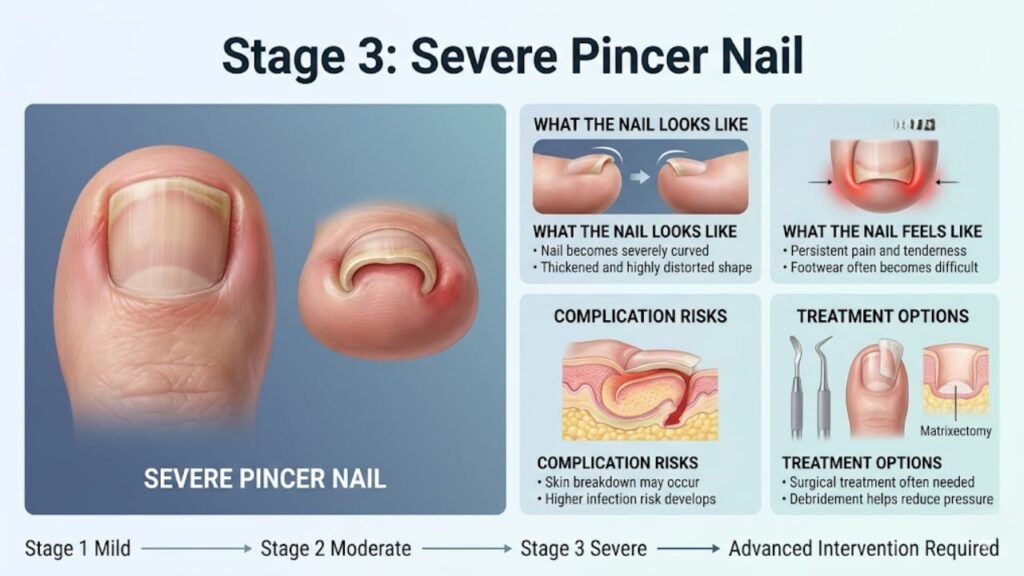
What the nail looks like:
At the severe stage, the nail plate has taken on a dramatically deformed shape. When viewed from the toe end, the nail may be nearly tubular or omega-shaped — the edges have curved so far inward that they are almost meeting beneath the nail plate. The nail is significantly thickened and very hard.
The nail plate may appear dark yellow, brown, or even partially black. The nail bed visible at the nail tip may look compressed and pale, reflecting the reduced blood flow from prolonged nail bed compression.
The nail fold skin on both sides is often inflamed, thickened, or shows signs of breakdown from chronic nail edge pressure.
What the nail feels like:
Severe pincer nail causes significant, persistent pain. Patients at this stage typically experience:
- Constant pain in the nail and surrounding toe
- Significant pain with any footwear — even wide or soft shoes
- Tenderness to light touch around the nail
- In the most advanced cases, breakdown of the skin along the nail edges with potential secondary bacterial infection
Nail structure:
The nail is severely compressing the nail bed on both sides. Chronic compression has altered the tissue beneath and alongside the nail. In some cases, the nail edges have broken through the surrounding skin, creating small wounds that are slow to heal and at risk of infection.
Risk of complications:
High. Severe pincer nail carries a real risk of:
- Secondary bacterial infection in the nail fold tissue
- Chronic skin breakdown alongside the nail edges
- In diabetic patients, significantly elevated risk of complications from any of the above
Treatment at Stage 3:
Stage 3 pincer nail almost always requires professional podiatric management. Non-surgical options are limited when deformity is severe.
Conservative options if attempted:
- Aggressive nail debridement and reshaping
- Nail bracing — more challenging at this stage due to deformity severity but sometimes used in combination with other treatments
- Protective padding for the nail fold skin
Surgical options typically needed:
- Partial nail avulsion — removing the curved edges of the nail under local anesthesia while preserving the central nail. This immediately relieves the nail edge pressure on the surrounding tissue. In some cases, the edges grow back with the same curvature — which is why matrix treatment of the edges is often considered alongside avulsion.
- Partial matrixectomy — chemically or surgically destroying the lateral portion of the nail matrix so the problematic curved edges do not regrow. This is a more definitive procedure.
- Total nail avulsion — complete nail removal, typically reserved for the most severe or complicated presentations
- Subungual osteophyte removal — when a bone spur beneath the nail is contributing to the deformity, surgical removal of the osteophyte may be needed as part of management
Pincer Nail Shape Types Within the Stages
At any stage, the specific shape of the curvature may differ. These shape variations are sometimes used to describe pincer nail presentations more precisely:
| Shape Type | Description | Typical Stage |
|---|---|---|
| Tile nail | Mild uniform curve across the nail width | Stage 1 to early Stage 2 |
| Trumpet nail | Sharper downward curve at the nail edges | Stage 2 to Stage 3 |
| Omega nail | Extreme curvature — edges almost meeting | Severe Stage 3 |
How Pincer Nail Stages Progress Over Time
Understanding why pincer nail stages progress helps patients appreciate the importance of early management.
At the mild stage, the curved nail applies only minor force to the nail bed. The nail bed tissue tolerates this force without significant change. But as the nail continues to grow in its curved pattern — unmanaged — the curvature typically becomes more pronounced with each growth cycle. This happens because:
- The nail bed tissue being compressed responds by becoming more fibrous, which further reinforces the curved nail shape
- The nail matrix, producing nail in a curved growth direction, continues producing nail in that same direction
- If footwear continues to apply lateral pressure, it reinforces rather than corrects the curvature
This self-reinforcing progression is why early intervention — at Stage 1 or early Stage 2 — is so much more effective than waiting for the deformity to become severe.
Can Pincer Nail Be Prevented From Getting Worse?
At mild stages, progression can often be significantly slowed or stopped with:
- Correct footwear — removing lateral nail pressure is the single most important environmental change
- Early nail bracing — applying corrective force while the deformity is mild and the nail is still relatively flexible
- Regular professional nail care — keeping the nail trimmed correctly and monitored for progression
- Managing underlying conditions — treating psoriasis, optimizing diabetes management, addressing circulatory conditions
At severe stages, prevention of further deterioration is still possible, but the focus shifts toward managing the existing deformity and its complications rather than reversing it.
Frequently Asked Questions
What do pincer nail stages look like at the beginning?
Mild pincer nail stages show a subtle increase in the nail’s across-width curvature. The nail looks slightly more curved than a flat normal nail but is not dramatic. Most patients notice it only when comparing their nail to others or when examining it specifically.
Are all pincer nail stages painful?
Pain typically increases with progression through pincer nail stages. Stage 1 is usually painless or mildly uncomfortable. Stage 2 produces noticeable tenderness and footwear discomfort. Stage 3 causes significant, sometimes constant pain that affects daily activity.
Can pincer nail be fixed without surgery?
Mild to moderate pincer nail stages often respond to nail bracing, professional debridement, and footwear correction without requiring surgery. Severe Stage 3 deformity usually requires surgical intervention — partial avulsion with or without matrixectomy — because the curvature is too severe for non-surgical correction.
How long does treatment take across pincer nail stages?
Nail bracing treatment for mild to moderate pincer nail stages typically runs 6 to 12 months. Nails grow slowly — approximately 1.5 mm per month — so correction takes time. Surgical treatment provides more immediate relief but is followed by a healing period and monitoring for recurrence.
Does pincer nail come back after treatment?
Recurrence is possible, particularly when genetic predisposition is the underlying cause. After any treatment, ongoing preventive measures — correct footwear, regular professional nail care, monitoring for early signs of curvature returning — are important for maintaining the improvement achieved.
When should I see a podiatrist for pincer nail?
At any pincer nail stage where pain is present, where footwear is becoming difficult to manage, where the nail fold skin shows signs of irritation, or where you have diabetes or poor circulation. Earlier evaluation produces better treatment options and outcomes.
Summary
Pincer nail stages describe a progressive deformity that moves from mild inward nail curvature causing little discomfort, through moderate curvature with increasing nail fold pressure and pain, to severe tubular or omega-shaped nail causing significant compression, pain, and risk of skin breakdown.
Understanding which stage your nail has reached determines what treatment is realistically appropriate. Mild stages respond well to footwear correction and nail bracing. Moderate stages need professional nail care and structured bracing. Severe stages typically require surgical intervention to remove the curved nail edges and prevent regrowth in the same pattern.
The most important practical message about pincer nail stages is this: the earlier the intervention, the simpler and more effective the treatment. A Stage 1 nail that is addressed with correct shoes and early bracing is a very different management situation from a Stage 3 nail that requires surgery.
Struggling to get an appointment?
We help patients in your area bypass clinic waitlists by instantly finding verified podiatry doctors who accept their insurance.