Can Tight Shoes Cause Nail Deformities?
Find a Podiatrist Near You
Get same-day appointments with verified podiatrists. Insurance accepted.
Tight shoes cause nail deformities — and this happens far more gradually and quietly than most people expect. There is no single dramatic moment. No sudden injury that explains the change. Just months of repeated pressure, restricted toe movement, and low-level mechanical stress that slowly alter how the nail grows, how thick it becomes, and sometimes how permanently it deforms.
Many people with thick, curved, or painful toenails never connect those nail changes to their footwear. They assume it is fungal. They try antifungal products. They get no results. The real cause — shoes that were too short, too narrow, or too rigid over too long a period — continues doing exactly what it was doing while treatment targets the wrong problem.
This guide explains how and why tight shoes cause nail deformities, which specific deformities are most commonly caused by footwear pressure, what the warning signs are, and what steps actually prevent or manage the damage.
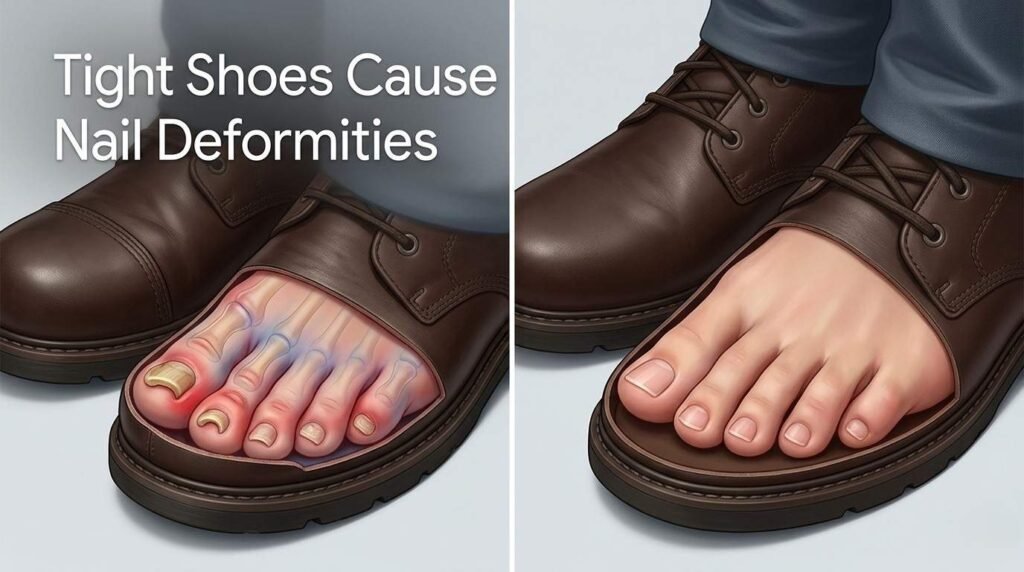
How Tight Shoes Cause Nail Deformities — The Basic Mechanism
The nail grows from the nail matrix — a small strip of tissue under the skin at the base of the nail, just behind the cuticle. The matrix produces nail cells that push forward, harden, and become the nail plate. The shape, thickness, and structure of the nail are largely determined by what happens at this growth center.
When tight shoes cause nail deformities, the underlying mechanism involves continuous, repetitive mechanical stress applied to the nail and its surrounding structures:
Downward compression from the shoe ceiling
When the toe box is too shallow, the shoe roof presses directly down on the nail plate with every step. This compresses the nail against the nail bed beneath it.
Forward pressure from short shoes
When the shoe is too short, the longest toe is pushed against the front of the shoe with every step — especially during walking, running, or descending stairs. The nail tip hits the shoe interior repeatedly throughout the day.
Lateral compression from narrow toe boxes
When the shoe width is insufficient, the toes are squeezed together. This applies inward pressure to the nail edges from both sides simultaneously.
Each individual application of pressure is minor. But repeated thousands of times per day, across months and years, these forces progressively alter how the nail matrix produces nail. The matrix responds to sustained mechanical stress by producing thicker, structurally altered nail — and in some cases, nail that grows in a different direction or with a different curvature than before.
This is precisely how tight shoes cause nail deformities through gradual, cumulative damage rather than sudden injury.
5 Nail Deformities Caused by Tight Shoes
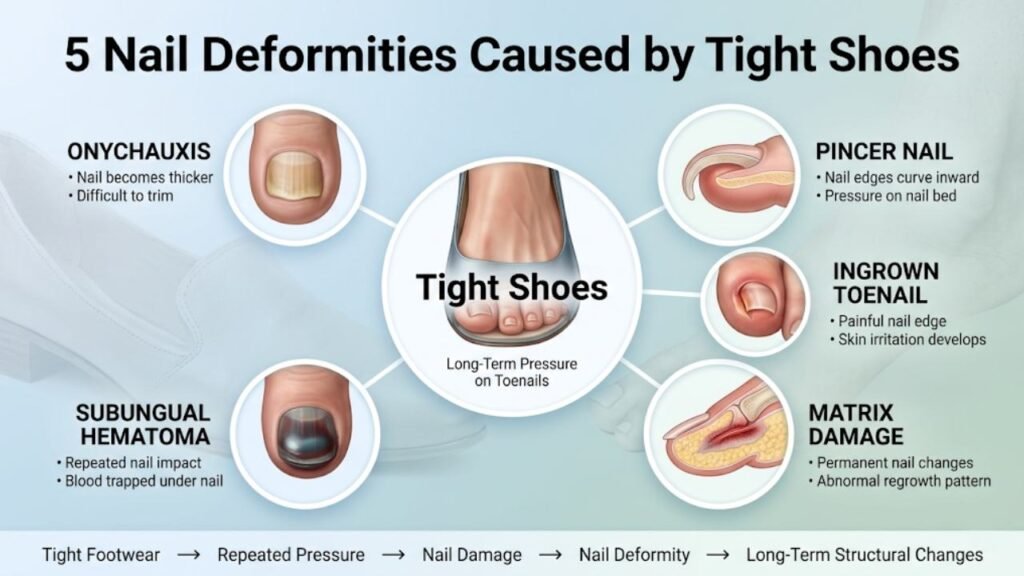
Deformity 1: Nail Plate Thickening (Onychauxis)
Onychauxis — uniform nail plate thickening — is one of the most direct results when tight shoes cause nail deformities through sustained downward or forward nail pressure.
The nail matrix treats the continuous mechanical load as a signal to build a more protective nail. It produces thicker layers of nail plate cells in response. Over months, the nail becomes noticeably denser, harder, and more difficult to trim with standard nail clippers.
What this looks like:
- The nail appears taller and denser than adjacent nails
- Color may shift to a more opaque, yellowish tone
- The nail surface may feel rough or irregular
- Standard nail clippers are inadequate — the nail is too hard to cut cleanly
The footwear connection:
Nail thickening from footwear is often mistaken for fungal infection. The two can look very similar. Laboratory testing is the only reliable way to distinguish between tight-shoe-caused nail thickening and fungal onychomycosis. When testing is negative, footwear is typically a primary contributing factor.
Deformity 2: Pincer Nail (Nail Edge Curvature)
Pincer nail develops when lateral compression from narrow footwear pushes the nail edges inward repeatedly over time. The nail curves from both sides, eventually compressing the nail bed tissue beneath it.
This is one of the clearest examples of how tight shoes cause nail deformities by actively reshaping the nail’s growth pattern. The nail matrix, receiving consistent lateral pressure signals, progressively produces nail that grows with increasing inward curvature.
What this looks like:
- The nail, viewed from the toe end, is curved inward on both sides
- In mild cases, slightly more curved than normal — easy to overlook
- In moderate to severe cases, the nail takes on a tunnel or trumpet shape
- The nail fold skin on the sides of the nail may appear irritated or thickened
Why this matters:
As the nail edges curve increasingly inward, they compress the nail bed beneath. This reduces blood flow to the nail bed tissue and can eventually cause chronic pain, skin breakdown at the nail sides, and secondary infection.
Pincer nail from tight footwear can stabilize and sometimes partially improve when footwear is corrected at the mild stage. By moderate or severe stage, professional treatment — and sometimes surgical correction — is needed.
Deformity 3: Ingrown Toenail (Onychocryptosis)
Ingrown toenail is among the most common and most painful outcomes when tight shoes cause nail deformities through lateral compression.
In a shoe with an inadequate toe box width, the sides of the shoe press the surrounding skin inward toward the nail edge while the nail grows forward. This effectively pushes the nail edge into the skin fold rather than allowing it to grow clear. Alternatively, the lateral pressure causes the nail to curve at its growth edge, directing it into the skin at the corner.
What this looks like:
- Pain and tenderness at one or both nail corners, typically the great toenail
- Redness, swelling, and warmth at the affected nail fold
- Skin growing over or being penetrated by the nail edge
- In advanced cases, discharge, significant swelling, and difficulty walking
The footwear connection:
Ingrown nails have multiple causes — including incorrect trimming technique and genetic nail shape — but footwear is a major contributing factor, particularly for recurring ingrown nails in patients who have had the nail treated surgically and had it return. If footwear is not corrected alongside nail treatment, the mechanical cause continues to drive recurrence.
Deformity 4: Subungual Hematoma (Blood Under the Nail)
When tight shoes cause nail deformities through forward pressure — particularly in shoes that are too short — the nail tip repeatedly contacts the shoe front with force. During running or descending stairs, this impact can rupture small blood vessels beneath the nail, causing blood to pool between the nail plate and the nail bed.
What this looks like:
- Dark red, purple, or black discoloration visible beneath the nail
- Pain at the time of the injury (though this varies — sometimes painless)
- The nail may be tender for several days after the injury
- In severe hematomas, the nail may eventually loosen and fall off
A subungual hematoma from repeated shoe-related impact is often mistaken for nail fungal infection because both produce dark nail discoloration. The key distinguishing features are the clear trauma history and the absence of the typical crumbling, debris, or spreading characteristics of fungal infection.
Repeated subungual hematomas in the same nail — which happens when footwear is not corrected — can damage the nail matrix, potentially leading to permanent changes in how that nail grows.
Deformity 5: Nail Matrix Damage and Permanent Nail Changes
When tight shoes cause nail deformities over an extended period without any management or footwear correction, the sustained mechanical stress can eventually damage the nail matrix itself.
The matrix cells, subjected to chronic inflammatory signals from ongoing pressure, may develop scar tissue changes that permanently alter their nail production capacity. Unlike temporary nail changes that resolve when footwear is corrected, matrix damage produces a nail that remains structurally abnormal even after the mechanical cause is removed.
Signs that matrix damage may have occurred:
- The nail looks the same year after year despite footwear changes
- New nail growing from the base is already thick, irregular, or abnormally curved
- The nail has never fully recovered to its pre-problem appearance
- Multiple nail growth cycles have completed without progressive improvement
Matrix damage from footwear represents the most serious end of how tight shoes cause nail deformities — a point where management shifts from reversing the problem to managing its structural consequences.
Who Is Most Vulnerable to Footwear-Related Nail Deformities
While tight shoes cause nail deformities in any adult who wears poorly fitting footwear long enough, certain groups face particularly elevated risk.
Runners and endurance athletes
Distance runners experience repetitive nail-to-shoe contact throughout every run. Downhill running creates maximum forward impact as the foot slides toward the shoe front with each step. Many experienced runners develop thick or blackened great toenails as a direct result. Running shoes that are too short are the most common specific cause.
Workers in heavy or safety footwear
Safety boots with rigid toe caps, construction boots, and heavy occupational footwear concentrate pressure at the toe box throughout long working days. Even well-constructed safety footwear causes problems when the size is incorrect or the toe box design is too narrow.
Women who regularly wear narrow or pointed footwear
Pointed-toe shoes and high heels both compress the forefoot and push the toes forward simultaneously — combining lateral compression with forward pressure in a particularly damaging way.
Older adults
Foot shape changes with age — feet often widen and flatten. Shoes that fit correctly in younger years may not fit correctly in later decades. Older adults also have slower nail growth, meaning altered nail produced by the matrix stays in place longer before being replaced.
People with diabetes
Reduced sensation from peripheral neuropathy means pressure from tight shoes causes nail damage without the warning signal of pain. Diabetic patients may develop significant nail deformities from footwear without being aware of ongoing damage.
Recognizing Footwear-Related Nail Damage Early
The most effective approach to preventing tight shoes from causing nail deformities is catching the early warning signs before structural changes become established.
Early warning signs to monitor:
- Tenderness or soreness along the nail edges or nail tip after wearing specific shoes
- A feeling of pressure on the nail inside footwear that is not present when barefoot
- Any new nail discoloration — particularly dark discoloration at the nail tip — that develops during or after periods of intensive footwear use
- Nails that are becoming progressively more difficult to trim
- Redness or mild swelling at the nail fold sides
- A nail that seems to be curving more than it used to
These early changes are reversible in most cases if the footwear issue is identified and corrected promptly. The same changes, ignored and continued, progress toward the structural deformities described above.
Footwear Assessment: What Good Shoe Fit Actually Means
Understanding what appropriate footwear looks like gives patients a practical framework for preventing tight shoes from causing nail deformities.
Toe Box Length
There should be approximately one thumb’s width of space between the longest toe and the front of the shoe when standing and bearing weight. This allows for foot spreading and toe-to-shoe impact absorption during movement.
Toe Box Width
The widest part of the shoe should match the widest part of the foot without compressing the toes. When standing in the shoe, the toes should be able to spread slightly — not press against each other or the shoe sides.
Toe Box Height
The toe box ceiling should be high enough that the nails do not contact it during normal standing or movement. This is particularly important for patients with already-thickened nails.
Shoe Length Assessment
Shoe size should be assessed while standing and bearing weight — feet expand under load. Shoe size measured at the end of the day (when feet are at their largest) is the most accurate measure for footwear selection.
Specific Shoe Types That Are High-Risk for Nail Deformities
- Pointed-toe styles — lateral compression at the forefoot
- High heels above 2 inches — forward foot shifting compresses toes
- Athletic shoes with minimal toe box depth — particularly in running
- Shoes worn beyond their structural life — compressed midsoles reduce interior space
Treatment When Tight Shoes Have Already Caused Nail Deformities
If footwear has already produced nail changes, the appropriate management depends on the type and severity of deformity.
For nail thickening from footwear:
- Footwear correction — the most important step
- Professional nail debridement to reduce thickness and restore comfortable trimming
- Monitoring progress as new nail grows in after footwear is corrected
- Laboratory testing to rule out concurrent fungal infection
For pincer nail from footwear:
- Footwear correction — wider toe box reduces lateral nail pressure
- Nail bracing (orthonyxia) — corrective nail braces applied by a podiatrist apply outward force to flatten the nail over time
- Professional nail trimming to manage edge discomfort
- Surgical options for moderate to severe curvature that has not responded to conservative management
For ingrown toenail from footwear:
- Footwear correction alongside nail treatment — without correcting the shoe, ingrown nails recur
- Professional nail care — partial avulsion under local anesthesia removes the ingrown nail edge and relieves immediate pain
- Matrixectomy of the nail edge may be considered for recurrent cases
- Education on correct nail trimming technique alongside footwear correction
For subungual hematoma from footwear:
- Small hematomas — monitoring until nail grows out
- Large, painful hematomas — decompression by a podiatrist to relieve pressure
- Footwear correction to prevent recurrence
- Allow 9 to 18 months for full nail replacement if nail was lost
For matrix damage from chronic footwear pressure:
- Footwear correction to stop ongoing damage
- Regular professional debridement for structural nail management
- Realistic expectations — permanent matrix damage may not produce a fully normal nail even with excellent footwear
- Surgical options if the nail is causing ongoing complications
Frequently Asked Questions
Can tight shoes permanently damage toenails?
Yes. When tight shoes cause nail deformities over an extended period without correction, the damage can progress to nail matrix scarring that permanently changes how the nail grows. Early correction of footwear prevents this outcome in most cases.
How long does it take for tight shoes to cause nail deformities?
The timeline varies depending on how tight the shoes are and how much time is spent wearing them. Significant changes can develop over months in very tight footwear worn all day. Gradual changes from moderately tight shoes may take one to two years to become clearly visible.
Will my nails recover if I change shoes?
At early stages — mild thickening or very mild curvature — yes, improving footwear allows the nail to grow back progressively more normally over 9 to 18 months. At later stages with established structural changes or matrix damage, footwear correction stops further damage but may not fully reverse existing deformity.
How do I know if my thick nail is from shoes or fungus?
Laboratory testing — KOH microscopy or fungal culture performed by a podiatrist or doctor — is the only reliable way to distinguish between the two. Shoe-related nail thickening looks very similar to fungal nail thickening from the outside.
Are safety or steel-toe boots bad for nail health?
Not inherently — the safety standard does not cause nail problems, the fit does. Safety boots in the correct size with adequate toe box width and depth can be worn all day without nail deformity. The same boots in too-short or too-narrow sizes cause exactly the problems described in this guide.
Should I see a podiatrist for nail changes I think are from my shoes?
Yes. A podiatrist can confirm the cause through examination and testing, provide professional nail care for existing deformities, assess your footwear, and provide specific guidance on the right shoe characteristics for your foot shape and activity level.
Summary
Tight shoes cause nail deformities through a clear mechanical process — sustained compression, forward pressure, and lateral squeezing that the nail matrix responds to by producing structurally abnormal nail. The five deformities most commonly caused by footwear are nail plate thickening, pincer nail, ingrown toenail, subungual hematoma, and — in severe cases — permanent nail matrix damage.
The changes develop gradually, which makes them easy to miss until they are well established. The best protection is appropriate footwear — correct length, width, and depth — combined with regular nail monitoring and early professional assessment when nail changes appear.
If you have nail changes that have not responded to antifungal treatment, or if you work in heavy footwear or do significant running and have noticed your nails changing, an honest footwear assessment alongside laboratory testing is the most practical next step.
Struggling to get an appointment?
We help patients in your area bypass clinic waitlists by instantly finding verified podiatry doctors who accept their insurance.