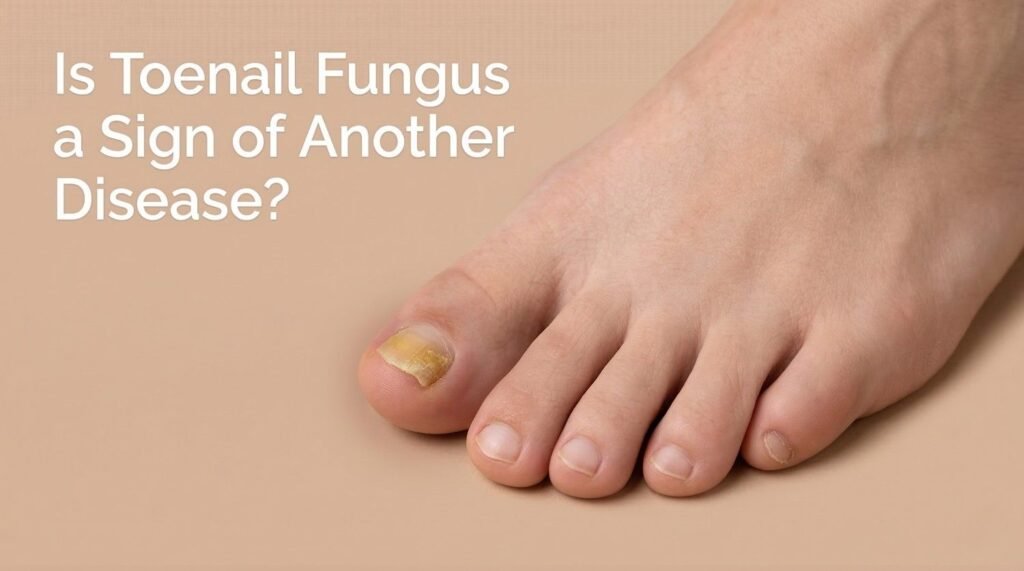
Is Toenail Fungus a Sign of Another Disease?
Find a Podiatrist Near You
Get same-day appointments with verified podiatrists. Insurance accepted.
Toenail fungus a sign of another disease — this is a question most patients never think to ask, because nail fungus seems like a straightforward problem caused by picking up spores at the gym or pool. And in many cases, that is exactly what it is. A one-time infection in an otherwise healthy person is usually just an infection.
But there is a group of patients for whom toenail fungus is telling a more important story. These are the people whose infection keeps coming back. The ones whose nails never fully cleared even after completing treatment. The ones who developed nail fungus without any obvious exposure, or who developed it across multiple nails at once. For these patients, the nail change is not just a cosmetic issue — it may be the first visible sign of something happening inside their body that has not yet been diagnosed.
This guide explains the connection between nail fungus and underlying health conditions — which diseases are genuinely linked, what patterns of nail infection should prompt a closer look at overall health, and when seeing a doctor goes beyond treating the nail itself.
When Is Toenail Fungus Just Toenail Fungus?
Most cases of toenail fungus are exactly what they appear to be — a fungal infection picked up from an environmental source. Gym locker rooms, public pools, shared footwear, contaminated nail tools, and infected household members are the most common sources.
In these straightforward cases:
- The infection typically starts in one nail
- There is a clear or at least plausible exposure history
- The patient has no significant underlying health conditions
- Treatment produces good results when completed properly
- The infection does not return quickly after successful treatment
For these patients, toenail fungus a sign of another disease is not the relevant clinical concern. The infection is the problem, and treating the infection is the solution.
When Toenail Fungus May Signal Something More
Certain patterns of nail fungal infection consistently point toward an underlying health factor that is making the person more susceptible. These patterns should prompt both the patient and their healthcare provider to look beyond the nail itself.
Patterns that suggest toenail fungus may be a sign of another disease:
- Infection in multiple nails simultaneously without obvious exposure
- Infection that returns quickly — within months — after completing a full treatment course
- Nail fungus that did not respond to correct, complete treatment
- Infection that started near the cuticle (proximal nail) rather than the nail tip — this pattern specifically is associated with immune system compromise
- Unusually severe nail destruction for the apparent duration of infection
- Nail fungus developing alongside other recurring infections — skin infections, urinary tract infections, or thrush
- A patient who has no known risk factors (no gym use, no pool, good hygiene) developing persistent nail infection
Any of these patterns is a reason to evaluate the underlying health picture rather than simply prescribing another treatment course.
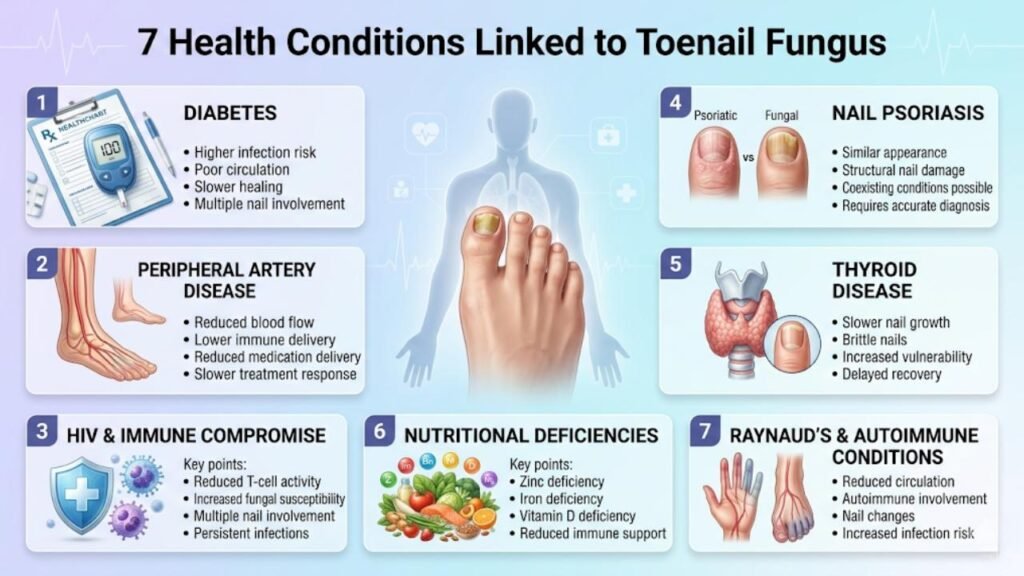
7 Health Conditions Linked to Toenail Fungus
1. Diabetes — The Most Common Underlying Connection
Diabetes is the most frequently linked health condition when toenail fungus a sign of another disease is being considered. The connection is direct and well-established.
Elevated blood sugar creates a favorable environment for fungal growth throughout the body, including in the nail tissue and the skin surrounding the nails. At the same time, diabetes damages the blood vessels that supply the feet — reducing the flow of immune cells and medication to the nail area — and impairs the function of the immune cells that fight fungal organisms.
What makes this connection clinically important:
Many people with type 2 diabetes are undiagnosed or poorly controlled for years before their diagnosis is confirmed or their management is optimized. Persistent nail fungal infection in a patient without other obvious risk factors — particularly someone middle-aged or older who is overweight — is a reasonable prompt to check blood sugar levels.
Signs the fungal infection may be linked to diabetes:
- Infection affecting multiple nails
- Slow or incomplete response to treatment
- Recurring infection after apparently successful treatment
- Other foot problems coexisting — dry cracked skin, slow-healing cuts, or numbness in the feet
If you have persistent toenail fungus and have not had your blood sugar checked recently, bringing this up with your doctor is worth doing.
2. Poor Circulation (Peripheral Artery Disease)
Healthy blood flow to the feet is essential for two things related to nail fungus — immune defense and treatment delivery. When peripheral blood flow is impaired, both functions are compromised.
Peripheral artery disease (PAD) is a condition where the arteries supplying blood to the legs and feet become narrowed from fatty deposits. It is particularly common in people who smoke, have high blood pressure, high cholesterol, or diabetes.
How poor circulation contributes to nail fungus:
When blood flow to the feet is reduced, immune cells reach the nail area in smaller numbers and more slowly. The local immune environment is weakened, allowing fungal organisms that a well-perfused immune system would handle to instead establish and persist.
Additionally, antifungal medications — including oral terbinafine — reach the nail primarily through the blood supply to the nail matrix and nail bed. Reduced blood flow means reduced drug delivery, which explains why patients with significant peripheral artery disease often have treatment response rates below what is expected for otherwise healthy patients.
Signs that circulation may be contributing:
- Cold feet consistently
- Pale or bluish skin on the feet
- Leg pain during walking that stops with rest
- Other vascular risk factors (smoking, high blood pressure, high cholesterol)
- Very slow nail growth
- Nail fungus that responds poorly despite correct treatment
3. HIV and Immune-Compromising Conditions
HIV infection is one of the clearest examples of toenail fungus a sign of another disease because the type of nail fungus infection changes in a characteristic way as CD4+ immune cell counts decline.
Specifically, proximal subungual onychomycosis — where the infection enters the nail near the cuticle rather than the nail tip — is so strongly associated with immune suppression that its presence in someone without a known immune-compromising condition should prompt evaluation for undiagnosed immune deficiency.
In everyday clinical practice, proximal subungual onychomycosis presenting in someone with no obvious immune compromise is one of the recognized clinical triggers for HIV testing.
Beyond HIV, other conditions and treatments that suppress the immune system — including lupus, rheumatoid arthritis managed with biologic medications, organ transplant, and blood cancers — all create the kind of immune environment where nail fungal infections become more common, more persistent, and more extensive.
Nail fungus patterns associated with immune compromise:
- Proximal subungual pattern (infection near the cuticle)
- Rapid spread to multiple nails
- Simultaneous nail and skin fungal infections at multiple body sites
- Infection in fingernails and toenails at the same time
4. Nail Psoriasis — Where Things Get Complicated
Psoriasis is a chronic inflammatory skin condition that affects nails in approximately 80 to 90 percent of patients with the skin form of the disease. Nail psoriasis produces changes that look remarkably similar to fungal nail infection — pitting on the nail surface, nail thickening, nail lifting, and subungual debris accumulation.
The clinical complication is this: nail psoriasis and nail fungal infection can coexist. Psoriatic nail changes disrupt the normal nail architecture, creating structural vulnerabilities that make fungal infection significantly easier to establish. Patients with nail psoriasis have elevated rates of concurrent onychomycosis.
Why this matters for the toenail fungus a sign of another disease question:
A patient with nail changes that are being attributed entirely to fungal infection may actually have psoriasis either alone or alongside fungal infection. Treating only the fungal component will produce incomplete or no improvement in the psoriatic changes. Treating only the psoriasis will not clear the fungal component.
Signs that psoriasis might be involved:
- Psoriatic skin changes elsewhere on the body (elbows, knees, scalp)
- Small pits or dents in the nail surface — this pattern is more characteristic of psoriasis than fungal infection
- Family history of psoriasis
- Nail changes that include an “oil drop” discoloration — a yellowish-orange area under the nail that is characteristic of psoriatic onychopathy
5. Thyroid Disease
Thyroid disorders — both underactive (hypothyroidism) and overactive (hyperthyroidism) thyroid — produce nail changes that can mimic or predispose to fungal nail infection.
Hypothyroidism causes slow metabolism, slow nail growth, dry and brittle nails, and in some patients, nail thickening. The brittleness and surface irregularities of hypothyroid nails create entry points for fungal infection. Slow nail growth means that infected or damaged nail takes longer to grow out, giving any infection more time to establish.
Hyperthyroidism can cause onycholysis — the nail lifting away from the nail bed — which is both a direct nail change and an entry point that makes fungal infection more likely.
Neither thyroid condition directly causes fungal infection, but both create nail environments that are more vulnerable to it. A patient with recurrent nail problems and other possible thyroid symptoms — fatigue, weight changes, hair thinning, sensitivity to cold or heat — has a reasonable basis for thyroid function testing alongside nail fungus evaluation.
6. Nutritional Deficiencies
Certain nutritional deficiencies produce nail changes and simultaneously weaken immune defense against fungal organisms — a combination that contributes to both susceptibility to nail fungal infection and difficulty clearing it.
Iron deficiency
Iron deficiency anaemia can cause koilonychia — spoon-shaped nails — and brittle nails with altered surface texture. Iron deficiency also reduces white blood cell function, impairing the immune system’s antifungal capacity.
Zinc deficiency
Zinc is required for normal nail plate structure and for immune cell function. Zinc deficiency produces brittle, slow-growing nails with white spots and surface changes that can predispose to fungal entry. Simultaneously, impaired immune function from zinc deficiency reduces antifungal defense.
Vitamin D deficiency
Widespread in populations with limited sun exposure. Vitamin D deficiency impairs immune signaling and reduces the skin and nail barrier’s antimicrobial defense. There is an emerging body of research linking vitamin D deficiency specifically to increased susceptibility to dermatophyte infections.
Nutritional deficiency as a contributor to toenail fungus a sign of another disease is most likely in patients with restricted diets, malabsorption conditions (including celiac disease and inflammatory bowel disease), or chronic illness affecting appetite.
7. Raynaud’s Phenomenon and Autoimmune Conditions
Raynaud’s phenomenon — a condition where the blood vessels in the fingers and toes constrict excessively in response to cold or stress — reduces circulation to the extremities episodically. Repeated episodes of reduced blood flow to the nail unit impair both immune defense and the ability of antifungal medication to reach the nail.
Raynaud’s is often associated with underlying autoimmune conditions — lupus, scleroderma, Sjögren’s syndrome, and mixed connective tissue disease. These autoimmune conditions affect the immune system’s function in complex ways that can increase infection susceptibility, including to fungal organisms.
Nail changes in autoimmune conditions are common — and the question of whether nail changes in a patient with known or suspected autoimmune disease represent true fungal infection, nail changes from the autoimmune condition itself, or medication side effects requires careful clinical evaluation rather than empirical antifungal treatment.
Nail Patterns That Point Toward Underlying Disease
| Nail Pattern | What It May Suggest |
|---|---|
| Proximal subungual infection (near cuticle) | Immune compromise — worth evaluating |
| Simultaneous infection in many nails | Immune weakness, diabetes, or poor circulation |
| Nail infection not responding to complete treatment | Underlying health factor impairing treatment response |
| Pitting on the nail surface | Nail psoriasis (often alongside or instead of fungus) |
| Nail lifting without obvious trauma | Multiple causes — thyroid, psoriasis, or fungal |
| Very slow nail growth across multiple nails | Hypothyroidism, poor circulation, or nutritional deficiency |
| Recurring infection within months of treatment | Immune weakness, diabetes, or unaddressed athlete’s foot |
These patterns are not diagnostic on their own — they are signals that a broader clinical picture needs to be considered alongside the nail infection itself.
When to Ask Your Doctor About the Bigger Picture

If your nail fungus fits any of the patterns described above, raising the question of whether toenail fungus may be a sign of another disease with your doctor is a reasonable and appropriate thing to do.
Bring up the question specifically if:
- Your nail fungus has returned after completing a full, correct treatment course
- Multiple nails are infected without clear exposure history
- You have not had blood sugar, thyroid function, or iron levels checked recently
- You have other symptoms that might suggest an underlying condition — fatigue, unexplained weight changes, circulation symptoms, recurring infections elsewhere
- You have family history of autoimmune disease, diabetes, or thyroid conditions
Your doctor can screen for the most relevant underlying conditions based on your full symptom picture and health history. This is not about alarming yourself — it is about using the information your nails are providing to make sure nothing important is being missed.
Frequently Asked Questions
Is toenail fungus always a sign of another disease?
No. Most cases of toenail fungus are straightforward infections from environmental exposure without any underlying disease involved. The question becomes more relevant when the infection is persistent, recurring, unusually severe, or presents in a pattern that suggests immune or circulatory weakness.
Which disease is most commonly linked to toenail fungus?
Diabetes is the most common underlying condition associated with persistent or recurring toenail fungus in the general population. Diabetic patients develop nail fungal infections more often and have more difficulty clearing them than otherwise healthy adults.
Should I get blood tests if I have persistent toenail fungus?
If your infection has not responded to complete treatment or keeps returning, discussing blood tests with your doctor makes sense. Relevant tests depending on your symptoms and history might include blood sugar, thyroid function, full blood count, iron levels, and vitamin D. Your doctor will recommend what is appropriate for your specific situation.
Can treating an underlying disease cure my nail fungus?
Better-managed underlying conditions — particularly diabetes — improve the immune environment and blood flow to the feet, which makes antifungal treatment more effective. But the nail infection itself still needs direct antifungal treatment. Addressing the underlying condition improves outcomes; it does not replace specific nail treatment.
What does it mean if my nail fungus started near my cuticle?
Proximal subungual onychomycosis — infection beginning near the cuticle — is specifically associated with immune system compromise. If this pattern is present in someone with no known immune issue, it is worth discussing with your doctor, as it can occasionally be an early indicator of undiagnosed immune system problems.
Can nail psoriasis be mistaken for toenail fungus?
Yes — frequently. Both conditions produce thickening, discoloration, and nail lifting. Laboratory testing — KOH microscopy and fungal culture — is the only reliable way to distinguish between them. This distinction matters because treating nail psoriasis with antifungal medication produces no benefit.
Summary
Is toenail fungus a sign of another disease? In most cases, no — it is a localized infection from an environmental source. But in patients whose infection is persistent, recurrent, unusually severe, or presents in patterns associated with immune or circulatory compromise, the nail is sometimes telling a more important story about what is happening inside the body.
Seven health conditions have a well-established link to toenail fungus — diabetes, poor peripheral circulation, HIV and immune-compromising conditions, nail psoriasis, thyroid disease, nutritional deficiencies, and Raynaud’s phenomenon with associated autoimmune conditions. Each creates a specific biological vulnerability that makes fungal nail infection more likely, more persistent, and harder to treat.
If your nail fungus fits any of the concerning patterns described in this guide, raising the question with your doctor — rather than simply repeating another treatment course — may lead to the discovery of something worth knowing about your broader health. Your nails are visible evidence of what is happening in your body. Sometimes they deserve to be read that way.
Struggling to get an appointment?
We help patients in your area bypass clinic waitlists by instantly finding verified podiatry doctors who accept their insurance.