Can Thick Nails Grow Back Normal?
Find a Podiatrist Near You
Get same-day appointments with verified podiatrists. Insurance accepted.
Thick nails grow back normal in many cases — but not in all cases, and the difference between a nail that recovers and one that does not comes down to a single factor that most patients do not know to ask about. That factor is the condition of the nail matrix — the growth center at the base of the nail that produces every layer of nail plate the nail will ever have.
If the nail matrix is healthy, intact, and free of the condition that caused the thickening, the nail it grows will progressively reflect that healthy function. Over months, new nail emerging from the base will be thinner, smoother, and more normal than the nail it is replacing.
If the nail matrix has been damaged, scarred, or is subject to an ongoing condition that disrupts its function, the nail it produces will continue to be abnormal regardless of what happens to the existing nail plate. Treating the visible thick nail without addressing what is happening at the matrix level is why so many patients find their nail returns to the same state after treatment.
This guide explains exactly what determines whether thick nails grow back normal, what realistic recovery looks like for each of the main causes of nail thickening, and how to assess whether your nail is actually recovering.
Why the Nail Matrix Is the Critical Factor
The nail matrix sits beneath the skin at the base of the nail, just behind the cuticle. It produces nail cells continuously — these cells push forward, harden as they move, and become the visible nail plate growing out toward the tip.
Everything visible about the nail — its thickness, its surface texture, its translucency, whether its edges curve or remain flat — is determined by what the matrix is producing at the time those cells were made. The nail plate you see today was produced by your matrix weeks to months ago.
This means:
When you ask whether thick nails grow back normal, you are really asking whether your matrix is currently producing normal nail cells. If it is, the new nail growing from the base will be progressively more normal. If it is not — because the matrix is still infected, still inflamed from psoriasis, still damaged from past trauma, or still under pressure from footwear — the new nail will be more of the same.
This is also why assessing nail recovery requires looking at the right part of the nail. The existing thick nail plate was produced by a damaged or disrupted matrix weeks or months ago. The new nail at the base — the part emerging from just above the cuticle — reflects what the matrix is doing right now. Recovery is visible at the base, not the tip.
When Thick Nails Grow Back Normal: Favorable Conditions
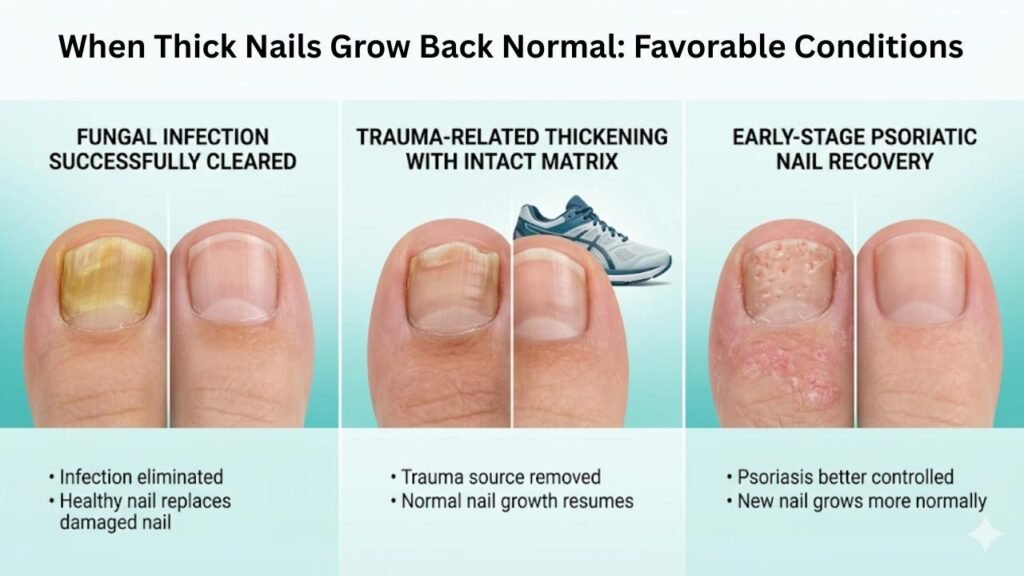
1. Fungal Infection Successfully Cleared
Fungal nail infection is the most common medical cause of nail thickening, and it is also one of the more recoverable causes when treatment is complete and effective.
Dermatophyte fungi invade the nail plate and nail bed, disrupting normal nail cell production and causing the nail to thicken as the infection advances. When appropriate antifungal treatment — most commonly oral terbinafine — eliminates the fungal organisms from the nail unit, the matrix is no longer being disrupted by the infection.
What recovery looks like:
- New nail growing from the base becomes progressively thinner and clearer in color
- The transition from new healthy nail to old infected nail is visible as a line moving up the nail month by month
- The thick, discolored nail at the tip gradually grows out as new nail replaces it from the base
- Full nail replacement from base to tip takes 9 to 18 months
The key requirement: Treatment must genuinely eliminate the fungal organisms. This means completing the full prescribed course of oral antifungal medication — not stopping when the nail “looks better.” The nail looking better during treatment reflects medication suppressing the infection, not the infection being fully cleared. Stopping early leaves fungal organisms in place and the nail will regrow thick.
2. Trauma-Related Thickening With Intact Matrix
When nail thickening resulted from a specific traumatic event — a stubbing injury, a dropped weight, repetitive microtrauma from poorly fitting footwear — and the nail matrix was not permanently damaged, the nail has the capacity to grow back normal once the source of trauma is removed.
What recovery looks like:
- After footwear is corrected or the traumatic activity is modified, the matrix begins producing more normal nail
- New nail at the base is progressively thinner and more structurally normal
- The nail tip area, produced during the period of trauma, remains abnormal and gradually grows out
- Recovery timeline: 12 to 18 months for the improved nail to fully replace the previously affected nail
The key requirement: The source of ongoing trauma must be genuinely eliminated. A patient who corrects their running shoes but continues to run the same mileage in slightly tight shoes will not see full recovery. The matrix needs a trauma-free environment to produce normal nail.
3. Early-Stage Psoriatic Nail Changes
Nail psoriasis produces thickening, pitting, and structural changes through immune-mediated disruption of the nail matrix and nail bed. When psoriasis is adequately managed through appropriate systemic treatment — particularly biologic medications with good nail response — the matrix can begin producing progressively more normal nail.
What recovery looks like:
- Pitting decreases in frequency and depth as matrix function normalizes
- New nail at the base is smoother and more structurally normal
- Subungual hyperkeratosis (debris under the nail) gradually reduces
- Recovery is often partial rather than complete — nail psoriasis with significant matrix involvement may not produce a fully normal-appearing nail even with good systemic treatment
The key requirement: Effective systemic management of the psoriasis. Topical treatment applied to the nail alone produces limited improvement in psoriatic nail changes. Systemic treatment — particularly biologic agents targeting IL-17 or IL-23 pathways — produces the most significant nail recovery.
When Thick Nails May Not Grow Back Normal: Limiting Factors
1. Permanent Nail Matrix Scarring
If the nail matrix itself has sustained permanent structural damage — from severe acute trauma, from years of chronic pressure, from a severe infection that reached and damaged the matrix, or from a surgical procedure that inadvertently altered the matrix — the nail cells it produces are permanently altered.
Scarred matrix tissue produces thick, irregular, disorganized nail. This is not a temporary dysfunction that will resolve — it is a permanent change to the nail’s production center.
Signs that matrix damage may be permanent:
- The nail has looked the same for several years despite treatment attempts
- New nail emerging from the base is already thick from the very beginning — not becoming thick later as the nail grows out
- The nail never returned to normal after a specific injury event
- Multiple treatment courses have been completed with no visible change in the new nail growing from the base
When matrix damage is permanent, the realistic goal shifts from “growing back normal” to “managing the nail’s structural consequences” — regular professional debridement to keep the nail at a comfortable, manageable thickness.
2. Ongoing Untreated Underlying Cause
When the condition causing nail thickening remains active, thick nails cannot grow back normal because the matrix continues to receive the same disruptive signals it was receiving when the thickening began.
Common scenarios:
- Fungal infection that was not completely eliminated — organisms remain in the matrix and continue disrupting nail production
- Psoriasis that is inadequately managed systemically — the immune inflammation driving matrix disruption continues
- Footwear or athletic activity that continues to apply mechanical stress to the nail — the matrix continues responding with thicker nail production
- Poor circulation that continues to deprive the matrix of adequate oxygen and nutrients
In every one of these scenarios, the new nail emerging from the base will continue to be structurally abnormal because the matrix environment has not changed. Treating only the existing thick nail plate — through debridement, laser, or waiting — without addressing the cause is the most common reason patients feel their nails “never get better.”
3. Genetic Nail Characteristics
Some individuals have inherited nail matrix characteristics that produce naturally thicker nails than the general population. In these cases, the nail is not thickening in response to any treatable condition — it is simply producing nail that is structurally thicker than average as an inherited trait.
For these individuals, thick nails cannot grow back normal in the sense of becoming as thin as a fully normal nail, because “normal” for their matrix is a thicker nail. Management — professional debridement to keep nails comfortable — is more appropriate than treatment aimed at reversing an inherent genetic characteristic.
How to Tell If Your Nail Is Actually Growing Back Normal
Patients monitoring their nail for signs of recovery often make the mistake of looking at the tip or middle of the nail — the oldest parts — and concluding nothing is improving. This is the wrong part of the nail to monitor.
Look at the base of the nail — the area just above the cuticle, the newest nail. This is the part produced most recently by the matrix and reflects its current state of function.
- If the nail at the base looks significantly thinner, smoother, or clearer in color than the nail further up — recovery is occurring
- If the nail at the base looks just as thick and abnormal as the rest of the nail — the matrix is still producing abnormal nail
Track the boundary line — as new healthy nail grows in from the base, a visible transition line separates it from the older abnormal nail. This line should move approximately 1.5 mm per month up the nail as new nail pushes the older nail forward. If you can see and track this line moving, recovery is occurring.
Monthly photography — taking a photo of the nail in the same lighting and angle each month and comparing them over 6 months is the most practical way to objectively assess whether thick nails are growing back normal. Subjective day-to-day assessment is unreliable because the changes are too gradual.
Realistic Timelines for Nail Recovery
| Nail Condition and Treatment | New Normal Nail at Base | Full Nail Replacement |
|---|---|---|
| Fungal infection cleared with full oral antifungal course | Begins within 3 to 6 months | 12 to 18 months |
| Trauma-related — footwear corrected | Begins within 2 to 4 months | 12 to 18 months |
| Nail psoriasis with effective systemic treatment | Begins within 3 to 6 months | 12 to 18 months |
| Permanent matrix damage | Normal nail does not emerge — consistently thick nail from base | Management not recovery |
| Genetic thickening | Normal by individual’s genetic baseline — may be thicker than average | Ongoing management needed |
The common thread in recovery cases is patience. Even when everything is going right — treatment was completed, the cause was eliminated, the matrix is functioning properly — it still takes 12 to 18 months for the new normal nail to travel from the base to the tip and fully replace the abnormal nail. Many patients abandon treatment or conclude it has failed because they do not see the nail looking fully normal at 3 or 6 months. Understanding that recovery is visible at the base first and progresses forward over many months prevents premature discouragement.
What Helps Thick Nails Grow Back Normal
Treat the Cause Completely
This is the single most important factor. Thick nails grow back normal only when the matrix is given the right environment to produce normal nail. That requires eliminating what disrupted it in the first place.
- For fungal infection: complete the full antifungal treatment course — 12 weeks for terbinafine, 48 weeks for topical agents
- For trauma: genuinely correct the footwear or activity creating the nail stress
- For psoriasis: work with your dermatologist on effective systemic management
- For circulation-related thickening: optimize the underlying vascular health with your physician
Regular Professional Debridement
Professional nail debridement during the recovery period serves two purposes: it makes the nail manageable and comfortable while new nail grows in, and it removes excess nail material that can impede topical medication penetration if antifungal therapy is being used.
Debridement does not accelerate nail growth — nails grow at a genetically determined rate. But it keeps the existing nail in a state where the recovery is more easily visible and the toe remains comfortable throughout the process.
Good Foot Hygiene and Moisture Control
During recovery, maintaining a dry, clean foot environment supports the conditions in which new nail grows best. Moisture creates a favorable environment for fungal reinfection during the recovery period. Daily thorough drying after bathing, moisture-wicking socks, and rotating footwear to allow drying between wears all contribute.
Treating Concurrent Athlete’s Foot
Tinea pedis — athlete’s foot — is the most common route of nail reinfection. Even a nail whose fungal infection has been successfully cleared can be reinfected from athlete’s foot on the surrounding skin. Treating any concurrent skin fungal infection and applying topical antifungal to the skin around the nail as maintenance after treatment completion significantly reduces reinfection during the recovery period.
Frequently Asked Questions
Can thick toenails ever fully return to normal?
Yes, in many cases — particularly when the thickening was caused by fungal infection or trauma and the nail matrix was not permanently damaged. Full recovery takes 12 to 18 months from when treatment begins, because that is how long it takes for completely new nail to replace the old nail plate.
How do I know if my thick nail is recovering?
Look at the base of the nail — just above the cuticle — rather than the tip. If the new nail growing from the base is progressively thinner, clearer, or smoother than the nail further up, recovery is occurring. Monthly photographs comparing nail appearance at the base over time are the most reliable way to track progress.
What if my thick nail does not improve even after treatment?
If the new nail emerging from the base remains as thick and abnormal as the existing nail despite completing appropriate treatment, two possibilities exist: the underlying cause was not fully resolved (incomplete fungal clearance, ongoing pressure, persistent psoriasis), or the nail matrix sustained permanent damage. Professional re-evaluation to determine which situation applies guides the next management step.
How long does it take for thick nails to grow back normal?
From the time the underlying cause is eliminated and the matrix begins producing normal nail, it takes approximately 12 to 18 months for the new nail to fully replace the previously thickened nail from base to tip. The nail does not change overnight — it is a gradual month-by-month process.
Can nutrition help thick nails grow back normal faster?
Ensuring adequate nutrition — particularly biotin, zinc, iron, and protein — supports normal nail cell production. Significant nutritional deficiencies impair nail growth. However, for patients with adequate nutrition, supplementation does not meaningfully accelerate nail growth rate, which is primarily genetically determined.
Is professional nail debridement needed during recovery?
Professional debridement is not strictly necessary for recovery to occur — the matrix drives recovery, not the management of the existing nail plate. However, debridement during the recovery period makes the nail more comfortable, makes the recovery more visible, and in fungal infection cases, significantly improves topical medication penetration.
Summary
Thick nails grow back normal when the nail matrix — the growth center at the nail base — is healthy enough to produce normal nail and free from the condition that disrupted it. When these conditions are met, recovery is genuinely possible and often complete, though it always takes 12 to 18 months because that is how long toenail replacement takes.
Recovery is not possible in cases of permanent matrix scarring, ongoing untreated underlying cause, or genetic nail characteristics — though in all these cases, effective management can keep the nail comfortable and functional even if fully normal appearance is not achievable.
The most important practical steps for any patient hoping thick nails grow back normal are: confirm the diagnosis, treat the underlying cause completely, assess recovery at the nail base rather than the tip, and have realistic patience for the 12 to 18 month timeline that full nail replacement requires.
If you have been managing thick nails without clear improvement, professional re-evaluation — assessing whether the underlying cause has truly been eliminated and whether the matrix is showing signs of recovery — is the most useful next step.
Struggling to get an appointment?
We help patients in your area bypass clinic waitlists by instantly finding verified podiatry doctors who accept their insurance.