Toenail Fungus Treatment for Seniors
Find a Podiatrist Near You
Get same-day appointments with verified podiatrists. Insurance accepted.
Toenail fungus treatment for seniors is more complex than the same treatment in younger adults — not because the infection itself is fundamentally different, but because the combination of age-related biological changes, multiple medications, and often reduced functional reserve creates a clinical situation that requires more careful planning, modified treatment expectations, and heightened monitoring.
Onychomycosis (fungal nail infection) is significantly more prevalent in older adults than in the general population. Prevalence estimates in adults over 60 are substantially higher than in adults under 40 — a difference driven by a set of age-related biological factors that both increase susceptibility to infection and make the infection harder to treat and eliminate.
Understanding why toenail fungus is more common and more persistent in seniors — and what the treatment implications are — gives older patients and their caregivers a realistic framework for making informed treatment decisions and setting appropriate expectations.
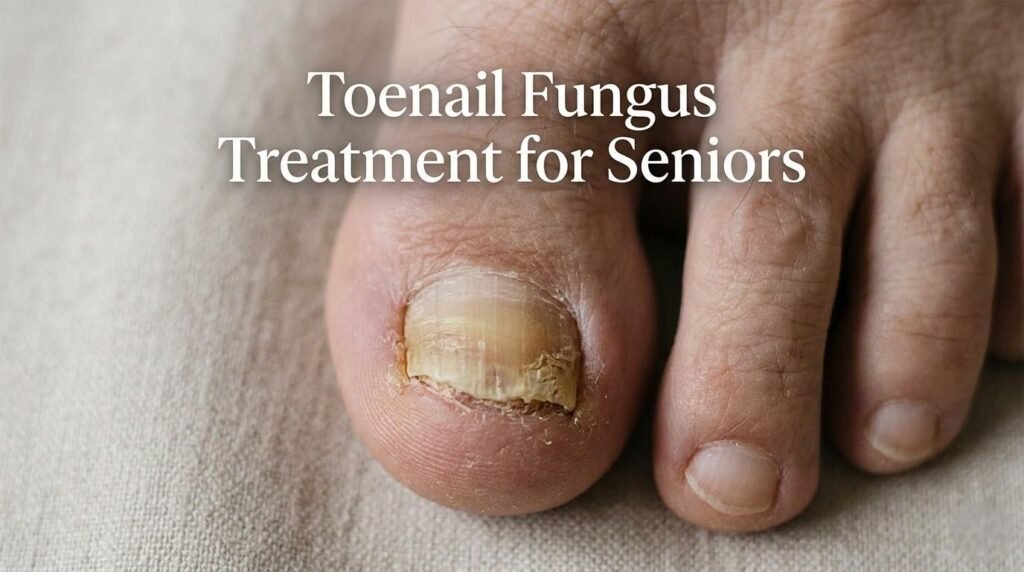
Why Toenail Fungus Is More Challenging in Seniors
Several biological changes that accompany normal aging create both greater susceptibility to fungal nail infection and greater resistance to treatment.
Slower Nail Growth
Nail growth rate declines significantly with age. Young adults grow toenails at approximately 1.5 mm per month. Older adults may grow toenails at 0.8 to 1.0 mm per month — nearly half the rate.
This matters for toenail fungus treatment for seniors in two critical ways:
During treatment: Because oral antifungal medications work by being incorporated into newly produced nail plate (the drug travels from the nail matrix forward with the growing nail), slower nail growth means the drug-containing nail advances more slowly toward the tip. The 12-week course of terbinafine produces a shorter column of drug-containing nail in a senior patient than in a younger patient.
After treatment: Full nail replacement — the process by which the new, healthy nail completely replaces the previously infected nail from base to tip — takes 12 to 18 months in middle-aged adults. In seniors with very slow nail growth, this can extend to 18 to 24 months. This does not mean treatment has failed — it means recovery takes longer.
Reduced Peripheral Circulation
Aging reduces peripheral blood flow to the extremities — a process accelerated in seniors with hypertension, cardiovascular disease, diabetes, or peripheral artery disease. For toenail fungus treatment for seniors, this has direct treatment implications.
Oral antifungal medications reach the nail via blood delivery to the nail matrix and nail bed. Reduced peripheral blood flow means lower drug delivery to the nail — producing lower drug concentrations at the site of infection than the same dose would produce in a healthy younger adult. The drug may technically be in the bloodstream at appropriate concentrations but simply not reaching the nail effectively.
This pharmacokinetic disadvantage partly explains why toenail fungus treatment for seniors produces lower cure rates than the same treatment in younger adults, even with the same treatment protocol and full adherence.
Immunosenescence
The immune system changes with age in a way that reduces its efficiency — a process called immunosenescence. Several relevant changes occur:
- Neutrophil function declines — the first-responder immune cells that attack fungal organisms work less effectively
- T-lymphocyte function changes — reducing the adaptive immune response that supports antifungal clearance
- Overall inflammatory response becomes dysregulated
The practical consequence: even when antifungal medication suppresses and reduces the fungal colony, the immune system’s role in clearing residual organisms — a function that complements medication in younger adults — is less reliable in seniors. This contributes to lower cure rates and higher recurrence rates.
Nail Structural Changes
Age-related nail changes independent of infection include:
- Increased nail plate thickness (onychauxis) from slower nail growth with continued matrix production
- Drier, more brittle nail keratin from reduced nail plate lipid content
- Surface irregularities and longitudinal ridging
- More extensive onycholysis (nail separation) tendency
These structural changes make drug penetration — particularly for topical agents — even more challenging, and make mechanical debridement even more important as part of toenail fungus treatment for seniors.
Assessing Treatment Safety: The Unique Senior Considerations
Before examining specific treatment options, the assessment process for toenail fungus treatment for seniors involves several considerations not typically relevant in younger adults.
Polypharmacy and Drug Interactions
The average adult over 65 takes multiple prescription medications. Both terbinafine (CYP2D6 inhibitor) and itraconazole (CYP3A4 inhibitor) produce significant drug interactions that must be assessed before prescribing.
Terbinafine interactions relevant in seniors:
- Beta-blockers (metoprolol, propranolol) — terbinafine inhibits CYP2D6, increasing beta-blocker blood levels
- Tricyclic antidepressants — increased exposure from CYP2D6 inhibition
- Some antidepressants (SSRIs metabolized by CYP2D6)
Itraconazole interactions relevant in seniors:
- Statins (simvastatin, lovastatin) — itraconazole dramatically increases statin levels, creating rhabdomyolysis risk. This is one of the most clinically significant interactions in practice.
- Warfarin — increased anticoagulant effect requiring careful INR monitoring
- Calcium channel blockers
- Multiple cardiac medications
A complete medication review before initiating any oral antifungal is non-negotiable in toenail fungus treatment for seniors.
Liver and Kidney Function
Age-related decline in liver and kidney function affects how drugs are metabolized and eliminated. The same dose of terbinafine or itraconazole produces higher exposure (higher plasma concentrations, longer persistence) in an older adult with reduced hepatic and renal clearance. This increases both the potential for efficacy — slightly — and the potential for adverse effects.
- Liver function tests (ALT, AST, bilirubin, alkaline phosphatase)
- Basic metabolic panel including creatinine and eGFR (kidney function)
- Review of any existing liver conditions (fatty liver disease, prior hepatotoxic drug reactions)
Fall Risk Considerations
Thickened, painful, or deformed toenails from onychomycosis affect gait and balance — directly contributing to fall risk, which is one of the most serious health concerns for adults over 65. This gives toenail fungus treatment for seniors a fall prevention dimension that goes beyond cosmetic improvement. Effective nail treatment is genuinely part of comprehensive fall prevention in elderly patients.
Treatment Options: What Works and What to Prioritize
Oral Terbinafine — Still the Most Effective
Despite the pharmacokinetic challenges, oral terbinafine remains the most effective single treatment for dermatophyte toenail onychomycosis in seniors. Lowered cure rates compared to younger adults do not mean the treatment is ineffective — they mean expectations need to be calibrated appropriately.
Standard protocol: 250 mg daily for 12 weeks
Modified considerations for seniors:
- More rigorous pre-treatment baseline liver function testing
- More frequent mid-treatment monitoring (typically at 4 to 6 weeks rather than only at baseline)
- Complete medication interaction review before prescribing
- May require dose reduction if renal function is significantly reduced (eGFR below 50 mL/min in some guidelines)
Realistic efficacy expectations for toenail fungus treatment for seniors:
Mycological cure rates (laboratory confirmed elimination) in senior populations are typically reported at 50 to 65 percent — versus 70 to 80 percent in general adult populations. Complete cure (clear nail + negative lab) rates may be 25 to 40 percent. These are lower numbers, but represent meaningful treatment benefit.
Oral Itraconazole — Alternative When Terbinafine Is Contraindicated
For seniors who cannot take terbinafine due to drug interactions (particularly with beta-blockers or certain antidepressants), itraconazole is the alternative.
Pulse dosing (200 mg twice daily for 1 week per month × 3 to 4 months) reduces total drug exposure, which may be advantageous in seniors with more limited hepatic reserve.
The statin interaction must be managed: Seniors on simvastatin or lovastatin require either temporary statin cessation during itraconazole treatment or switch to a non-CYP3A4-affected statin (e.g., rosuvastatin, pravastatin). This should be coordinated with the prescribing cardiologist or primary care physician.
Topical Antifungal Agents — More Important in Seniors Than in Younger Adults
Topical antifungals (efinaconazole, ciclopirox, tavaborole) have limited efficacy as standalone treatment for established onychomycosis in any population. In seniors — where nail thickness reduces penetration further — their role as standalone therapy is even more limited.
1. As adjunct to oral therapy:
Daily topical efinaconazole or ciclopirox alongside a 12-week terbinafine course provides antifungal activity from the nail surface simultaneously with systemic delivery from below. Combination oral + topical consistently produces better outcomes than oral alone.
2. As maintenance and prevention after clearing:
For seniors who achieved clearance after treatment, ongoing prophylactic topical application (once or twice weekly to previously infected nails) significantly reduces recurrence risk. This is more important in seniors than in younger adults because the underlying susceptibility factors — slow nail growth, reduced circulation, immunosenescence — do not resolve with treatment and continue to confer elevated reinfection risk.
3. For seniors who cannot take oral antifungals:
When polypharmacy interactions, significant hepatic impairment, or other medical factors preclude oral antifungal use, topical agents combined with professional nail debridement represent the best available alternative. Cure rates are lower, but improvement and symptom management are achievable.
Professional Nail Debridement — Essential Component of Toenail Fungus Treatment for Seniors
Professional nail debridement by a podiatrist is the most consistently beneficial component of toenail fungus treatment for seniors — regardless of which other modalities are used.
Why debridement is particularly important in seniors:
Drug penetration: Seniors’ nails are typically thicker from both the fungal infection and age-related onychauxis. The combination produces nail plate thickness that severely limits topical drug penetration and reduces even systemic drug delivery to the nail bed. Debridement reduces thickness to near-normal levels, dramatically improving drug access.
Fungal load reduction: Physical removal of heavily infected nail plate and subungual debris directly eliminates a substantial proportion of the fungal organism burden — reducing the total load that medication must eliminate.
Safety: For seniors with limited dexterity, poor visual acuity, or difficulty bending, self-trimming of thick infected nails creates real injury risk. Professional nail care eliminates this risk and provides regular clinical monitoring of nail and surrounding skin condition.
Frequency for toenail fungus treatment for seniors: Every 6 to 10 weeks during active treatment; continuing every 8 to 12 weeks after treatment completion for maintenance.
Laser Therapy — Adjunctive Option, Honest Assessment
Laser therapy (particularly Nd:YAG 1064 nm) produces measurable improvement in nail appearance and some antifungal effect in many patients. For toenail fungus treatment for seniors specifically, it offers the advantage of avoiding systemic drug exposure and drug interactions — which is genuinely relevant given seniors’ polypharmacy burden.
However:
- Laser as monotherapy produces lower complete cure rates than oral antifungal therapy
- Multiple sessions are required
- Cost is significant and typically not covered by insurance
- Evidence for laser in seniors specifically is not well-established
Laser therapy is most useful in toenail fungus treatment for seniors as an adjunct alongside topical antifungal therapy for seniors who cannot take oral antifungals — not as a replacement for the oral + debridement combination in seniors who can safely tolerate oral therapy.
Practical Management: The Senior Treatment Protocol
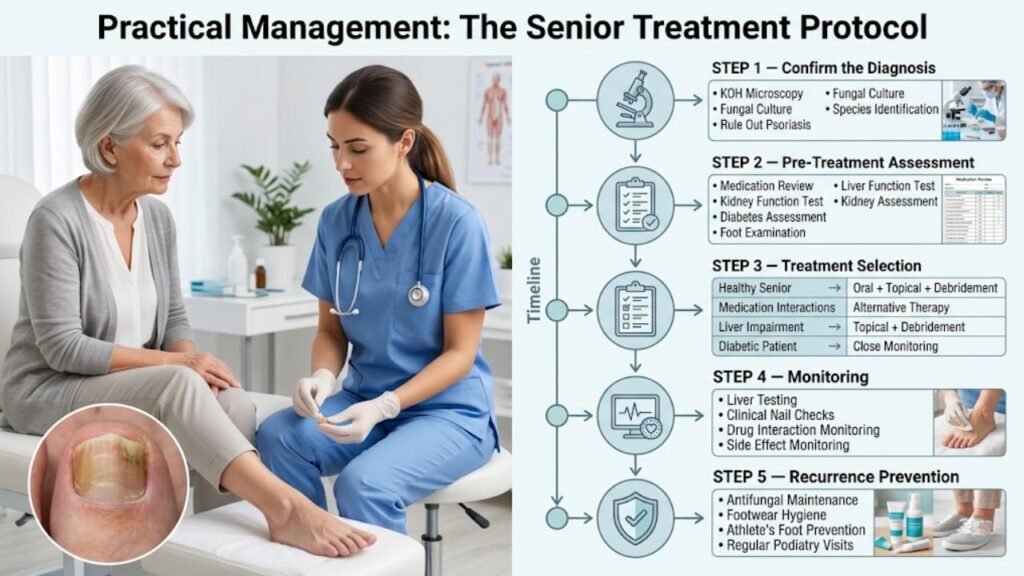
Step 1: Confirm the Diagnosis
KOH microscopy and fungal culture before starting any treatment. This is more important in seniors because:
- Multiple non-fungal conditions (nail psoriasis, trauma-induced dystrophy, age-related thickening) mimic onychomycosis
- Treating a non-fungal condition with antifungal medication wastes months and delays appropriate care
- Species identification (dermatophyte vs yeast vs mold) is essential for medication selection
Step 2: Comprehensive Pre-Treatment Assessment
- Full medication list review for interactions
- Baseline liver function and renal function testing
- Cardiovascular assessment if applicable (cardiac conditions affect itraconazole safety)
- Diabetes status and glycemic control assessment
- Foot and nail examination for concurrent conditions
Step 3: Treatment Selection
Match treatment to the senior’s specific health profile:
| Patient Profile | Recommended Approach |
|---|---|
| Healthy senior, no significant drug interactions | Oral terbinafine + topical efinaconazole + regular debridement |
| Beta-blocker or antidepressant use preventing terbinafine | Itraconazole pulse + topical + debridement (with medication review) |
| Statin use with itraconazole needed | Switch to non-CYP3A4 statin or choose terbinafine if possible |
| Significant hepatic impairment | Topical antifungal + aggressive debridement + laser |
| Multiple medications making all oral options high-risk | Topical + debridement + laser; defer oral until medications reviewed |
| Diabetic senior | Prompt treatment with preferred oral option; closer monitoring; podiatric co-management |
Step 4: Monitoring
More frequent than standard adult monitoring:
- Liver function at baseline and 4 to 6 weeks during oral terbinafine
- INR monitoring if on warfarin and itraconazole prescribed
- Clinical nail assessment at each debridement appointment
- Watch for symptoms of drug toxicity: unusual fatigue, jaundice, dark urine, taste change (terbinafine)
Step 5: Prevention After Treatment
Recurrence prevention is even more critical in toenail fungus treatment for seniors because the underlying risk factors persist:
- Twice-weekly topical antifungal maintenance on previously infected nails
- Antifungal powder inside footwear regularly
- Replacement or disinfection of footwear from during the infection period
- Protective footwear in all communal wet areas
- Immediate treatment of athlete’s foot if it develops
- Regular podiatric monitoring — every 3 to 4 months in the first year after clearing
The Role of Caregivers in Toenail Fungus Treatment for Seniors
For elderly adults receiving care at home or in residential facilities, caregivers play a critical role:
Daily foot inspection: For seniors who cannot easily examine their own feet, caregiver daily foot checks catch early nail and skin changes before they become significant problems.
Medication adherence support: The 12-week oral course and 48-week topical course require consistent daily use. Caregivers can support adherence through reminders, medication organization, and topical application assistance where dexterity is limited.
Footwear management: Ensuring appropriate breathable footwear and protective footwear for communal areas reduces reinfection risk.
Facility hygiene: In assisted living and care home settings, communal shower and bathroom floor hygiene, regular replacement of communal bath mats, and resident education about protective footwear in communal areas all reduce the fungal transmission risk that makes senior facilities higher-risk environments for onychomycosis.
Frequently Asked Questions About Toenail Fungus Treatment for Seniors
Is it safe for seniors to take oral antifungal medication for nail fungus?
Oral terbinafine and itraconazole can be safely used by many seniors with appropriate pre-treatment assessment, medication interaction review, and monitoring. The key is careful evaluation before prescribing — not automatic exclusion based on age. Many seniors successfully complete toenail fungus treatment for seniors with oral antifungal therapy without significant adverse effects.
How long does toenail fungus treatment take in seniors?
Toenail fungus treatment for seniors takes longer than the same treatment in younger adults. The oral course is the same (12 weeks for terbinafine), but full nail replacement — and the visible final result — takes 18 to 24 months in seniors with slow nail growth, versus 12 to 18 months in younger adults.
What if my senior parent or patient cannot take oral antifungal medication?
Topical antifungal therapy combined with regular professional nail debridement is the most effective non-oral approach. Adding laser therapy sessions provides additional antifungal benefit without systemic drug exposure. These combinations produce lower cure rates than oral-containing regimens but provide meaningful improvement and symptom management.
Why does nail fungus keep coming back in elderly patients?
The underlying risk factors — slow nail growth, reduced circulation, immunosenescence — do not resolve with treatment. These factors create persistent susceptibility to reinfection. Ongoing preventive measures (prophylactic topical antifungal, footwear hygiene, protective footwear in communal areas) combined with regular professional nail monitoring are essential for maintaining treatment results in seniors.
Should elderly patients with diabetes be more concerned about nail fungus?
Yes. Diabetic seniors face the same susceptibility factors as other seniors plus additional diabetes-specific risks — impaired immune function, peripheral vascular disease, and neuropathy that masks early pain warning. Nail infections in diabetic seniors carry a higher risk of progressing to secondary bacterial infection and associated complications. Prompt professional treatment — rather than home monitoring — is appropriate for any diabetic senior who develops nail fungal infection.
Summary
Toenail fungus treatment for seniors must account for the biological realities of aging — slower nail growth that extends recovery timelines, reduced peripheral circulation that limits drug delivery to the nail, immunosenescence that reduces the immune system’s role in clearing residual infection, and polypharmacy that requires careful drug interaction assessment before prescribing.
Oral terbinafine remains the most effective treatment when safely tolerable, producing mycological cure in 50 to 65 percent of senior patients with full adherence. Combined with regular professional nail debridement and daily topical antifungal therapy, outcomes improve further. When oral antifungals are contraindicated, topical antifungal plus aggressive debridement plus laser provides the best available non-systemic alternative.
Treatment timelines are longer than in younger adults. Prevention after treatment is more important in seniors due to persistent underlying risk factors. Regular professional podiatric monitoring — both during treatment and in the years following — provides the ongoing clinical oversight that gives toenail fungus treatment for seniors its best chance of lasting success.
Struggling to get an appointment?
We help patients in your area bypass clinic waitlists by instantly finding verified podiatry doctors who accept their insurance.