Winter Footwear and Nail Health
Find a Podiatrist Near You
Get same-day appointments with verified podiatrists. Insurance accepted.
Winter footwear and nail health share a relationship that catches many people off guard. Summer foot problems — athlete’s foot from pool exposure, nail damage from open-toed sandals hitting surfaces — are easy to connect to the season. Winter’s foot and nail problems are subtler, but they are real and they are predictable.
The shift to winter footwear creates a specific set of conditions that affect toenails in ways summer footwear does not. Heavy boots, thick socks, extended daily wear, reduced foot ventilation, and the physiological effects of cold on peripheral circulation combine to make winter a season where existing nail problems worsen and new ones develop. Understanding the winter footwear and nail health connection allows you to maintain nail health through the colder months rather than discovering problems in spring when the boots come off.
How Winter Footwear Changes the Environment for Your Nails
To understand the winter footwear and nail health relationship, it helps to compare what the toenail environment looks like in summer versus winter:
Summer: Open sandals or breathable low-profile shoes, lighter socks or no socks, frequent air exposure, more regular visual inspection (because feet are visible), lower sustained moisture, better ventilation.
Winter: Heavy closed boots worn for extended hours daily, thick wool or synthetic socks, multiple sock layers, reduced air exposure, months of infrequent visual inspection (nails hidden under boots), higher sustained moisture from sweat trapped in thick footwear, impaired ventilation.
The winter shift creates three overlapping problems for winter footwear and nail health:
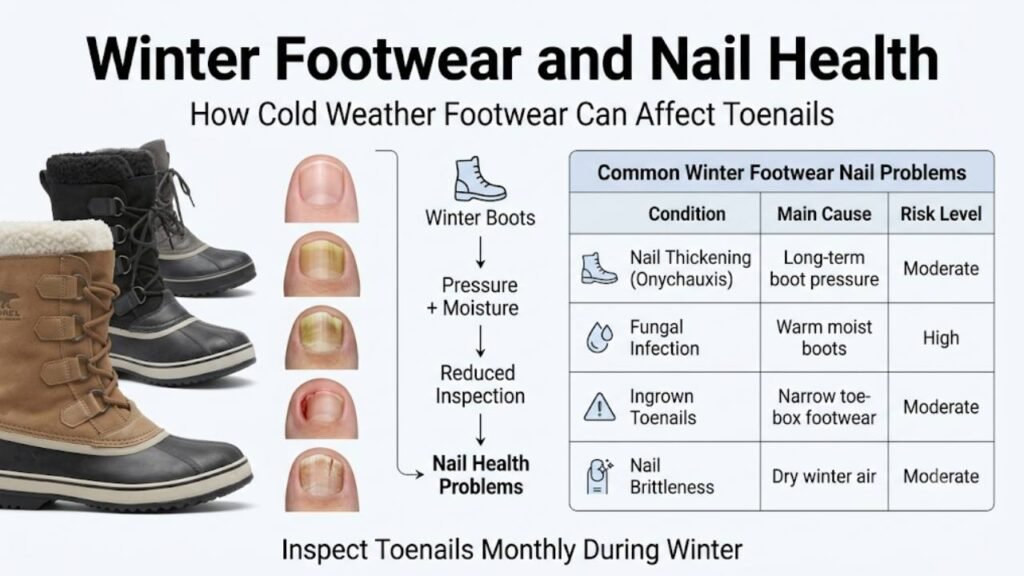
1. Increased internal moisture: Heavy boots with thick insulation trap heat and sweat more effectively than summer footwear. The foot produces the same amount of sweat regardless of season — but in summer shoes with better ventilation, that sweat can partially evaporate. In winter boots, it cannot. The result is a more consistently moist shoe interior that supports fungal growth and skin maceration.
2. Mechanical pressure changes: Winter boots are typically heavier, stiffer, and have a more enclosed toe box than summer footwear. This changes how force is distributed across the nail during walking. Some winter boots — particularly dress boots and fashion boots — have narrow toe boxes that compress the toes laterally and increase nail-to-boot contact during movement. This mechanical pressure contributes to nail plate thickening, subungual hematoma, and ingrown nail risk over the winter months.
3. Reduced circulation from cold: Cold temperatures cause vasoconstriction — the blood vessels in the extremities narrow to conserve core body heat. Reduced blood flow to the feet means the nail matrix and nail bed receive less oxygen, fewer nutrients, and fewer immune cells. This slowed nail growth and reduced local immunity make nails more susceptible to fungal infection establishing and more resistant to clearing. The winter footwear and nail health connection is partly a winter physiology issue, not just a footwear issue.
Specific Winter Footwear and Nail Health Problems
1. Nail Thickening and Onychauxis
One of the most consistent winter footwear and nail health patterns is progressive nail thickening during winter months. Patients sometimes notice this in spring when removing boots for the first time — their nails appear thicker and harder than they were before winter.
What causes this: The mechanical pressure of heavy boot wear throughout winter stimulates the nail matrix (the nail’s growth center) to produce a thicker, more protective nail plate. This is the same adaptive response seen in athletes whose nails thicken from repetitive footwear impact. Over months of sustained winter boot wear, multiple nails can develop visible thickening.
Additionally, reduced peripheral circulation from cold temperatures slows the rate at which the nail plate is replaced. Slower growth means each thick nail plate section remains in place longer before being replaced by new growth.
How to manage this for winter footwear and nail health: Regular professional nail debridement during winter months keeps nails at a manageable thickness despite the pressures of heavy boot wear. This is particularly relevant for older adults, whose nails may already be thickening from age-related changes, and for patients with poor circulation.
2. Nail Fungal Infection — Accelerated by Winter Conditions
Winter footwear and nail health intersect most significantly in the area of fungal infection. Several aspects of winter foot hygiene converge to make nail fungal infection more likely during winter months:
The moisture factor: As described above, heavy winter boots maintain a warmer, more moist shoe interior than summer footwear. Dermatophyte fungi — the organisms responsible for athlete’s foot and nail infection — require moisture for spore germination and growth. The sustained moist conditions inside winter boots provide exactly this environment.
The visibility factor: In summer, people see their feet regularly and notice early nail changes. In winter, feet are hidden inside boots for months. An infection that starts as a small yellow spot at the nail tip in October may have progressed to moderate onychomycosis by the time boots come off in March — because it was not seen and was not treated.
The inspection gap: Many people who would notice and act on a nail change when wearing open footwear never see their toenails during winter months unless they specifically look. Building nail inspection into winter routines is an essential component of winter footwear and nail health maintenance.
Practical winter nail inspection routine: Once monthly, remove all nail polish, examine each toenail in good lighting for any new discoloration or texture change. Take photographs and compare month-to-month. Any persistent change warrants professional evaluation rather than waiting for spring.
3. Ingrown Toenails — Winter Boot Risk
Winter footwear and nail health problems include a seasonal increase in ingrown toenails in people who wear narrow-toe-box boots. Fashion boots and some dress boots are designed with narrow or pointed toe boxes that look stylish but compress the toes and change how nail edges interact with the surrounding skin.
The mechanism: Lateral compression from a narrow boot toe box presses the surrounding skin inward toward the nail edge. As the nail grows forward, the edge grows into this displaced skin rather than over it. This is accelerated by nail softening from the moist boot interior, which makes the nail edge more likely to flex into surrounding tissue rather than maintaining its rigid direction.
Who is most affected: Women who wear fitted leather boots for extended daily periods during winter face higher ingrown toenail risk than in summer months when more accommodating footwear is worn. But any individual who transitions from wide summer footwear to a narrower winter boot may notice ingrown nail issues developing as the season progresses.
Prevention as part of winter footwear and nail health: Choosing winter boots with adequate toe box width — enough that the toes are not compressed together when standing — significantly reduces ingrown nail risk. This applies even to fashion boots: the difference between a boot that compresses the toes and one that fits with appropriate width is not always visible from the outside.
4. Nail Brittleness and Dryness
Winter conditions — both the cold air outside and the heated dry air indoors — significantly reduce skin and nail hydration. This seasonal dryness affects winter footwear and nail health by producing nail plates that are more brittle, more prone to splitting and peeling at the edges, and structurally less resilient than during summer months.
The combination of dry winter conditions reducing nail plate hydration and the physical stress of heavy boot wear produces nails that chip and break more readily during winter than at other times of year.
Managing winter nail brittleness: Applying nail oil or cuticle oil regularly during winter months — daily if possible — replenishes the lipid content of the nail plate that dry winter conditions deplete. This is most effective when applied to slightly hydrated nails — right after bathing while the nail is still slightly warm from water exposure.
Choosing Winter Boots for Better Nail Health
The winter footwear and nail health connection means that boot selection matters clinically, not just cosmetically.
Toe Box Width and Depth
Width: The toe box should accommodate all five toes without lateral compression. When standing in the boot, the toes should not be pressed against each other. A simple test: press your finger along the outside of the boot at the toe area — you should feel soft, uncompressed material, not the resistance of toes pressed against the boot interior.
Depth: The toe box should be deep enough that the nail does not contact the boot ceiling during walking. Heavy boots change the mechanics of how force is distributed through the foot, and a shallow toe box combined with thick insoles can reduce the effective space for the nail during movement.
For patients with pre-existing nail problems: If you have thick nails, a history of ingrown toenails, or active nail fungal infection, wider toe box boots are particularly important for winter footwear and nail health.
Breathability Within Winter Boots
Winter boots need insulation for warmth — but insulation and breathability are not mutually exclusive. Several approaches allow winter boots to provide warmth while maintaining better winter footwear and nail health by reducing internal moisture:
Waterproof-breathable membranes (Gore-Tex and similar): These materials allow moisture vapor to escape from inside the boot while preventing external water from entering. They are more expensive than standard waterproof construction but meaningfully reduce internal moisture accumulation during wear — directly improving winter footwear and nail health.
Leather uppers: Natural leather has inherent breathability that many synthetic boot materials lack. A leather-upper winter boot with appropriate insulation maintains better internal moisture management than an equivalent boot with a solid synthetic upper.
Removable insoles: Boots with removable insoles allow the insole to be taken out and dried separately, significantly reducing the moisture that builds up inside boots between wears. This simple feature has a meaningful impact on winter footwear and nail health by reducing the duration of elevated moisture exposure inside the boot.
Winter Sock Selection and Nail Health
Sock choice is the second most important variable in winter footwear and nail health after boot selection itself.
Merino wool socks: Merino wool is warm, naturally moisture-wicking, and inherently antibacterial — making it one of the best sock choices for winter footwear and nail health. It manages moisture by wicking sweat away from the foot surface while maintaining warmth without trapping moisture against the skin the way wet cotton does.
Performance synthetic socks: Moisture-wicking synthetic sock materials achieve similar moisture management to merino wool. They are often less expensive and dry faster after washing.
The cotton sock problem in winter: Heavy cotton athletic socks are a common winter choice because they feel warm and comfortable. But cotton absorbs and retains moisture rather than wicking it — making them poorly suited for the winter footwear and nail health goal of reducing sustained moisture inside warm boots. Wet cotton socks against the foot in a warm boot create exactly the conditions that support fungal growth.
Avoiding double-socking: Wearing two pairs of socks for extra warmth is common in cold weather. However, double socking reduces toe clearance inside the boot — the combined sock thickness takes up space that should allow toe movement without nail contact. This can worsen nail-to-boot contact mechanics and contribute to nail trauma. A single good-quality warm sock of appropriate thickness achieves better winter footwear and nail health than two thinner socks.
Winter Nail Care Routine: Practical Summary
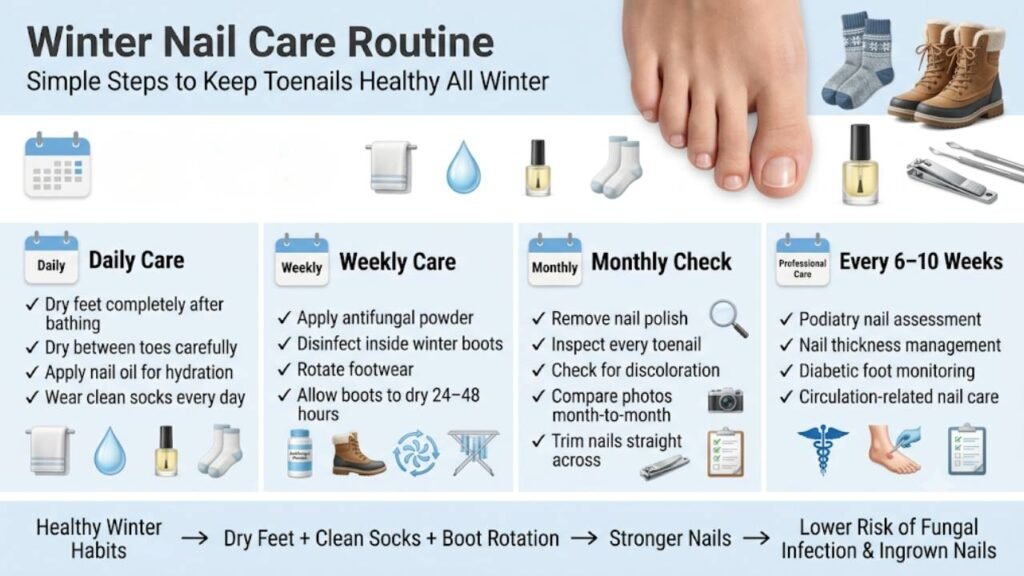
The winter footwear and nail health maintenance routine can be simple and takes minimal time:
Daily:
- Complete foot drying after bathing, with specific attention to interdigital spaces
- Apply nail oil if nails are becoming dry and brittle
- Change socks daily — do not rewear winter socks without laundering
Weekly:
- Apply antifungal powder to feet and inside boots as part of boot hygiene
- Allow boots to fully dry (at least 24 to 48 hours) between wears — maintain a boot rotation system
Monthly:
- Remove all nail polish and inspect every toenail in good lighting for any new changes
- Compare to previous month’s inspection — photograph if helpful
- Trim nails straight across as needed, maintaining appropriate length
Every 6 to 10 weeks:
- Professional podiatric nail care — particularly for older adults, diabetic patients, those with poor circulation, and anyone with pre-existing nail conditions
Frequently Asked Questions About Winter Footwear and Nail Health
Why do my toenails get thicker in winter?
Winter footwear and nail health are connected through the sustained mechanical pressure of heavy boot wear and reduced peripheral circulation from cold temperatures. Both stimulate the nail matrix to produce thicker nail. This is a normal adaptive response that is more prominent with heavy winter boot wear than summer footwear.
Can wearing winter boots cause nail fungal infection?
Winter boots do not cause nail fungal infection directly — fungal organisms must be present. However, the moist, warm, poorly-ventilated interior of winter boots creates conditions favorable for fungal growth if spores are present. Combined with the inspection gap of winter (nails hidden for months), winter footwear and nail health problems including fungal infection often develop and progress unnoticed until spring.
Should I moisturize my nails during winter?
Yes. Dry winter air combined with central heating depletes nail plate hydration, making nails more brittle and prone to splitting. Nail oil or cuticle oil applied after bathing — when the nail is still slightly warm and hydrated — replenishes this moisture effectively as part of winter footwear and nail health maintenance.
How do I prevent ingrown toenails from winter boots?
Choose boots with adequate toe box width and depth so the toes are not laterally compressed. Trim toenails straight across (not rounded at the corners). Keep nails at an appropriate moderate length — not so long they contact the boot front, not so short the skin can fold over the nail edge.
Summary
Winter footwear and nail health are connected through three main mechanisms: increased internal moisture from heavy insulated boots, mechanical pressure from stiffer winter footwear, and reduced peripheral circulation from cold temperatures. Together, these factors create conditions for nail thickening, fungal infection development and progression, ingrown nails, and increased nail brittleness during winter months.
The practical response to the winter footwear and nail health challenge is: choose boots with adequate toe box width and breathable construction, use moisture-wicking socks rather than cotton, maintain a boot rotation to allow full drying between wears, inspect nails monthly throughout winter, apply nail oil to combat seasonal dryness, and maintain professional nail care appointments rather than skipping them during winter.
Spring nail problems are almost always winter problems that went unnoticed. Monthly winter nail inspection is the simplest change that produces the most consistent improvement in catching problems when they are easy to treat.
Struggling to get an appointment?
We help patients in your area bypass clinic waitlists by instantly finding verified podiatry doctors who accept their insurance.